VaporUSA's 11-slide deck, built in PowerPoint 2013 and dated 15 March 2015, pitches importing vaporizers and e-liquid from the US into Manizales, Colombia. The underlying work is better than the document: the founder incorporated a Colombian entity, ran a real test import to measure customs feasibility and landed cost, made first sales, and discovered that bulk e-liquid rebottled under his own label carries 830% markup against 69% for resold brands. Then he published none of the results. The traction slide ends on a box headed 'Sales & revenue generation' with no revenue in it. There is no as…
Key takeaways
- VaporUSA's 11-slide March 2015 deck ends on a slide headed 'Sales & revenue generation' and never states a single revenue figure, unit sold, customer count or landed cost — despite having run a real import specifically to measure those things.
- The deck has no ask: no amount, no instrument, no valuation, no equity offered, no use of funds and no runway. It also has no team slide and no competition slide across all eleven pages.
- Slide 3 prints '$1.7 Billion to $2.4 Billion in 2014 growing at a 23% rate' — that growth is 41.2%, and the error understates the founder's own market by nearly half.
- Slide 2 headlines the category as 'more than doubling every year' (100%) while slide 3 cites 41% growth from the same category one page later.
- Slide 5 reports 5,000,000 smokers out of 48 million Colombians and labels it 9%; the actual figure is 10.4%. The city figure, 56,000 of 431,563, computes cleanly to 13%.
- The deck implies Manizales smokes at 1.3x the national rate — a genuine argument for the chosen location — and never mentions it.
- The real business is on slide 9 in one sentence: bulk-bought e-liquid rebottled under the company's own label carries 830% markup on 10ml and 485% on 30ml, against 69% for third-party brands — yet the marketing plan optimises for 'the widest range' of third-party liquid.
- The market is sized entirely in people and never converted into money: no price point, no basket size, no purchase frequency, no switch rate, no ARPU anywhere in the file.
What this deck actually is
Eleven slides, 720 x 540 points — 4:3, the aspect ratio of a projector, not a laptop — built in Microsoft PowerPoint 2013 and exported at 23:29 on 15 March 2015 with a -05:00 timezone offset, consistent with Bogotá. It is a seed deck for VaporUSA S.A.S , a newly incorporated Colombian company importing vaporizers and e-liquid from the United States to sell in Manizales, a city of 431,563 people in the coffee region of Caldas.
The PDF's document properties are the tell. The title field reads "Investor Pitch Deck Template" and the author field reads "Crowdfunder" — the equity-crowdfunding platform that published a free deck template in the mid-2010s. The founders downloaded the template, typed over the placeholder slides and never opened File → Properties. Every diligence associate who checks metadata sees the word "Template" before they see the word "VaporUSA".
That matters more here than in most decks, because the template is the only structure the document has. The Crowdfunder outline gives you Opportunity, Product, Market, Traction, Plan. What it does not give you — and what the founders never added — is an ask, a use of funds, a team slide, a competition slide, a single financial projection, or one unit of revenue . Eleven slides go by, the tenth one is headed "Traction" and ends on a box labelled "Sales & revenue generation", and the deck closes without ever telling you how much money the company has made or how much money it wants.
What it does contain is genuinely interesting: a founder who incorporated an entity, ran a real import through Colombian customs to test feasibility and cost, made first sales, and came back with a markup table showing bulk e-liquid bottled at 830% . That is a real, tested, unglamorous insight about a real business. It is on slide 9 of 11, in six words of body copy, with no volumes attached.
Slide-by-slide walkthrough
Slide 1 — Cover
The company mark, then a sentence in quotation marks: " Importing & Selling the highest quality Vaporizers and e-Liquid from the United States to Colombia ". Below it, four contact lines: an email, a Colombian mobile (+57 310 479 8973), a US number in the Orlando area code (407 965-8973), and www.vaporusa.com.co.
The sentence does the job a cover sentence should. In eighteen words a reader knows the product, the sourcing, the destination and the positioning claim. Most seed covers do not manage that; they say "reimagining X" and make you wait four slides.
Three things are missing and one is odd. There is no date , no round name and no amount — the reader cannot tell whether they are holding a March document or a September one, and for a company whose entire traction section is a four-month timeline, staleness is the whole risk. The company is also called VaporUSA and registered as a Colombian S.A.S. selling in Colombia; the brand asserts an American origin that the corporate entity does not have. That is a defensible marketing decision in an import business — it is also the kind of thing a deck should say out loud on the cover rather than leave a reader to reconcile on slide 10.
The two phone numbers are the small thing that reveals the stage. Sharing the trailing digits of a Colombian mobile and a US virtual line is the signature of a one-person operation running both countries off a forwarded number. There is nothing wrong with that. There is something wrong with a deck that shows it on slide 1 and then never introduces the person.
Slide 2 — Opportunity
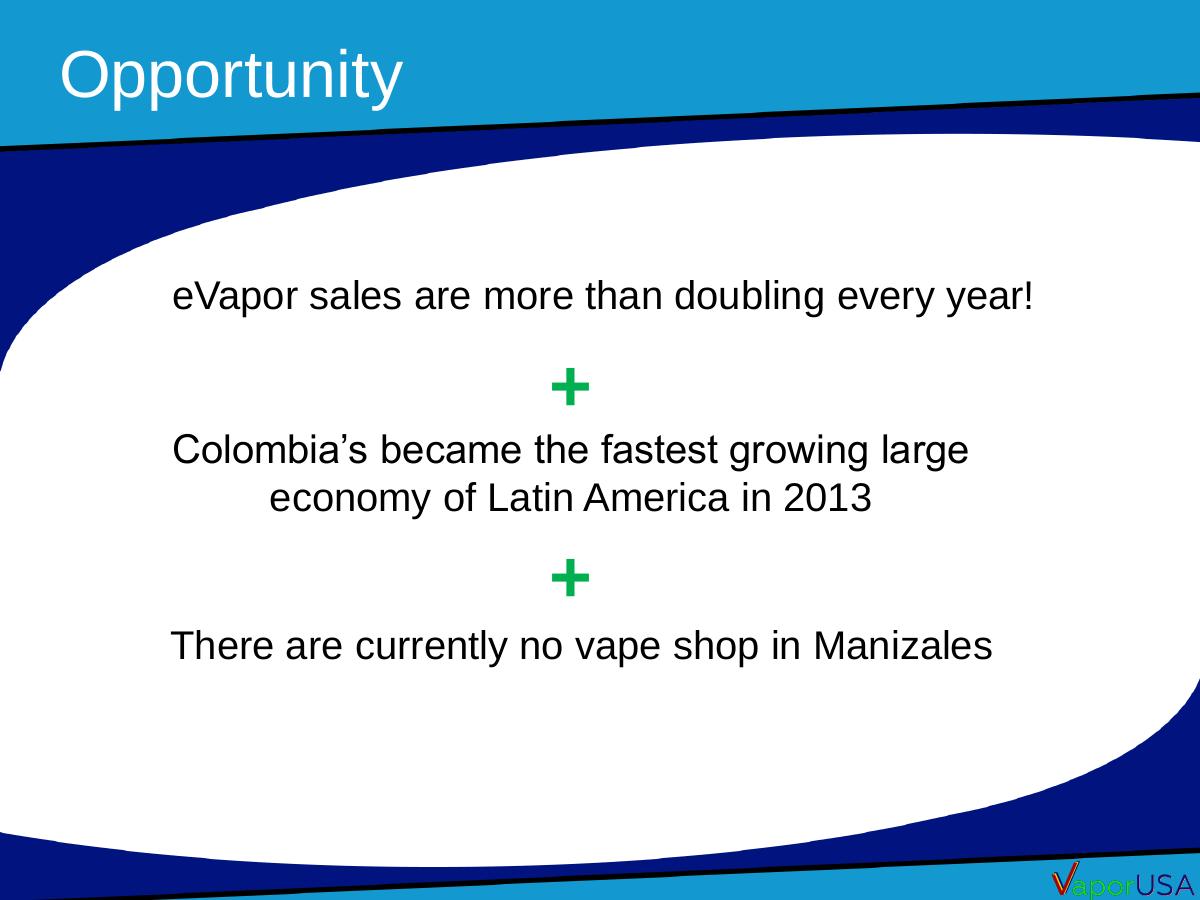
Three stacked claims joined by plus signs: " eVapor sales are more than doubling every year! " + " Colombia's became the fastest growing large economy of Latin America in 2013 " + " There are currently no vape shop in Manizales ".
The structure is right — category growth, plus country growth, plus local vacancy — and each of the three lines has a problem.
The first line contradicts the next slide. Slide 2 says the category is "more than doubling every year" ; slide 3 says it "grew from a $1.7 Billion to $2.4 Billion in 2014". Those are not the same claim and they are not close. Doubling is 100%. $1.7bn to $2.4bn is 41%. The deck's headline growth rate is roughly 2.4x its own cited growth rate, one slide apart. A reader who notices will assume the bigger number was chosen for the headline and the smaller one buried, which is exactly what appears to have happened.
The second line — fastest growing large economy — leans on an undefined adjective. Peru grew faster than Colombia in 2013, and Peru is excluded from the superlative purely by an unstated size threshold that the deck never names. The claim is technically survivable and rhetorically weak, because the reader's first thought is "large by what cut-off?" and the deck has no answer.
The third line is the one that should have been the whole slide, and it is the one presented most casually — including the grammatical slip, " no vape shop " rather than "no vape shops". A category growing 41% a year with zero physical retail presence in a city of 431,563 people is a genuine, checkable, first-mover argument. It also cuts both ways, and the deck never acknowledges the other edge: an empty market can mean unserved demand or it can mean no demand . There is no evidence offered for which one Manizales is. No waiting list, no survey, no pre-orders, no online order volume shipped into Caldas, no count of tobacconists already selling disposables under the counter.
Slide 3 — A promising product
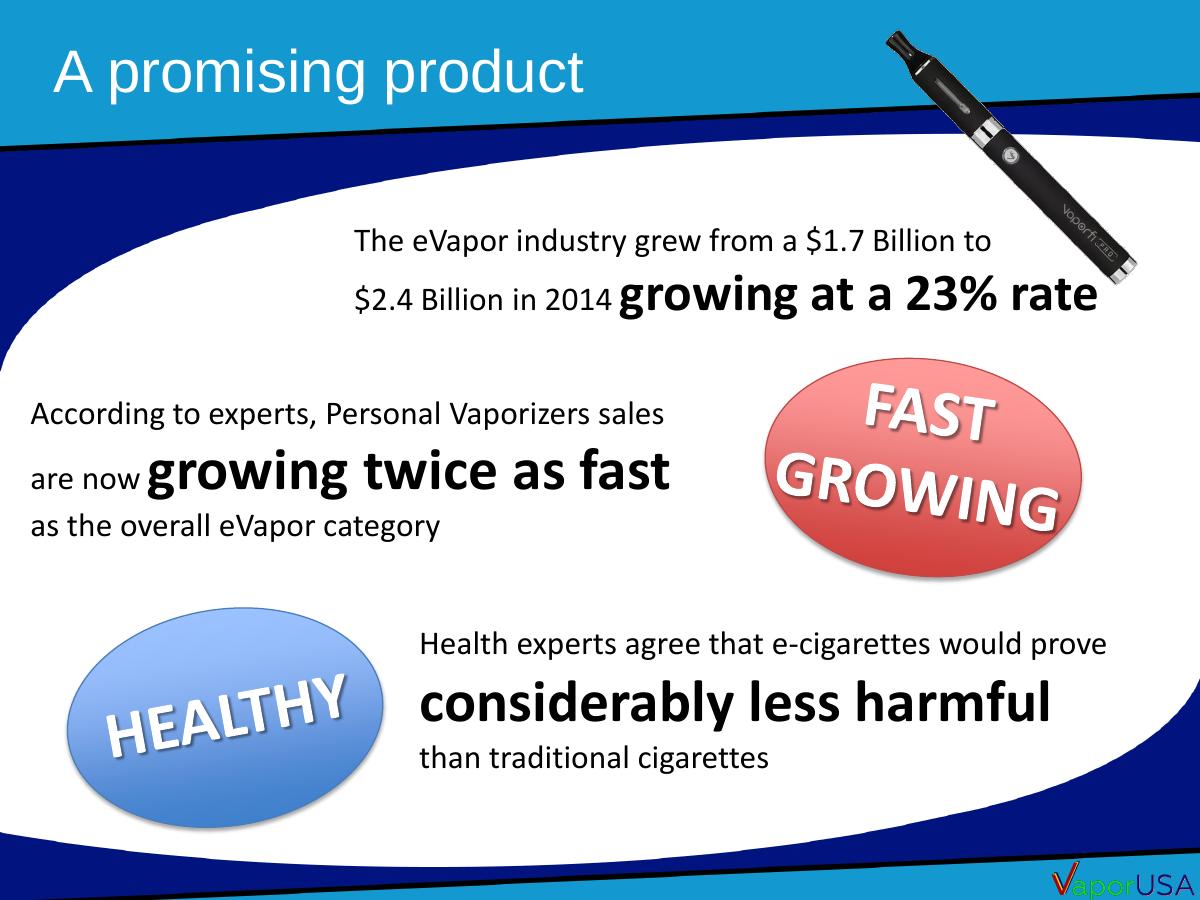
Three claims: personal vaporizers growing "twice as fast as the overall eVapor category" according to experts ; the industry growing " from a $1.7 Billion to $2.4 Billion in 2014 growing at a 23% rate "; and " Health experts agree that e-cigarettes would prove considerably less harmful than traditional cigarettes ".
The middle line contains the deck's clearest arithmetic error. $1.7bn to $2.4bn is 41.2% growth, not 23%. The two figures and the rate are printed in the same sentence, so this is not a sourcing dispute a reader has to research — it is a subtraction and a division, and it fails in the reader's head in about four seconds. It is also the wrong kind of error to make, because it is conservative : the true growth implied by the deck's own numbers is nearly double the rate it advertises. The founder has understated his own market and still got the sum wrong, which tells a diligence reader that no one checked the slide rather than that anyone inflated it.
Both the first and third claims are attributed to "experts" and "health experts" with no source, no institution, no date and no citation anywhere in the file . In a general-consumer category that would be lazy. In a nicotine-delivery category, in 2015, being pitched to an investor, it is a liability: the health-comparison claim is a regulated marketing statement in most jurisdictions, and a deck that makes it in a company's own voice with no attribution is showing an investor how the company will describe its products to customers. The 2015 Public Health England review — published a few months after this deck — is the citation the founder needed and did not have. One footnote would have converted the weakest line on the slide into the strongest.
Slide 4 — A Safe and Growing Country
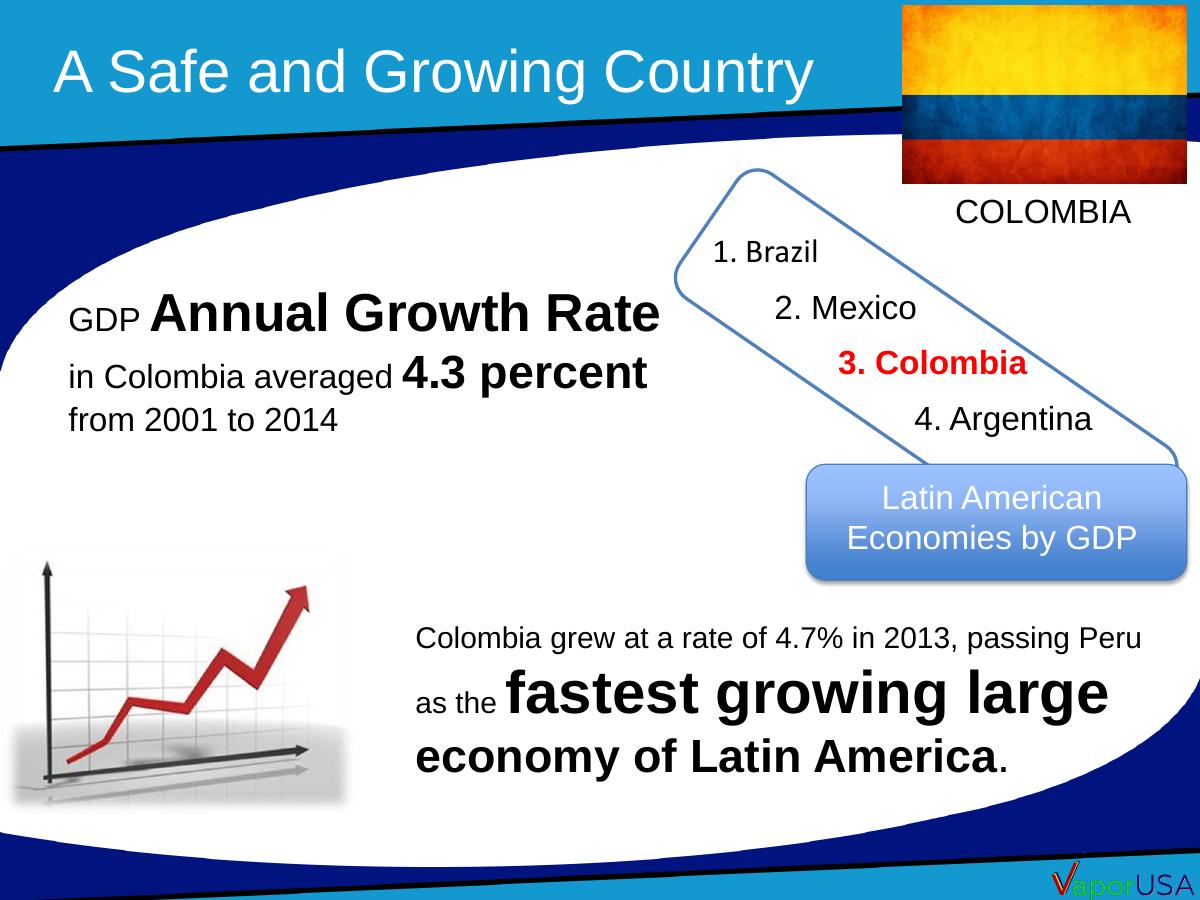
A map of Colombia, three statistics — 4.3% average GDP growth 2001–2014, 4.7% growth in 2013, "passing Peru as the fastest growing large economy of Latin America" — and a ranked list headed Latin American Economies by GDP : 1. Brazil, 2. Mexico, 3. Colombia, 4. Argentina.
The slide's job is to defuse a real objection — most foreign investors' mental model of Colombia in 2015 was security, not GDP — and macro-stability is a fair thing to put in front of them. The execution undercuts it twice.
First, the ranking is wrong for the year being discussed. Argentina's nominal GDP was materially larger than Colombia's in 2013 and 2014; placing Colombia third and Argentina fourth reverses them. It is the sort of detail that costs nothing to check and, when caught, makes every other unsourced number on the slide suspect by association.
Second, and more important: this slide is about Colombia and the business is about Manizales. National GDP growth of 4.7% has almost no bearing on whether 56,000 smokers in one mid-sized Andean city will walk into a vape shop. The relevant macro facts for this business are import duty on nicotine products, the COP/USD rate — which moved from roughly 1,900 to over 2,400 pesos to the dollar across 2014 into early 2015, a currency shift of about 25% against a company whose entire cost base is denominated in dollars and whose entire revenue is in pesos — and Colombian regulation of e-cigarette retail. None of those three appear anywhere in the deck. An import arbitrage business pitched at the exact moment the peso collapsed, with no FX slide, is the single largest unaddressed risk in the file.
Slide 5 — Target Market
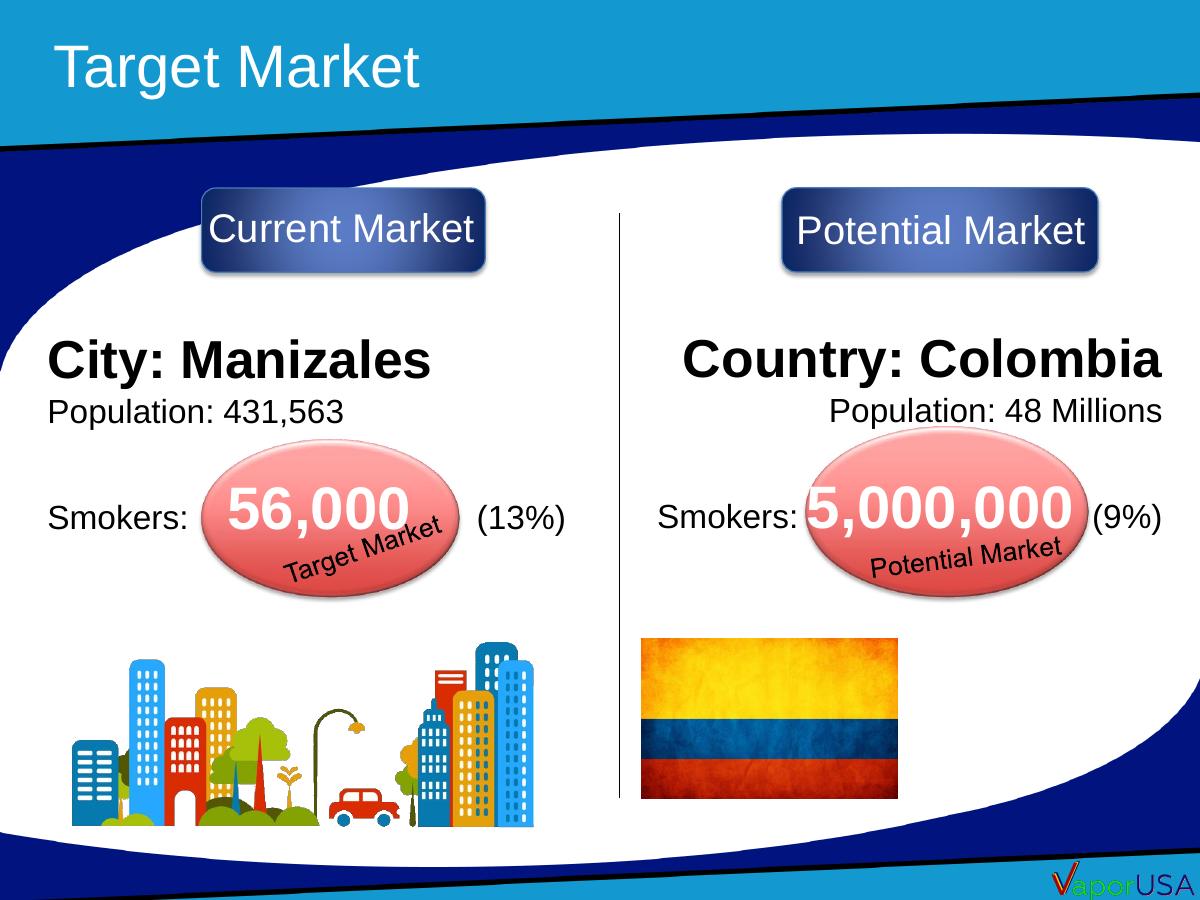
Two columns. Current Market: City: Manizales, Population 431,563, Smokers 56,000 (13%). Potential Market: Country: Colombia, Population 48 Millions, Smokers 5,000,000 (9%).
The population figure being given to the person — 431,563, not "about 430,000" — is a good sign; it means someone pulled the census rather than rounding a memory. The percentages then break.
5,000,000 out of 48,000,000 is 10.4%, not 9%. If the 9% is right, the smoker count should read about 4.3 million. If the 5 million is right, the rate should read 10.4%. One of the two printed numbers is wrong and the deck does not say which. Meanwhile the city rate — 56,000 of 431,563 — computes to 12.98% , so that pair is internally clean.
Which leaves the more interesting problem: the deck is claiming that Manizales smokes at roughly 1.3 times the national rate and says nothing about it. If that is true, it is a genuine argument for the location — the founder chose a city that over-indexes on the exact behaviour he is monetising, and that deserves a sentence and a source. If it is an artefact of mixing a city survey with a national one, it undermines both numbers. Either way, the most defensible thing on the slide is the thing the slide does not mention.
And beneath all of it: this is a market sized entirely in people, and the deck never converts a single person into a peso. There is no price point, no basket size, no purchase frequency, no assumed conversion of smokers to vapers. Fifty-six thousand smokers is not a market; 56,000 smokers × an x% switch rate × an average monthly spend is a market, and that arithmetic — which the founder is uniquely positioned to estimate, having already made sales — appears nowhere in eleven slides.
Slide 6 — Benefits of Vaping
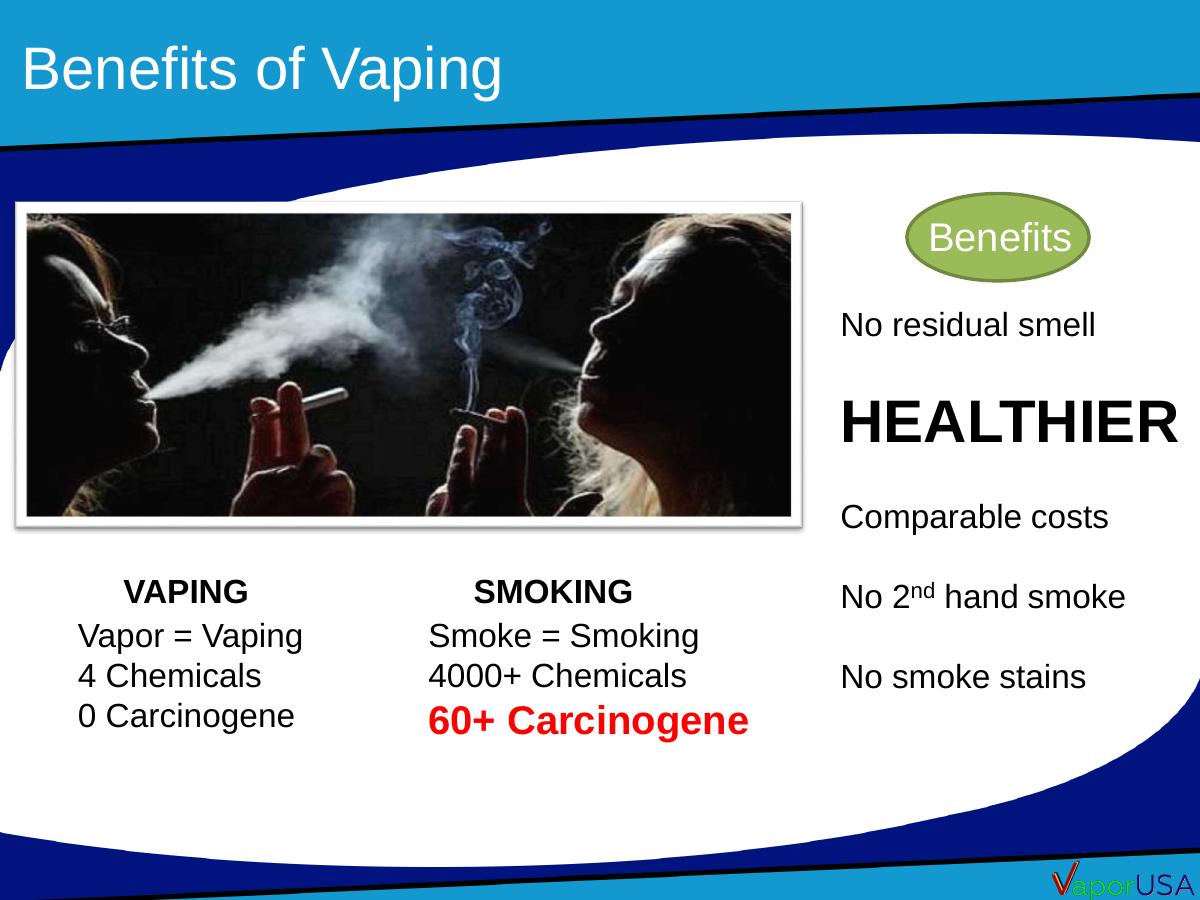
A two-column comparison. VAPING: Vapor = Vaping, 4 Chemicals, 0 Carcinogene. SMOKING: Smoke = Smoking, 4000+ Chemicals, 60+ Carcinogene. Alongside, a benefits list: HEALTHIER, no residual smell, comparable costs, no 2nd hand smoke, no smoke stains.
The 4-versus-4,000 contrast is the most persuasive visual argument in the deck and it is also the most exposed. The word "Carcinogene" is misspelt, twice, in the largest type on the slide — a French/Spanish transliteration of "carcinogen" that survived to export. The chemical counts carry no source . And "0 Carcinogene" is an absolute, which is the one shape of claim that is trivially falsifiable: contemporaneous analyses of e-liquid aerosol identified carcinogens at low levels, so a footnoted "95% fewer" or "orders of magnitude lower" would have been both stronger and true, while "0" invites an investor to disprove the slide with one search.
"Comparable costs" is the odd entry in a benefits list. If vaping costs about the same as smoking, that is a neutral fact being dressed as an advantage — and it is strictly worse than the truth the founder already knows. He has a markup table two slides later showing bulk e-liquid at 830%. A customer switching to refillable e-liquid at that markup is still spending far less per month than on cigarettes; the cost argument is a strong one and the deck softens it to "comparable" without doing the monthly-spend comparison that would have won it.
Slide 7 — Marketing Plan
One bullet: " Open 1st vape shop in Manizales ". One supporting line: "Offer the highest quality personal vaporizers and the widest range of e-Liquid in Colombia."
This is the emptiest slide in the file, and it is titled Marketing Plan. Opening a shop is not a marketing plan; it is a capital expenditure. There is no location, no rent, no fit-out cost, no staffing, no opening date, no launch tactic, no customer acquisition channel and no cost per customer . For a business whose entire go-to-market is a single physical door in a single city, the door's rent is arguably the most important number in the company, and it is absent.
The supporting line also sets up a strategic contradiction the deck never resolves. "Widest range of e-Liquid" means stocking many third-party brands. Slide 9 shows that third-party e-liquid carries a 69% markup while VaporUSA's own bottled e-liquid carries 485–830% . The stated strategy therefore optimises for the low-margin half of the business, and the slide that says so sits two pages before the slide that proves it.
Slide 8 — Products: Personal Vaporizers
Four devices with markups: GreenSmoke Essential Kit 71% , Haus Personal Vaporizer 69% , Vaporfi Pro Starter Kit 60% , Vaporfi Rebel II Starter Kit 87% .
Real numbers from real imports, which is more than most seed decks have. Three problems.
First, every product is someone else's brand. The deck's answer to "what stops the next importer" is never given — there is no exclusivity, no distribution agreement, no supplier contract mentioned. The moat, if there is one, is the customs and logistics knowledge the founder built in slide 10's import test, and the deck never claims it.
Second, markup is not margin and the deck never converts. An 87% markup is a 46.5% gross margin. A reader skimming for a margin number will take 87% and be wrong by forty points. Sophisticated readers will do the conversion; the deck should have.
Third, a markup percentage without a price and a volume is not a financial fact. There is no landed cost, no retail price, no units sold, no expected monthly units. Four percentages on a slide cannot be multiplied into anything.
Slide 9 — Products: e-Liquid
Four lines: Vaporfi (30ml) 69% , Mountbakervapor (12ml) 69% , VaporUSA e-Liquid (10ml) 830% , VaporUSA e-Liquid (30ml) 485% . One line of body copy: "Bottling and selling e-Liquid purchased in bulk is what makes vape shop so profitable".
This is the actual business and it is slide 9 of 11, in one sentence, with a typo in it.
The insight is correct and it is the reason vape retail worked in that era: the device is a loss-leading razor sold at 60–87%, and the consumable is a razor blade decanted from a bulk drum at eight or nine times cost. The founder has run the import, done the bottling and measured both halves. That is the finding an investor pays for, and the deck buries it below a marketing plan that contains one bullet.
Two details deserve attention. The 10ml bottle carries a higher markup (830%) than the 30ml (485%) , which is the correct and normal shape — smaller units carry proportionally more packaging-and-convenience premium — and it implies a merchandising strategy (push the small bottle, use the large one as a value anchor) that the deck does not draw. And the gap between own-brand and resale is enormous: 830% against 69% is a twelve-fold difference in markup on the same shelf. If the founder had put one honest mix scenario on this slide — say, x bottles a month at each markup against the shop's rent — he would have had the only real financial model in the deck, built entirely from numbers he already possessed.
Slide 10 — Traction
A four-box horizontal timeline across Dec 14, Jan 15, Feb 15, Mar 15: Product & Market Research → Creation of VaporUSA S.A.S → Importation & product testing → Sales & revenue generation , each with a short description. The importation box explains the intent precisely: "Import various vaping products including bulk e-Liquid to verify importation feasibility, timeframe and costs."
Read as a founder's log, this is a good four months. Research, incorporate, run a real import to measure customs feasibility and landed cost, then sell. It is sequenced correctly and it is all execution rather than intention.
Read as a traction slide, it is a timeline with no quantity anywhere on it . The final box is literally headed "Sales & revenue generation" and states "First sales of personal vaporizers and e-Liquid. Generating revenue." — and does not say how much. Not revenue, not units, not customers, not repeat purchases, not the landed cost the import was specifically run to discover. The founder ran an experiment whose entire purpose was to produce numbers, and then printed the experiment without the results.
This is the deck's defining failure and it is worth stating plainly: a small real number beats a large vague one at seed. "$1,400 of sales in six weeks from 23 customers, 40% of it repeat e-liquid" is a fundable sentence for a business this size. "Generating revenue" is not a sentence an investor can do anything with, and its vagueness reads as concealment even when — as here — the truth was probably just modest.
Slide 11 — 3 Year Plan
Three columns. 2015: open first vape shop in Manizales; offer the widest range of e-Liquid in Colombia (100 flavours × 4 nicotine levels). 2016: start direct distribution of e-liquid and vaporizers to local shops and stores; expand distribution across Caldas. 2017: open second shop; expand distribution to Antioquia, Risaralda, Tolima and Quindío.
The strategic logic is sound: prove retail in one city, then use the retail shop as a demonstration for a wholesale distribution business, then replicate. The move from retail to distribution in year two is the right move, because distribution is where the 830% bottling margin scales past the footfall of one door.
And there is not one number in the entire slide — no revenue, no shop count beyond "second", no wholesale accounts, no headcount, no capital required per shop, no gross margin, no break-even. Then the deck ends. There is no ask slide. No amount, no instrument, no valuation, no equity offered, no use of funds, no runway, no milestones the money buys. There is also no team slide — after eleven slides the reader does not know the founder's name, whether anyone else is involved, or whether anybody in the company has run a retail operation before. And there is no competition slide ; the only competitive statement in the file is "no vape shop in Manizales" on slide 2, which does not address online sellers shipping into Caldas, informal imports, or the cigarette itself.
An investor reaching the end of this deck knows the category, the city, the smoker count and the markups, and cannot answer three questions: who is asking, how much do they want, and what will they do with it.
What VaporUSA got right
The deck is worth studying because the underlying work is better than the document.
It ran the experiment before writing the deck. Slide 10 describes an import executed specifically to verify feasibility, timeframe and cost. Most decks at this stage describe a plan to find out; this one describes having found out.
It found the real margin and named it. "Bottling and selling e-Liquid purchased in bulk is what makes vape shop so profitable" is the single most useful sentence in the file, and it is backed by two own-brand markups the founder measured himself.
It picked a defensible wedge. One city, no incumbent physical retail, an over-indexing smoker rate, and an entity already incorporated to import legally. That is a narrower and more credible starting point than the "Latin America" positioning most decks in this category reached for.
The cover sentence works. Eighteen words that state product, sourcing, destination and quality position, with no jargon.
What a founder should take from this
Print the number you already have. This company had made sales and did not say how many. If you have run the experiment, the result belongs in 40-point type. A modest true figure outperforms "generating revenue" every time.
Check the arithmetic in every sentence that contains two numbers and a rate. $1.7bn to $2.4bn is 41%, not 23%. 5m of 48m is 10.4%, not 9%. Neither error helps the company — both were self-inflicted, and both are found by a reader in seconds.
Do not let two slides disagree. "More than doubling every year" on slide 2 and 41% growth on slide 3 cannot both be the same category, and the reader will trust the smaller one and discount you for the larger.
Source every health, safety or regulatory claim, or delete it. In a regulated category, an unattributed "0 Carcinogene" is not enthusiasm, it is a compliance signal — and the citation that would have made it defensible existed.
Name the currency risk before the investor does. A dollar cost base and a peso revenue line during a 25% currency move is the first question any experienced import investor asks. Answering it unprompted converts the biggest risk into evidence of competence.
Never end without the ask. No amount, no instrument, no use of funds and no team means the reader has no action to take. Every other flaw in this deck is survivable; this one guarantees no reply.
Open File → Properties before you export. A title field reading "Investor Pitch Deck Template" and an author field reading "Crowdfunder" tell a reader the structure was inherited. It takes ten seconds to fix and it is the first metadata anyone checks.
Frequently asked questions
- What is the VaporUSA pitch deck?
- An 11-slide seed investor deck created in PowerPoint 2013 and exported on 15 March 2015 at 23:29 from a machine in the -05:00 timezone, consistent with Bogotá. VaporUSA S.A.S is a Colombian company importing personal vaporizers and e-liquid from the United States to sell in Manizales, a city of 431,563 in the Caldas region. The deck is 720 x 540 points — 4:3 — and its PDF title metadata still reads 'Investor Pitch Deck Template' with 'Crowdfunder' as the author.
- How many slides is the VaporUSA pitch deck?
- Eleven. The sequence is cover, opportunity, product category, country macro, target market, benefits of vaping, marketing plan, vaporizer products and markups, e-liquid products and markups, traction timeline, and a three-year plan. There is no team slide, no competition slide, no financials slide and no ask slide.
- What is the biggest weakness in the VaporUSA deck?
- That it never prints a number it already had. Slide 10's timeline ends with a box headed 'Sales & revenue generation' stating only 'First sales... Generating revenue' — no amount, no units, no customers, and not even the landed cost that the company's test import was explicitly run to discover. A close second is the absence of any ask: no amount, instrument, valuation, use of funds or runway, so a persuaded reader has no action to take.
- What arithmetic errors are in the VaporUSA deck?
- Two clear ones and one contradiction. Slide 3 states the eVapor industry grew 'from a $1.7 Billion to $2.4 Billion in 2014 growing at a 23% rate' — that is 41.2% growth. Slide 5 states 5,000,000 smokers out of 48 million Colombians and labels it 9% — that is 10.4%. And slide 2 headlines the category as 'more than doubling every year' while slide 3 cites 41% growth for the same category.
- What did VaporUSA get right in its pitch deck?
- It ran the experiment before writing the deck: the company incorporated a Colombian entity and executed a real test import to verify customs feasibility, timeframe and cost. It found and named the actual margin engine — rebottling bulk e-liquid under its own label at 485-830% markup against 69% for resold brands. It chose a narrow, checkable wedge, one city with no incumbent vape shop. And the cover sentence states product, sourcing, destination and positioning in eighteen words.
- What should founders copy from the VaporUSA deck?
- The traction slide's structure — research, incorporate, run a costed test import, sell — is the right sequence for any physical-goods business, and the honesty of running an import purely to measure feasibility is rare. Copy that and then do the thing VaporUSA did not: attach the measured results to each box. Also copy the cover sentence's plain-language specificity, and the three-year plan's logic of proving retail first, then converting the shop into a wholesale distribution business where the bottling margin scales.