Vayu Eendhan’s pitch deck addresses the severe air pollution in India, specifically targeting the state of Uttar Pradesh. The company proposes a multi-purpose plant model that functions as an air cleaner, fuel generator, and hydrogen producer. By capturing atmospheric CO2 and converting it into 'ultra-low carbon fuels,' the startup aims to create a circular carbon economy. The deck identifies a massive $3 trillion global oil market and a projected $150 billion hydrogen market by 2050. However, the presentation is highly conceptual, relying on third-party process diagrams rather than proprieta…
Key takeaways
- The startup identifies a critical health crisis in India, citing 46 lakhs deaths per year due to air pollution on Slide 2.
- The business model relies on multi-purpose plants to offset high operational costs through diverse revenue streams, including air cleaning fees and fuel sales (Slide 4).
- Vayu Eendhan targets the hydrogen sector, aiming to collaborate with companies like Toyota for refueling networks (Slide 4).
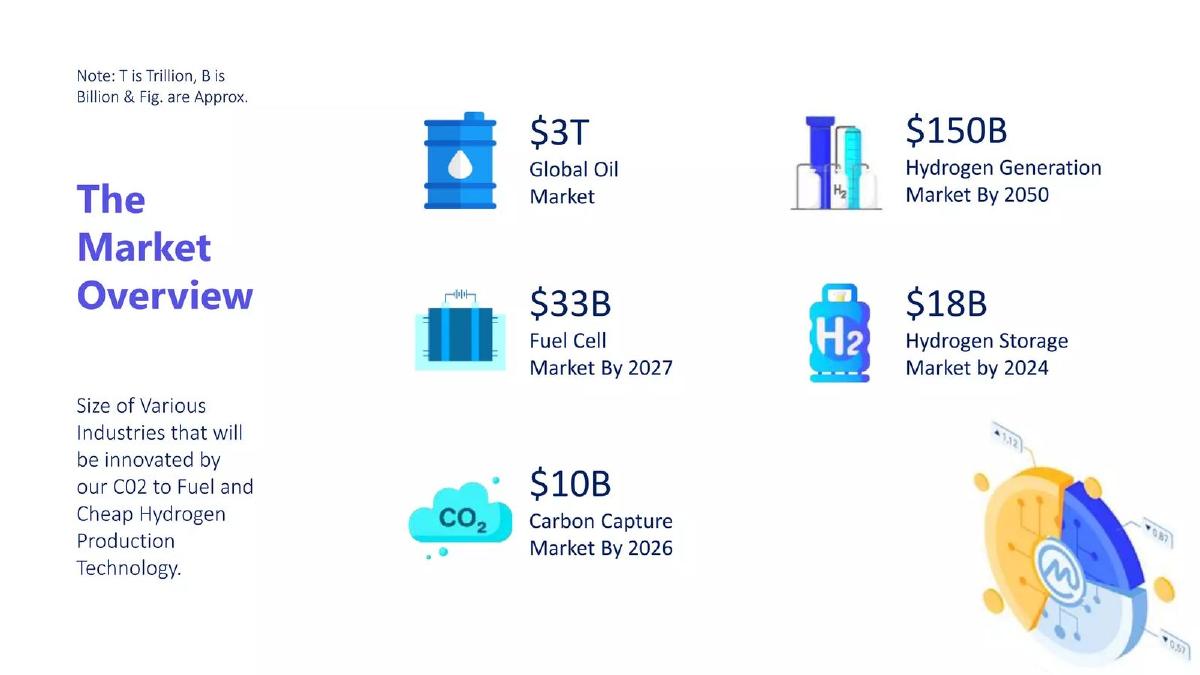
- Market sizing is ambitious, citing a $3T global oil market and a $10B carbon capture market by 2026 (Slide 3).
- The technical process involves Direct Air Capture (DAC) and fuel synthesis using renewable electricity and water (Slide 5).
- The deck explicitly states a lack of funds to enter the industry, positioning the company at a pre-seed or ideation stage (Slide 6).
- Geographic focus is heavily weighted toward Uttar Pradesh, noting that 7 out of 10 of the most polluted cities are in that state (Slide 2).
- The deck omits critical investor information, including the management team, current traction, and a specific funding amount requested.
Vayu Eendhan Pitch Deck Analysis
Vayu Eendhan presents a high-level conceptual pitch focused on the intersection of environmental remediation and renewable energy production. The deck is structured to highlight the severity of the air pollution crisis in India, particularly in the state of Uttar Pradesh, and proposes an industrial solution that converts atmospheric waste into economic value.
Slide 1: Title Slide
The title slide introduces the company name, Vayu Eendhan , with the tagline "Pollution to Fuel." The visual elements include stylized illustrations of wind turbines, solar panels, and a bicycle, signaling a commitment to green energy and sustainable urban mobility. The name "Vayu Eendhan" translates from Hindi to "Air Fuel," which directly reflects the company's core value proposition.
Slide 2: The Problems
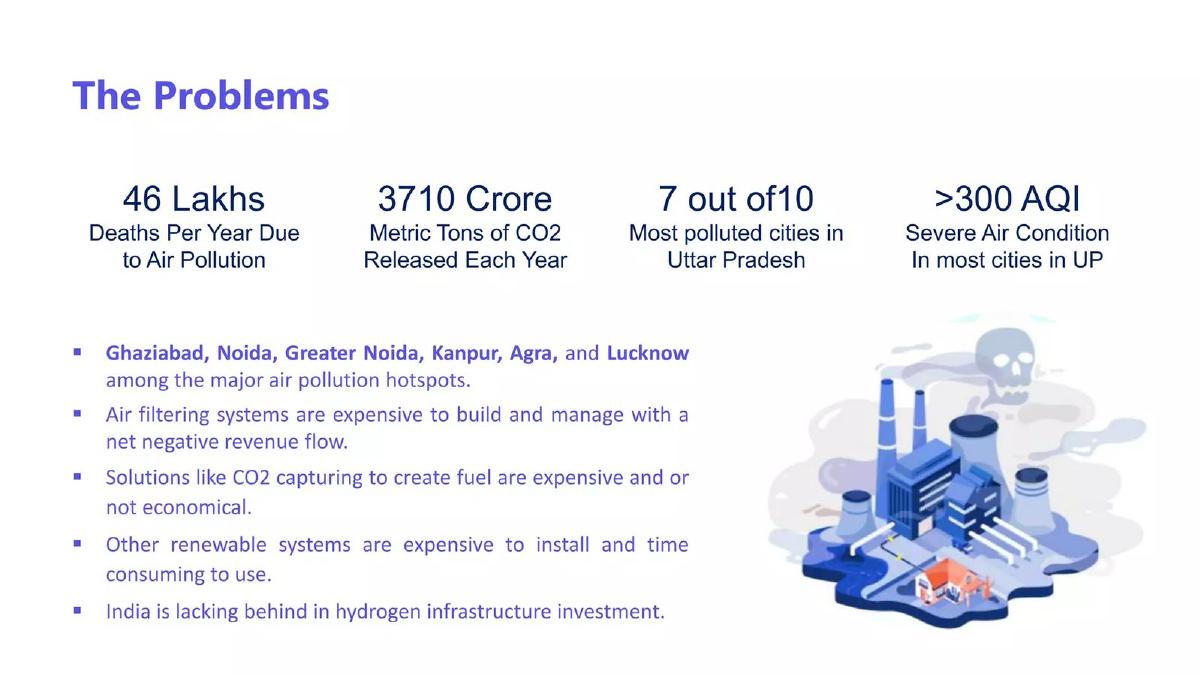
This slide establishes the urgency of the mission using stark statistics. It cites 46 Lakhs deaths per year due to air pollution and 3710 Crore metric tons of CO2 released annually. The slide narrows its focus to Uttar Pradesh, noting that 7 out of 10 of the most polluted cities are in that state, with AQI levels frequently exceeding 300 . Key pain points identified include the high cost of current air filtering systems (which have "net negative revenue flow") and India's lag in hydrogen infrastructure investment. This slide effectively sets the stage for a solution that needs to be both environmentally impactful and economically viable.
Slide 3: The Market Overview
Vayu Eendhan identifies five distinct market segments it aims to disrupt. The figures cited are large-scale global projections: a $3T Global Oil Market , a $150B Hydrogen Generation Market by 2050, a $33B Fuel Cell Market by 2027, an $18B Hydrogen Storage Market by 2024, and a $10B Carbon Capture Market by 2026. While these numbers demonstrate the massive ceiling for the industry, the deck does not provide a Serviceable Addressable Market (SAM) specifically for the Indian context or the company's initial geographic target of Uttar Pradesh.
Slide 4: The Business Plan
The business plan focuses on "multi-purpose plants" to create multiple revenue streams. The strategy includes:
Setting up plants in high-population areas to charge factories fees for air cleaning while selling fuel locally. · Creating portable versions for factories to minimize emission footprints and avoid carbon taxes via a subscription model. · Collaborating with companies like Toyota to create a hydrogen refueling station network. · Eliminating long-haul transportation costs by placing CO2-to-fuel conversion plants near existing fuel stations and using pipelines.
The slide acknowledges the "high cost" of these systems but argues that the diversity of revenue streams will offset these expenses.
Slide 5: Processes & Lifecycle
This slide provides a technical overview of the system. It features three diagrams illustrating Direct Air Capture (DAC) and Fuel Synthesis . The process involves taking air from the atmosphere, capturing CO2, and using renewable electricity and water to produce "Ultra-Low Carbon Fuels." A secondary diagram shows a co-location scenario where electricity generators (solar/wind) feed into hydrogen distribution and storage hubs. The diagrams appear to be standard industry process flows rather than proprietary engineering schematics, suggesting the company is in the conceptual phase of technical development.
Slide 6: Summarizing
The final slide reiterates the aim to create a carbon-neutral economy but contains a candid admission: "we are lacking the funds required to even enter the industry." It summarizes the four use cases for their plants: Air Cleaner , Fuel Generator , Emission Controller , and Hydrogen Generator . The slide concludes by positioning the venture as a way to support the economy of states like Uttar Pradesh with additional revenue. Notably, this slide serves as the conclusion but lacks a specific call to action, contact information, or a team overview.
What Works in the Vayu Eendhan Deck
The deck is successful in problem identification . By focusing on specific cities (Ghaziabad, Noida, Kanpur) and citing local AQI levels, the founders create a compelling narrative of necessity. The transition from "pollution as a health hazard" to "pollution as a feedstock" is a strong logical pivot that aligns with global trends in circular economies. Additionally, the multi-revenue stream approach is a pragmatic way to address the notoriously difficult unit economics of carbon capture technology.
What is Missing from the Vayu Eendhan Deck
The most significant omission is the Team Slide . In deep-tech and industrial startups, the pedigree of the engineering and leadership team is the primary factor for investors. There is no mention of who is building this or their qualifications. Furthermore, the deck lacks Unit Economics . While it mentions that costs are high, it provides no data on the cost per ton of CO2 captured or the projected price per liter of the resulting fuel. There is also no Traction or Roadmap ; it is unclear if a prototype exists or if the company has secured any Memorandums of Understanding (MoUs) with the factories or partners like Toyota mentioned in the text. Finally, the Ask is missing; investors need to know how much capital is required and what milestones that capital will achieve.
What a Founder Should Copy
Founders should emulate the clear categorization of market opportunities seen on Slide 3. Breaking down a massive industry into sub-sectors (Storage, Generation, Capture) helps investors understand the various 'exit ramps' or pivot points for the technology. The geographic specificity on Slide 2 is also a best practice; instead of solving "global warming," the deck solves "pollution in Uttar Pradesh," which makes the initial go-to-market strategy feel more tangible and manageable for a seed-stage startup.
Frequently asked questions
- What is the core technology proposed by Vayu Eendhan?
- The core technology is a CO2-to-fuel conversion system. According to Slide 5, the process utilizes Direct Air Capture (DAC) to pull CO2 from the atmosphere, which is then combined with water and renewable electricity through fuel synthesis to create 'ultra-low carbon fuels.' The company also plans to integrate hydrogen production capabilities into larger plants to serve the growing hydrogen energy sector.
- How does the company plan to generate revenue?
- Vayu Eendhan outlines four primary revenue streams on Slide 4: charging factories fees or taxes to clean their air, providing portable carbon-capture versions to factories via a subscription model, selling produced fuel to high-population areas, and collaborating with automotive partners like Toyota to build and monetize a hydrogen refueling station network.
- What specific problem is the company solving in India?
- The company is targeting the extreme air pollution levels in North India. Slide 2 notes that cities like Ghaziabad, Noida, and Lucknow frequently experience AQI levels above 300. They argue that current air filtering systems are 'net negative' in revenue and that India is lagging in hydrogen infrastructure, which their multi-purpose plants intend to address.
- What are the biggest risks identified in the deck?
- The deck itself admits to significant hurdles. Slide 4 and Slide 6 mention the 'high cost of converting Air Filtering systems' and 'high costs of CO2 to Fuel.' Furthermore, Slide 6 explicitly states the company is 'lacking the funds required to even enter the industry,' indicating a high execution risk and a lack of existing prototype or pilot plant data.
- Is there a clear investment 'ask' in this deck?
- No. While the deck mentions a need for funds on Slide 6, it does not specify a dollar amount, a valuation, or a breakdown of how the capital would be used (e.g., R&D, CAPEX for the first plant, or hiring). The deck also lacks a team slide, which is a standard requirement for institutional investors to evaluate the founders' ability to execute such a complex industrial project.