Depict.ai’s 2020 Seed deck is a high-signal, low-noise presentation that successfully raised $2.9M by focusing on proof of value. Rather than getting bogged down in the mechanics of their AI, the founders leveraged a 'Unique Insight' slide to explain why traditional recommender systems fail and how their computer vision approach yields 2-6x better results. The deck is heavily weighted toward social proof, featuring a dedicated slide for a Staples contract and a logo wall of over 20 customers. Most notably, the business model is built on a 10% cut of revenue uplift, transforming the product fr…
Key takeaways
- The deck uses a performance-based pricing model, charging a 10% cut of the overall revenue uptick generated by the tool (Slide 7).
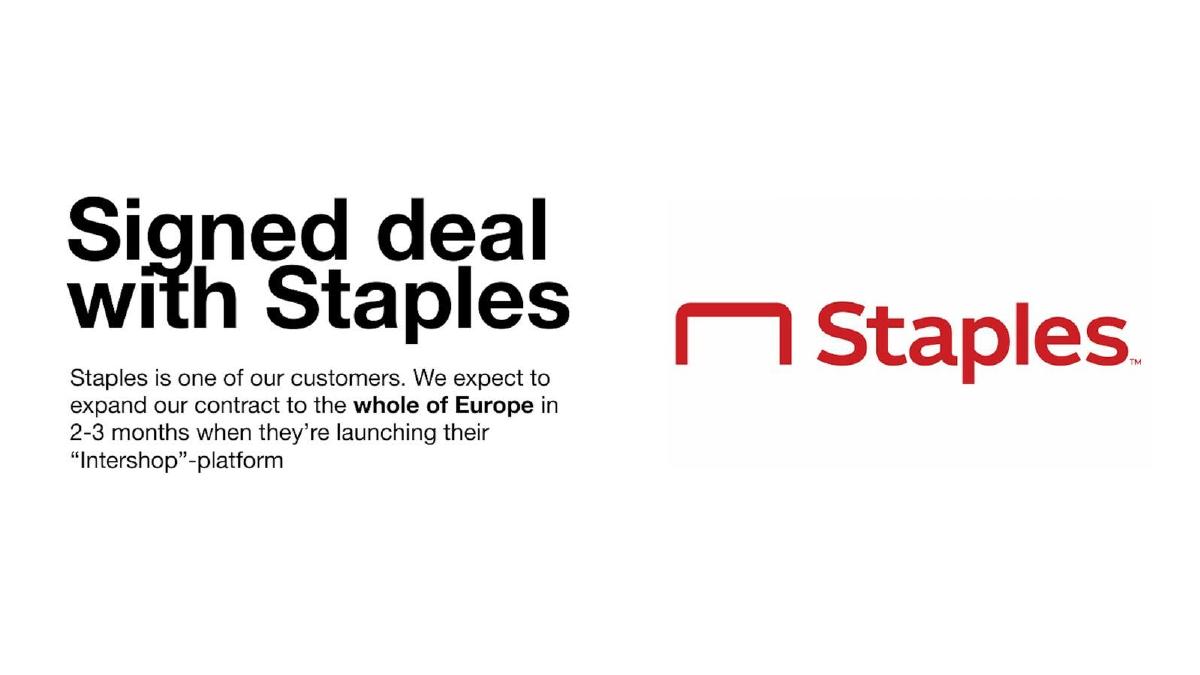
- A dedicated slide highlights a signed deal with Staples, noting an expected expansion to the 'whole of Europe' within 2-3 months (Slide 3).
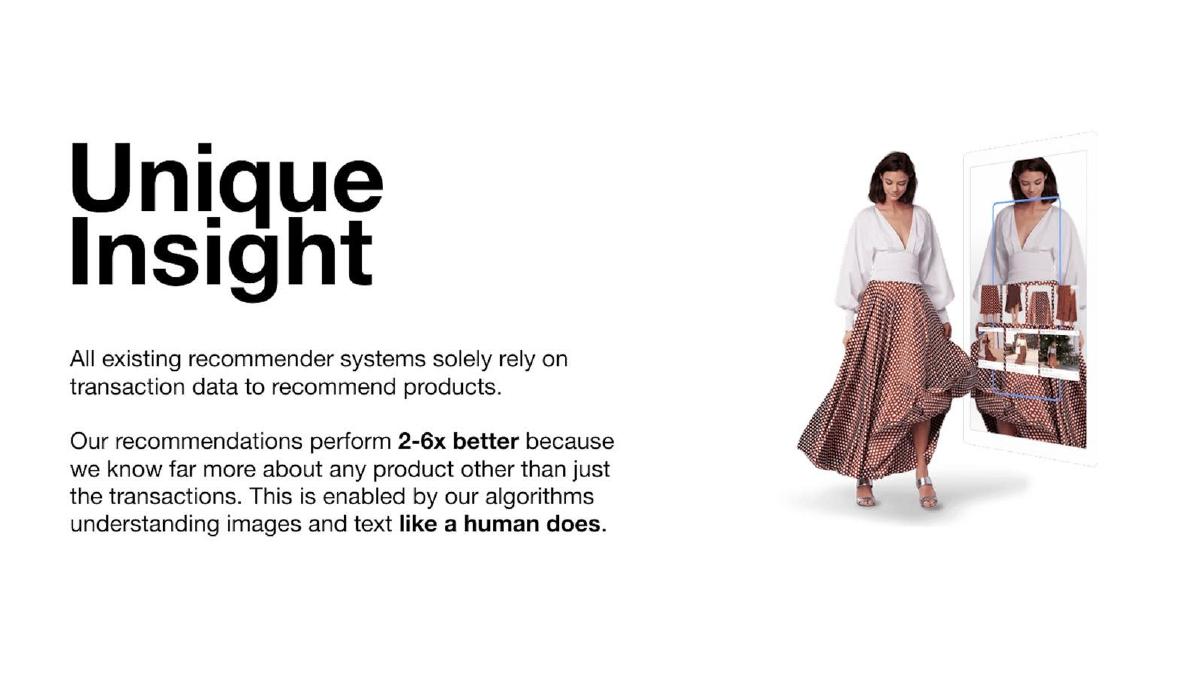
- The 'Unique Insight' slide claims their recommendations perform 2-6x better because they analyze images and text rather than just transaction data (Slide 5).
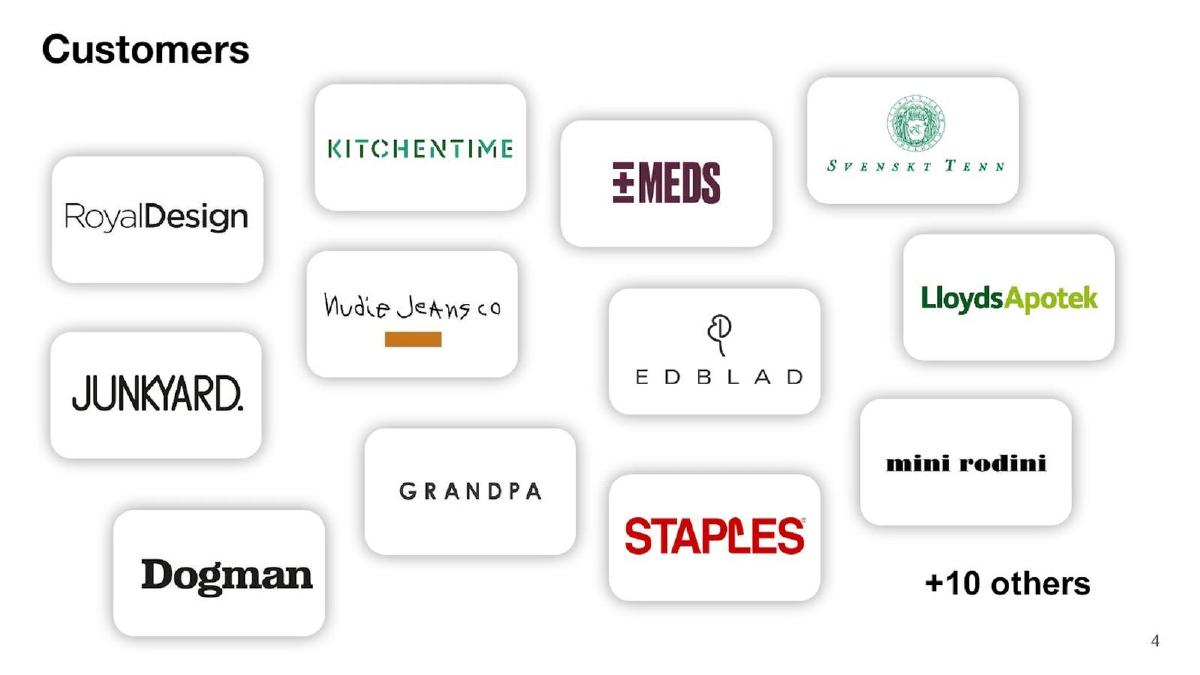
- Traction is visualized through a logo wall featuring 11 named brands and a note indicating '+10 others' (Slide 4).
- A/B test results show a 2x increase in click-through rate compared to AWS Personalize and a 150% increase in add-to-cart compared to Nosto (Slide 8).
- The Total Addressable Market (TAM) is calculated as $12B, based on a $3T e-commerce market and a 4% average revenue uplift (Slide 9).
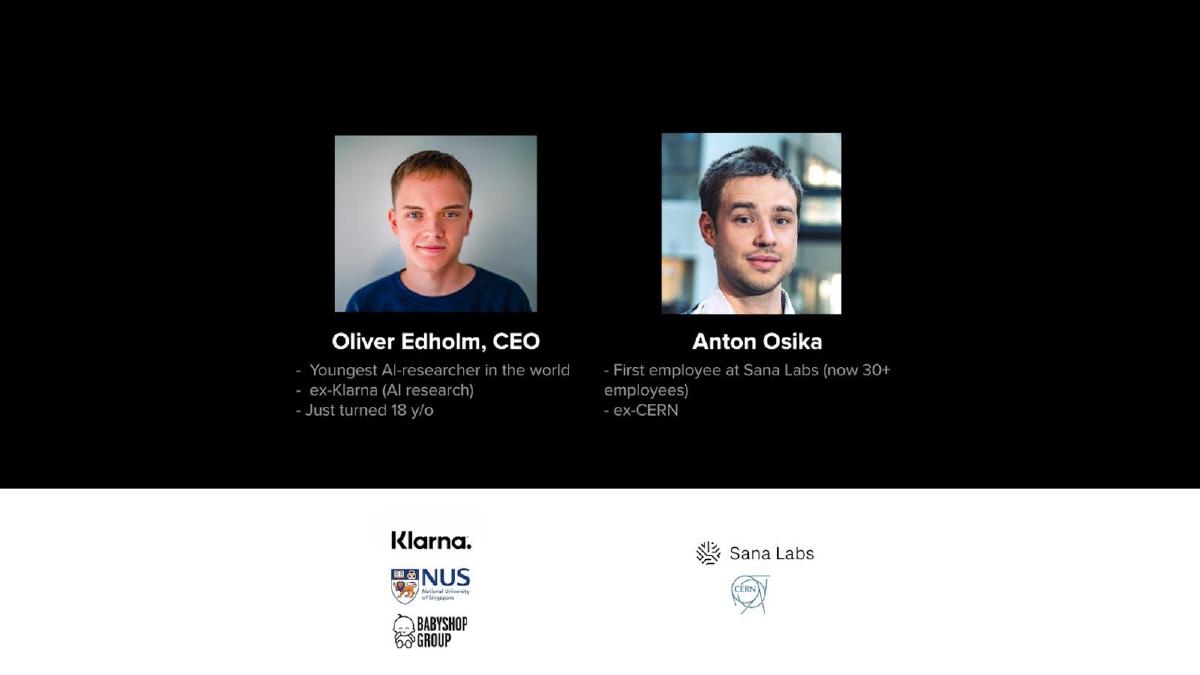
- The team slide emphasizes technical pedigree, noting the CEO was the 'youngest AI-researcher in the world' and the co-founder was ex-CERN (Slide 2).
- The deck completely omits a slide detailing the specific funding amount requested or the planned allocation of capital.
Executive Summary: High-Signal Simplicity
Depict.ai’s Seed deck is a study in brevity. Raised in 2020, this $2.9M round was secured using just 10 slides that largely ignore the 'how' of the technology to focus entirely on the 'what' of the results. In an industry—AI for e-commerce—crowded with buzzwords, Depict.ai chose to lead with logos and A/B test data. By the time an investor reaches the end of the deck, the technical feasibility is assumed because the commercial results are already on the page.
Slide 1: Title and Value Proposition
The deck opens with a minimalist title slide. The sub-headline, "Amazon-quality product recommendations for any e-commerce store," is a classic 'X for Y' positioning statement. It identifies the gold standard (Amazon) and the target market (any e-commerce store) immediately. There are no decorative graphics, just a clear promise of value.
Slide 2: The Team
The team slide is strategically placed early to establish technical authority. CEO Oliver Edholm is highlighted as being "Just turned 18 y/o" and the "Youngest AI-researcher in the world," with experience at Klarna. Anton Osika is positioned as the technical anchor with "ex-CERN" credentials and experience as the first employee at Sana Labs. By lead-loading the deck with these credentials, the founders preemptively answer questions about their ability to build complex neural networks.
Slide 3: The Anchor Tenant
Slide 3 is an unusual but effective choice: a single-customer spotlight. It announces a "Signed deal with Staples." The text notes that Staples is expected to expand the contract to the "whole of Europe in 2-3 months." Using a household name like Staples so early in the deck serves as a massive de-risking mechanism for investors, proving that the product can scale to enterprise-level requirements.
Slide 4: The Logo Wall
Following the Staples spotlight, Slide 4 displays a broader customer base. It features 11 logos including RoyalDesign, Nudie Jeans co, KitchenTime, and LloydsApotek , with a footer stating "+10 others." This indicates that the company had at least 21 customers at the time of the Seed round, a significant amount of traction for a startup at this stage.
Slide 5: The Unique Insight
This is the 'Problem/Solution' hybrid slide. Depict.ai argues that "All existing recommender systems solely rely on transaction data." Their insight is that by understanding "images and text like a human does," they can perform "2-6x better." The visual shows a fashion model with a bounding box, suggesting computer vision is the core differentiator. This slide explains the 'secret sauce' without needing a deep dive into architecture.
Slide 6: The Data Scarcity Problem
Slide 6 reinforces the 'Unique Insight' by explaining the market pain point. It states that "Individual e-commerce stores do not ever have enough data" to do recommendations properly. It draws a parallel to credit card fraud detection, noting that a single store lacks the aggregate data to predict outcomes. This sets the stage for why a third-party AI layer like Depict.ai is a necessity rather than a luxury.
Slide 7: The Business Model
The 'How we sell' slide is perhaps the strongest in the deck. It outlines a low-friction sales funnel: 1. Show comparisons, 2. Offer a free 2-week A/B test, and 3. "Take a 10% cut of the overall revenue uptick." This performance-based pricing is a 'no-brainer' for customers, as they only pay if the software makes them money. For investors, this signals a highly scalable, high-margin recurring revenue stream tied directly to customer success.
Slide 8: A/B Test Results
Slide 8 provides the empirical proof for the claims made on Slide 5. It compares Depict.ai against three benchmarks:
Amazon Web Services: 2x increase in click-through rate vs AWS Personalize. · Largest competitor (Nosto): 150% increase in add-to-cart for the customer Reforma. · In-house data scientist: 270% increase in revenue from recommendations for KitchenTime.
This slide effectively kills the 'competition' objection by showing head-to-head wins against both giants (AWS) and incumbents (Nosto).
Slide 9: Market Size (TAM)
The market slide uses a simple bottom-up calculation. It takes a "$3T E-commerce market," applies a "4% average overall revenue uplift," and then applies their "10% Cut on revenue increase" to arrive at a "$12B TAM." This is a logical, defensible way to show how a niche tool can become a multi-billion dollar opportunity.
Slide 10: Conclusion
The deck ends abruptly with a "Thank you" slide. There is no contact information, no 'Ask,' and no roadmap. While this works for a deck intended to be presented live, it leaves a gap for a deck sent as a standalone file.
What Depict.ai Does Well
The primary strength of this deck is its focus on outcomes over features . Many AI startups spend five slides explaining their transformer models or data pipelines; Depict.ai spends one slide on the 'insight' and three slides on the revenue they generate for customers. The inclusion of the Staples contract expansion (Slide 3) and the specific A/B test percentages (Slide 8) creates a sense of inevitability. Furthermore, the business model (Slide 7) is perfectly aligned with the customer's incentives, which is a powerful narrative for a Seed-stage company trying to prove product-market fit.
What is Missing from the Deck
The most glaring omission is the Funding Ask . There is no mention of how much the company is raising ($2.9M, as reported by Business Insider) or what the milestones for the next 18 months look like. Additionally, there is no Product Roadmap . Investors are left wondering if Depict.ai intends to stay purely in recommendations or expand into search, personalization, or inventory management. Finally, while the team slide is impressive, it lacks a Sales/GTM lead , which is a common concern for technical-heavy founding teams in the e-commerce space.
Founder's Playbook: What to Copy
Founders should emulate the Performance-Based Pricing slide (Slide 7) . If your software has a measurable impact on a customer's bottom line, stating that you take a percentage of that 'uplift' is the most compelling way to demonstrate value. Also, the Competitive Benchmarking (Slide 8) is a masterclass in positioning. By naming AWS and Nosto, Depict.ai isn't just saying they are 'good'; they are saying they are 'better than the best.' If you have A/B test data against a known incumbent, it should be the centerpiece of your deck. Lastly, the Unique Insight (Slide 5) is a great way to simplify complex tech. Instead of explaining the math, explain why the current way of doing things is fundamentally broken and how your 'insight' fixes it.
Frequently asked questions
- How does Depict.ai differentiate itself from other AI recommendation engines?
- According to Slide 5, most systems rely solely on historical transaction data. Depict.ai claims a 'Unique Insight' by using algorithms that understand product images and text 'like a human does.' This allows them to provide relevant recommendations even without a massive history of user purchases, which they claim leads to a 2-6x performance improvement over traditional methods.
- What is the specific business model presented in the deck?
- Slide 7 outlines a three-step sales process: showing a demo comparison, offering a free 2-week A/B test to prove revenue impact, and then charging a monthly recurring fee equal to a 10% cut of the overall revenue uptick. This performance-based approach reduces the barrier to entry for skeptical e-commerce managers.
- Who are the competitors mentioned in the Depict.ai deck?
- Slide 8 explicitly names three competitive benchmarks: Amazon Web Services (specifically AWS Personalize), Nosto (referred to as the 'Largest competitor'), and 'In-house data scientists.' The slide uses A/B test data from customers like Reforma and KitchenTime to show superior performance against these alternatives.
- What is the background of the founding team?
- Slide 2 highlights CEO Oliver Edholm as an 18-year-old former AI researcher at Klarna and the 'youngest AI-researcher in the world.' Co-founder Anton Osika is described as an ex-CERN researcher and the first employee at Sana Labs. The slide uses logos from Klarna, NUS, and CERN to anchor their technical credibility.
- Is there a clear financial 'Ask' in this pitch deck?
- No. The 10-slide deck concludes with a 'Market' slide and a 'Thank you' slide. It does not state how much money the company is looking to raise, the valuation, or how the funds will be spent. This information was likely reserved for the verbal pitch or a supplemental data room.