Greater Places is an urban planning resource platform that, as of its 2017 deck, had established a global community of 5,000 members and earned a 'Top 10' industry ranking. The pitch outlines a transition from a content-heavy 'How To' manual and newsletter toward a mobile-first marketplace connecting buyers (B2G/B2B) with professional sellers of urban design products and services. The deck projects a revenue climb from $75,000 at the end of 2017 to $9.3 million by 2019, driven by an aggressive scaling of advertisers. While the deck provides clear market segmentation and a specific $425,000 as…
Key takeaways
- The company claims a pre-existing global community of 5,000 members and a 'Top 10' urban planning resource ranking as of 2016 (Slide 3).
- The business model is a multi-sided marketplace targeting B2G and B2B buyers, professional sellers, and academic/non-profit influencers (Slide 2).
- Revenue streams are diversified across sponsored content, membership tiers (Basic, PRO, Enterprise), and specialized urban planning tools (Slide 6).
- The U.S. market size is calculated starting from a $340B public and private community market, filtered down to a $33M bottom-up ad market (Slide 5).
- The go-to-market strategy projects reaching 3,000 advertisers and 1,500 members by 2019 (Slide 7).
- The financial ask is specifically $425,000, with the largest allocation (40%) directed toward marketing (Slide 9).
- The deck highlights previous successful validation through two Kickstarter campaigns and a newsletter (Slide 3).
- Future technical goals include deep learning, content aggregation, and data-driven real estate deals (Slide 6).
Greater Places Pitch Deck Analysis
Greater Places presents a niche but potentially high-value proposition: a digital ecosystem for the urban planning and city design industry. The deck focuses on the transition from a content-led community to a transaction-led marketplace. By leveraging an existing audience of 5,000 members, the company seeks to bridge the gap between government buyers and professional service providers.
Slide 1: Title Slide
The deck opens with a high-resolution night photograph of a vibrant, pedestrian-friendly street, likely in Asia, with the text "Connecting people & ideas to create great places" . The branding is minimal, with the GreaterPlaces.com logo in the bottom right corner. This slide establishes the emotional and aesthetic goal of the company—urban vibrancy—without immediately detailing the technology or business model.
Slide 2: Market Stakeholders
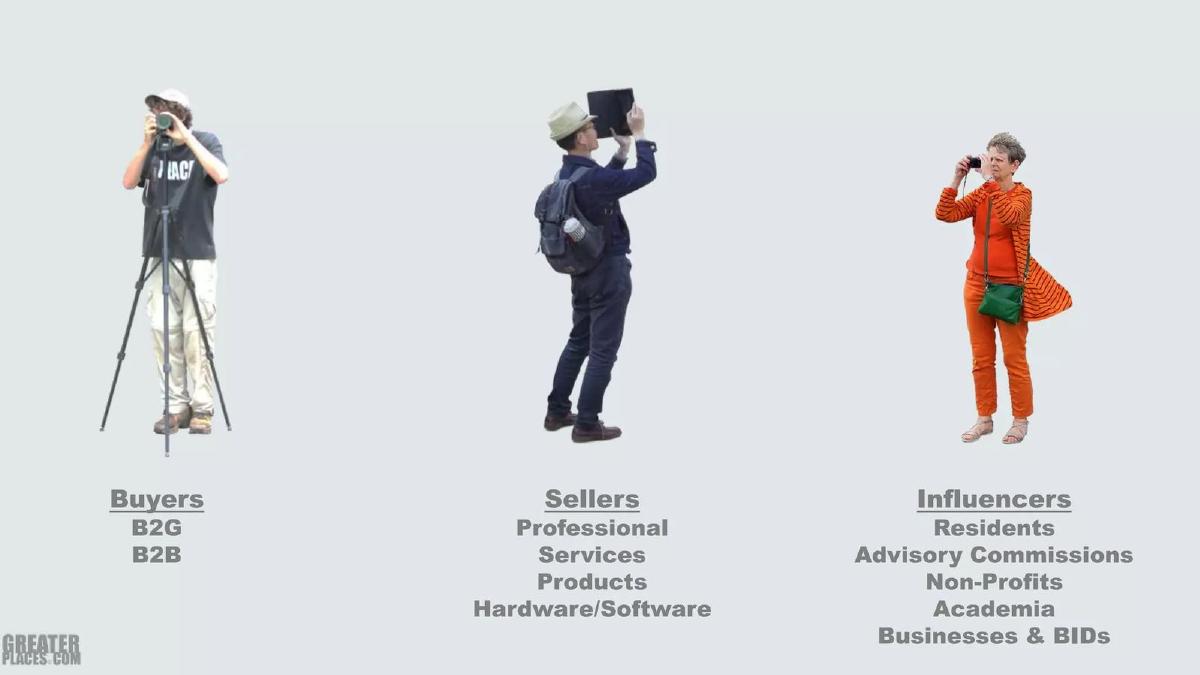
This slide segments the platform's users into three categories: Buyers (B2G and B2B), Sellers (Professional Services, Products, Hardware/Software), and Influencers (Residents, Advisory Commissions, Non-Profits, Academia, Businesses & BIDs). By including 'Influencers,' Greater Places acknowledges the complex, multi-stakeholder nature of urban planning, where community buy-in is often as important as the budget itself.
Slide 3: Platform History and Traction
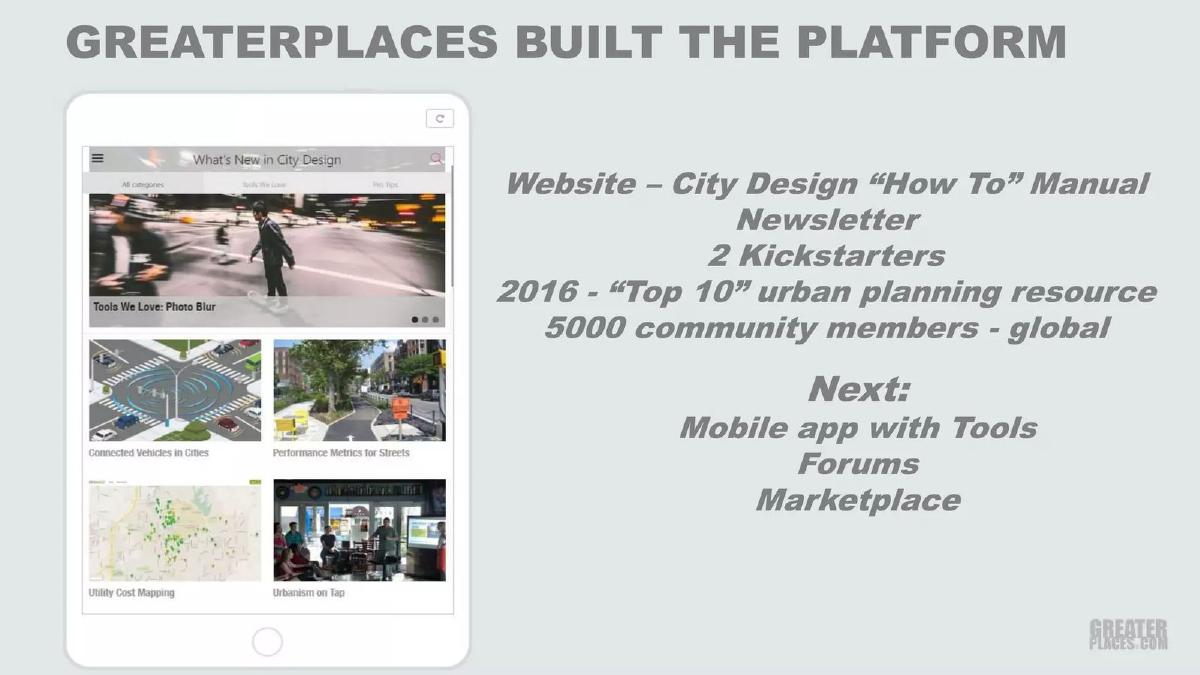
Greater Places uses this slide to establish credibility. It notes that they have already "Built the Platform," which includes a website, a city design manual, and a newsletter. Key metrics cited include 2 Kickstarters , a 2016 "Top 10" urban planning resource ranking, and a global community of 5,000 members . The slide also previews the 'Next' phase: a mobile app featuring tools, forums, and a marketplace.
Slide 4: Product Visualization
Titled "How the App & Marketplace Work," this slide shows two mobile mockups. One features "Real Time Schedules" for transit, and the other features "TransitScreen," a live transportation display. The text describes benefits such as providing travelers with 'information at a glance' and helping cities update information in real-time. This slide attempts to show the utility of the platform for the end-user (the resident) while hinting at the data services cities might buy.
Slide 5: Market Size (U.S.)
The market sizing slide uses a concentric circle diagram to narrow down the opportunity. It starts with a $340B Public + Private Community Market , narrows to a 20% Addressable segment, and then filters for a 2% Digital Ad Budget . After subtracting Google's 41% share, it arrives at a $680m figure. A separate "Bottom Up Ad Market" is valued at $33m , based on the 'Top 13 Competition - Trade Assns.' This is a conservative and realistic approach to market sizing, focusing on reachable ad dollars rather than the entire infrastructure budget.
Slide 6: Business Model
The business model is divided into four pillars: Marketplace (Product & Service Portfolios, Sponsored Content, E-newsletter Ads), Membership (Basic, PRO, Enterprise), Tools (Print Tools, Email Forums, Photos/Videos, Augmented Reality, Team Builder, Data Driven Decision Support), and Future (Deep Learning, Content Aggregation, Data driven real estate deals). This suggests a diversified revenue stream, though it risks appearing unfocused for an early-stage startup.
Slide 7: Go To Market Strategy
This slide provides a timeline and revenue projections. For 2017 (current) , the focus is on beta launch and trial advertisers. By the end of 2017 , they project $75K in revenue and 100 advertisers. 2018 sees a jump to $1.6 million with a sales team and 800 advertisers. By 2019 , the goal is $9.3 million with 3,000 advertisers and 1,500 members. The steep revenue curve between 2018 and 2019 is ambitious, implying a high degree of scalability in their advertiser acquisition.
Slide 8: Impact and Efficacy
Under the heading "HOW EFFECTIVE IS YOUR STARTUP INVESTMENT?" , the deck shows two more app screens. One discusses "Green Building Rating Systems" and the other "PlanITImpact," a tool for sustainable design. The slide lists benefits like environmental impact reduction and ROI insights for real estate developers. This slide serves to reinforce the 'Tools' aspect of the business model mentioned on Slide 6.
Slide 9: The Ask
The final slide in this set is "The Ask," requesting $425,000 . The allocation is clearly defined: 40% Marketing , 35% Testing, Web + App Design , 20% Content & Customer Development , and 5% Legal & Business . The use of a hexagon graphic for the dollar amount is a stylistic choice, but the breakdown provides the necessary transparency for potential investors.
What Greater Places Does Well
The deck excels at identifying a specific, underserved niche. Urban planning is a massive industry that often relies on fragmented, legacy communication methods. By identifying Influencers (Slide 2) as a core part of the ecosystem, Greater Places shows a sophisticated understanding of how city design projects actually get approved and funded. The inclusion of Kickstarter history (Slide 3) is a strong signal of product-market fit and community willingness to pay, which is often hard to prove in the B2G space.
The market sizing (Slide 5) is also a highlight. Rather than claiming they will capture a percentage of the total $340B infrastructure market, they logically drill down to the digital advertising and trade association spend. This makes the $680M and $33M figures feel attainable and grounded in reality.
What is Missing from the Deck
The most significant omission in the provided slides is a Team Slide . In a niche industry like urban planning, the founders' pedigree, connections to municipal governments, and technical expertise are paramount. Without knowing who is building the 'Deep Learning' or 'Augmented Reality' tools mentioned on Slide 6, an investor cannot assess execution risk.
Furthermore, the deck lacks Unit Economics . While Slide 7 projects $9.3 million in revenue, it does not explain the Customer Acquisition Cost (CAC) for those 3,000 advertisers or the Lifetime Value (LTV) of a 'PRO' member. The jump from $1.6M to $9.3M in one year is a 5.8x increase, which usually requires a very clear, proven acquisition engine that isn't detailed here. There is also no Competition Slide ; while Slide 5 mentions 'Trade Assns,' a direct comparison against existing urban planning forums or procurement software would be beneficial.
Founder Takeaways
Validate with community first: Greater Places' strongest point is its 5,000-member community and Kickstarter success. Founders should always highlight pre-existing traction that proves people care about the problem before asking for money to scale the solution.
Be realistic about market size: Don't just show the 'Total Addressable Market' (TAM). Show the 'Serviceable Obtainable Market' (SOM) by filtering for your specific business model (e.g., digital ads vs. total construction spend). It builds trust with analysts.
Connect the 'Ask' to the 'Go To Market': Greater Places asks for 40% of their funds for marketing (Slide 9) and projects a massive increase in advertisers (Slide 7). This alignment shows that the founders know exactly what lever they are trying to pull with the investment capital.
Diversify revenue carefully: Slide 6 lists memberships, ads, tools, and data deals. For a $425k seed round, this can look like 'feature creep.' Founders should be careful to signal which revenue stream is the primary engine and which are secondary 'future' opportunities to avoid looking unfocused.
Frequently asked questions
- What is the core product of Greater Places?
- Greater Places began as a content platform featuring a city design 'How To' manual and a newsletter. The deck outlines its evolution into a mobile app that includes professional tools, community forums, and a marketplace. The app serves as a central hub where urban planners and city officials can find real-time transit schedules, green building rating systems, and sustainable design applications like PlanITImpact.
- How does Greater Places plan to generate revenue?
- The startup utilizes a three-pronged monetization strategy. First, a marketplace for products and services featuring sponsored content and e-newsletter ads. Second, a subscription-based membership model with Basic, PRO, and Enterprise tiers. Third, the sale of specialized 'Tools' such as augmented reality features, team builders, and data-driven decision support systems for urban design professionals.
- What is the target market for this platform?
- The platform targets three distinct groups: Buyers, which include B2G (government) and B2B entities; Sellers, encompassing professional services, product vendors, and hardware/software providers; and Influencers, which include residents, advisory commissions, non-profits, and academia. The deck specifically focuses on the U.S. market, identifying a $680M addressable segment within the broader community market.
- What are the funding requirements and planned use of proceeds?
- Greater Places is seeking $425,000 in investment. The allocation of these funds is broken down into four categories: 40% for Marketing, 35% for Testing and Web/App Design, 20% for Content and Customer Development, and 5% for Legal and Business expenses. This suggests a heavy focus on user acquisition and technical refinement of the marketplace platform.
- What traction has the company demonstrated so far?
- At the time of the pitch, the company reported having 5,000 global community members and two successful Kickstarter campaigns. It was recognized as a 'Top 10' urban planning resource in 2016. The deck also mentions a current (2017) phase of launching a beta version, enlisting the community, and engaging trial advertisers to validate the marketplace concept.