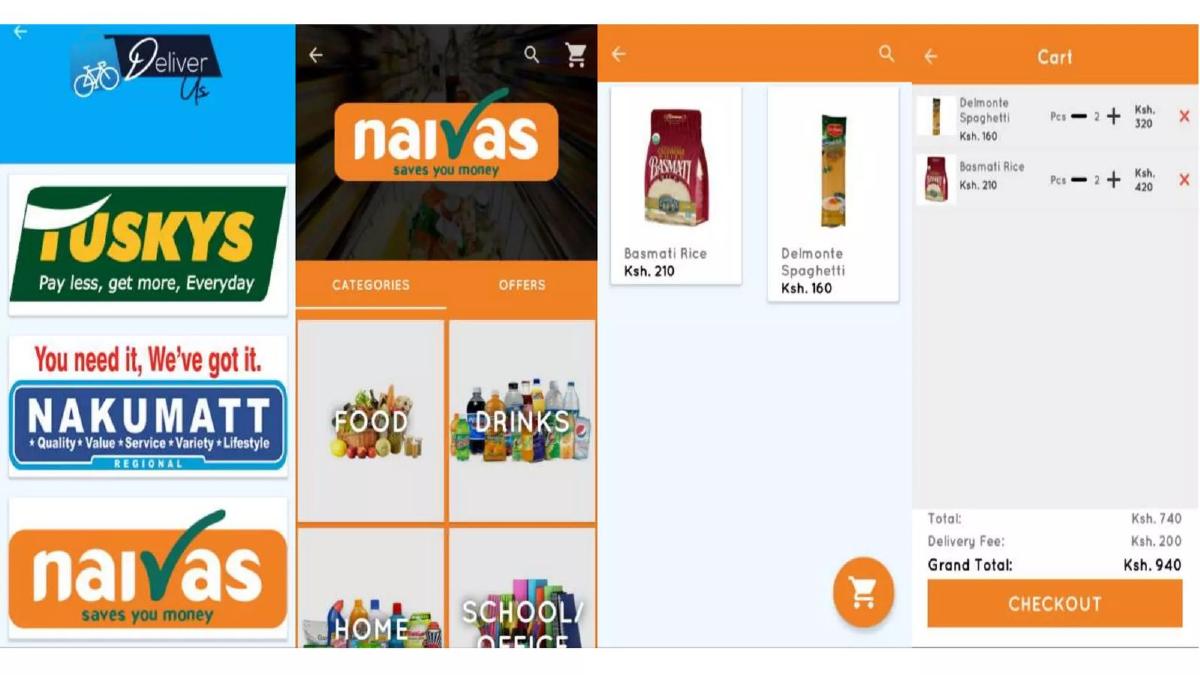
Deliverus Online Supermarkets aims to disrupt the Kenyan retail sector by solving the friction points of physical shopping: traffic congestion, long checkout lines, and difficult product discovery. The deck highlights a market with 90% mobile penetration and 39 million internet users, positioning the company as a first-mover in a nascent e-commerce landscape. By utilizing a network of cyclists and integrating M-Pesa for payments, Deliverus promises 30-minute delivery for a flat fee of Ksh 150. While the deck provides clear revenue projections based on a 10,000-subscriber target, it lacks crit…
Key takeaways
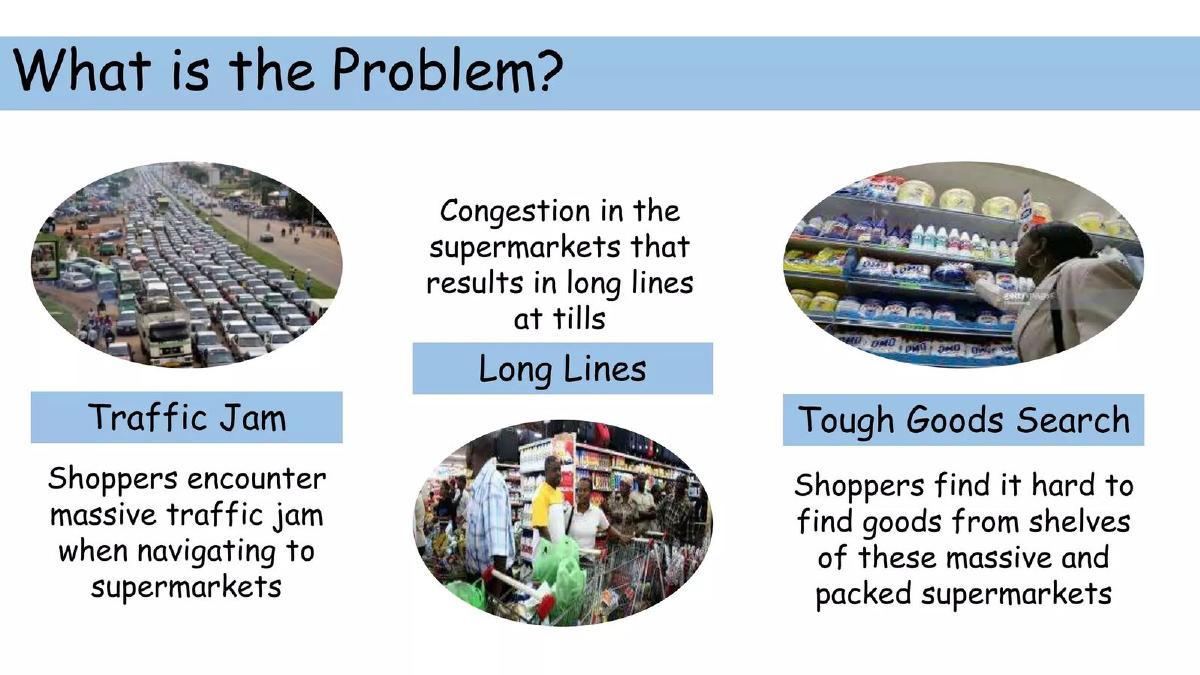
- The problem slide identifies three specific physical retail pain points: traffic jams, long checkout lines, and difficult goods search (Slide 2).
- The product workflow relies on four steps: Search, Order, Pay (via M-Pesa), and Deliver (Slide 3).
- Market validation is based on Kenya's 90% mobile penetration and a total e-commerce market value of Sh4.3 Billion (Slide 4).
- Financial projections assume a base of 10,000 subscribers to generate an annual revenue of Ksh 43,200,000 (Slide 5).
- The competitive advantage is built on a Ksh 150 delivery fee, which is claimed to be half the price of competitors (Slide 6).
- The company claims first-mover status, stating all competitors are in pilot, pre-revenue, or prototype stages (Slide 7).
- Strategic partnerships are listed with major Kenyan retailers including Tuskys, Uchumi, Nakumatt, Chandarana Foodplus, and Naivas (Slide 7).
- The business is operated by White Web Kenya, based in Nairobi's Central Business District (Slide 8).
Deliverus Online Supermarkets: A Deep Dive into Kenyan E-Grocery Logistics
The Deliverus Online Supermarkets pitch deck represents a specific era of the Kenyan tech ecosystem, focusing heavily on the intersection of mobile money (M-Pesa) and hyper-local logistics. The deck, presented by White Web Kenya, attempts to bridge the gap between traditional brick-and-mortar retail giants and an increasingly mobile-first consumer base. Below is a slide-by-slide breakdown of the presentation.
Slide 1: Title and Branding
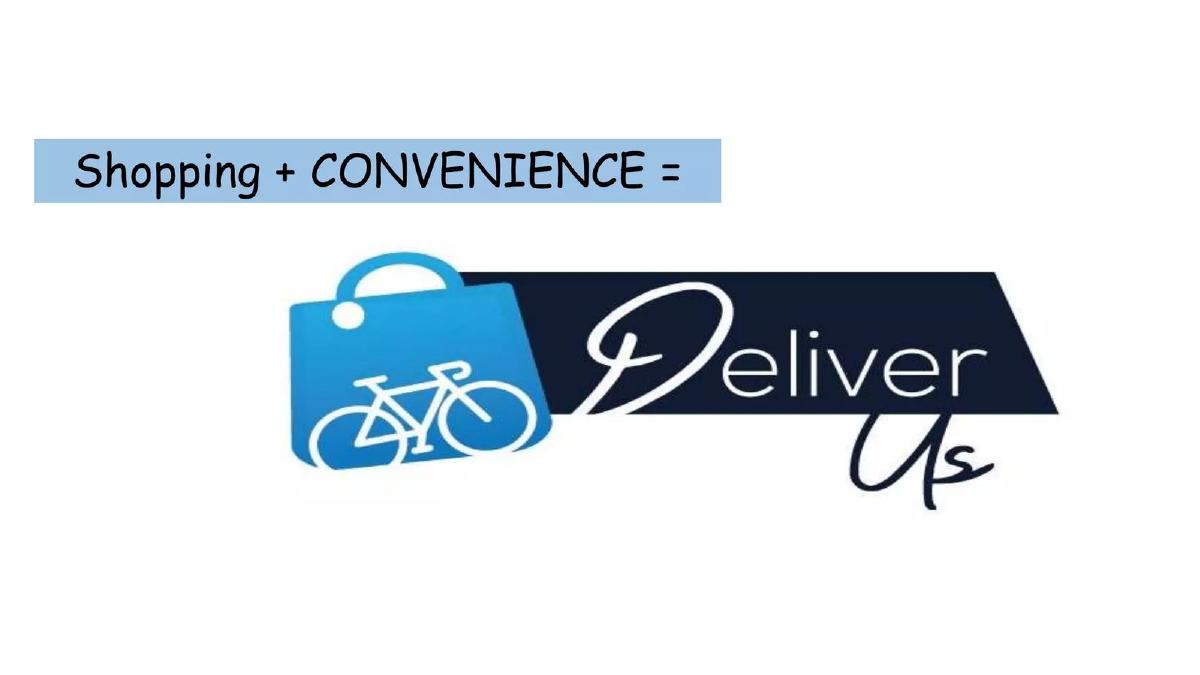
The cover slide introduces the company name, 'Deliverus Online Supermarkets,' accompanied by the tagline 'We Got You.' The logo features a blue shopping bag containing a bicycle icon, which immediately signals the company's reliance on two-wheeled logistics. The branding is functional, though the use of Comic Sans-style fonts in the subtitle suggests a less formal approach to the visual design.
Slide 2: The Problem Statement
Slide 2 identifies three core pain points for Kenyan shoppers. First is the 'Traffic Jam,' noting that shoppers encounter massive congestion when navigating to supermarkets. Second is 'Long Lines,' specifically congestion at the tills. Third is the 'Tough Goods Search,' highlighting the difficulty of finding items in 'massive and packed supermarkets.' By using real-world imagery of Nairobi traffic and crowded aisles, the founders ground the problem in a relatable daily experience for their target demographic.
Slide 3: Product Workflow
This slide explains the user journey in four icons: Search (finding a preferred supermarket), Order (selecting goods from online inventories), Pay (via mobile payment options, specifically highlighting M-Pesa), and Deliver . The most significant claim on this slide is the delivery time: 'Get your delivery in 30 minutes.' This sets a high bar for operational excellence, especially given the traffic problems mentioned in the previous slide.
Slide 4: Market Validation
The founders use macro-economic data to justify the opportunity. They cite four key metrics: 90% Mobile Penetration, 67% Smartphone Penetration, 39 Million Internet Users in Kenya, and a total E-Commerce worth of Sh4.3 Billion in Kenya. While these figures provide a sense of the 'Total Addressable Market,' the deck does not narrow this down to a 'Serviceable Obtainable Market' (SOM) specific to grocery delivery in Nairobi.
Slide 5: Financial Projections
This slide provides a snapshot of the business model's potential scale. The projections are based on a target of 10,000 'Deliverus Subscribers.' The math is presented as follows:
Daily Revenues (1,000 customers/day): Ksh 120,000 · Monthly Revenues: Ksh 3,600,000 · Annual Revenues: Ksh 43,200,000
It is important to note that these figures are 'after deduction of Cyclists Commission.' However, the deck does not clarify if these revenues include the markup on groceries or if they are solely derived from delivery fees and subscriptions.
Slide 6: Competitive Advantage
Deliverus stakes its claim on three pillars: price, speed, and market timing. They state their delivery fee is 'only Ksh 150,' which they claim is half the price of competitors. They reiterate the 30-minute delivery promise and claim to be 'First in Market,' asserting that all competitors are currently in pilot or pre-revenue stages. The slide uses a 'Fun, Fast, Effective' checklist, though 'Fun' is not defined in a business context.
Slide 7: Partners
This slide displays the logos of major Kenyan supermarket chains: Tuskys, Uchumi, Nakumatt, Chandarana Foodplus, and Naivas. These are the 'Big Five' of Kenyan retail from the mid-2010s. The deck implies these are active partners providing inventory access, which would be a significant moat if exclusive. However, the nature of these partnerships (e.g., formal API integration vs. simple 'personal shopper' model) is not detailed.
Slide 8: Contacts
The final slide provides the corporate identity: White Web Kenya. It lists a physical address at Cargen House on Harambee Avenue in the Nairobi CBD. This provides a level of legitimacy by showing a fixed place of business, but the deck ends abruptly without a call to action or a specific funding request.
What Works in This Deck
Local Context: The deck does an excellent job of identifying problems specific to the Nairobi urban environment. The focus on traffic and M-Pesa integration shows a deep understanding of the local consumer's friction points.
Operational Clarity: The four-step process (Search, Order, Pay, Deliver) is simple and easy for an investor to visualize. The commitment to a 30-minute window is a bold, measurable KPI that defines the brand's value proposition.
Market Timing: By highlighting the high smartphone and mobile penetration rates, the founders successfully argue that the infrastructure for a digital grocery business is already in place.
What Is Missing
The Team: This is the most glaring omission. Investors back people, especially in early-stage logistics where execution is everything. There is no mention of who is running White Web Kenya or their background in retail or technology.
Unit Economics: While the deck mentions a Ksh 150 delivery fee, it doesn't explain the cost of customer acquisition (CAC), the average order value (AOV), or the churn rate. Without these, the 'Annual Revenue' projection is just a hypothetical number.
The Ask: A pitch deck is a fundraising tool. This deck fails to mention how much money the company is looking for, what equity they are offering, or how the funds will be deployed (e.g., hiring more cyclists, marketing, or tech development).
Competitive Analysis: Claiming that all competitors are 'pre-revenue' is a dangerous assumption in a pitch. A more robust deck would name specific competitors and provide a feature-by-feature comparison.
Founder Takeaways
Quantify the 'Why Now': Deliverus uses market validation data well. Founders should always link broad market trends (like mobile penetration) directly to their product's necessity.
Be Specific About Partnerships: If you list logos of multi-billion shilling companies like Naivas or Tuskys, be prepared to explain the depth of that relationship. Are you a preferred partner, or are you just shopping their aisles like a regular customer?
Address the 'How': 30-minute delivery in Nairobi traffic is a massive claim. A founder should include a slide on 'Logistics Tech' or 'Fulfillment Strategy' to explain how they bypass the very traffic jams they identified as a problem.
Don't Forget the Team: Never skip the team slide. Even a simple list of past roles and successes provides the credibility needed to make the rest of the deck believable.
Frequently asked questions
- What is the primary value proposition of Deliverus?
- Deliverus focuses on convenience and speed. According to Slide 6, they offer 30-minute delivery for a flat fee of Ksh 150. This is designed to save customers from the 'massive traffic jams' and 'long lines at tills' described on Slide 2. By digitizing the inventory of physical supermarkets, they allow users to bypass the physical search process entirely.
- How does the company handle payments and logistics?
- Logistics are handled by a network of cyclists, as referenced in the revenue deductions on Slide 5. Payments are integrated with M-Pesa, the dominant mobile money platform in Kenya, as shown in the product workflow on Slide 3. This alignment with local infrastructure is a key part of their operational strategy.
- What are the projected financials for the business?
- Slide 5 outlines a model based on 10,000 subscribers. At a volume of 1,000 customers per day, the company projects daily revenue of Ksh 120,000 after paying cyclist commissions. This scales to a projected total annual revenue of Ksh 43,200,000. However, the deck does not specify the gross margins on the goods themselves.
- Who are the competitors and how does Deliverus differentiate?
- While specific competitor names are not listed, Slide 6 claims Deliverus is 'Cheap' because its Ksh 150 fee is half that of others. Slide 6 also asserts they are 'First in Market,' claiming that all other players are currently in pre-revenue or prototype stages, though it does not provide evidence for these claims.
- What critical information is missing from this deck?
- The deck is missing several standard venture components. There is no 'Team' slide showcasing the founders' expertise. There is no 'Ask' slide detailing how much capital is being raised or how it will be spent. Additionally, there is no data on customer acquisition costs (CAC) or historical traction to prove the model works.