IPRally’s Series A deck is a masterclass in efficiency, using just 12 slides to articulate a complex technical solution for a high-value niche. The company addresses the 'insane' manual labor of patent searching, where professionals currently spend 4-100 hours per search with near-zero automation. By converting 100 million patents into a structured graph format, IPRally claims to offer the first AI that 'thinks like a patent professional.' The deck leans heavily on social proof, listing blue-chip clients like NVIDIA and Siemens, and showcases a consistent ARR growth trajectory from 2019 throu…
Key takeaways
- The current patent search process is highly manual, with ~0% automation and 4-100 hours required per search (Slide 3).
- IPRally has processed 100 million patents into a structured graph format to match an 'engineer mindset' (Slide 4).
- The company boasts significant enterprise traction, naming NVIDIA, Siemens Energy, and L'Oréal among its 100+ customers (Slide 4).
- Revenue growth is visualized through an ARR chart showing consistent upward momentum from March 2019 to November 2022 (Slide 5).
- The team is comprised of 32 specialists, including a tech team of 16 and a commercial team of 12 (Slide 6).
- CEO Sakari Arvela brings 18+ years of experience as a European Patent Attorney, establishing deep founder-market fit (Slide 6).
- The platform aims to reduce the 40% invalidity rate of challenged patents by improving search accuracy (Slide 3).
- IPRally utilizes the Clojure programming language as a 'special advantage' for their technical development (Slide 6).
IPRally Series A Teardown: The Power of Niche AI
IPRally’s Series A deck is a concise 12-slide presentation that focuses on a specific, high-friction problem in the legal and R&D space: patent search. According to publisher reports from Business Insider, this deck helped the European-based startup secure $10.6M in 2024. The deck is characterized by its clean design and a heavy emphasis on technical differentiation and enterprise traction.
Slide 1-2: The Vision and Value Proposition
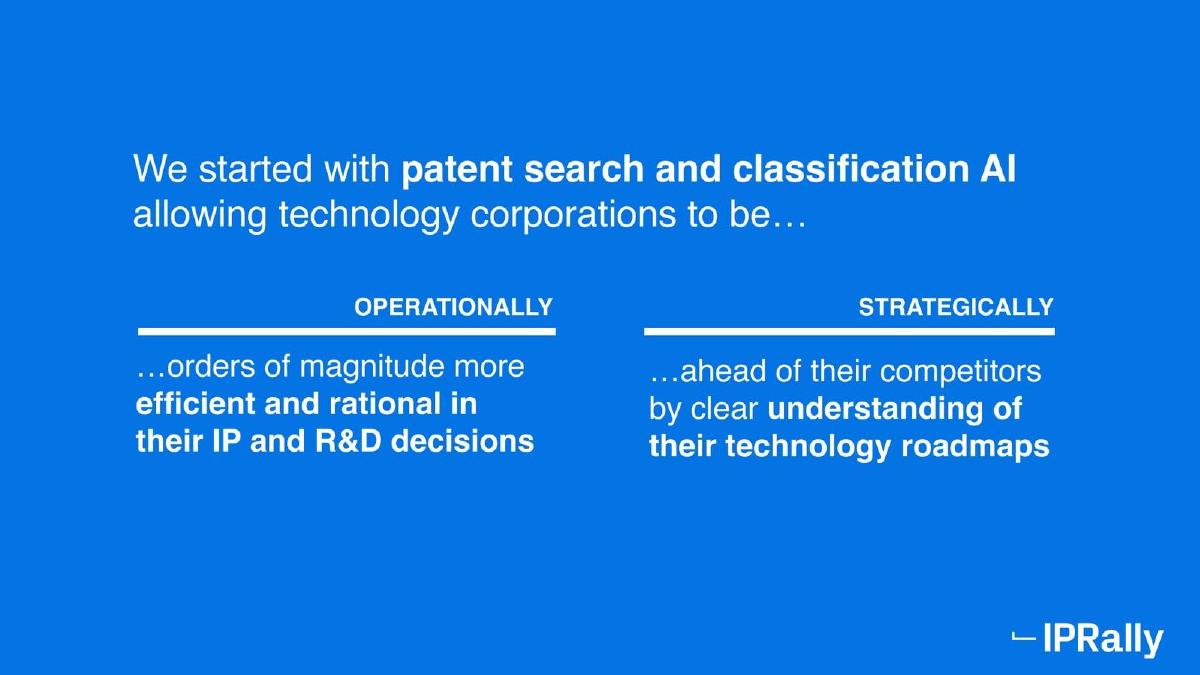
The deck opens with a minimalist title slide (Slide 1) that introduces the company as 'The technology AI.' This is immediately followed by Slide 2, which frames the company’s impact across two dimensions: operational and strategic. Operationally, IPRally claims to make technology corporations 'orders of magnitude more efficient and rational' in their IP and R&D decisions. Strategically, it promises to keep them 'ahead of their competitors' by providing a clearer understanding of technology roadmaps. By splitting the value prop this way, IPRally appeals to both the department heads looking for efficiency and the C-suite looking for competitive advantages.
Slide 3: The 'Insane' Problem
Slide 3 is perhaps the most effective slide in the deck. It uses five key metrics to illustrate why the current patent search process is 'insane' and 'highly inefficient.' The slide notes a '~0% automation level,' '4-100 h used per search,' and a '4+ yrs' timeline to get a patent. Most importantly for the business case, it highlights that '50 B€' is spent to get and maintain patents, yet '40%' of challenged patents are eventually found invalid. This suggests a massive market where the current tools are failing to provide quality assurance. The visual at the bottom of the slide illustrates the manual slog: building hundreds of complex queries, getting hundreds of irrelevant hits, and crawling through tens of pages per hit.
Slide 4: The Graph AI Solution and Traction
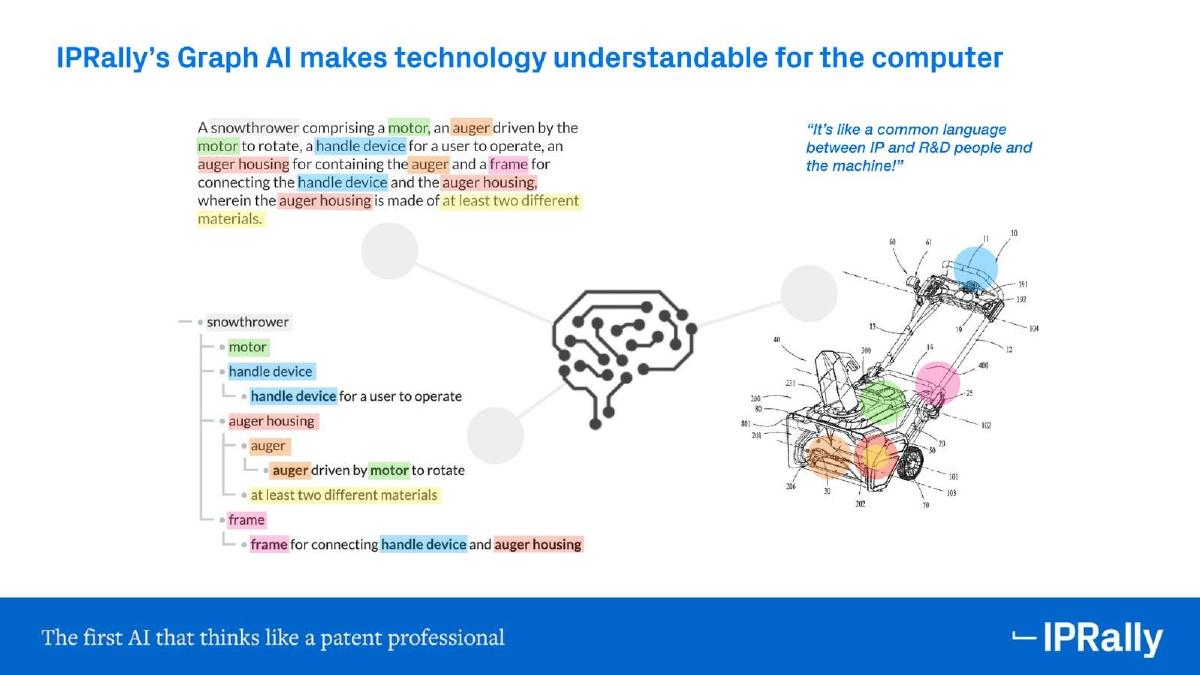
Slide 4 introduces IPRally’s 'Graph AI' as the solution. The company claims to have converted 100 million patents into a 'highly structured graph format.' This is a critical technical moat; they aren't just building a wrapper around a Large Language Model (LLM), but are instead creating a proprietary data structure. The slide also serves as a massive social proof engine, displaying logos for NVIDIA, Siemens Energy, ABB, L'Oréal, and others. Stating they have '100+ more' customers at the Series A stage is a powerful indicator of market pull.
Slide 5: The Growth Trajectory
Slide 5 provides a standard ARR (Annual Recurring Revenue) growth chart. While the Y-axis lacks specific dollar amounts (a common practice in public versions of decks), the curve shows consistent, accelerating growth from March 2019 to November 2022. The slide annotates key milestones along the curve, such as the 'Product launch in the Nordics,' 'First US customers,' and the 'Seed round raised.' This timeline demonstrates 'determined execution,' showing that the team hits their milestones and successfully expands into new geographies like the DACH region and the US.
Slide 6: The Specialized Team
The team slide (Slide 6) emphasizes 'highly specialized skills.' CEO Sakari Arvela is a European Patent Attorney with 18+ years in the space, which is the ultimate founder-market fit for a legal tech company. CTO Juho Kallio brings 10+ years of software development and NLP experience. The slide also highlights the broader team of 32, noting a tech team of 16 and a commercial team of 12. Interestingly, they list the use of the 'Clojure language' as a special advantage for the tech team, suggesting a focus on functional programming to handle their complex graph data structures.
What IPRally Does Exceptionally Well
The IPRally deck succeeds because it doesn't over-explain the AI. In a market currently saturated with 'AI-first' startups, IPRally focuses on the output and the proprietary data . By mentioning the conversion of 100 million patents into a graph format, they signal to investors that they have done the heavy lifting of data engineering that a generic competitor cannot easily replicate.
Furthermore, the problem slide (Slide 3) is a masterclass in quantifying pain. By linking the inefficiency of search to the 40% invalidity rate of patents, they transform 'saving time' into 'mitigating multi-million dollar legal risks.' This elevates the product from a 'nice-to-have' productivity tool to a 'must-have' risk management platform.
What Is Missing from the Deck
While the deck is strong on traction and technology, it omits several key financial and strategic components typically expected in a Series A pitch:
The Ask: There is no slide detailing how much money is being raised or how it will be spent. While we know from external reports it was $10.6M, the deck itself doesn't outline the roadmap for this capital. · Unit Economics: There is no mention of Customer Acquisition Cost (CAC), Lifetime Value (LTV), or churn rates. For a SaaS company at Series A, these metrics are usually vital to prove the scalability of the sales motion. · Market Size (TAM): While they mention a 50B€ spend on patents, they don't explicitly define their Total Addressable Market for the software itself. · Competition: The deck assumes a vacuum. It doesn't mention legacy players like Clarivate or Patsnap, even though CCO Andreas Cehlinder is noted to have come from those organizations. A competitive matrix would have helped clarify their positioning against these incumbents.
Lessons for Founders
Founders can learn two major lessons from IPRally’s approach. First, Founder-Market Fit is a primary asset. If you have 18 years of experience in a boring, complex industry like patent law, make that the centerpiece of your credibility. Investors are much more likely to fund a domain expert building for their own peers than a generalist building for an industry they don't understand.
Second, leverage social proof early and often. IPRally didn't just list their customers; they listed NVIDIA and Siemens . For a startup, one blue-chip logo is worth ten unknown startups. If you have enterprise traction, put those logos on a slide as early as possible to de-risk the investment in the eyes of the VC. The fact that IPRally could show a 3-year growth curve with these names attached made the $10.6M raise a much easier sell.
Frequently asked questions
- What is the core technology behind IPRally?
- IPRally utilizes 'Graph AI,' which differs from standard keyword-based search. According to Slide 4, they have analyzed and converted 100 million patents into a highly structured graph format. This allows the AI to match technology concepts with an 'engineer mindset' rather than just matching text strings, which is the traditional method used in the industry.
- How does IPRally quantify the problem they are solving?
- Slide 3 presents a stark view of the status quo: patent searching has ~0% automation, takes 4-100 hours per search, and results in 40% of challenged patents being found invalid. They also note that it takes 4+ years to get a patent and that 50B€ is spent annually on patent acquisition and maintenance.
- Who are IPRally's notable customers?
- The company has secured over 100 customers. Slide 4 highlights several major global corporations, including NVIDIA, Siemens Energy, ABB, L'Oréal, Dolby, Infineon, Elkem, KONE, and DeLaval. This level of enterprise adoption is a strong signal of product-market fit for a Series A company.
- What does the team structure look like?
- As of the Series A, the company had 32 employees. Slide 6 breaks this down into a Tech team of 16 (focused on AI, Product, and Devops) and a Commercial team of 12 (covering Sales, Marketing, and Customer Success). The leadership includes a mix of patent law expertise and SaaS scaling experience.
- Is there a specific financial 'ask' in the deck?
- No. While publisher reports confirm a $10.6M Series A raise in 2024, the 12-slide deck provided does not include a slide detailing the specific amount of capital sought, the valuation, or the planned allocation of funds. This information was likely reserved for the full data room or verbal discussions.