InvoiceASAP’s 2019 investor deck is a study in persistence, showcasing a revenue trajectory that spans from 2012 to 2018. The company positions itself as a central hub for SMBs, connecting mobile invoicing with major accounting and CRM platforms like QuickBooks, Xero, and Salesforce. By 2018, the platform had processed $3.5 billion in invoices across 17,756 paid merchants. While the deck lacks a specific 'Ask' slide or detailed unit economics in this version, it effectively uses market data from Intuit to validate the growing demand for cloud-based financial tools. The team slide emphasizes o…
Key takeaways
- The company demonstrated six years of continuous monthly revenue growth from May 2012 through early 2018 (Slide 4).
- As of Q1 2018, InvoiceASAP reported $392,927 in quarterly revenue and 17,756 total paid merchants (Slide 4).
- The platform has significant scale in transaction volume, having facilitated the creation of 901,201 invoices totaling $3.5 billion (Slide 4).
- Market validation is supported by Intuit data showing small business cloud adoption rising from 37% in 2015 to a projected 78% in 2020 (Slide 2).
- The product strategy relies heavily on an 'Integration Opportunities' model, connecting the 'ASAP Cloud' to 14 external platforms including NetSuite and Sage (Slide 3).
- The leadership team includes a mix of functional VPs and external directors with backgrounds in SaaS localization and large-scale franchising (Slide 5).
- The deck identifies that 85% of small businesses are willing to invest more in software solutions over a 5-year period (Slide 2).
- There is a notable absence of a competition slide, financial projections beyond 2018, or a specific funding request in the provided slides.
Executive Summary: A Mature Approach to SMB Fintech
The InvoiceASAP investor deck from April 2019 presents a company that has moved well beyond the 'idea' phase. Unlike many early-stage decks that rely on hypothetical projections, this presentation is anchored by six years of historical performance data. The narrative focuses on the digital transformation of small and medium-sized businesses (SMBs), positioning InvoiceASAP as the essential bridge between mobile field work and back-office accounting systems. By leveraging a heavy integration strategy, the company avoids the 'walled garden' trap, instead opting to become a vital component of a larger software ecosystem.
Slide 1: Title and Branding
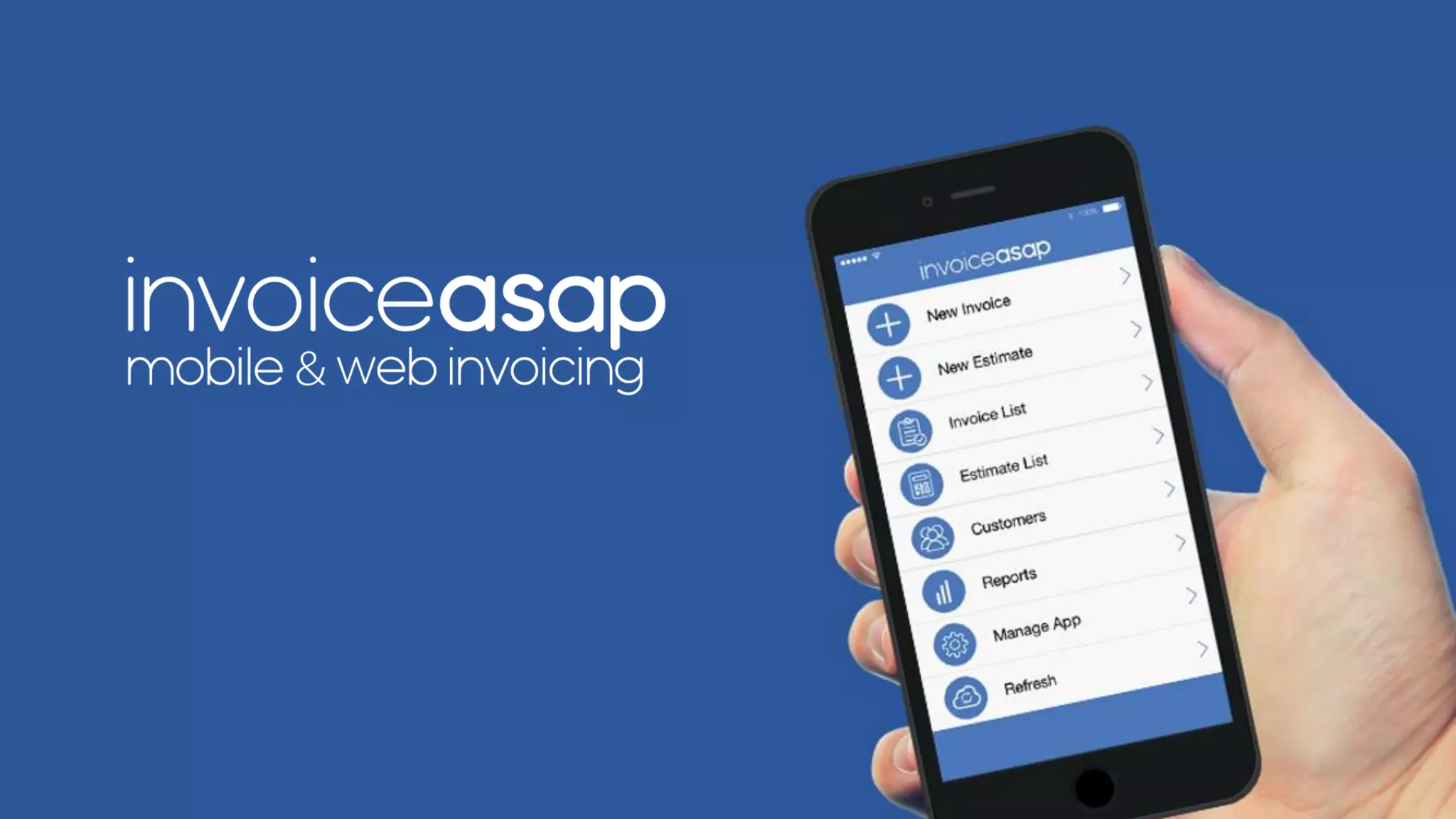
The cover slide is minimalist, featuring the InvoiceASAP logo and the tagline "mobile & web invoicing." A high-quality product shot shows the mobile interface on a smartphone, emphasizing the 'mobile-first' nature of the solution. The interface displayed includes clear calls to action: "New Invoice," "New Estimate," and "Invoice List." This immediately establishes the product's utility without requiring explanatory text. The use of a deep blue brand color conveys a sense of professional stability, appropriate for a financial services company.
Slide 2: Market Validation and SMB Trends
This slide uses data attributed to Intuit to build a compelling case for the 'why now' of the business. It highlights three critical statistics: 85% of small businesses are willing to invest more in software over the next five years, cloud adoption is expected to jump from 37% (2015) to 78% (2020), and 65% of SMBs are specifically looking for solutions to generate invoices and accept payments. By citing Intuit, a dominant player in the space, InvoiceASAP validates its market without having to defend its own internal research. The slide successfully argues that the 'opportunity doesn't come often' for this level of digital migration.
Slide 3: The Integration Ecosystem
Slide 3, titled "Integration Opportunities," is perhaps the most strategically important slide in the deck. It places the "ASAP Cloud" at the center of a four-way integration map. To the left are CRMs like Salesforce, Insightly, and SugarCRM. To the right are accounting giants like QuickBooks, Sage, Xero, and Microsoft Dynamics. The top features enterprise procurement tools like Coupa and Ariba. This visual communicates that InvoiceASAP is not trying to replace these platforms; rather, it makes them more valuable by providing a mobile entry point for data. This 'hub-and-spoke' model is a classic de-risking strategy in SaaS, as it creates high switching costs for users who have synced their invoicing with their primary accounting records.
Slide 4: Historical Revenue and KPIs
This slide provides the 'proof of life' for the business. It features a bar chart showing "Summary of Monthly Revenue Growth 2012 - 2018." The chart shows a consistent upward trend, starting from near-zero in May 2012 and reaching a peak of over $150,000 in monthly revenue by early 2018. The right side of the slide lists "2018 Q1 KPIs," including $392,927 in revenue and 17,756 total paid merchants. The most impressive figure is the "$ Invoices Created: $3.5B," which demonstrates the massive volume of economic activity flowing through the platform. This scale suggests that InvoiceASAP has significant data assets and a deeply embedded user base.
Slide 5: Team and Governance
The "Team Summary" slide lists five internal executives and two external directors. CEO Paul Hoeper is positioned as an industry expert, while the rest of the C-suite (COO Anne Maxwell and CTO Jeremy Watkins) are noted for deployment and scalability expertise. The inclusion of VP-level roles for Customer Success (Jeena Kaur) and UI/UX (Michelle Jones) indicates a company that has matured enough to have specialized departments. The presence of independent directors from Transifex and a major Domino’s franchise (RPM Pizza) suggests a board that understands both high-growth SaaS and the specific needs of high-volume SMB operators. The legal firm Sheppard Mullin is also prominently featured, adding a layer of institutional credibility.
Slide 6: Conclusion
The final slide is a simple "thank you" with the company logo. While standard, it marks the end of a very lean 11-slide deck (of which 6 were analyzed here). The lack of a contact slide or a final 'call to action' in this specific set of slides is a missed opportunity to drive immediate investor engagement, though such information is often reserved for the final page of the full 11-slide version.
What Works in This Deck
Longevity of Data: Showing a six-year revenue chart is rare in startup pitches. It proves the business is not a 'flash in the pan' and has survived multiple market cycles. · Ecosystem Positioning: By showing logos of partners like NetSuite and Salesforce, the company borrows the credibility of those multi-billion dollar entities. · Clear Metrics: The Q1 2018 KPIs are specific and cover both the company's top line (revenue) and the platform's utility (invoices created). · Market Timing: The use of the Intuit cloud adoption chart provides a macro-economic tailwind that makes the company's growth feel inevitable rather than forced.
What Is Missing
The Funding Ask: There is no mention of how much money is being raised, the valuation, or the specific milestones the new capital will help achieve. · Competitive Landscape: The deck does not address how InvoiceASAP differentiates itself from direct competitors like FreshBooks, Wave, or the mobile apps provided by QuickBooks and Xero themselves. · Unit Economics: While total revenue is shown, there is no data on Customer Acquisition Cost (CAC), Lifetime Value (LTV), or churn rates, which are essential for evaluating a SaaS business. · Future Projections: The deck stops at Q1 2018. Investors would want to see a 3-5 year forecast to understand the potential return on investment.
Founder's Guide: What to Copy
The 'Proof of Scale' Metric: InvoiceASAP includes the total dollar value of invoices created ($3.5B). Even if your company doesn't take a percentage of the transaction, showing the total volume of money moving through your system is a powerful way to demonstrate importance to the user. · Third-Party Validation: If you are in a crowded market, don't just say the market is big. Use a chart from a market leader (like Intuit) to show the specific trend you are riding. It makes your claims harder to dispute. · Integration as Strategy: If your product is a 'tool' rather than a 'platform,' show exactly how it fits into the user's existing workflow. The integration slide in this deck is a perfect example of how to visualize being a 'must-have' addition to a tech stack.
Frequently asked questions
- What is InvoiceASAP's primary value proposition according to the deck?
- Based on the slides, the value proposition is mobile and web invoicing that integrates seamlessly with a business's existing tech stack. Slide 3 illustrates this by placing the 'ASAP Cloud' at the center of a web of integrations including CRMs like Salesforce and accounting software like QuickBooks and Xero, suggesting they act as the mobile front-end for these larger systems.
- How does the company justify the market opportunity?
- InvoiceASAP uses third-party data from Intuit to show a massive shift in SMB behavior. Slide 2 notes that 78% of small businesses were expected to adopt cloud technology by 2020, up from just 37% in 2015. They also highlight that 65% of SMBs are focused on generating invoices and accepting payments, which aligns directly with their core product.
- What do the revenue numbers tell us about the company's stage?
- With Q1 2018 revenue of $392,927, the company was operating at an annual run rate of approximately $1.57 million. The revenue chart on Slide 4 shows a steady, non-linear growth path since 2012, indicating a post-revenue, growth-stage company that has moved past the initial product-market fit phase and into scaling its merchant base.
- Who are the key people behind InvoiceASAP?
- The team is led by CEO Paul Hoeper, described as an industry expert in invoicing and mobile. The executive suite includes COO Anne Maxwell and CTO/CPO Jeremy Watkins. Interestingly, the deck highlights independent directors like Antonio Espinosa (COO of Transifex) and Richard Mueller III (COO/CFO of RPM Pizza), suggesting a focus on both SaaS scaling and real-world SMB operations.
- What critical fundraising information is missing from this deck?
- The provided slides lack a 'The Ask' slide, which would detail how much capital is being raised and how it will be used. Additionally, there are no slides covering the competitive landscape, customer acquisition costs (CAC), lifetime value (LTV), or future financial projections, which are standard requirements for a comprehensive investor pitch.