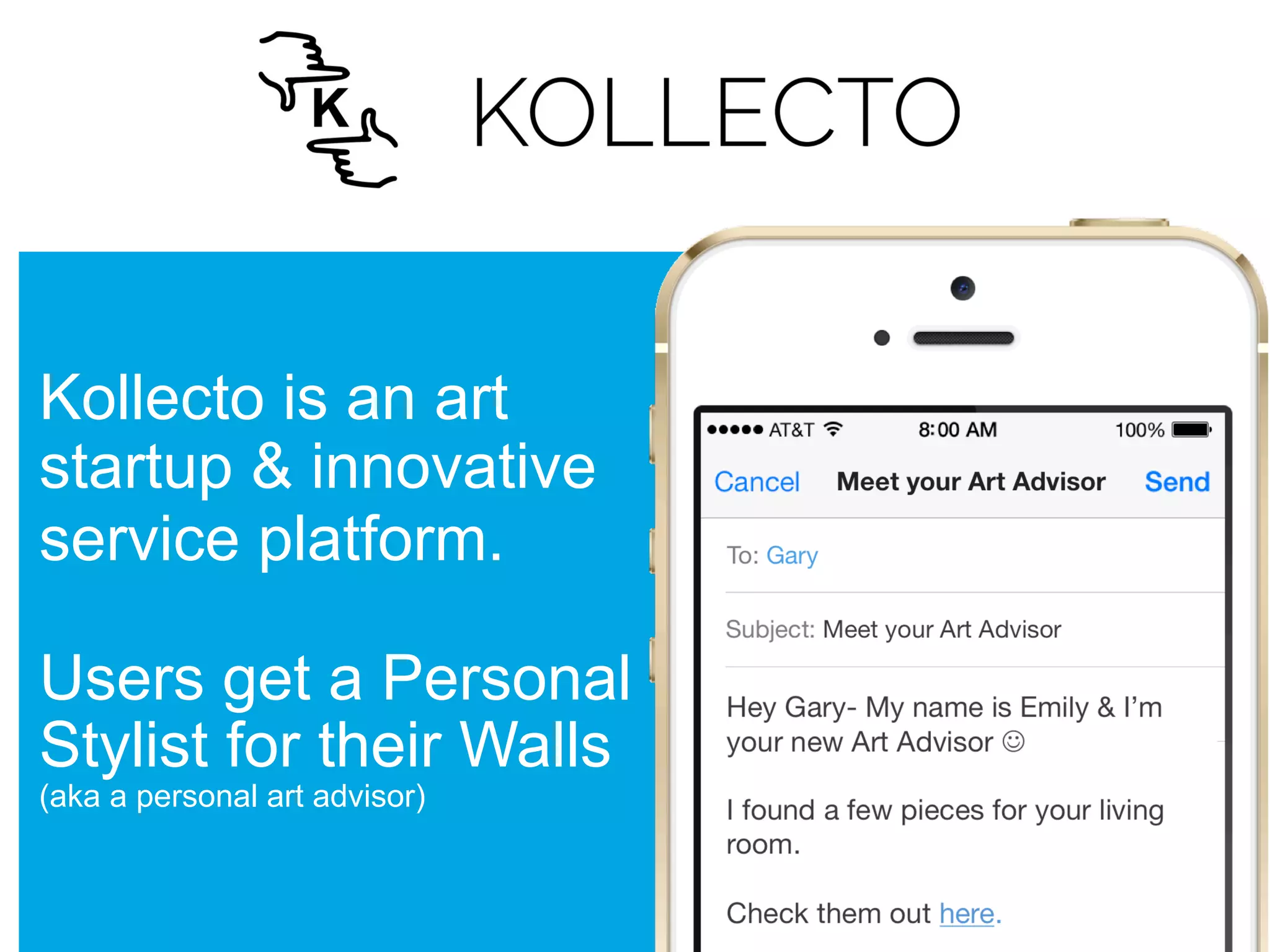
Kollecto positions itself as a 'Personal Stylist for your Walls,' targeting the burgeoning online art market which it claims is expected to double to $3.7B. The deck highlights a significant market gap: while traditional art advisors require a $10,000 minimum budget, Kollecto services clients in the $100-$5,000 range. The presentation is notable for its transparency regarding early-stage metrics, showing a 56% purchase rate among clients who redeem beta invites. However, the 'Ask' is unconventional, seeking a mere $15,000 to finance art for clients, suggesting a debt-facility or micro-seed ap…
Key takeaways
- The online art market is projected to reach $3.7B in the next five years, driven by younger buyers (Slide 2).
- Kollecto identifies a massive price gap, targeting budgets of $100-$5,000 compared to the $10,000+ required by traditional firms (Slide 3).
- The platform claims a high-intent user base, with 56% of clients who redeem a beta invite ultimately buying art (Slide 4).
- Top-of-funnel traffic is modest at ~1,000 monthly unique visitors, with a 9%-14% conversion rate to beta requests (Slide 4).
- The competitive landscape slide positions Kollecto as the only player offering both price negotiation and art financing for low-budget buyers (Slide 3).
- Social proof is established through Twitter testimonials from users and advisors, including a mention of founder Tara Reed (Slide 5).
- The current funding ask is exceptionally low at $15,000, specifically earmarked for 'financing art for our clients' (Slide 6).
- The deck omits critical sections including team biographies, a business model/revenue breakdown, and a long-term roadmap.
Slide-by-Slide Analysis
Slide 1: Title and Value Proposition
The cover slide introduces Kollecto with a minimalist logo featuring a hand-drawn 'K' motif. The primary text defines the company as an 'art startup & innovative service platform.' The most important element here is the sub-headline: 'Users get a Personal Stylist for their Walls (aka a personal art advisor).' By using the 'Personal Stylist' analogy, the company immediately anchors its service to the successful 'Stitch Fix' model of curated commerce. An iPhone mockup displays a simulated email from an advisor named Emily to a user named Gary, reinforcing the personal, human-centric nature of the service.
Slide 2: The 'Why' (Market Opportunity)
This slide addresses the macro-opportunity and the emotional friction of the current market. It cites that the online art market is expected to double to $3.7B in the next five years. More importantly, it identifies two psychological barriers: 20% of people find art shopping more intimidating than buying real estate, and 50% say cost is the main reason they abstain. This slide effectively sets up the 'Problem' by highlighting that the market is growing but remains structurally inaccessible to the average consumer.
Slide 3: Competitive Landscape
Kollecto uses a two-part competitive analysis. The top half uses a visual hierarchy to show Kollecto sitting between 'Online Gallery Chat' features and 'Traditional Art Advisory Firms.' The bottom half is a feature comparison matrix. It highlights a specific market gap: traditional advisors require a $10,000+ budget, while Kollecto services the $100-$5,000 range. The matrix claims Kollecto is the only service providing 'Art Financing' and 'Price Negotiation' for young, first-time buyers. This is a strong slide because it identifies a specific, underserved price bracket.
Slide 4: Marketing & Sales Funnel
This is the most data-dense slide in the deck. It presents a classic four-stage funnel. It starts with ~1,000 monthly unique visitors and shows a 9%-14% conversion to beta access requests. The company notes they are 'excited about this' conversion rate. The funnel then narrows to a 30% redemption rate for beta invites—an area they explicitly state they are 'focused on improving.' The final stage is a 56% purchase rate for clients. Disclosing a weakness (the 30% redemption rate) while highlighting a strength (the 56% purchase rate) builds significant credibility with analysts.
Slide 5: What Customers Say
Instead of standard pull-quotes, Kollecto uses screenshots of Twitter testimonials. This provides a layer of authenticity that plain text lacks. The tweets come from Kate Kendall, Foladé, and mariah swanson. These testimonials confirm the 'Art Advisor' branding is resonating with users. Notably, one tweet mentions founder Tara Reed, which serves as the only mention of leadership in the provided slides. The use of social proof here validates the demand for a 'personal' touch in a digital marketplace.
Slide 6: The Ask
The final slide is highly unconventional for a startup pitch. It states they are raising $15,000 to 'continue financing art for our clients.' It lists a 'Current Round' of $15,000 with a date of 10/21 and a 'Next Round' as TBD for 12/30. A $15,000 ask is extremely low for a venture-backed startup, suggesting this deck might have been used for a very early incubator, a crowdfunding campaign, or a specific debt-financing request rather than a Seed or Series A equity round.
What Kollecto Does Well
Clarity of Analogy: The phrase 'Personal Stylist for your Walls' is an excellent hook. It takes a complex, intimidating luxury service (art advisory) and makes it understandable by comparing it to fashion services that have already been democratized by technology. This reduces the cognitive load for the investor.
Funnel Transparency: Many early-stage decks hide their conversion rates or only show 'up and to the right' growth charts. Kollecto’s willingness to show a 30% drop-off at the beta redemption stage, and labeling it as a focus for improvement, demonstrates a data-driven culture. It shows the founders understand where their leaks are.
Niche Identification: The competitive matrix clearly identifies the 'missing middle' of the art market. By quantifying the budget requirements of traditional firms ($10,000+) versus their own ($100-$5,000), they make a compelling case for a massive, underserved segment of 'HENRYs' (High Earners, Not Rich Yet).
What is Missing from the Deck
Team Slide: There is no slide detailing the founders' backgrounds, technical expertise, or domain experience in the art world. In early-stage investing, the 'who' is often more important than the 'what,' and this deck leaves that question entirely to a single Twitter mention.
Business Model & Unit Economics: While we see the purchase conversion rate (56%), we don't know how Kollecto makes money. Do they take a commission from the gallery? Do they charge a subscription fee for the advisor? Do they make a margin on the financing? Without knowing the Average Order Value (AOV) and the take rate, it is impossible to calculate the Lifetime Value (LTV) of a customer.
Product Depth: The deck relies on a single email mockup. There is no information on how the 'Art Advisor' actually works. Is it an AI-driven recommendation engine, or are there hundreds of humans behind the scenes? The scalability of the business depends entirely on this distinction, which is left unaddressed.
Long-term Vision: The 'Ask' slide is focused on a very short-term $15,000 goal. There is no 'Big Picture' slide that explains how this becomes a billion-dollar company. Investors want to see the path from 1,000 visitors to 1,000,000 visitors.
Founder's Takeaway: What to Copy
Use Social Proof Authentically: If you have customers talking about you on social media, use the actual screenshots. It is much more convincing than a stylized quote block. It proves that real people are willing to attach their public identity to your brand.
Define Your 'Price Gap': If you are entering a market with established high-end players, use a slide like Slide 3 to show exactly which budget tier they are ignoring. Quantifying the 'Budget Requirement' of competitors is a powerful way to show market opportunity.
Own Your Funnel: Even if your numbers aren't perfect, showing that you track them from 'Visitor' to 'Buyer' shows professional rigor. Use the 'We're focused on improving this' callout to turn a mediocre metric into a sign of operational awareness.
Frequently asked questions
- What is Kollecto's core value proposition?
- Kollecto acts as a 'Personal Stylist for your Walls,' providing a personal art advisor to help users navigate the intimidating process of buying art. It targets the 20% of people who find art shopping more intimidating than buying real estate and the 50% who cite cost as their primary barrier to entry.
- How does Kollecto differentiate itself from online galleries like Artsy?
- According to Slide 3, regular online galleries are 'do it yourself' platforms where users must navigate thousands of options and negotiate prices alone. Kollecto differentiates by offering a human-in-the-loop (or managed) experience that includes price negotiation and financing, which competitors like Saatchi or Artsy reportedly lack for lower-budget tiers.
- What are the key conversion metrics disclosed in the deck?
- The deck reports ~1,000 monthly unique visitors. From this traffic, 9%-14% request beta access. Of those who receive an invite, 30% redeem it. The most impressive metric is the bottom-of-funnel conversion: 56% of those who redeem the invite proceed to purchase art.
- Why is the funding ask only $15,000?
- Slide 6 states the $15,000 is to 'continue financing art for our clients.' This suggests the company may be acting as a lender or using the capital to facilitate transactions where the buyer pays in installments, rather than seeking traditional venture capital for operational scaling.
- Who is the founder of Kollecto?
- While there is no dedicated team slide in the provided images, Slide 5 features a tweet mentioning @TaraReed_, identifying her as the founder. The deck relies on these social testimonials to establish the founder's identity rather than a formal professional biography.