Layla’s 8-slide seed deck is a masterclass in narrative-driven pitching, focusing heavily on the 'why now' of Generative AI and the shift in consumer behavior toward short-form video. The deck identifies a massive friction point: 90% of travel discovery happens on social media, yet users cannot book directly from those platforms. By positioning itself as the connective tissue between inspiration (Instagram/TikTok) and transaction (Skyscanner/Booking.com), Layla secured $3M in 2024. While the deck is visually stunning and high on vision, it notably lacks a team slide, business model details, a…
Key takeaways
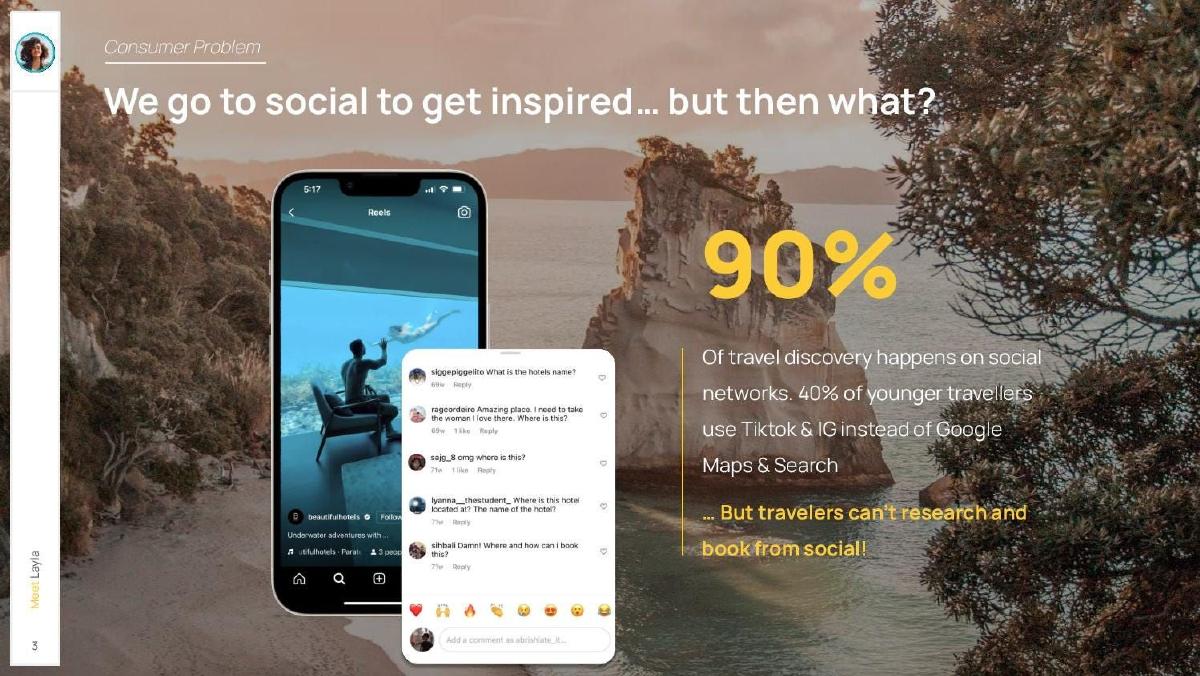
- The deck identifies that 90% of travel discovery happens on social networks, yet users cannot research or book there (Slide 3).
- Layla targets a specific demographic shift, noting that 40% of younger travelers use TikTok and Instagram instead of Google Maps and Search (Slide 3).
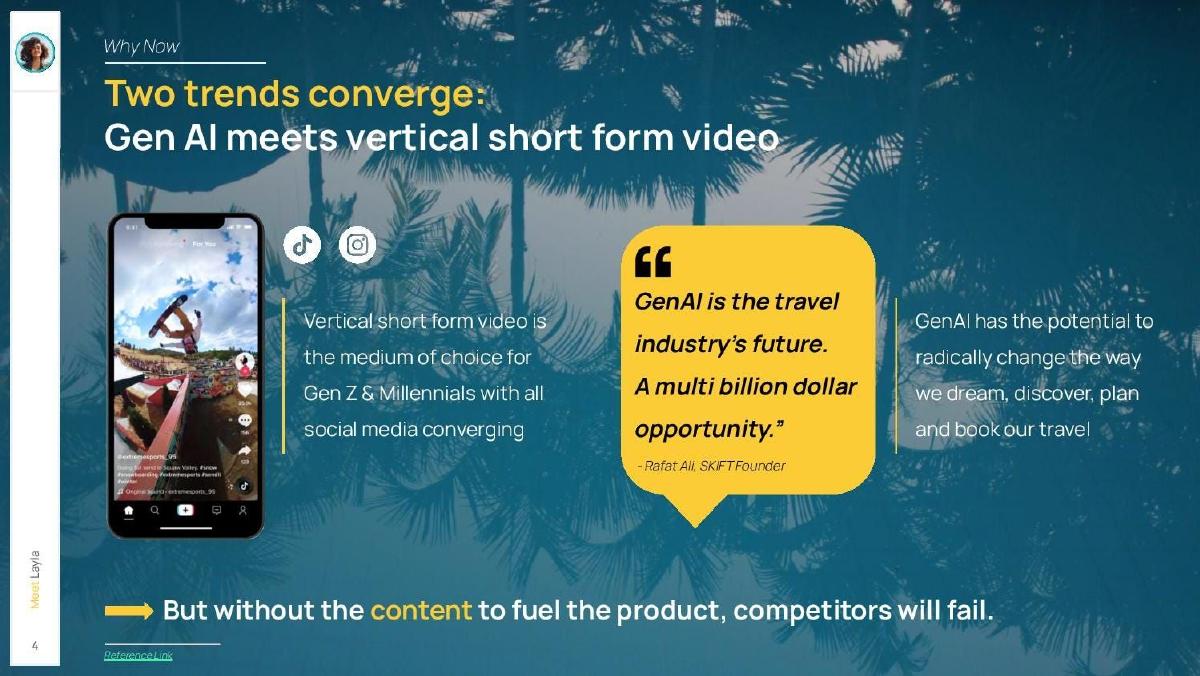
- The 'Why Now' slide centers on the convergence of Generative AI and vertical short-form video as a multi-billion dollar opportunity (Slide 4).
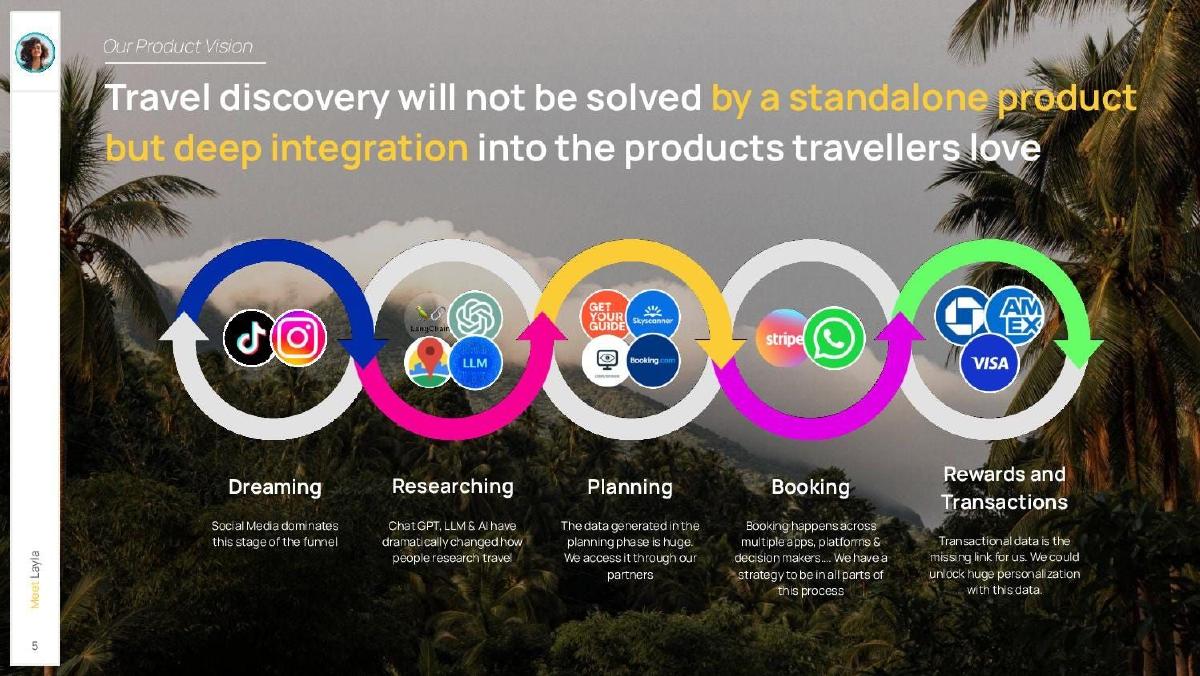
- The product vision relies on deep integration with existing platforms like WhatsApp, Instagram, and Skyscanner rather than being a standalone silo (Slide 5).
- The startup claims to have built multiple proprietary tools to harness content and data, including an Instagram bot (Slide 6).
- Traction is hinted at through the Instagram bot, which reportedly generates 10 million likes and 100k comments monthly (Slide 6).
- The deck completely omits a team slide, a business model/revenue slide, and a specific funding ask.
- As reported by Business Insider, this deck successfully raised $3M in a 2024 Seed round for the Berlin-based travel startup.
The 8-Slide Vision: Layla’s $3M Seed Deck
Layla, a Berlin-based travel startup, raised $3M in 2024 using a deck that is remarkably brief. At only eight slides, the presentation focuses almost entirely on the macro shift in consumer behavior and the technological unlock provided by Generative AI. As reported by Business Insider, the company successfully closed its Seed round despite omitting several slides typically considered mandatory for a fundraising deck.
Slide 1: Title Slide
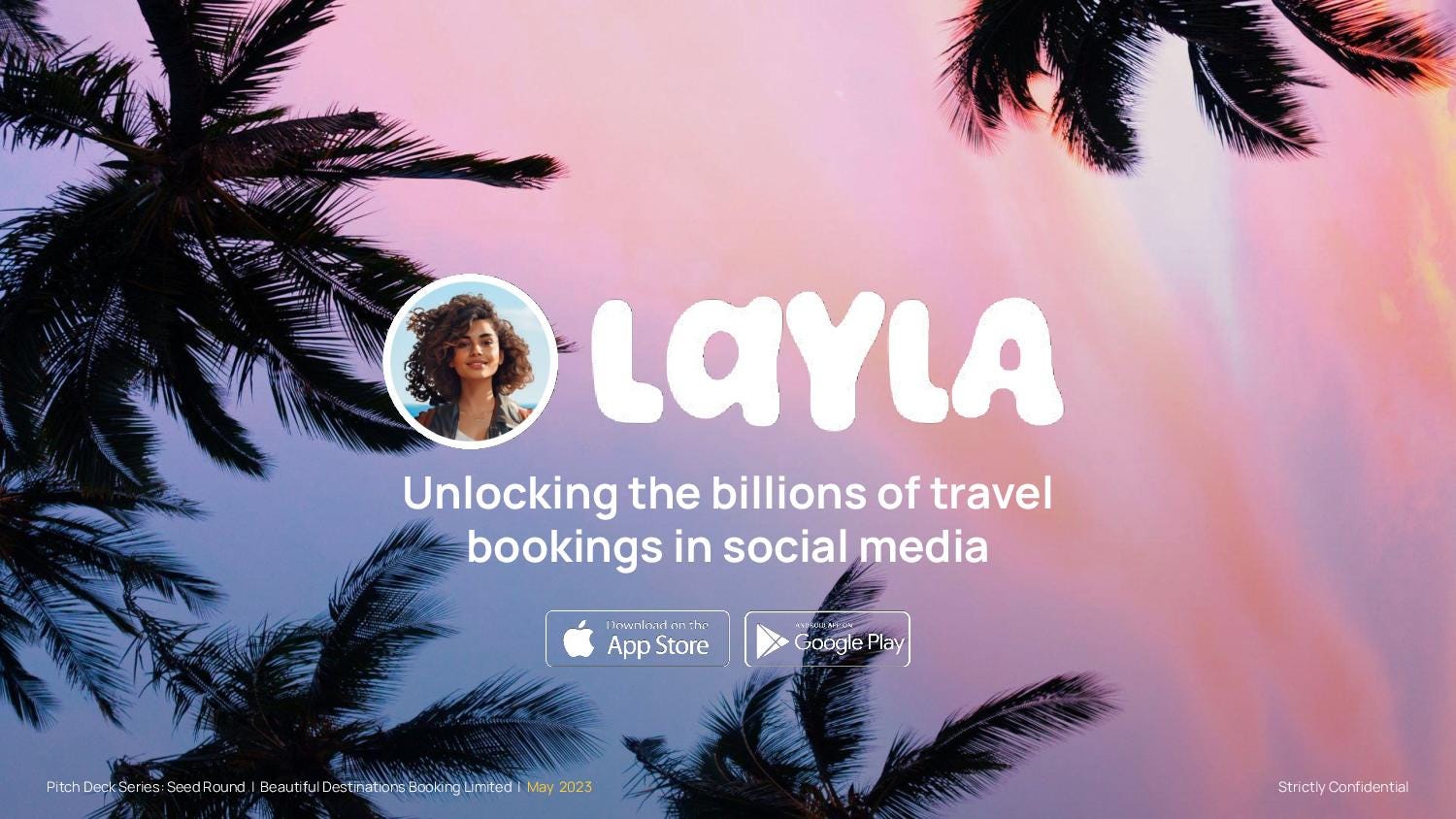
The opening slide features the Layla logo against a backdrop of palm trees at sunset. The tagline is clear and ambitious: "Unlocking the billions of travel bookings in social media." It includes App Store and Google Play badges, signaling that the product is live and available for download. The footer notes the date as May 2023 and the entity as "Beautiful Destinations Booking Limited," suggesting a corporate lineage or partnership with the well-known Beautiful Destinations media brand.
Slide 2: The Industry Problem
Slide 2 addresses the 'Industry Problem,' stating that "Travel discovery has been broken for decades." The visual shows a chaotic web of logos including Expedia, TripAdvisor, Kayak, Skyscanner, and Google Maps. The text highlights that multiple platforms with zero personalization make planning cumbersome and stressful. The 'result' cited is a common pain point: dozens of tabs open with no progress toward an actual booking.
Slide 3: The Consumer Problem
This slide shifts from industry structure to user behavior. It claims that "90% of travel discovery happens on social networks" and that "40% of younger travellers use Tiktok & IG instead of Google Maps & Search." The slide uses a screenshot of an Instagram Reel with comments like "Where is this?" and "How can I book this?" to illustrate the gap between inspiration and transaction. This is the core thesis of the company: travelers want to book what they see on social media but currently cannot.
Slide 4: The 'Why Now'
Layla attributes its timing to the convergence of two trends: "Gen AI meets vertical short form video." It quotes Rafat Ali, founder of SKIFT, stating that GenAI is a "multi-billion dollar opportunity." The slide argues that while vertical video is the medium of choice for Gen Z and Millennials, competitors will fail without the specific content to fuel the AI product. This suggests that Layla views its content library or access as a primary moat.
Slide 5: Product Vision and Integration
Slide 5 outlines a five-stage funnel: Dreaming, Researching, Planning, Booking, and Rewards/Transactions. The central argument is that "Travel discovery will not be solved by a standalone product but deep integration into the products travellers love." The slide shows a flow from Instagram/TikTok through LLMs and Skyscanner, ending with Stripe and Visa. Notably, it mentions that transactional data is the "missing link" that could unlock "huge personalization."
Slide 6: The Solution (How We'll Fix It)
This slide introduces the actual product interface. It showcases an Instagram bot that reportedly generates "10 Million Likes, 100k comments / monthly." The UI shows a chat interface where a user asks for a "warm" destination for a "weekend" from "Berlin." The AI then provides hyper-personalized recommendations. The slide explicitly mentions leveraging OpenAI and integrating geocoding to enable "text to travel."
Slide 7: The Big Product Vision
Slide 7 expands on the app's functionality, describing it as a "Content + AI travel discovery and booking app." It breaks the user journey into three steps: 1. Hyper-personalised discovery via content intelligence, 2. Prompt-based visual exploration, and 3. A seamless payment system. The mockups show a sophisticated UI that transitions from a video feed to a booking confirmation screen for a flight from BER to DXB.
Slide 8: Closing Slide
The final slide is a simple brand reinforcement, featuring the Layla logo over an aerial shot of a tropical coastline. It repeats the "Strictly Confidential" and "Beautiful Destinations Booking Limited" markings from the title slide. There is no contact information or call to action on this slide.
What Layla’s Deck Does Well
The deck excels at identifying a massive, relatable friction point . By quantifying the shift in search behavior (40% of youth moving away from Google), Layla makes a compelling case that the incumbents are vulnerable. The use of real social media comments to illustrate the problem (Slide 3) is a highly effective way to prove user intent without needing a complex data set.
Furthermore, the visual storytelling is top-tier . As a travel company, the deck uses high-quality imagery that reflects the product's aesthetic. The integration map on Slide 5 is also a strong strategic visual; it shows that Layla isn't trying to fight the giants (Instagram, Booking.com) but rather act as the glue that connects them. This reduces the perceived risk of user acquisition costs, as they plan to meet users where they already are.
What is Missing from the Layla Deck
Despite raising $3M, this deck is missing several components that are usually non-negotiable for Seed rounds:
No Team Slide: There is no mention of the founders, their backgrounds, or why they are the right people to build this. In a Seed round, the team is often the most important factor. · No Business Model: The deck explains how the product works but not how it makes money. While one can assume affiliate fees from bookings, a slide detailing unit economics or revenue share models is absent. · No Competition Analysis: The deck mentions that "competitors will fail" without content, but it doesn't name those competitors or provide a feature-by-feature comparison. · No Financial Ask: There is no slide stating how much capital is being raised, the valuation, or the milestones the company intends to hit with the $3M.
Founder Takeaways: The Power of Narrative
The Layla deck proves that a strong narrative can sometimes outweigh a lack of granular detail . For founders in the consumer space, the lesson here is to focus on the "Why Now." Layla didn't just say they were a travel app; they said they were the solution to a specific technological and cultural shift (GenAI + Vertical Video). By anchoring their pitch in a trend that investors are already excited about, they were able to raise significant capital with a very lean presentation.
However, founders should be cautious. It is likely that the missing information (team, financials, roadmap) was provided in a secondary document or during the due diligence process. The 8-slide deck likely served as a "teaser" or a high-level vision document to secure the first meeting, rather than the exhaustive source of truth for the entire deal.
Frequently asked questions
- What is the primary problem Layla is trying to solve?
- According to Slide 2 and 3, travel discovery is 'broken' because it is fragmented across multiple platforms with zero personalization. While 90% of discovery happens on social media, there is no direct path to research or book from those platforms, leading to 'dozens of tabs open' and no progress toward a booking.
- How does Layla use Artificial Intelligence?
- Slide 6 and 7 detail the use of GenAI for hyper-personalized recommendations and 'text to travel' capabilities. The platform leverages OpenAI and LLM prompting to provide prompt-based visual exploration, allowing users to chat with a bot to find destinations based on specific criteria like weather or travel companions.
- What platforms does Layla integrate with?
- Slide 5 illustrates a product vision that integrates with social platforms (TikTok, Instagram), communication tools (WhatsApp), search/booking engines (Skyscanner, Booking.com, GetYourGuide), and payment processors (Stripe, Visa, Amex).
- Is there any evidence of user traction in the deck?
- Yes, Slide 6 mentions that their Instagram bot achieves 10 million likes and 100k comments per month. This serves as the primary metric to prove that their content-led discovery model resonates with the target audience.
- What critical information is missing from the Layla pitch deck?
- The deck is missing several standard venture components: a Team slide (founders and background), a Business Model slide (how they make money), a Competition slide, and a Funding Ask slide (how much they are raising and for what).