The Klotz Group of Companies pitch deck outlines a $100M investment program targeting multifamily real estate in the Southeastern U.S. The presentation relies heavily on macro-economic data from 2016-2018 to justify a shift from homeownership to renting, citing a 50-year high in renter share at 37%. The firm positions itself as a vertically integrated sponsor with over 450 professionals and a portfolio of 12,000+ units. The investment structure is aggressive, targeting a 30% IRR and a 2.5x equity multiple over a 4-year term. While the deck provides a clear breakdown of property classification…
Key takeaways
- The fund targets a $100M total size for a joint venture or co-sponsored program (Slide 1).
- Investment focus is on Class A, B, and C multifamily assets, including light value-add and strategic development (Slide 19).
- The program targets a 30% IRR and a 2.5x equity multiple with a 10% quarterly preferred return (Slide 19).
- Market thesis is built on the fact that 600,000 U.S. households became renters in 2016, marking 12 consecutive years of growth (Slide 5).
- The South is highlighted as the largest generator of GDP growth, representing 50% of all housing starts in 2017 (Slide 9).
- The Klotz Group claims a vertically integrated platform with over 450 professionals and a history dating back to 1995 (Slide 13).
- The firm manages a portfolio of 12,000+ multifamily units across institutional joint ventures and private syndications (Slide 13).
- The organizational structure includes specialized departments for Operations, Legal, Accounting, and Investments, including 8 Acquisition Directors (Slide 17).
Executive Summary and Fund Thesis
The Klotz Group of Companies presents a structured investment opportunity focused on the multifamily residential sector. The deck, titled "Klotz Investment Opportunity Overview," outlines a $100M fund or joint venture program. The core thesis rests on two pillars: the institutionalization of the rental market due to shifting American demographics and the superior economic performance of the Southeastern United States. The presentation is designed for institutional or high-net-worth investors, emphasizing scale, vertical integration, and aggressive return targets.
Slide 1: Title and Program Scope
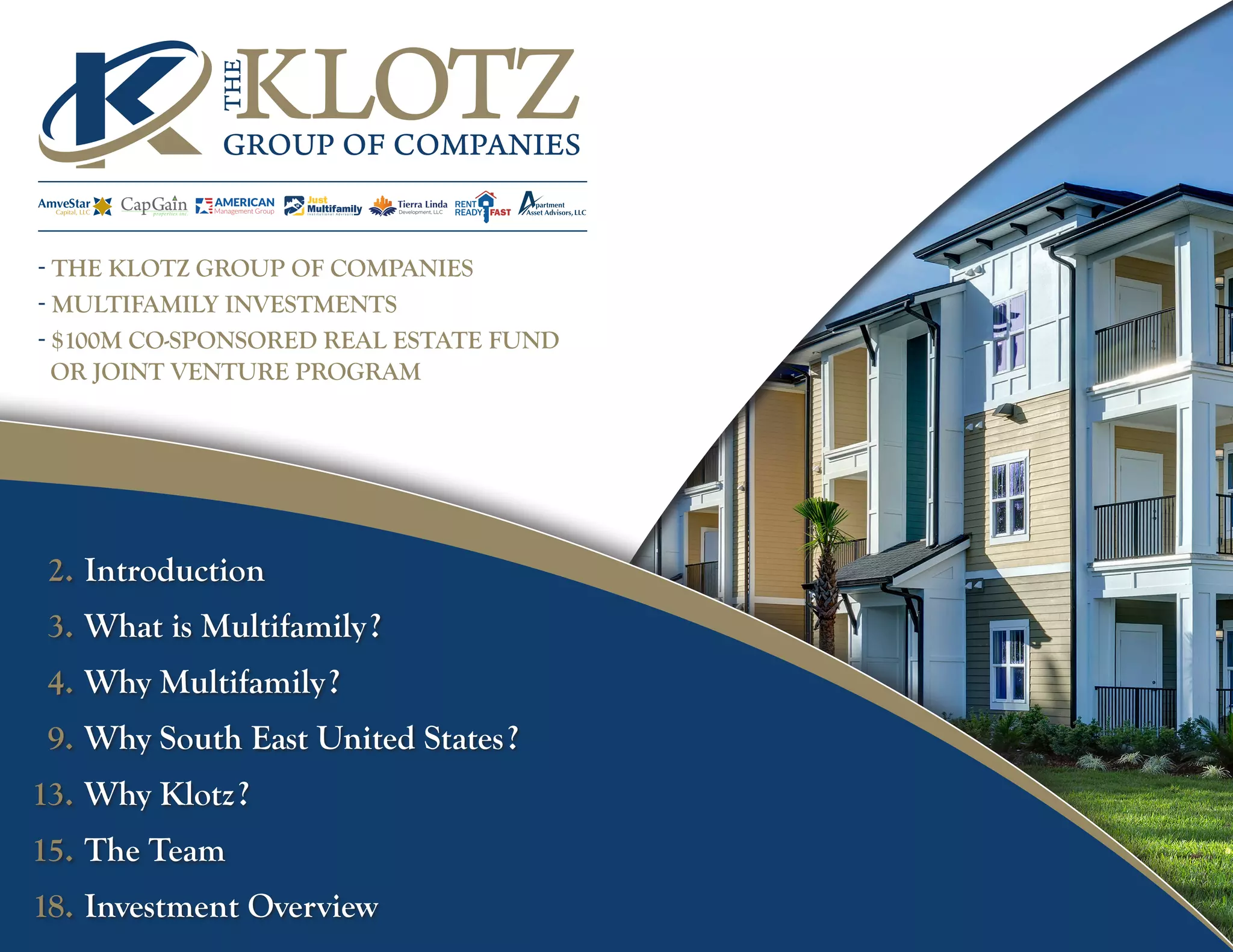
The cover slide introduces The Klotz Group of Companies and its various subsidiaries, including AmVestar Capital, CapGain Properties, and American Management Group. It explicitly states the ask: a "$100M Co-Sponsored Real Estate Fund or Joint Venture Program." The visual focus is on a modern multifamily development, establishing the asset class immediately. The slide also provides a table of contents, indicating a standard flow from market education to team and investment specifics.
Slide 3: Defining the Asset Class
Slide 3 provides a "Multifamily Property Classification Overview." This is an educational slide that defines the differences between Class A, B, C, and D properties. Key metrics mentioned include the age of the product (e.g., Class A is typically built within the last 10 years, while Class D is over 30 years old) and the level of amenities. By including this, the founders ensure all potential investors are aligned on the terminology used in the subsequent investment overview, where they target A, B, and C assets.
Slide 5: The Macro Case for Multifamily
This slide focuses on the supply-demand imbalance in the U.S. housing market. It cites that the renter share of U.S. households reached a 50-year high of 37% in 2016. A critical data point provided is that the industry averaged 225,000 completions per year from 2011-2016, while the U.S. will need an average of 328,000 units per year through 2030 to satisfy demand. Two charts illustrate the 12 consecutive years of rental demand growth and a projected widening gap between new apartment households and units built through 2030.
Slide 7: Expert Opinions and Market Sentiment
Slide 7 utilizes external validation, quoting a February 2018 article from Pensions & Investments. The text highlights that foreign investors and open-end real estate funds are moving into multifamily due to demographic trends. It specifically mentions that "Young and older Americans are preferring to rent apartments rather than buy homes." This slide serves to de-risk the sector by showing that larger institutional players are already validating the strategy.
Slide 9: Regional Focus - The Southeast
The deck narrows its geographic focus to the Southeastern United States. Slide 9 lists growth highlights: the South represented 50% of all housing starts in 2017 and 45% of all multifamily starts. It notes that the region grew its population by 49% over the past two decades. The slide argues that the Southeast is an "economic powerhouse" with a diversifying base, citing industrial expansion and port markets like Savannah, Miami, and Charleston as drivers for multifamily demand.
Slide 11: Visual Proof and Market Attractiveness
Continuing the regional argument, Slide 11 includes quotes regarding the U.S. real estate market being the "safest market for many years." It specifically points to interest from Latin American investors in the Southeast market. The bottom of the slide features four high-quality photographs of property interiors and amenities (pools, lounges, bedrooms), providing a visual standard for the types of assets the fund intends to target or has previously managed.
Slide 13: Company History and Scale
Slide 13 introduces "The Klotz Group" as a vertically integrated platform. It states the firm has been committed to the multifamily industry since 1995 and currently owns and operates over 12,000 units. The text emphasizes their "nationwide presence" but highlights corporate offices in Charlotte, Atlanta, and Jacksonville. This slide is intended to establish the firm as a "best in class" sponsor with a long track record of syndicating private real estate partnerships before launching their first fund in 2010.
Slide 15: Executive Leadership
The team slide presents a traditional hierarchical org chart. Jeff Klotz is listed as CEO, supported by Jeffrey Vaughn (CIO), David Glaser (CFO), Bob Clarkson (President of Operations), and William Corley (Chief Legal Officer). Below the executive tier, the chart shows a layer of Divisional Leaders and Asset Management. The slide reinforces the claim of having a "team of over 400" professionals, suggesting the infrastructure is already in place to manage the $100M deployment.
Slide 17: Operational Bench Strength
Slide 17 breaks down the staff by department to prove the "vertical integration" mentioned earlier. The list is extensive: 8 Acquisition Directors, 5 Regional Managers, 2 Due Diligence Engineers, 2 CPAs, and a dedicated Legal team. This level of detail is meant to reassure investors that the firm does not outsource critical functions like underwriting or property management, which theoretically leads to better cost control and execution.
Slide 19: The Investment Terms
The final slide in this set provides the "Investment Overview" table. This is the most critical slide for a fundraising teardown. The program targets a $100M size with a 4-year term. The regional focus is narrowed to FL, GA, NC, SC, TN, and AL. Financial targets are aggressive: a 30% IRR and a 2.5x equity multiple. The waterfall includes a 10% quarterly preferred return and a 70/30 split between Limited Partners and the General Partner. It also notes that LPs will retain 100% ownership of all assets in the portfolio.
What The Klotz Group Does Well
The deck excels at macro-economic storytelling. By using data from the Joint Center for Housing Studies of Harvard University and the U.S. Census Bureau (Slide 5), the founders build a logical case for why multifamily is a safe bet. They successfully transition from a national housing shortage to a regional growth story in the Southeast, making the specific geographic focus feel like a data-driven necessity rather than a mere preference.
The emphasis on vertical integration is another strength. In real estate private equity, investors often worry about "fee-stacking" where a sponsor hires third-party managers who also take a cut. By showing an internal team of 450 people (Slide 13) and specific roles like "Due Diligence Engineers" (Slide 17), Klotz signals that they control the entire value chain, which can lead to higher operational efficiency.
What Is Missing From The Deck
The most significant omission is a detailed track record or "case study" slide. While Slide 13 mentions they own 12,000+ units, the deck does not provide specific examples of past projects, their entry/exit cap rates, or the actual realized IRRs for previous investors. For a fund targeting a 30% IRR—which is very high for multifamily—investors would typically expect to see evidence that the team has achieved similar results in the past.
Furthermore, there is no mention of the current pipeline. A $100M fund requires a significant number of deals to deploy capital effectively. The deck explains how they will find deals (via 8 Acquisition Directors) but does not list any properties currently under LOI (Letter of Intent) or in the immediate sights of the sponsor. Finally, the deck lacks a clear "Risk Factors" slide, which is standard for institutional real estate offerings to address interest rate sensitivity or construction cost inflation.
Instructions for the Modern Founder
Founders in the real estate or capital-intensive sectors should take note of how Klotz uses "Expert Opinion" (Slide 7 and 11) to bolster their claims. If you are entering a market that is perceived as crowded or mature, using third-party institutional validation can help move the conversation from "Is this a good sector?" to "Are you the right team to execute in this sector?"
Additionally, the clear breakdown of investment terms on a single slide (Slide 19) is a best practice. It avoids ambiguity regarding the waterfall, the preferred return, and the term of the investment. However, founders should ensure that if they set high targets like a 30% IRR, they immediately follow that slide with a historical performance table to prove those numbers are grounded in reality rather than just aspiration.
Frequently asked questions
- What is the primary investment objective of the fund?
- The primary objective is to deploy $100M into multifamily real estate assets across the Southeastern United States. According to slide 19, the focus includes Class A, B, and C properties, ranging from light value-add projects to opportunistic strategic developments. The fund seeks to capitalize on high rental demand and regional GDP growth in states like Florida, Georgia, and the Carolinas.
- What are the targeted financial returns for investors?
- The deck specifies a targeted Program IRR of 30% and an equity multiple of 2.5x or greater. Slide 19 details a 10% quarterly preferred return for investors. The profit split after the preferred return is reached is 70% to the Limited Partners (LP) and 30% to the General Partner (GP).
- How does the company justify the focus on the Southeastern U.S.?
- Slide 9 notes that the South is the most populous region in the U.S. and accounted for 47% of total U.S. population growth over the last two decades. Additionally, 10 of the 15 fastest-growing large cities in 2017 were located in the South, and the region accounted for 45% of all multifamily starts that year.
- What is the operational scale of The Klotz Group?
- The firm describes itself as a vertically integrated platform. Slide 13 states they employ over 450 professionals and have been active in the multifamily industry since 1995. They currently own and operate more than 12,000 units. Slide 17 further details a deep 'bench' including 8 Acquisition Directors and 5 Regional Managers.
- What is the proposed term and governance of the investment?
- As per slide 19, the program has a 4-year term with a 1-year extension option. Governance is stated to follow typical institutional levels meeting ILPA (Institutional Limited Partners Association) standards. AmVestar Capital LLC is named as the Sponsor/General Partner responsible for fund management, audits, and valuations.