The Host Co. secured $1.9M in seed funding in 2022 with a concise 9-slide deck that targets the intersection of retail and the short-term rental (STR) market. The platform allows Airbnb and VRBO hosts to sell in-home items, snacks, and local services via QR codes. The deck leans heavily on the 'why now' of the booming STR market, citing 14,000 new hosts joining Airbnb monthly in 2021. While the deck excels at defining a clear user persona—primarily women over 40 seeking supplemental income—it notably lacks a team slide, competitive analysis, and a specific breakdown of the $1.9M ask. Despite…
Key takeaways
- The deck identifies a massive total addressable market with 8.1 million global short-term rental listings (Slide 6).
- The business model relies on a web-based platform with no cash exchanged, featuring theft prevention measures (Slide 4).
- Airbnb was reportedly onboarding 14,000 new hosts per month in 2021, providing a tailwind for the platform (Slide 6).
- The roadmap projects scaling from 500 listings in June 2022 to 81,000 listings by the fourth year (Slide 8).
- Financial projections target $23 million in profit per year by year four, based on a 1% market share (Slide 6 and 8).
- The Go-To-Market strategy leverages niche Facebook groups with over 400,000 hosts and potential HGTV integration (Slide 9).
- The deck completely omits a team slide, leaving the founders' backgrounds and expertise unknown to the reader.
- There is no explicit 'Ask' slide detailing how the $1.9M reported by Business Insider would be allocated.
Introduction: The Shoppable Airbnb
The Host Co. entered the market at a time when short-term rentals (STRs) were evolving from simple lodging into curated experiences. Their 9-slide pitch deck, used to raise a $1.9M seed round in 2022, presents a straightforward solution to a common guest problem: wanting to buy the items they use during their stay. By turning rentals into shoppable showrooms, the company aims to unlock a new revenue stream for hosts and a convenient retail channel for brands.
Slide 1: Title Slide
The deck opens with a minimalist title slide featuring The Host Co. logo and the tagline: "Shop your Airbnb." It is a clean, brand-focused start that immediately identifies the niche: the intersection of e-commerce and hospitality.
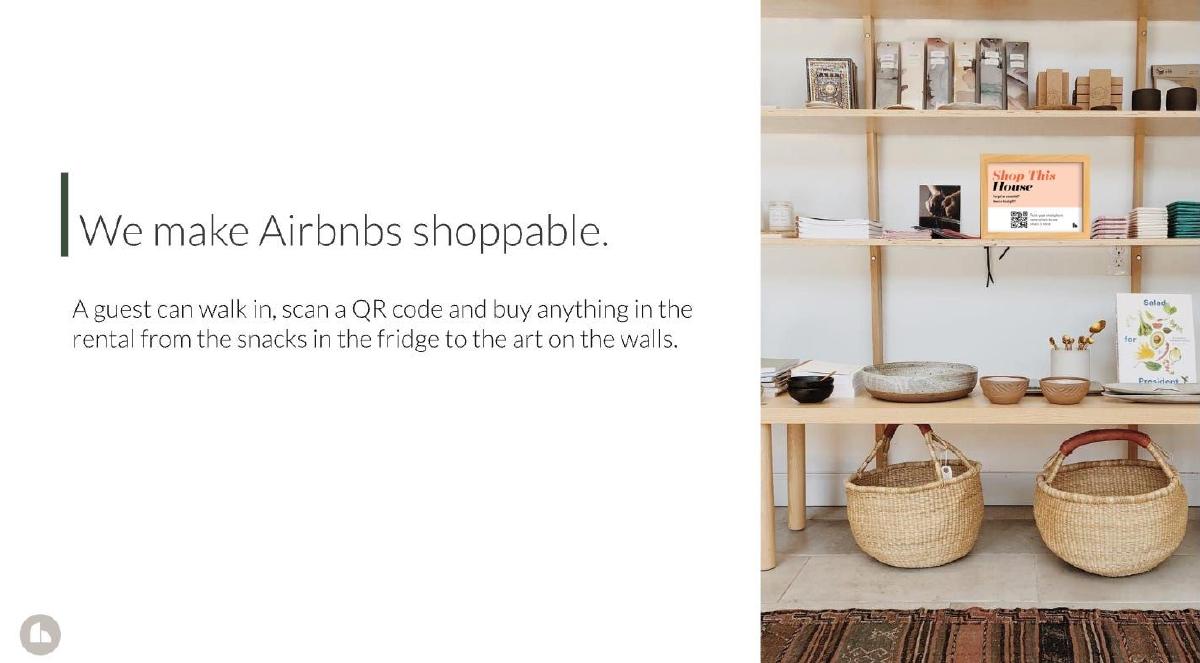
Slide 2: The Value Proposition
Slide 2 defines the core offering: "We make Airbnbs shoppable." The text explains that guests can scan a QR code to buy anything from "snacks in the fridge to the art on the walls." The right side of the slide features a high-quality lifestyle image of a shelf with a framed QR code, demonstrating how the product physically integrates into a rental space without being intrusive.
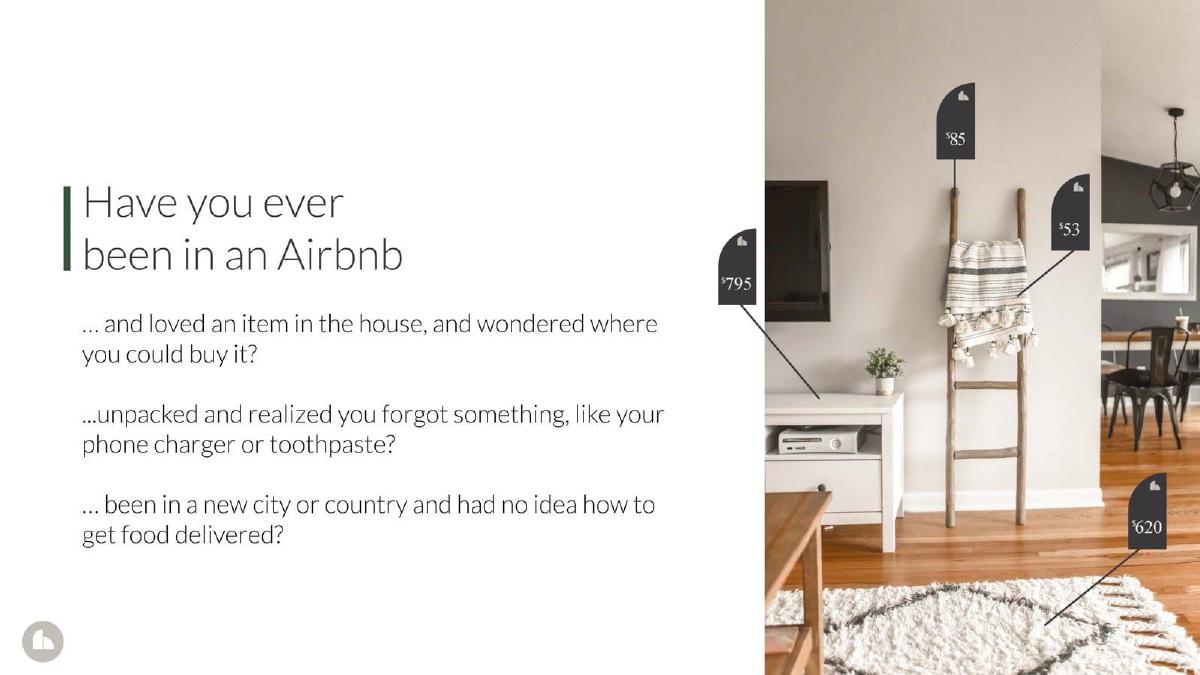
Slide 3: The Problem Statement
Using a series of relatable scenarios, Slide 3 addresses the guest's pain points. It asks if the reader has ever loved an item in a house and wondered where to buy it, or realized they forgot an essential like a phone charger or toothpaste. It also touches on the difficulty of navigating food delivery in a new city. The visual on the right shows a living room with price tags ($795, $85, $53, $620) superimposed over furniture and rugs, making the "shoppable room" concept concrete.
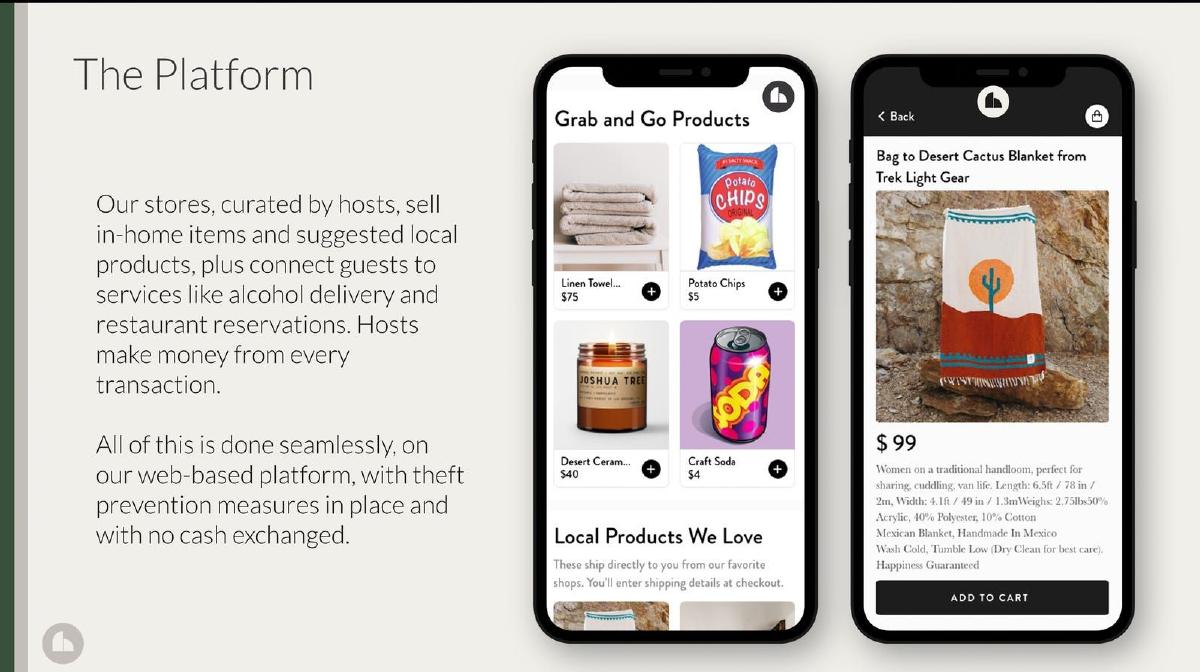
Slide 4: The Platform
This slide provides the technical and operational overview. The Host Co. describes its product as a "web-based platform" where hosts curate stores. Key features mentioned include:
Sale of in-home items and suggested local products. · Connection to services like alcohol delivery and restaurant reservations. · Theft prevention measures. · A cashless transaction system.
The slide includes two mobile mockups showing the user interface: a "Grab and Go" section for snacks and towels, and a detailed product page for a $99 blanket. This slide effectively communicates that the platform is more than just a link; it is a full-service retail engine.
Slide 5: The Buzz (Social Proof)
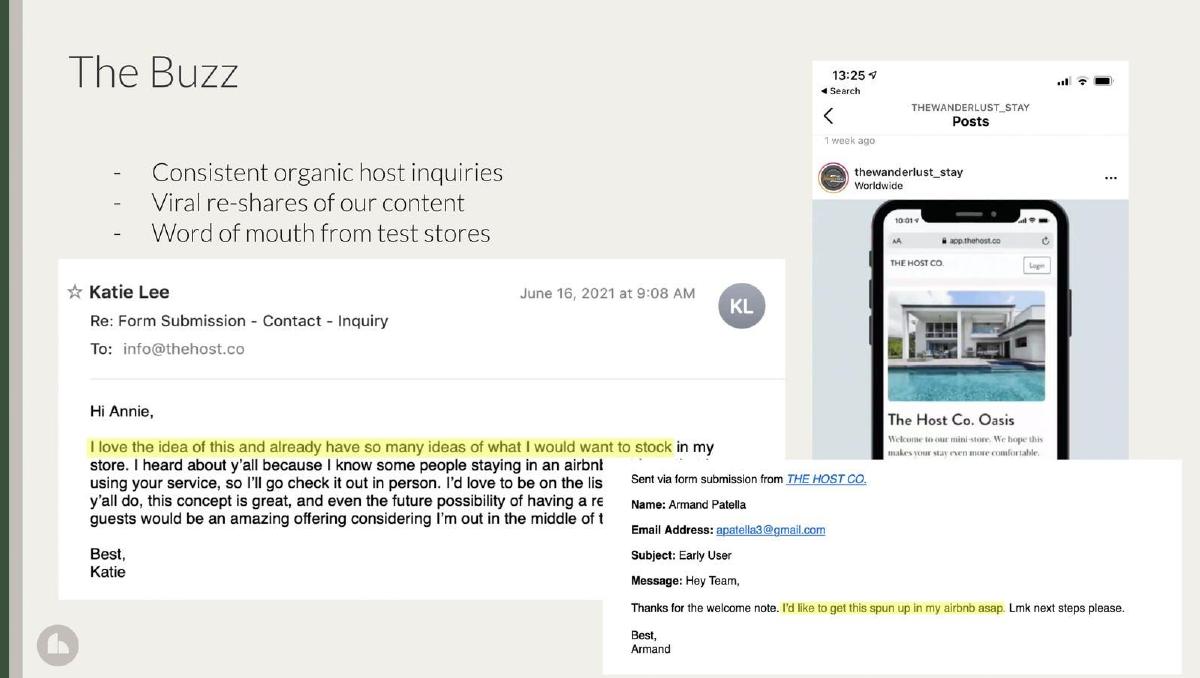
Slide 5 focuses on early traction and market pull, titled "The Buzz." It lists "Consistent organic host inquiries," "Viral re-shares," and "Word of mouth from test stores." The slide includes screenshots of emails and Instagram posts from early users. One email from "Katie Lee" dated June 16, 2021, states, "I love the idea of this and already have so many ideas of what I would want to stock in my store." This qualitative data serves to validate the demand before the deck moves into quantitative market data.
Slide 6: Market Opportunity
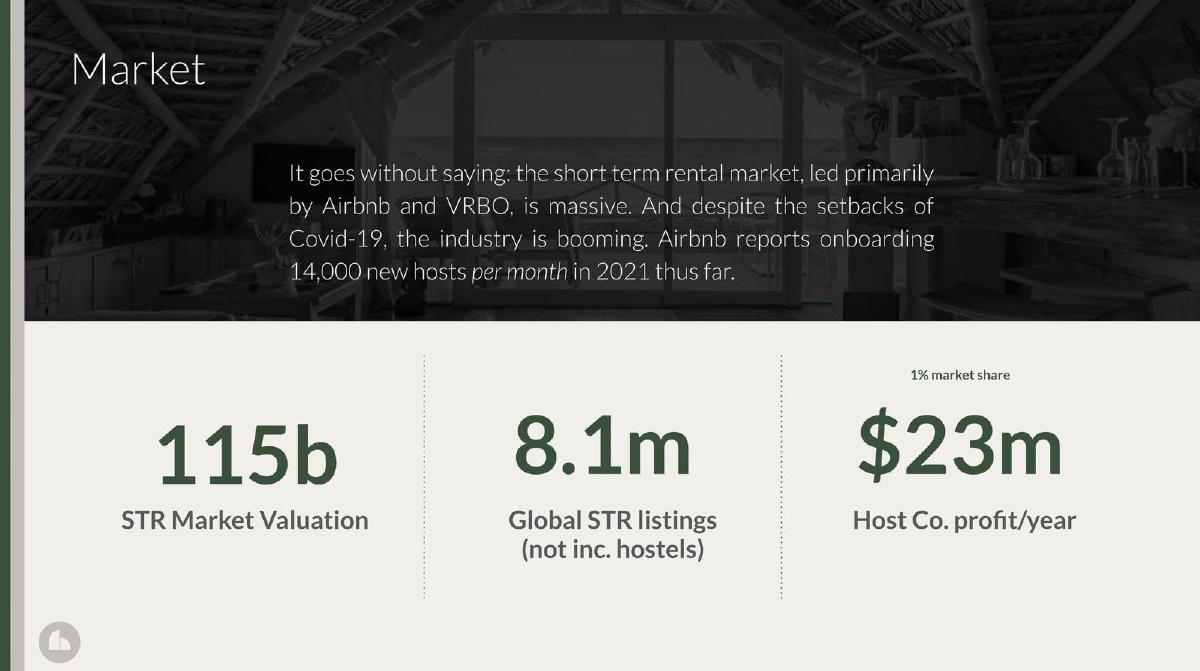
Slide 6 presents the macro-environment. It cites a $115 billion STR market valuation and 8.1 million global STR listings (excluding hostels). A key growth metric provided is that Airbnb was onboarding 14,000 new hosts per month in 2021. The most aggressive claim on this slide is the "1% market share" projection, which equates to $23 million in profit per year for The Host Co. This slide bridges the gap between a "cool idea" and a scalable venture-backed business.
Slide 7: The Mission and Persona
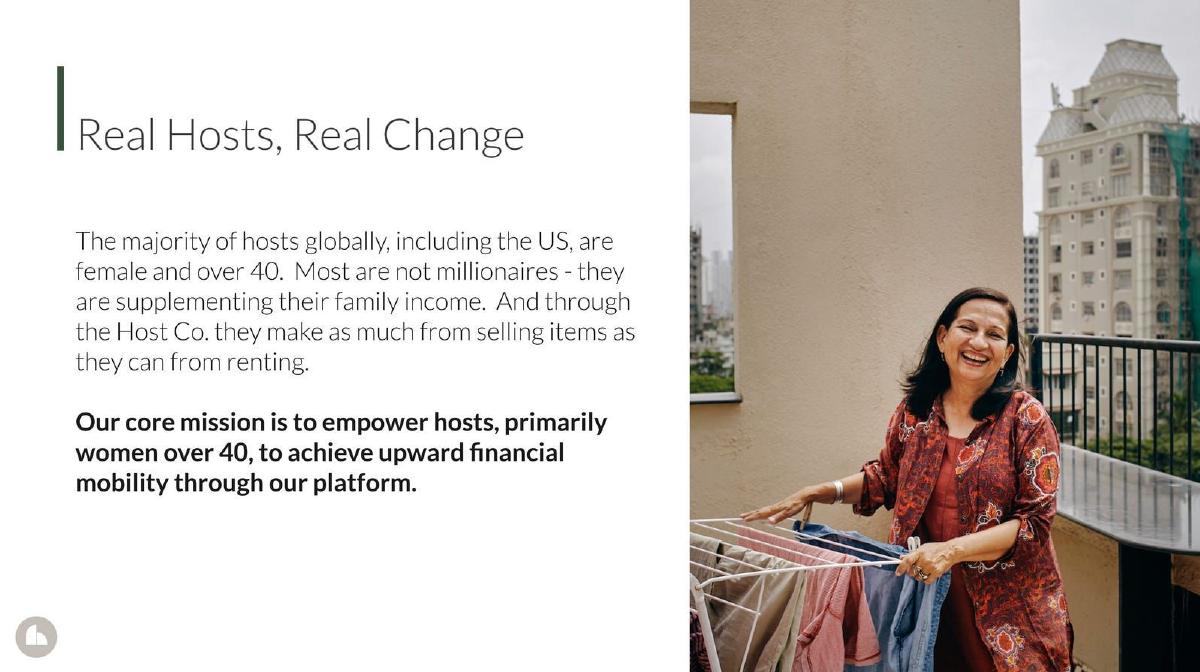
Titled "Real Hosts, Real Change," this slide humanizes the business. It identifies the primary host demographic: female and over 40, using the platform to supplement family income. The slide explicitly states the core mission is to "empower hosts... to achieve upward financial mobility." By focusing on a specific, underserved demographic, the company adds a social impact layer to its retail narrative.
Slide 8: Roadmap and Projections
Slide 8 outlines the execution plan from June 2022 through March 2023. The timeline includes:
June 2022: Early Adopter Rollout (500 listings). · September 2022: Open Rollout (1,000 listings). · October 2022: Partnership Expansion (3,000 listings). · November 2022: Marketing Expansion (6,000 listings). · Dec 2023: Scale to Mexico (16,500 listings). · March 2023: Scale to Canada (25,000 listings).
Below the timeline, the deck lists long-term financial targets: $2M in Year 2 (16.5k listings), $9M in Year 3 (40k listings), and $23M in Year 4 (81k listings). Note that the profit figure from Slide 6 ($23M) matches the Year 4 revenue/profit target here, suggesting the company expects high margins at scale.
Slide 9: GTM and Customer Acquisition
The final slide details the Go-To-Market (GTM) strategy. It lists five pillars:
Host ambassadors and digital campaigns. · Targeting 400k+ hosts in Facebook groups (LATAM & AMEA). · Focusing on the first 500 "evangelists." · Press coverage in Living, Decor, Travel, and Tech publications. · HGTV integration.
The slide ends with a mobile mockup of the sign-up page, reinforcing the call to action for hosts to "Start Selling."
What The Host Co. Deck Does Well
The deck excels at visual storytelling. By using high-quality photography of actual rental spaces and overlaying them with price tags or QR codes, the founders make a somewhat abstract concept (in-room retail) feel immediate and practical. The clarity of the "Problem" slide (Slide 3) is particularly strong, as it addresses both the high-end aspirational purchase (furniture) and the low-end necessity purchase (toothpaste).
Furthermore, the deck does a great job of identifying its "Champion." By focusing on the female host over 40 (Slide 7), the company moves away from a generic B2B pitch and into a mission-driven narrative. This is a powerful tactic for seed-stage fundraising, as it helps investors visualize the exact community the company is building.
What is Missing from The Host Co. Deck
The most glaring omission is a Team Slide . In a $1.9M seed round, the "who" is often as important as the "what." There is no mention of the founders' backgrounds, their experience in hospitality, or their technical expertise. For an investor, this creates a significant due diligence gap.
There is also no Competitive Landscape . The deck assumes a vacuum. While the concept is relatively niche, there are other players in the hospitality tech and "amenity management" space. Failing to acknowledge them can make a founder look naive about the market's complexity.
Finally, the deck lacks a clear Ask Slide . While we know from publisher reports that they raised $1.9M, the deck itself does not state how much they are looking for or how that capital will be deployed (e.g., % to engineering, % to sales). A roadmap (Slide 8) shows where they want to go, but it doesn't explain how the specific funding round fuels that journey.
Founder Takeaways
Use visual proof of concept. If your product lives in the physical world, show it there. The Host Co. didn't just describe a QR code; they showed it sitting on a shelf in a beautiful room. This reduces the cognitive load for the investor.
Define your 'Why Now' with specific tailwinds. Slide 6 points to the 14,000 new hosts joining Airbnb monthly. This isn't just a market size stat; it's a growth rate stat that suggests a widening window of opportunity.
Don't ignore the 'Who.' While The Host Co. was successful in raising, most founders should never omit a team slide. If you have a lean deck, ensure your background is prominent to establish credibility, especially if you are entering a crowded market like retail or travel.
Align your mission with your metrics. The Host Co. successfully linked their financial projections (Slide 8) back to their mission of host empowerment (Slide 7). When the number of listings grows, the number of "empowered women" grows. This creates a cohesive narrative that appeals to both the head and the heart of an investor.
Frequently asked questions
- What is the core product of The Host Co.?
- The Host Co. is a web-based retail platform for short-term rentals. As shown on Slide 2 and Slide 4, it allows guests to scan a QR code to purchase anything in the rental—from snacks in the fridge to the furniture and art—as well as book local services like alcohol delivery.
- How does the company plan to acquire new hosts?
- According to Slide 9, the Go-To-Market strategy includes host ambassador programs, digital marketing in Facebook groups with 400k+ members, press outreach in travel and tech publications, and a potential integration with HGTV.
- What are the projected financials for The Host Co.?
- Slide 8 outlines a growth trajectory where the company reaches $2 million in revenue with 16.5k listings in Year 2, $9 million with 40k listings in Year 3, and $23 million in profit with 81k listings by Year 4.
- Who is the primary target user for the platform?
- Slide 7 specifies that the majority of hosts are female and over 40 years old. The company positions its mission as empowering these women to achieve upward financial mobility by supplementing their rental income through retail sales.
- Does the deck mention any competition?
- No. The 9-slide deck does not include a competitive landscape or a 'Why Us' slide comparing The Host Co. to other retail or hospitality tech platforms. It focuses entirely on its own market opportunity and roadmap.