The Ladies Learning Code pitch deck is a brief, 7-slide presentation that prioritizes mission and social impact over traditional business metrics. Founded in 2011 and having raised $16.5 million, the organization (now Canada Learning Code) uses this deck to highlight the gender and diversity gap in Canada's tech sector. The deck effectively uses StatsCanada data to establish a problem and follows up with survey-based impact metrics to prove efficacy. However, it lacks standard startup deck components such as a business model, competitive analysis, a detailed team slide, or a specific financia…
Key takeaways
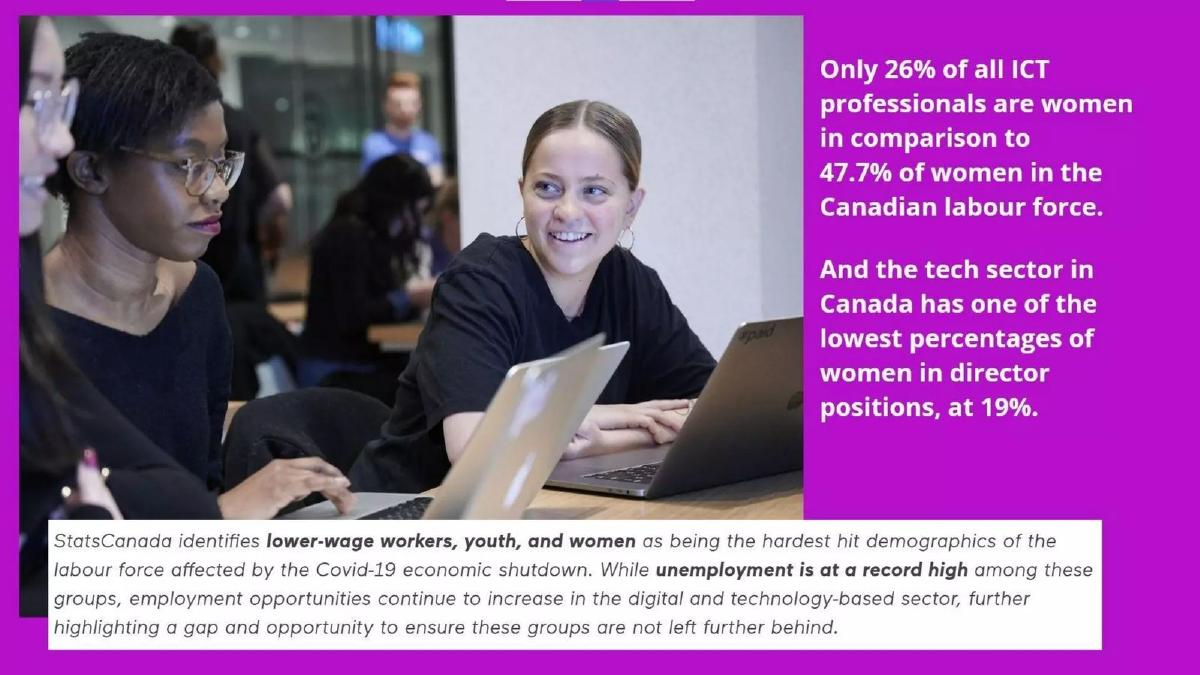
- The deck identifies a significant gender gap, noting that only 26% of ICT professionals in Canada are women (Slide 3).
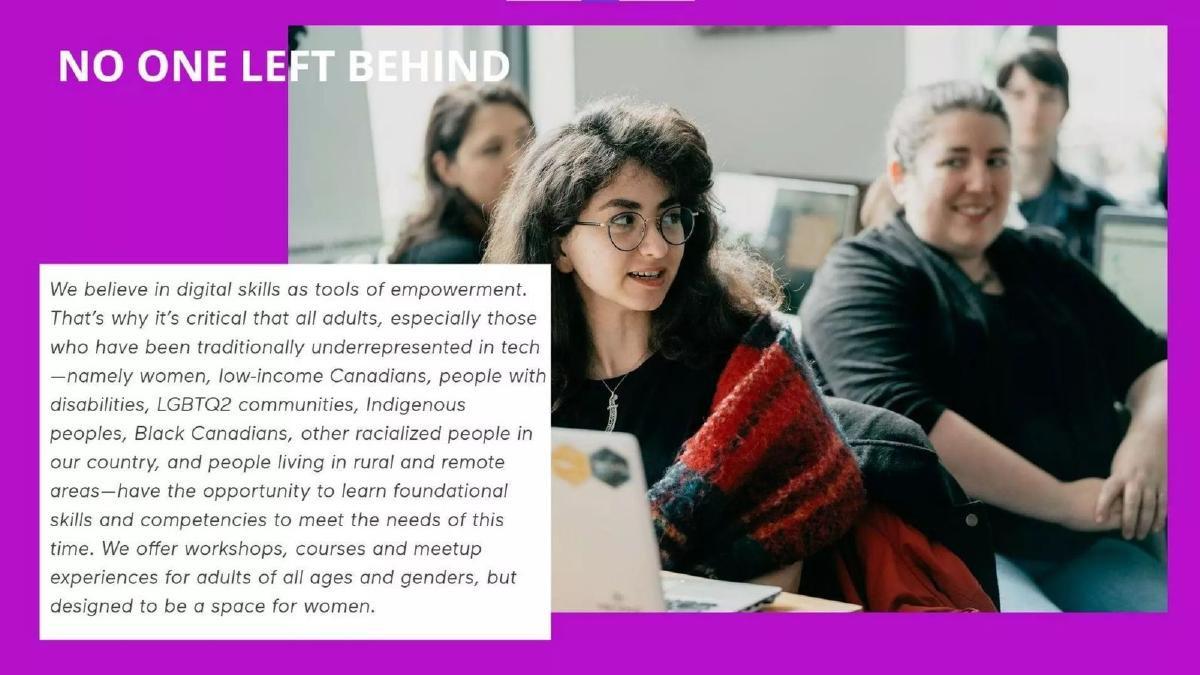
- The organization targets a wide range of underrepresented groups including low-income Canadians, people with disabilities, and Indigenous peoples (Slide 2).
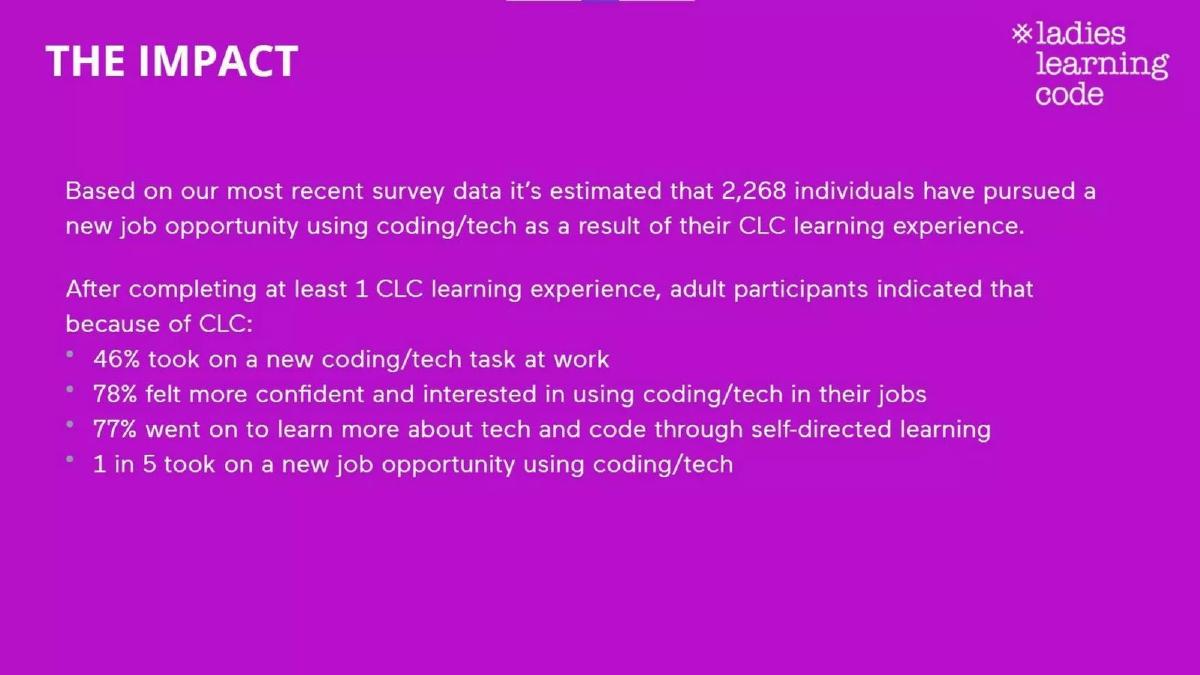
- Impact is measured through participant outcomes, with 1 in 5 participants taking on a new job opportunity using tech (Slide 6).
- The deck highlights a specific leadership gap, stating that only 19% of director positions in the Canadian tech sector are held by women (Slide 3).
- The program's efficacy is supported by survey data showing 78% of participants felt more confident in using tech in their jobs (Slide 6).
- The presentation omits a formal team slide, choosing instead to sign off as 'The Canada Learning Code Team' (Slide 7).
- There is no explicit financial ask or valuation mentioned within the 7 slides, focusing instead on 'sustainable, mutually-beneficial partnerships' (Slide 7).
- The deck mentions an estimated 2,268 individuals have pursued new job opportunities as a result of their learning experience (Slide 6).
Introduction: A Mission-First Presentation
The Ladies Learning Code pitch deck is a 7-slide document that serves more as a social impact report and partnership proposal than a traditional venture capital deck. Founded in 2011 and later rebranded as Canada Learning Code, the organization has successfully raised $16,500,000 according to catalogue facts. This teardown examines how the deck uses data and mission alignment to attract support for its educational initiatives.
Slide 1: Title Slide
The deck opens with a minimalist title slide featuring the brand name "ladies learning code" in a white typewriter-style font against a vibrant purple background. There is no tagline, date, or presenter information. It relies entirely on the brand identity established by the name itself.
Slide 2: Mission and Inclusivity
Slide 2, titled "NO ONE LEFT BEHIND," establishes the core philosophy. It defines digital skills as "tools of empowerment." Crucially, this slide broadens the scope of the organization beyond just women. It lists underrepresented groups including low-income Canadians, people with disabilities, LGBTQ2 communities, Indigenous peoples, Black Canadians, and those in rural areas. The slide explicitly states that while workshops are designed for women, they are open to adults of all ages and genders. This clarifies the market positioning as inclusive rather than exclusive.
Slide 3: The Problem Statement
This slide uses hard data to justify the organization's existence. It cites two key statistics: only 26% of ICT professionals are women (compared to 47.7% of the total Canadian labor force) and only 19% of tech director positions are held by women. It also references StatsCanada to highlight that lower-wage workers and women were hardest hit by the Covid-19 economic shutdown. By framing the tech sector as a growing opportunity amidst record-high unemployment in other sectors, the deck creates a sense of urgency for their solution.
Slide 4: The Solution and Methodology
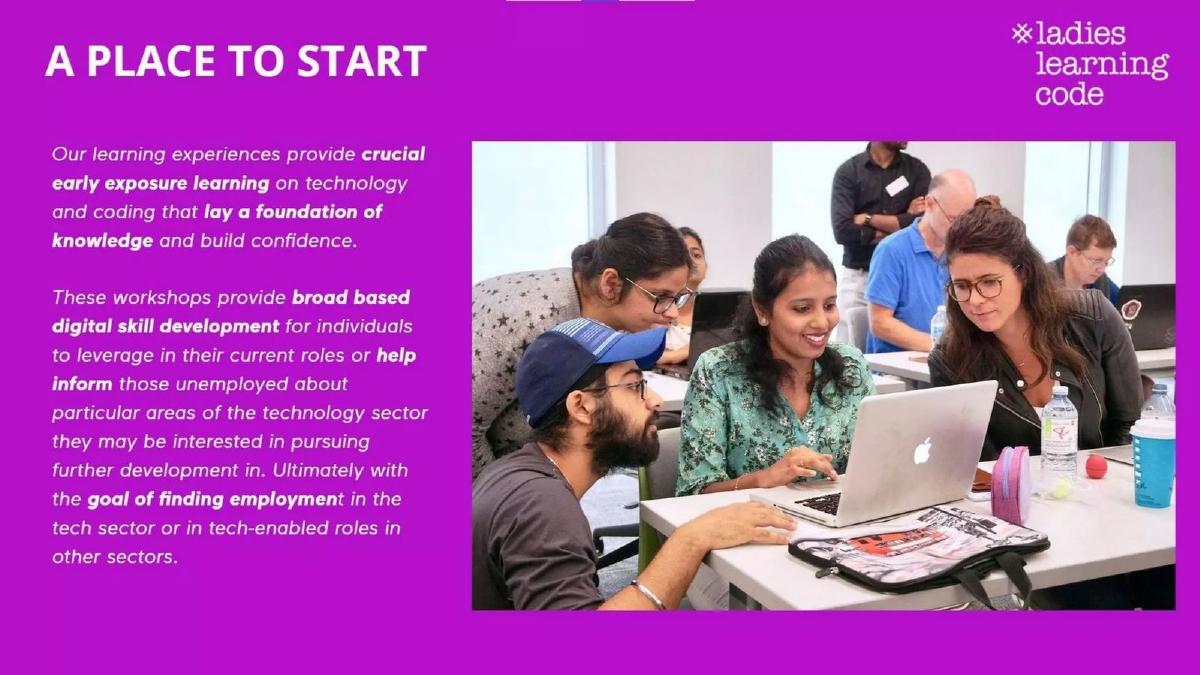
Titled "A PLACE TO START," Slide 4 describes the "what" of the organization. It focuses on "early exposure learning" intended to build confidence and lay a foundation of knowledge. The text explains that these workshops help individuals leverage skills in current roles or inform the unemployed about tech career paths. The ultimate goal is stated as finding employment in the tech sector or tech-enabled roles. This slide bridges the gap between the problem (unemployment/underrepresentation) and the impact (jobs).
Slide 5: Social Proof and Testimonials
Slide 5 provides a qualitative look at the experience through a testimonial from a "SQL workshop Participant." The quote emphasizes the "atmosphere," the "mentors," and the "hands-on experience." Interestingly, the participant mentions the workshop was online but still felt engaging. This serves as a subtle nod to the organization's ability to scale and adapt to remote learning environments.
Slide 6: Quantifiable Impact
This is the most critical slide for any impact-driven organization. Titled "THE IMPACT," it provides specific metrics derived from survey data. It claims that 2,268 individuals have pursued new job opportunities because of their CLC (Canada Learning Code) experience. Other metrics include: 46% took on new tech tasks at work, 78% felt more confident, and 1 in 5 took on a new job opportunity. These figures provide the necessary evidence that the program is not just a social club, but a functional career catalyst.
Slide 7: The Call to Action
The final slide, "THANK YOU FOR CHANGING THE FUTURE," is the closing pitch. It moves away from data and back to vision. It explicitly asks for "sustainable, mutually-beneficial partnerships for the long-term." It is signed by "The Canada Learning Code Team," notably omitting individual names or founder bios. This reinforces the idea of a collective mission rather than a founder-led venture.
What Works in This Deck
Strong Data Backing: The use of StatsCanada data and internal survey metrics (Slide 3 and Slide 6) gives the deck a level of professional credibility that many early-stage decks lack. It grounds the social mission in economic reality.
Clear Audience Definition: Slide 2 does an excellent job of defining exactly who the organization serves, which is vital for partners looking to meet specific Diversity, Equity, and Inclusion (DEI) goals.
Visual Consistency: The deck uses a consistent color palette and high-quality photography of actual workshops. This makes the organization feel established and transparent.
What is Missing
Business Model: There is no mention of how the organization sustains itself. Do participants pay? Do corporations sponsor? Without a slide on the financial engine, it is impossible to evaluate the sustainability of the "sustainable partnerships" they are seeking.
Team Slide: The absence of a team slide is a significant omission. Investors and partners generally want to know who is leading the organization, their backgrounds in education or tech, and their track record. Referring only to "The Team" on Slide 7 is overly anonymous.
The "How": While the deck mentions workshops and courses, it doesn't explain the curriculum, the duration of the programs, or the technology stack used to deliver them. A slide on the "Product" or "Platform" would help clarify the operational side of the business.
Competitive Landscape: The deck operates in a vacuum. It doesn't acknowledge other coding bootcamps or non-profits. Explaining why Ladies Learning Code is the preferred partner in this space would strengthen the pitch.
What a Founder Should Copy
The Impact Slide: Founders should emulate Slide 6. Instead of just saying "users love us," they provide specific percentages on confidence, task adoption, and job placement. This is the kind of data that converts skeptics into supporters.
The Problem-Opportunity Bridge: Slide 3 is a masterclass in framing. It doesn't just say "women aren't in tech." It links that fact to labor force statistics and the economic impact of the pandemic, turning a social issue into an economic opportunity.
Focus on Confidence: Many tech decks focus purely on the technical specs of their product. This deck correctly identifies that for their specific audience, "building confidence" (Slide 4) is as much a part of the value proposition as the code itself. Understanding the psychological needs of your user is a powerful narrative tool.
Frequently asked questions
- What is the primary goal of the Ladies Learning Code deck?
- The primary goal appears to be securing long-term partnerships rather than a standard equity investment. The deck focuses on the social mission of closing the digital skills gap for women and underrepresented groups in Canada. It uses impact data—such as the number of people who found jobs after workshops—to validate the organization's effectiveness to potential partners or donors.
- Does the deck include a business model or revenue projections?
- No. The deck completely omits financial projections, revenue models, or unit economics. This suggests the organization operates as a non-profit or social enterprise where the 'return' is measured in social impact and workforce development rather than dividends or an exit. For a traditional VC, this would be a major red flag, but for a social impact fund, it aligns with their reporting needs.
- How does the company define its target audience?
- While the name 'Ladies Learning Code' suggests a female-only focus, Slide 2 clarifies that they offer workshops for adults of all ages and genders. However, the spaces are specifically 'designed to be a space for women' and prioritize underrepresented groups including Indigenous peoples, Black Canadians, LGBTQ2 communities, and those in rural or remote areas.
- What evidence of 'Product-Market Fit' is provided?
- The deck provides evidence of 'Impact-Market Fit' through survey data on Slide 6. It cites that 77% of participants went on to learn more about tech through self-directed learning and 46% took on new tech tasks at work. These metrics serve as a proxy for product-market fit, showing that the educational 'product' meets a real need in the labor market.
- Who are the competitors mentioned in the deck?
- The deck does not mention any competitors. It treats the problem of digital illiteracy and the gender gap as a systemic issue rather than a competitive market. In a fundraising context, this is a missed opportunity to explain why their specific pedagogical approach is superior to other coding bootcamps or online learning platforms.