LabShare's 2017 pitch deck describes a platform designed to facilitate 'Open Innovation' by connecting companies with engineering firms. The solution focuses on three pillars: saving money through a matchmaking 'Brain,' establishing trust via third-party auditing and blockchain, and accelerating time to market through certification compliance. The business model is structured around a tiered subscription and commission system, with a 'Commercial' tier priced at 3000 EUR per year plus a 10% commission. While the deck provides a comprehensive list of engineering capabilities—including mechanica…
Key takeaways
- The solution relies on a matchmaking 'Brain' using deep learning algorithms, though this was noted as being 'on the roadmap' (Slide 3).
- Trust is established through a 3rd party auditing process and a planned blockchain stack for identity and transaction management (Slide 3).
- The platform offers a wide range of services including mechanical design, prototyping, and global market access certification (Slide 5).
- The business model includes a 'Commercial' tier at 3000 EUR/year plus 10% commission and a 'Pro' tier with custom fees (Slide 7).
- Go-to-market strategy involves partnerships with major ecosystems like Nokia, Philips, and GE Digital (Slide 9).
- The platform is described as an 'Open network of engineering firms' to speed up the innovation process (Slide 11).
- The project team consists of six individuals covering sales, TIC (Testing, Inspection, Certification), technical stacks, and legal (Slide 15).
- The deck lacks a specific slide for financial performance, historical revenue, or a clear investment ask.
LabShare Pitch Deck Analysis
LabShare positions itself as the 'Engineering Services of Tomorrow,' aiming to bridge the gap between companies requiring technical expertise and the engineering firms that possess it. The deck, dated 2017, focuses heavily on the breadth of services offered and the technological roadmap intended to facilitate these connections.
Slide 1: Title Slide
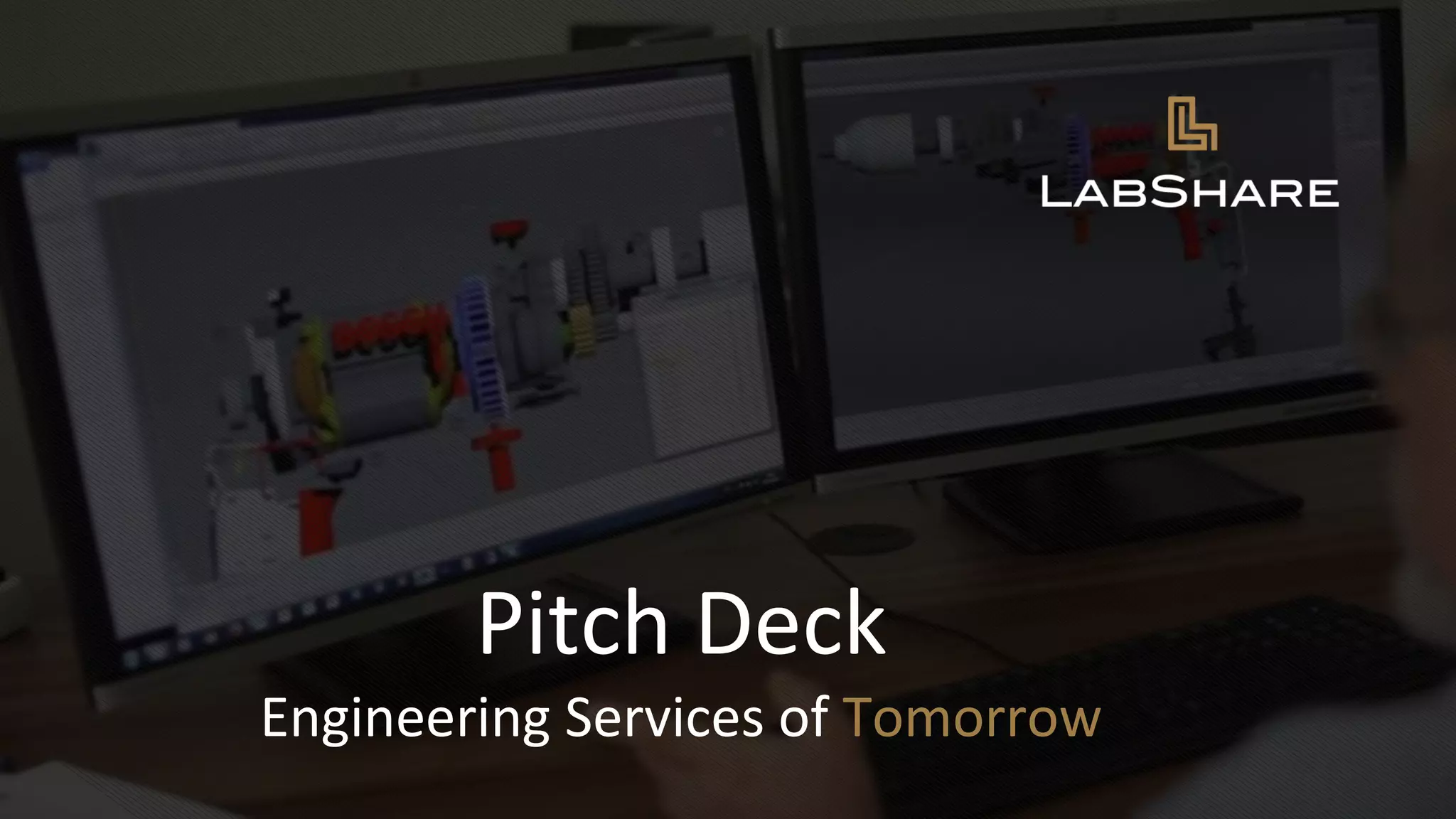
The title slide introduces LabShare with the tagline 'Engineering Services of Tomorrow.' The background image shows a dual-monitor setup displaying CAD (Computer-Aided Design) software, immediately signaling that the company operates in the industrial and mechanical engineering space. The branding is professional, using a gold and white logo against a dark background.
Slide 3: The Solution
This slide breaks down the LabShare value proposition into three categories: Save Money, Trust, and Time to Market. Save Money is driven by a 'Matchmaking Brain' using deep learning algorithms (noted as 'on the roadmap'). Trust is built through third-party auditing and a 'Blockchain stack' for transaction management (also 'on the roadmap'). Time to Market is addressed through certification of compliance for global markets. The slide uses imagery associated with Industry 4.0, software engineering, and smart connected devices.
Slide 5: Service Capabilities
Slide 5 provides a detailed list of the engineering services LabShare facilitates. These include:
Market Introduction Strategy & Roadmapping · Mechanical, Optical, EM & Thermal Design & Modelling · Benchmarking & Innovation Management · Engineering Change Management · Prototyping & Rapid Pre-production Routes · Manufacturing Audit & Efficiency Boost · Supply Chain Innovation & Management · Performance, Safety, EM & Chemical Testing · Software Engineering, Evaluation & Change Control · Quality Management Audit & Consulting · Digital Transformation Consulting & Instigation · Technical File Consulting & Management · Product Compliance Management · Global Market Access – Route to Certification
This list suggests a platform capable of handling the entire product lifecycle from ideation to global distribution.
Slide 7: Business Model
LabShare outlines a tiered subscription and commission model:
Basic (FREE): Includes displaying selected services, blog articles, and an 'ASK the EXPERT' program. · Commercial (3000EUR / year FEE + 10% commission): Adds capacity optimization, commercial programs, VIP programs, innovation deals, and a basic B2B sales package. · Pro (Custom fee + 10% commission): Adds a Pro B2B sales package, BDM (Business Development Management) services, Global Market Access, Co-Development programs, and investment opportunities.
The inclusion of a 10% commission across the paid tiers indicates a marketplace revenue model where LabShare takes a cut of the service contracts facilitated through the platform.
Slide 9: Go-To-Market Strategy
Events - Partnerships: Start-up events, meetups, fairs, and trade shows. · B2B Sales Process: Direct sales activities by agencies, lead generation (citing bant.io), and Key Account Managers (KAMs) in DACH and UK markets. · Global Ecosystems: Joining established programs like the Nokia Open Innovation Ecosystem, Philips Open Innovation Program, and GE Digital (Predix).
This strategy emphasizes leveraging existing industrial networks rather than building a user base from scratch.
Slide 11: Professional Experience
This slide reinforces the 'Open Innovation' concept. It describes LabShare as an 'Open network of engineering firms.' The text claims that each firm integrated into the platform offers 'deep domain know-how' and a 'consistent approach to speed up the innovation process.' Visuals show medical devices (Diatron) and engineering workstations, emphasizing the 'Professional Design Experience' and 'Global Software Certification' aspects of the business.
Slide 13: Digital Presence
Titled 'WE ARE ONLINE,' this slide shows screenshots of the LabShare platform front-end, a business landing page, and an online pitch deck. This serves as a proof of concept, showing that the digital infrastructure for the marketplace is already live or in a functional state.
Slide 15: Project Team
Tibor Zahorecz: Sales, BDM, Digital Platform. · Zoltán Karászi: TIC (Testing, Inspection, Certification), Engineering sector, Strategy. · Dr. Gareth Jones: LED, Lighting, medical sectors, MAS Certification. · Péter Popovics: Energy sector, Energy efficiency. · Ferenc Molnár: Technical stacks: Java, AI, Blockchain. · Dr. Márton Horváth: Legal, Compliance.
The team appears well-balanced between technical engineering expertise, software development, and the legal/regulatory requirements necessary for global certification services.
Slide 18: Capability Blocks to Innovation
This slide presents a complex flowchart of 'Capability blocks' categorized under Business Architecture, Product Engineering, Software Engineering, and Global Market Access Advisory. It maps the journey from ideation and customer insight through CAD verification, process simulation, and manufacturing optimization, ending with a global network of 500+ advisors across 20 countries. This slide attempts to visualize the 'back-end' logic of how LabShare manages an innovation project.
Slide 20: Closing Slide
The final slide features the LabShare logo and the phrase 'Design Experience - BETTER PRODUCTS.' It includes a background image of what appears to be a wearable exoskeleton or medical brace, further grounding the company's focus in high-tech physical product development.
What LabShare Does Well
LabShare succeeds in defining a very specific niche: the intersection of engineering services and regulatory compliance. By including 'Global Market Access' and 'Certification' as core pillars, they address a significant pain point for hardware companies looking to scale internationally. The tiered business model is clear and provides a path for both small firms (Free) and large enterprises (Pro) to engage with the platform. Furthermore, the team composition is highly relevant to the problem they are solving, particularly the inclusion of specialists in TIC and legal compliance.
What is Missing from the Deck
The most significant omission is traction . While slide 13 shows the platform is 'online,' there are no figures regarding how many engineering firms have signed up, how many matches have been made, or the total contract value (TCV) processed through the platform. Additionally, the deck lacks:
Financial Projections: There is no indication of expected revenue growth or break-even points. · The Ask: The slides do not state how much money the company is looking to raise or what the valuation expectations are. · Competitive Analysis: There is no mention of other engineering marketplaces or how LabShare differentiates itself from traditional consulting firms. · Unit Economics: While the 10% commission is stated, there is no data on the cost of customer acquisition (CAC) versus the lifetime value (LTV) of a 'Commercial' tier subscriber.
Founder Takeaways
Founders building marketplace businesses should take note of LabShare's tiered monetization strategy . By combining a flat annual fee with a percentage-based commission, the company ensures a baseline of predictable revenue while still benefiting from the upside of large contracts. However, founders should avoid the pitfall of listing too many 'on the roadmap' features (like the AI 'Brain' and Blockchain stack on slide 3) without providing a timeline or technical validation for them. Investors generally prefer to see what has been built rather than a long list of future aspirations. Finally, always include a clear 'Ask' slide; a pitch deck without a funding goal is merely a capabilities brochure.
Frequently asked questions
- What is the core value proposition of LabShare?
- LabShare acts as a matchmaking platform for engineering services. According to slide 3, it aims to help companies 'Save Money' by using a deep learning 'Brain' to find the best service deals, 'Trust' the transactions via blockchain and third-party audits, and reduce 'Time to Market' by managing global compliance and certification processes.
- How does LabShare generate revenue?
- The company uses a three-tier pricing model shown on slide 7. The 'Basic' tier is free. The 'Commercial' tier costs 3000 EUR per year plus a 10% commission on deals. The 'Pro' tier involves a custom fee plus a 10% commission and includes advanced services like 'Global Market Access' and 'Investment opportunities.'
- What technical services does the platform support?
- Slide 5 lists a comprehensive stack of engineering capabilities, including mechanical, optical, EM, and thermal design; prototyping; manufacturing audits; supply chain innovation; and performance, safety, and chemical testing. It also covers software engineering and quality management consulting.
- Who are the key members of the LabShare team?
- Slide 15 identifies six team members: Tibor Zahorecz (Sales/BDM), Zoltán Karászi (TIC/Strategy), Dr. Gareth Jones (LED/Medical/Certification), Péter Popovics (Energy sector), Ferenc Molnár (Technical stacks like Java/AI/Blockchain), and Dr. Márton Horváth (Legal/Compliance).
- What is missing from the LabShare pitch deck?
- The provided slides omit several critical fundraising elements. There is no slide detailing current traction (users, revenue, or successful matches), no financial projections for future years, and no 'Ask' slide specifying how much capital is being raised or how it will be allocated.