LABELit.cc is a social e-commerce startup based in Hamburg, Germany, aiming to monetize the visual web through crowdsourced product tagging. The 11-slide deck details a model where users identify items in photos (called 'Wants') and provide purchase links ('Haves') in exchange for a share of affiliate commissions. The company proposes a 33/33/33 revenue split between the user, the content publisher, and LABELit itself. While the deck provides an unusually detailed five-year financial projection—forecasting a break-even point in Q3 2016 and €34.7M in revenue by Year 5—it completely omits a tea…
Key takeaways
- The platform operates on a 'Want and Haves' system where users request product info and the community provides it (Slide 4).
- Revenue is based on an average 9% commission per purchase, split equally (33% each) between users, publishers, and LABELit (Slide 5).
- The technology suite includes a website, browser app, web plugin for publishers, and a mobile app in the pipeline (Slide 6).
- Marketing strategy relies on a three-step approach: trendsetters, social media 'Wants of the Day', and targeted advertising (Slide 7).
- The deck identifies competitors across three categories: consumer space (TheHunt), business solutions (Stipple), and affiliate platforms (Skimlinks) (Slide 8).
- Financial projections forecast scaling from 6 employees in Year 1 to 52 employees by Year 5 (Slide 10).
- The company is seeking €0.65m in seed funding after being bootstrapped for 18 months (Slide 10).
- There is no dedicated team slide, though four email addresses for individuals are listed on the final contact slide (Slide 11).
Slide-by-Slide Teardown
Slide 1: Title Slide
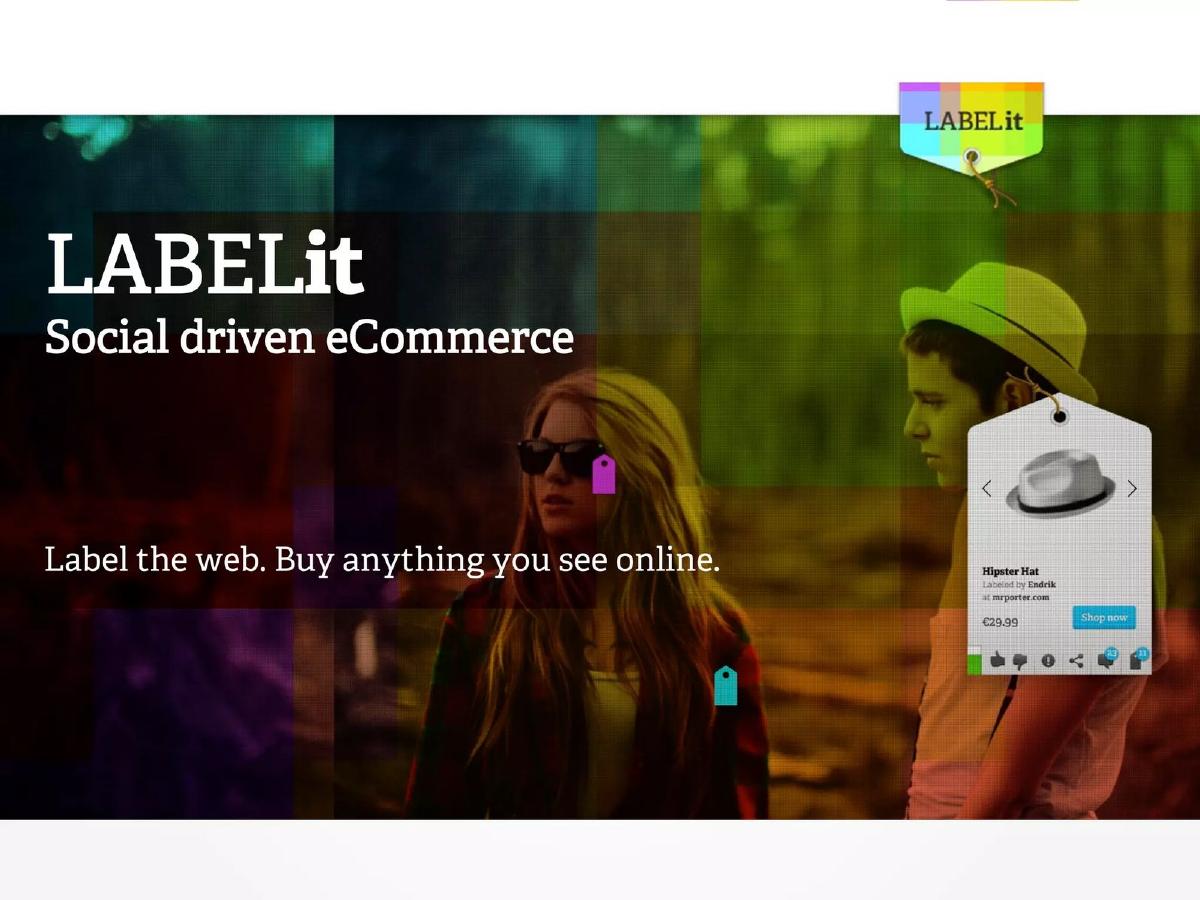
The cover slide introduces LABELit as 'Social driven eCommerce.' The tagline, 'Label the web. Buy anything you see online,' establishes the core value proposition immediately. Visually, it uses a high-quality lifestyle image with an overlay of a digital product tag, showing a 'Hipster Hat' for €29.99. This provides an instant visual context for what the product does before the presenter even speaks.
Slide 2: The Problem
The problem is framed as a common consumer frustration: seeing an item in a photo but not knowing where to buy it. The slide uses a 'street style' photograph of a man and a thought bubble asking, 'That shirt looks great! But where can I get it?' It is a simple, relatable pain point that requires no complex explanation.
Slide 3: The Solution
The solution slide mirrors the problem slide but replaces the thought bubble with a functional 'label.' It states that purchase information can be attached to images on any website by any user. The visual shows the specific product (a light blue shirt) with a 'Shop now' button and price (€17.95), effectively demonstrating the transition from discovery to commerce.
Slide 4: How does it work?
This slide introduces the 'Want and Haves' terminology. A 'Want' is created when a user asks the community to identify a product in a picture. A 'Have' is a completed label with price and info. The slide uses two examples: one asking for a bow tie and another identifying a blazer worn by Natalie Portman. This highlights the crowdsourced nature of the data entry, which is critical for the platform's scalability.
Slide 5: Business Model
The revenue model is explained through a flow chart. It claims an average 9% commission on every purchase from shops like Nike, ASOS, and Zalando. The commission is split 33/33/33 between the User (who does the work), the Publisher (whose content is used), and LABELit (the product). This is a transparent breakdown, though it raises questions about how they manage affiliate relationships across so many different retailers and publishers simultaneously.
Slide 6: Technology
The technology slide lists four tools: the main website, a browser app, a web plugin, and mobile apps. It uses status indicators: the website and browser app are 'Done and working,' the plugin is 'under development,' and the mobile app is in the 'production pipeline.' This gives a clear view of the current technical maturity and the roadmap ahead.
Slide 7: Marketing
The marketing strategy is divided into three phases: 'Friends and trendsetters' for the beta, 'Social media' (specifically 'Wants of the Day') for community management, and 'Targeted advertising' on Google and Facebook for scale. The slide mentions they have 'a lot of experience' with targeted campaigns, though it doesn't quantify this experience or name the individuals who possess it.
Slide 8: Key Competitors
The competition slide is well-segmented into 'Consumer Space' (TheHunt, Pinterest, Polyvore) and 'Business Solutions' (Stipple, Skimlinks). A footnote adds a geographic angle: 'at least in the US. In Europe there’s still a lot of potential for new solutions.' This suggests the company is positioning itself as the European leader in a space already proven by American counterparts.
Slide 9: Why LABELit?
This slide attempts to define the 'moat' or unique selling proposition. It claims to be the only product combining a consumer platform with a business approach (the web plugin) while providing financial benefits to all parties. It uses a Venn diagram-style graphic to show how consumers, publishers, and the central hub (LABELit.cc) interact.
Slide 10: Financial Planning
This is the most data-dense slide in the deck. It states the company has been bootstrapped for 18 months and is seeking €0.65m in seed funding. A 5-year table projects a break-even in Q3 2016. Revenue is projected to grow from €26,525 in Year 1 to €34.7M in Year 5. The table also tracks headcount, marketing spend, and server costs, providing a granular look at their assumptions for scaling the business.
Slide 11: Contact Slide
The final slide provides the company address in Hamburg, Germany, and a general email address. Crucially, it lists four individual email addresses for Endrik Hasemann, Helgo Magnussen, Goetz Magnussen, and Nicolas Kittner. While this identifies the key people, it is not a substitute for a proper team slide.
What Works Well
The clarity of the 'Want and Haves' system (Slide 4) is a highlight. It explains a potentially complex crowdsourcing mechanic in two simple steps. By using real-world examples like celebrity street style, the founders make the utility of the product immediately obvious. The business model slide (Slide 5) is also exceptionally clear; the 33% split is easy to remember and suggests a fair ecosystem that incentivizes all participants.
The financial table (Slide 10) is much more detailed than what is typically found in a seed deck. While the projections are highly optimistic, the inclusion of specific line items like 'Server' costs and 'Affiliate commissions' shows that the founders have at least attempted to model the unit economics of their growth. This level of transparency can build trust with analytical investors.
What Is Missing
The most glaring omission is a dedicated Team Slide. In seed-stage investing, the 'who' is often more important than the 'what.' While names are listed on the final slide, there is no information regarding their backgrounds, previous exits, technical expertise, or why they are the right people to build a social e-commerce giant. Without this, the deck feels like a plan without a pilot.
There is also a lack of current traction metrics. Slide 6 says the website is 'Done and working,' but there are no figures for current monthly active users (MAU), the number of labels already created, or the current click-through rate (CTR) on existing tags. For a company that has been bootstrapped for 18 months, investors would expect to see some evidence of user engagement or early revenue, rather than just 5-year forecasts.
What a Founder Should Copy
Founders should emulate the way LABELit handles the 'Problem/Solution' transition (Slides 2 and 3). By using the exact same image for both slides and simply changing the overlay, they create a 'before and after' effect that is visually powerful and requires very little text to understand. This is a highly effective way to demonstrate a product's value proposition.
The competitive analysis (Slide 8) is also a good template. Instead of a standard 'check-box' grid where the startup magically wins every category, LABELit categorizes competitors by their market focus (Consumer vs. Business). This shows a sophisticated understanding of the landscape and acknowledges that different competitors threaten different parts of their business model.
Final Analysis
LABELit.cc presents a logically structured argument for a crowdsourced affiliate model. The deck succeeds in explaining a three-sided marketplace (users, publishers, and retailers) without getting bogged down in technical jargon. The visual design is consistent, and the financial ask is clear and grounded in a detailed (if ambitious) 5-year plan. However, the total absence of founder bios and current traction data makes this a 'vision' deck rather than a 'proof of execution' deck. To move from a pitch to a term sheet, the founders would need to provide significant evidence that their 18 months of bootstrapping have resulted in a community that actually wants to 'label the web.'
Frequently asked questions
- How does LABELit.cc actually generate revenue?
- According to slide 5, the company earns through affiliate commissions. When a user buys a product through a 'label' placed on an image, the platform collects an average 9% commission. This commission is then split three ways: 33% goes to the user who placed the label, 33% to the publisher of the content, and 33% is retained by LABELit.cc as the platform provider.
- What is the current state of the product according to the deck?
- Slide 6 indicates that the core website (LABELit.cc) and the browser app are 'Done and working.' The web plugin for bloggers and publishers is listed as 'Currently under development,' while the mobile application for placing labels on mobile photos is in the 'production pipeline.' This suggests a functional MVP exists for the consumer-facing web experience.
- What are the specific financial targets mentioned in the deck?
- Slide 10 provides a detailed 5-year table. The company expects to lose €608,616 in Year 1 and €938,115 in Year 2 before reaching profitability in Year 3 with an operating income of €3,255,379. By Year 5, they project revenues of €34,787,000 and an operating income of €18,869,570, assuming they reach a headcount of 52 employees.
- Who are the founders of LABELit.cc?
- The deck does not include a team slide, which is a significant omission for a seed-stage pitch. However, slide 11 lists four contact email addresses: Endrik Hasemann, Helgo Magnussen, Goetz Magnussen, and Nicolas Kittner. Without bios or career histories, investors cannot evaluate the team's ability to execute the complex three-sided marketplace model described.
- What is the primary marketing strategy for growth?
- Slide 7 outlines a three-step marketing plan. First, they target 'friends and trendsetters' during the beta phase. Second, they use social media to share 'Wants of the Day' to drive community engagement. Finally, they plan to use targeted advertising on Facebook and Google, leveraging their stated experience in conversion-focused campaigns to scale the audience.