Lab Sensor Solutions presented an 11-slide deck in 2014 to raise a $345,000 Seed round. The deck focuses heavily on the human and financial cost of spoiled medical samples, citing a $1.6 billion annual waste figure on slide 5. The company positions itself as a 'Mobile Sensor as a Service' provider, utilizing Bluetooth Low Energy sensors to monitor temperature and location in real-time. A standout feature of the deck is the clear articulation of its business model on slide 7, claiming an 85% gross margin on a $25 per sensor monthly subscription. While the deck successfully identifies a high-st…
Key takeaways
- The deck identifies a specific $1.6 billion annual loss due to spoiled medical samples on slide 5.
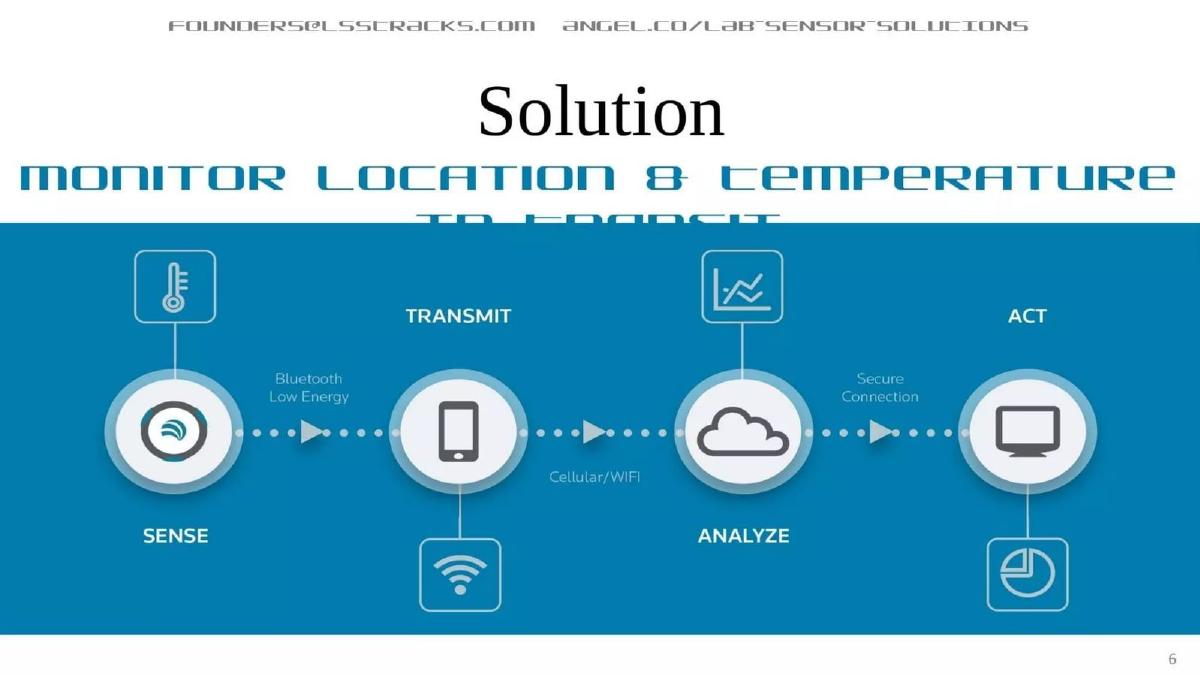
- The solution uses a four-step process: Sense (BLE), Transmit (Cellular/WiFi), Analyze (Cloud), and Act (Dashboard) as shown on slide 6.
- The business model is a subscription service priced at $25 per sensor per month on slide 7.
- The company claims a gross margin of over 85% for its sensor-as-a-service offering on slide 7.
- Traction data on slide 8 shows a transition from 3 customers to a pipeline of 22 labs representing 17,000 potential sensors.
- The deck leverages the Affordable Care Act as a market driver, noting a shift toward reimbursement for value rather than volume on slide 9.
- The team slide (10) highlights experience from major tech firms including Compaq, Cypress, and Rambus.
- There is no slide dedicated to the specific funding amount requested or the planned use of proceeds.
The Lab Sensor Solutions Teardown
Lab Sensor Solutions (LSS) entered the market in 2014 with a clear value proposition: the healthcare industry spends billions on lab automation but neglects the logistics of getting samples to the lab safely. This 11-slide deck is a study in identifying a high-friction, high-cost niche within the broader healthcare sector. By focusing on the 'Healthcare Cold Chain Logistics' (HCCL) industry, LSS avoids the generic 'IoT' label and instead pitches a specific solution for a regulated, high-stakes problem.
The Narrative Hook and Problem Definition
Slide 1: Title Slide The deck opens with a clean logo and the tagline 'Healthcare Sensors As A Service' and 'Real-Time Tracking Technologies.' The imagery shows a professional environment, immediately signaling a B2B healthcare focus.
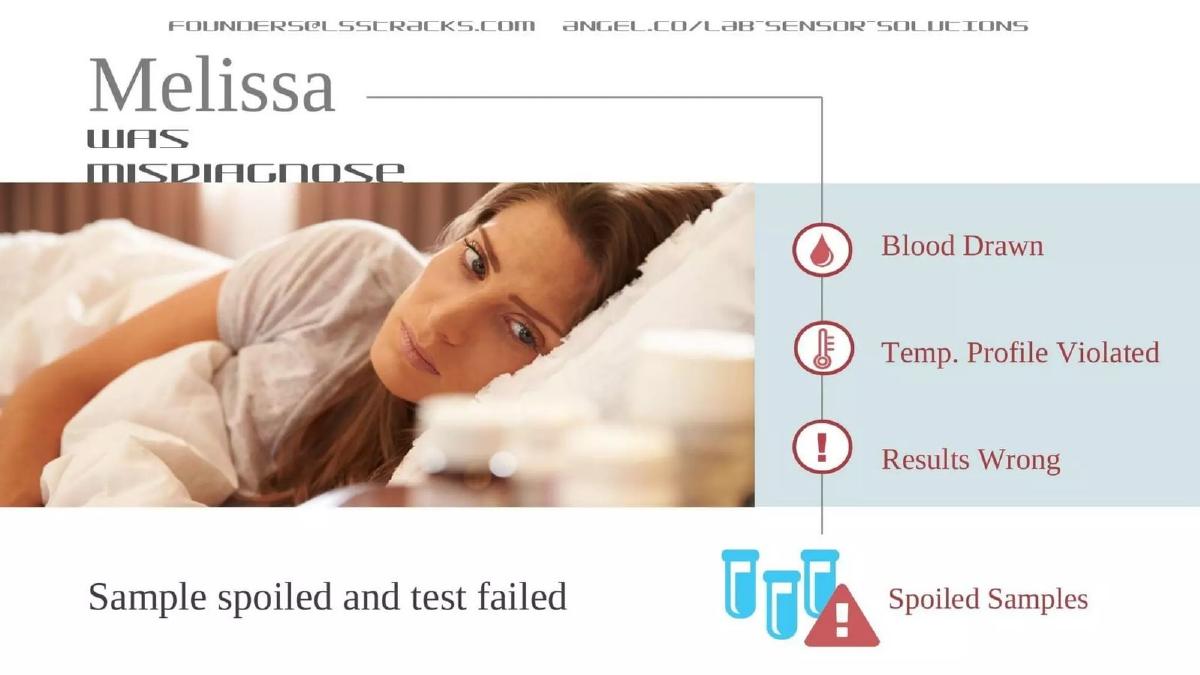
Slide 2: The Human Cost LSS uses a persona-based approach to illustrate the problem. Slide 2 features 'Melissa,' who was misdiagnosed. The slide traces the failure: Blood Drawn -> Temp. Profile Violated -> Results Wrong -> Spoiled Samples. This connects the technical failure (temperature) to a clinical outcome (misdiagnosis), which is a powerful way to frame a logistics problem for healthcare investors.
Slide 3: The Automation Gap This slide notes that 'Billions Spent on Lab Automation.' It sets up a contrast, suggesting that while the internal lab processes are high-tech, the external logistics are not.
Slide 4: The Pizza Paradox Using a humorous but effective comparison, slide 4 shows a pizza delivery driver with the text 'Little Spent to Prevent Spoilage.' The implication is that we track $15 pizzas more effectively than critical medical samples. This is a classic 'why now' and 'why this' framing technique.
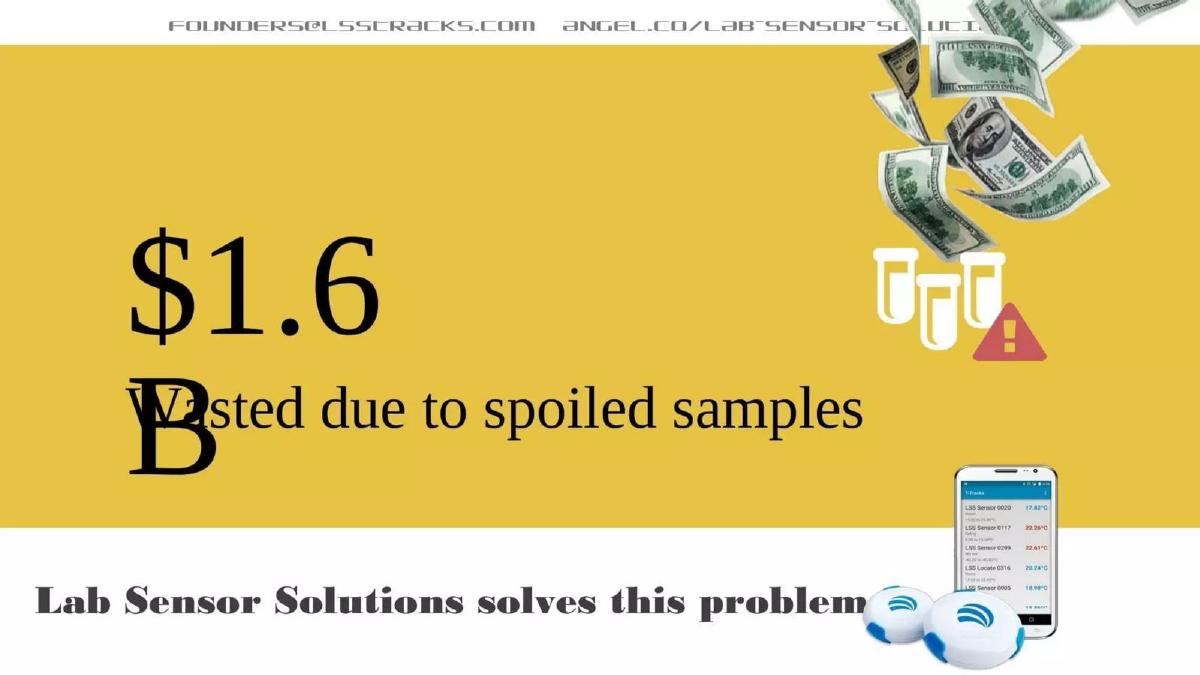
Slide 5: The Financial Impact The deck moves from the emotional to the analytical. Slide 5 states that '$1.6B Wasted due to spoiled samples.' It introduces the LSS solution—a mobile app and small circular sensors—as the direct remedy to this billion-dollar waste.
The Solution and Business Model
Slide 6: The Technical Workflow Slide 6 provides a high-level architecture of the 'Mobile Sensor as a Service' solution. It breaks the process into four stages: Sense (using Bluetooth Low Energy), Transmit (via Cellular/WiFi through a mobile device), Analyze (in the cloud), and Act (via a dashboard). This clarifies that LSS is not just a hardware company, but a data and analytics platform.
Slide 7: Subscription Business Model This is arguably the strongest slide in the deck. It defines the pricing: $25 per sensor per month . More importantly, it claims a Gross Margin of over 85% . For a hardware-enabled business, an 85% margin is highly attractive to Seed investors, as it suggests the company can scale like a software business despite the physical components.
Market Dynamics and Traction
Slide 8: Traction and Pipeline Slide 8 uses a color-coded area chart to show growth. As of the deck's creation, they had 3 customers (125 sensors). The 'Trials' phase included 6 trials representing 1,675 sensors. The 'Pipeline' shows 22 labs representing 17,000 potential sensors. The chart projects a growth path toward a goal of over 2.5 million sensors by 2019. This slide effectively shows the 'land and expand' potential within lab networks.
Slide 9: Regulatory Tailwinds Under the heading 'Disruption In Healthcare,' slide 9 cites the Affordable Care Act. It explains the shift from 'Volume' to 'Value' in reimbursement. The visual shorthand indicates that errors (spoiled samples) lead to a red 'no money' symbol. This positions the product as a 'must-have' for compliance and financial survival rather than a 'nice-to-have' efficiency tool.
The Team and Conclusion
Slide 10: The Team The team slide features four executives: Geoff Zawolkow (CEO), Jarie Bolander (COO), Daniel Paley (EVP Engineering), and Brad Jung (EVP Sales & Marketing). The bottom of the slide is anchored by a row of impressive corporate logos: Compaq, Cypress, Life Technologies, Ion Torrent, Rambus, and D&B. This signals that the founders have deep experience in both large-scale tech and specialized biotech sectors.
Slide 11: Closing The final slide is a simple 'Passion For Saving Lives' with contact information and an AngelList URL. It lacks a summary of the 'Ask' or a final call to action regarding the investment opportunity.
What Works in this Deck
Specific Problem Quantification: By citing the $1.6 billion waste figure on slide 5, the founders move the conversation from a vague logistics problem to a specific, addressable market opportunity.
Clear Unit Economics: Slide 7 is exceptionally clear. Investors often worry about the margins in hardware startups. By explicitly stating the $25/month subscription and the 85% gross margin, LSS addresses this concern head-on.
Regulatory Alignment: Connecting the product to the Affordable Care Act on slide 9 is a smart move. It shows the founders understand the macro-economic drivers of their specific industry, making the purchase decision seem inevitable for their customers.
What is Missing from this Deck
The Investment Ask: The most significant omission is a slide detailing the funding request. There is no mention of how much capital is being raised or what the specific milestones are for the next 12-18 months. According to catalogue facts, they raised $345,000, but that information is not in the slides.
Competitive Landscape: The deck assumes LSS is the only solution. There is no mention of existing data loggers, traditional cold chain solutions, or other IoT competitors. A slide showing why BLE is superior to existing RFID or passive logging solutions would have strengthened the technical case.
Use of Proceeds: Beyond the 'Ask,' there is no breakdown of how the money will be spent. Will it go toward manufacturing sensors, hiring a sales team, or refining the cloud analytics platform?
What a Founder Should Copy
The 'Pizza' Comparison: Using a relatable, everyday example (pizza tracking) to highlight a deficiency in a complex industry (healthcare) is an excellent communication tool. It makes the problem instantly understandable to non-experts.
The Workflow Diagram: Slide 6 is a model for how to explain an IoT stack. It doesn't get bogged down in technical specifications but clearly shows how data moves from the physical world to a decision-maker's screen.
Margin Transparency: If your business model has high margins, put them in large font. Slide 7 does this perfectly, ensuring that the '85% Gross Margin' is one of the most memorable data points in the deck.
Final Thoughts
Lab Sensor Solutions produced a focused, 11-slide deck that prioritizes the 'Why' and the 'How Much.' While it lacks the formal structure of a late-stage pitch (missing the Ask and Competition slides), it succeeds as a Seed-stage document by proving there is a massive, expensive problem and a high-margin way to solve it. The heavy reliance on the team's pedigree and the regulatory shift toward value-based care provides the necessary credibility to overcome the lack of detailed financial projections.
Frequently asked questions
- What is the core problem Lab Sensor Solutions addresses?
- The company addresses the failure of the healthcare cold chain. According to slide 5, $1.6 billion is wasted annually due to spoiled medical samples. Slide 2 illustrates the human impact, telling the story of 'Melissa,' who was misdiagnosed because a blood sample's temperature profile was violated during transit, leading to incorrect test results.
- How does the technology work according to the deck?
- Slide 6 outlines a 'Sense, Transmit, Analyze, Act' workflow. It uses Bluetooth Low Energy (BLE) sensors to 'Sense' environmental data. This data is 'Transmitted' via a mobile device (Cellular/WiFi) to the cloud. The cloud 'Analyzes' the data, which then allows the user to 'Act' via a secure connection to a dashboard or mobile app.
- What are the unit economics of the business?
- Slide 7 explicitly states a subscription business model. Lab Sensor Solutions charges $25 per sensor per month. The company claims this results in a gross margin of 'Over 85%.' This high margin suggests that the hardware cost is low relative to the recurring service revenue.
- What market drivers are mentioned in the pitch?
- Slide 9 points to 'Disruption in Healthcare' caused by the Affordable Care Act. It highlights a shift in reimbursement models where providers are paid for 'Value' rather than 'Volume.' The slide implies that spoiled samples (errors) lead to no reimbursement, creating a financial incentive for labs to adopt tracking technology.
- Is there a clear investment ask in this deck?
- No. The 11-slide deck concludes with a 'Passion For Saving Lives' slide (11) and contact information. It does not state the amount of capital being raised, the valuation, or how the funds will be allocated across engineering, sales, or operations.