K-Zen’s 18-slide seed deck from October 2018 is a masterclass in 'pedigree-based' fundraising. Rather than focusing on complex botanical science, the company positions cannabis beverages as a massive CPG opportunity ripe for professionalization. The deck successfully argues that the existing market is fragmented and amateurish, creating a vacuum for a team with 'Big Food' experience. With a $5 million seed round led by DCM, the founders used their backgrounds at Crystal Geyser, Earthbound Farm, and Clorox to validate their ability to scale. While the deck is light on specific unit economics a…
Key takeaways
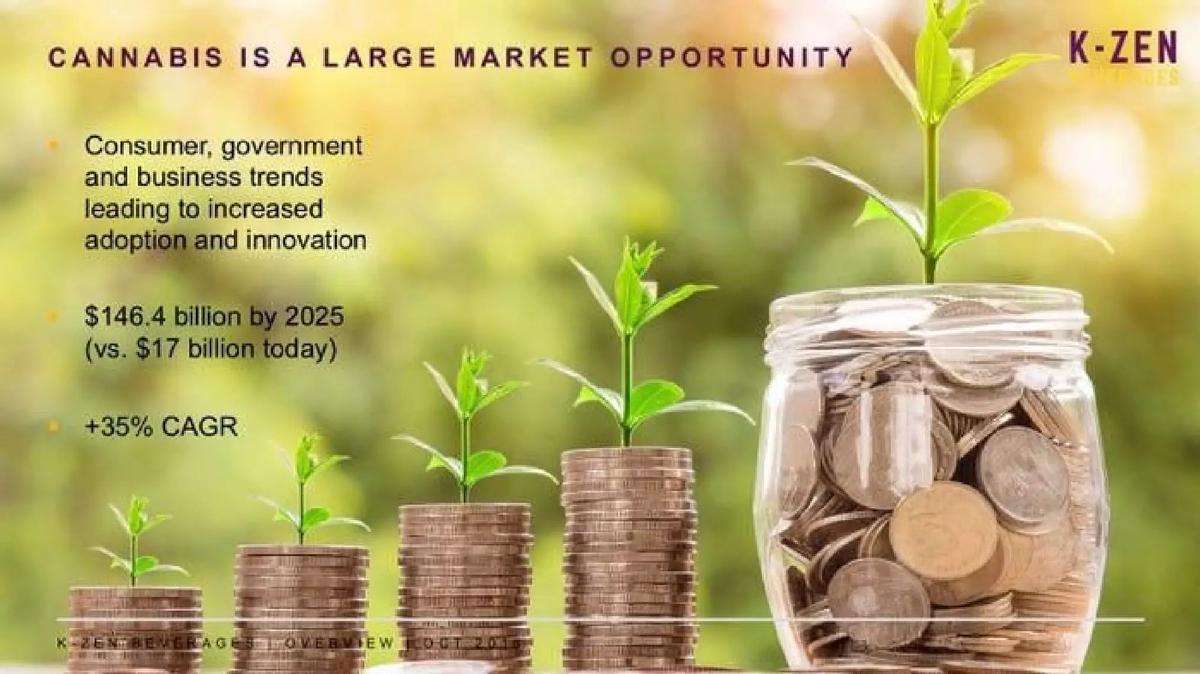
- The deck projects the cannabis market to grow from $17 billion to $146.4 billion by 2025 at a 35% CAGR (Slide 3).
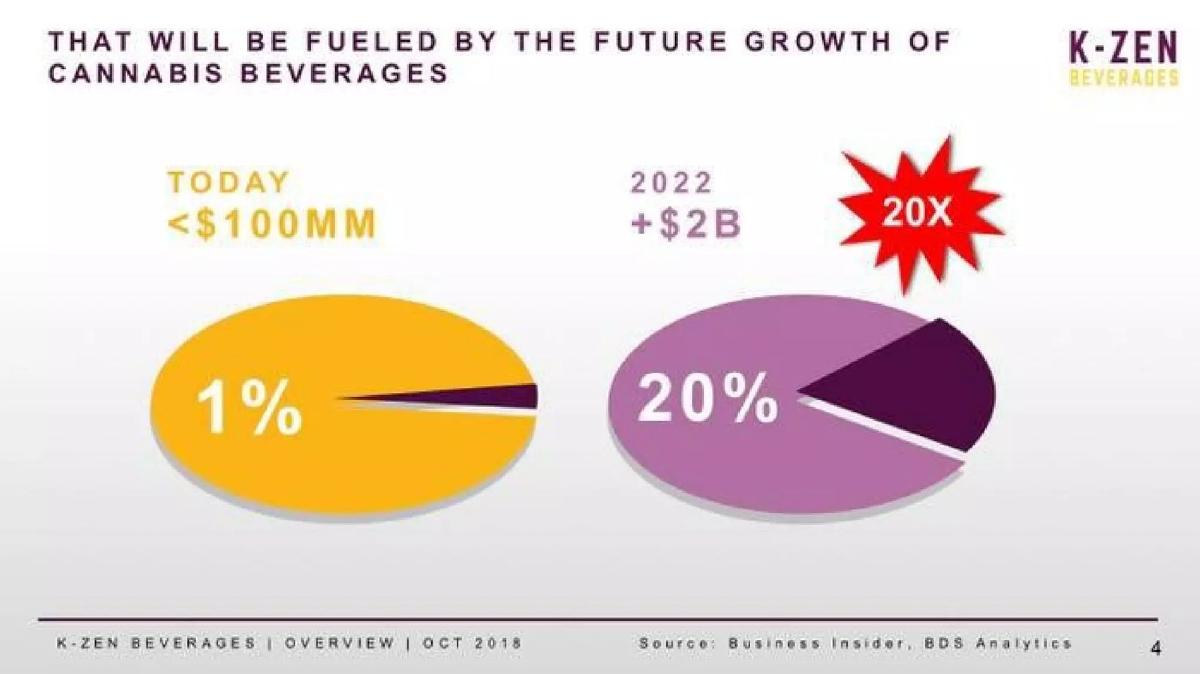
- K-Zen identifies a 20x growth opportunity for cannabis beverages specifically, moving from <1% to 20% of the cannabis market (Slide 4).
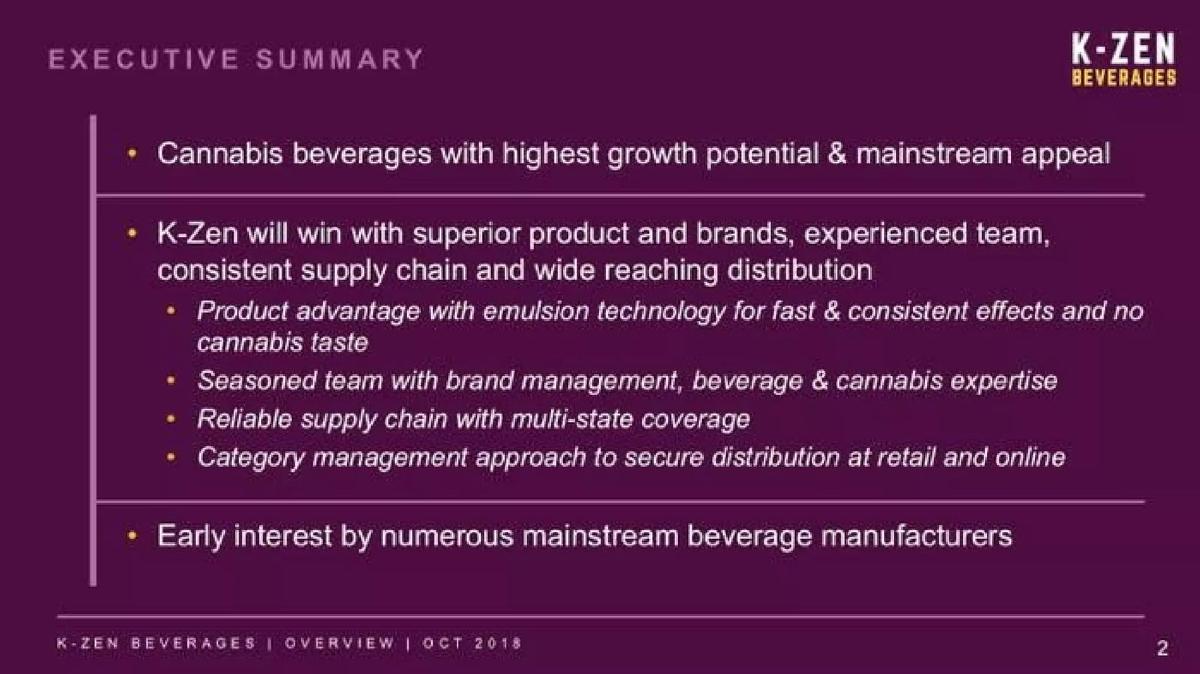
- The core technical advantage cited is emulsion technology, which provides fast effects and removes the cannabis taste (Slide 2).
- The team slide highlights deep CPG roots with past roles at Crystal Geyser, Nestlé, Clorox, and Safeway (Slide 8).
- K-Zen uses a 'Phase' approach to product rollout, prioritizing Soft Drinks, Sparkling Water, and Shots in Phase 1 (Slide 12).
- Consumer validation is supported by a survey of 800+ respondents showing over 80% appeal for their product concepts (Slide 14).
- The go-to-market strategy relies on third-party co-pack manufacturers for speed and scalability rather than building owned facilities (Slide 16).
- The deck lacks a specific 'Ask' slide detailing the exact dollar amount or use of funds, though catalogue facts confirm a $5M raise.
The CPG Professionalization of Cannabis
K-Zen’s pitch deck is a product of its time (2018), reflecting a period when venture capital was beginning to view cannabis not as a risky vice, but as a legitimate Consumer Packaged Goods (CPG) category. The deck’s design is clean, corporate, and intentionally avoids the 'stoner' aesthetic, opting instead for a palette of deep purple and gold that suggests premium branding. The central thesis is simple: the cannabis beverage market is currently run by amateurs, and a team of seasoned beverage executives can dominate it by applying standard CPG playbooks.
Slides 1-2: The Hook and Executive Summary
The deck opens with a minimalist title slide (Slide 1) dated October 2018. Slide 2 provides a high-level executive summary that sets the tone for the entire pitch. It identifies the core problem—a lack of mainstream appeal in current offerings—and proposes K-Zen as the solution. Key pillars mentioned include 'emulsion technology' for fast effects and 'no cannabis taste,' a 'seasoned team,' and a 'category management approach.' This slide is effective because it tells the investor exactly why the company will win before diving into the data.
Slides 3-6: Market Opportunity and Macro Trends
Slide 3 presents the macro cannabis market, citing a jump from $17 billion to $146.4 billion by 2025. Slide 4 is more specific, focusing on the 'Beverage' sub-sector. It claims beverages currently make up less than 1% of the market ( Slide 5 connects cannabis to broader health trends, using a visual of 'Coca-Cola Life' to suggest that cannabis drinks fit the 'smoke-free, discreet, low calorie' demands of modern consumers. Slide 6 uses social proof via news headlines, showing that major players like Molson Coors and Constellation Brands are already making billion-dollar bets on the sector. This frames K-Zen not as a pioneer in an unproven market, but as a fast-follower in a validated one.
Slides 7-10: The 'Amateur' Problem and the 'Professional' Team
Slide 7 is a clever piece of competitive positioning. It shows a photo of what looks like a home-brewing setup in a garage to represent 'existing challenges' like fragmented regional players and poor product quality. This sets the stage for Slide 8, the team slide, which is the strongest part of the deck.
The team includes Judy Yee (Co-CEO) , with experience at Crystal Geyser and Nestlé, and Soon Yu (Co-CEO) , a branding expert from VF Corp. Slide 10 reinforces this with a 'logo wall' of previous employers, including Clorox, Safeway, NBC, and Vans. For a seed-stage investor, this level of corporate pedigree significantly de-risks the execution side of the business.
Slides 11-15: Strategy and Product Development
Slide 11 outlines the 'How to Win' strategy, focusing on 'Crave-able Flavors' and 'Strategic Partners.' Slide 12 shows a sophisticated 'Assessment of Opportunities' matrix. K-Zen ranks different beverage types (Soft Drinks, Sparkling Water, Shots, etc.) based on 'Crossover Appeal' and 'Technical Feasibility.' They identify Soft Drinks, Sparkling Water, and Shots as 'Phase 1' targets.
Slide 13 shows early product concepts: Krūz (Sparkling Water), Kōst (Cooler/Soda), and LIT (Shot). Slide 14 provides the only 'traction' data in the deck: a survey of 800+ respondents showing that over 80% would 'definitely' or 'probably' try these products. While this isn't sales data, it provides a proxy for market fit at a pre-launch stage.
Slides 16-18: Operations and Conclusion
Slide 16 details the go-to-market strategy, which relies on 'co-pack manufacturers.' This is a capital-efficient model that avoids the massive overhead of building a proprietary bottling plant. Slide 17 summarizes the '5 P’s' (People, Product, Production, Placement, Partners), and Slide 18 is a simple closing logo slide. Notably, there is no 'Ask' slide in this version of the deck, which is a common omission in decks shared publicly after a round closes.
What Works in This Deck
The Team Pedigree: In the cannabis space, which was historically under-professionalized, showing a team with experience at Clorox and Nestlé is a massive differentiator. · Market Sizing: The deck does a great job of narrowing down a huge, vague market (Cannabis) into a specific, actionable sub-sector (Beverages). · Visual Clarity: The use of 'Phase' charts and 'How to Win' frameworks makes the business plan feel structured and inevitable rather than speculative. · Addressing Product Friction: By explicitly mentioning 'no cannabis taste' and 'rapid effects,' they address the two biggest consumer complaints about edibles/drinks.
What is Missing
Financial Projections: There is no mention of expected margins, revenue targets, or break-even points. For a $5M raise, investors usually require a detailed 3-5 year pro forma. · Regulatory Roadmap: Cannabis is a legal minefield. While they have a VP of Regulatory Affairs, the deck doesn't explain how they will navigate interstate commerce restrictions or FDA compliance. · The Ask: The deck concludes without stating how much money they are looking for or what the specific milestones for the next 18 months will be. · Unit Economics: There is no information on the COGS (Cost of Goods Sold) or the target MSRP (Manufacturer's Suggested Retail Price) for the drinks.
What a Founder Should Copy
The 'Amateur vs. Pro' Frame: If you are entering a fragmented market, use a slide like Slide 7 to visually contrast the 'old way' (garage startups) with your 'new way' (corporate-standard execution). · The Logo Wall: If your team has worked at recognizable brands, don't just list the names in text. Use the logos to create an immediate visual impact of credibility (Slide 10). · Phased Rollout: Don't try to launch everything at once. Showing a 'Phase 1, 2, 3' approach (Slide 12) demonstrates that you have a disciplined strategy for expansion. · Consumer Insights: If you don't have sales yet, a well-structured survey of 800+ people is a respectable way to show 'early interest' and validate your product concepts.
Frequently asked questions
- What is the primary value proposition of K-Zen?
- K-Zen positions itself as a professional CPG company entering a 'fragmented' and 'amateur' cannabis market. Their value prop is twofold: superior product experience (no cannabis taste and rapid onset via emulsion technology) and superior execution (leveraging a team with decades of experience in mainstream beverage and retail management).
- How does K-Zen justify the market opportunity?
- The deck uses a 'top-down' market sizing approach. It cites a total cannabis market of $146.4 billion by 2025 and argues that beverages will grow from a 1% niche to a 20% category share, representing a $2 billion+ opportunity by 2022. They also link this to the $2 trillion global mainstream beverage market.
- Who are the founders and what is their background?
- The company is led by Co-CEOs Judy Yee and Soon Yu. Yee brings executive experience from Crystal Geyser, Tejava, and Earthbound Farm. Yu is a branding expert and former Global VP of Innovation at VF Corp. This 'Big CPG' pedigree is the deck's strongest selling point for institutional investors.
- What is missing from the K-Zen pitch deck?
- The deck is notably missing a financial slide (revenue projections or burn rate), a specific 'The Ask' slide (though we know they raised $5M), and a detailed competitive landscape naming specific cannabis beverage rivals. It also lacks a clear regulatory roadmap beyond mentioning a VP of Regulatory Affairs.
- What was the outcome of this fundraising effort?
- According to catalogue facts, K-Zen successfully raised $5 million in Seed funding in May 2019, led by DCM. The deck, dated October 2018, served as the primary vehicle for this round, focusing on the transition of cannabis into a mainstream consumer category.