Promolta’s 13-slide deck from 2012 is a lean, traction-heavy presentation that prioritizes financial performance over technical complexity. The company identifies a massive bottleneck in the music industry—100 hours of video uploaded to YouTube every minute—and positions itself as the automated solution for artist discovery. The deck’s strength lies in its transparency regarding unit economics, specifically highlighting a $20 customer acquisition cost against a $50 first sale, resulting in a 'zero payback period.' While the deck lacks a formal 'Ask' slide or a detailed product roadmap, the co…
Key takeaways
- The company frames its value proposition as a 'Next Generation Record Label' on Slide 1, signaling a disruption of traditional industry gatekeepers.
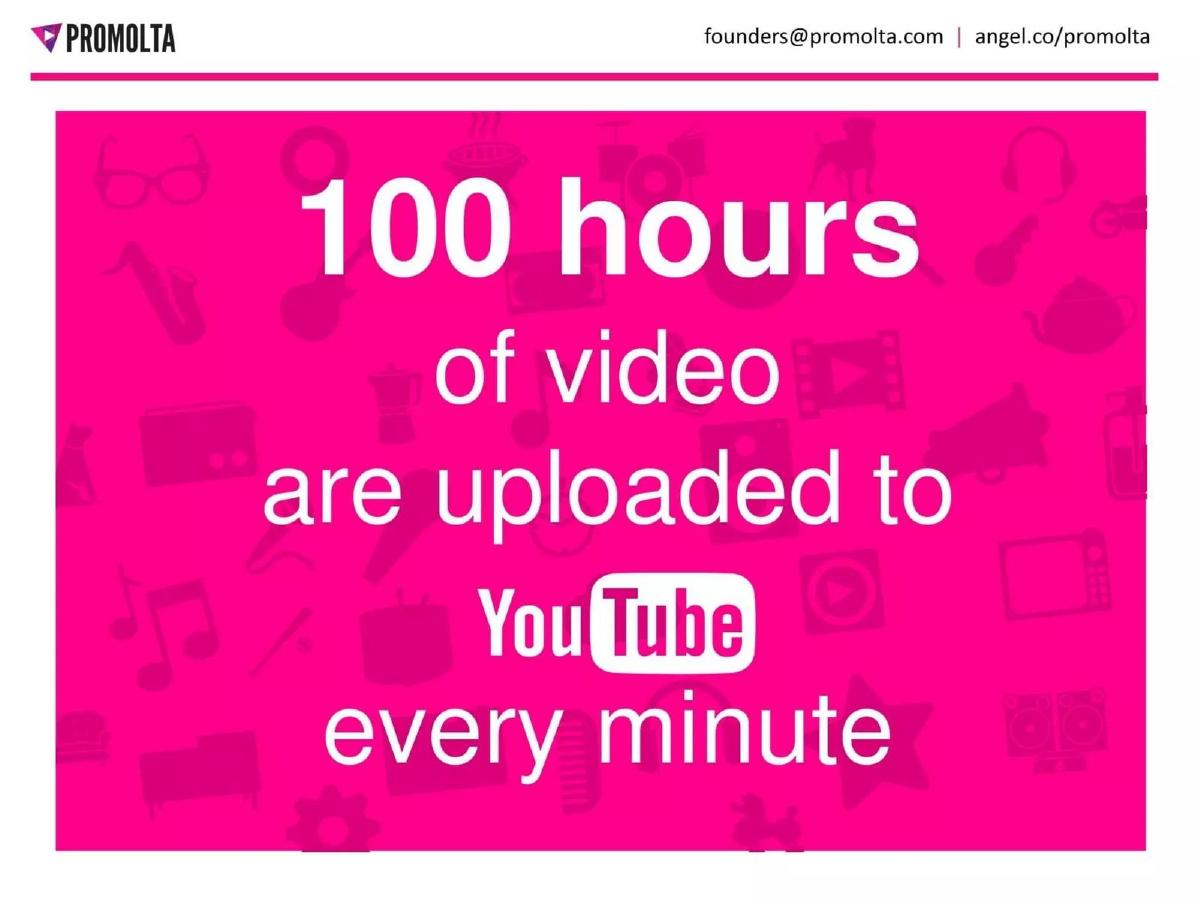
- Promolta uses a high-impact problem statement on Slide 2, noting that 100 hours of video are uploaded to YouTube every minute.
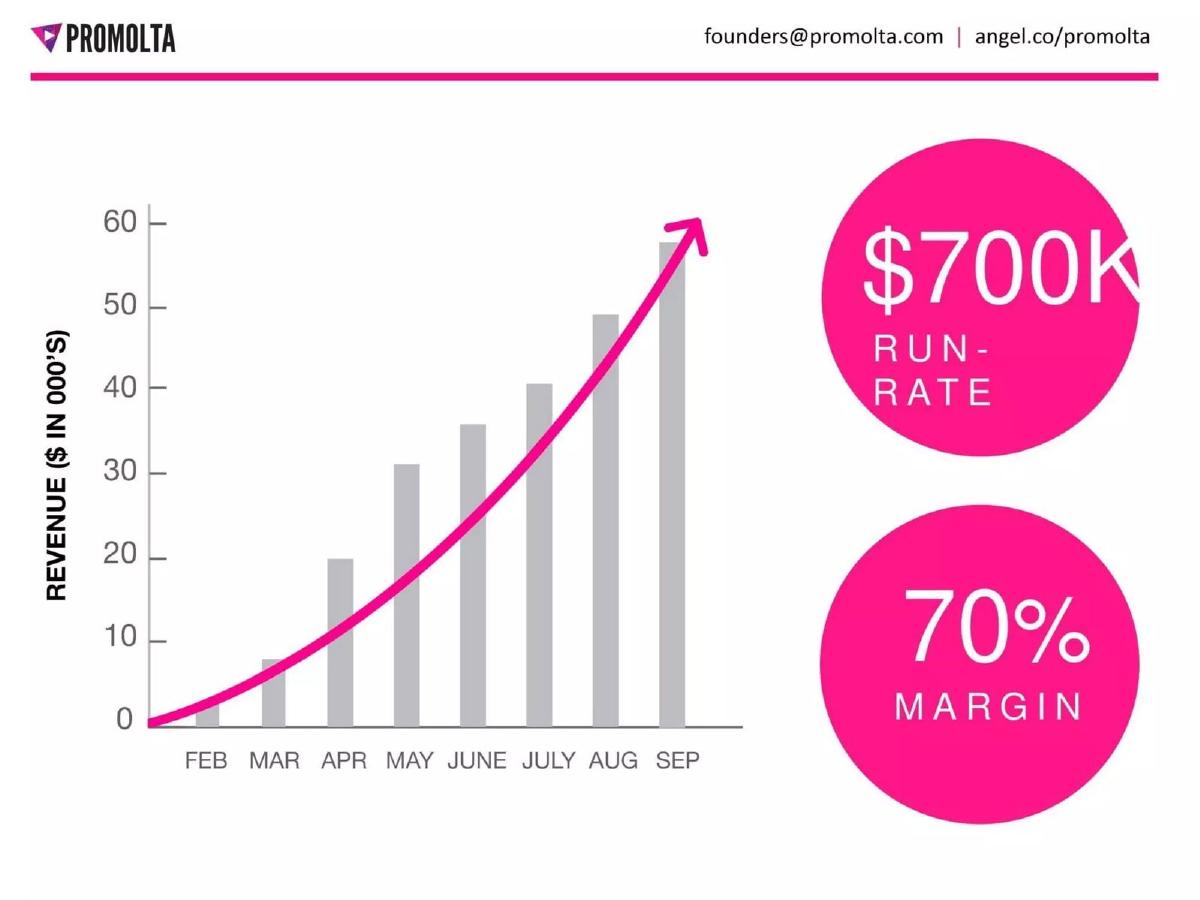
- Financial traction is the deck's centerpiece, with Slide 4 showing a revenue climb from near-zero in February to nearly $60,000 in September.
- The business model boasts a 70% margin and a $700,000 run-rate, as stated on Slide 4 and Slide 13.
- Unit economics are exceptionally strong, with Slide 9 illustrating a $20 ad spend leading directly to a $50 first sale.
- The deck claims a 'Zero Payback Period' on Slide 10, suggesting immediate profitability on customer acquisition.
- Market size is calculated at $6 billion based on 22.5 million musicians spending $250 per year (Slide 8).
- The team slide (Slide 12) relies on logos from major corporations like Citi, Intuit, and Priceline to establish professional credibility.
The High-Margin Distribution Play
Promolta’s 2012 pitch deck is a relic of the early 'creator economy' era, though it doesn't use that term. Instead, it uses the language of the music industry to describe what is essentially a specialized ad-tech platform. By calling itself a "Next Generation Record Label" on Slide 1, Promolta sets an ambitious tone. It isn't just a tool; it's a replacement for the most powerful institutions in music. The deck is visually sparse, relying on large typography and bold pink accents to drive home a narrative of rapid growth and efficiency.
Slides 1-3: The Problem and the Identity
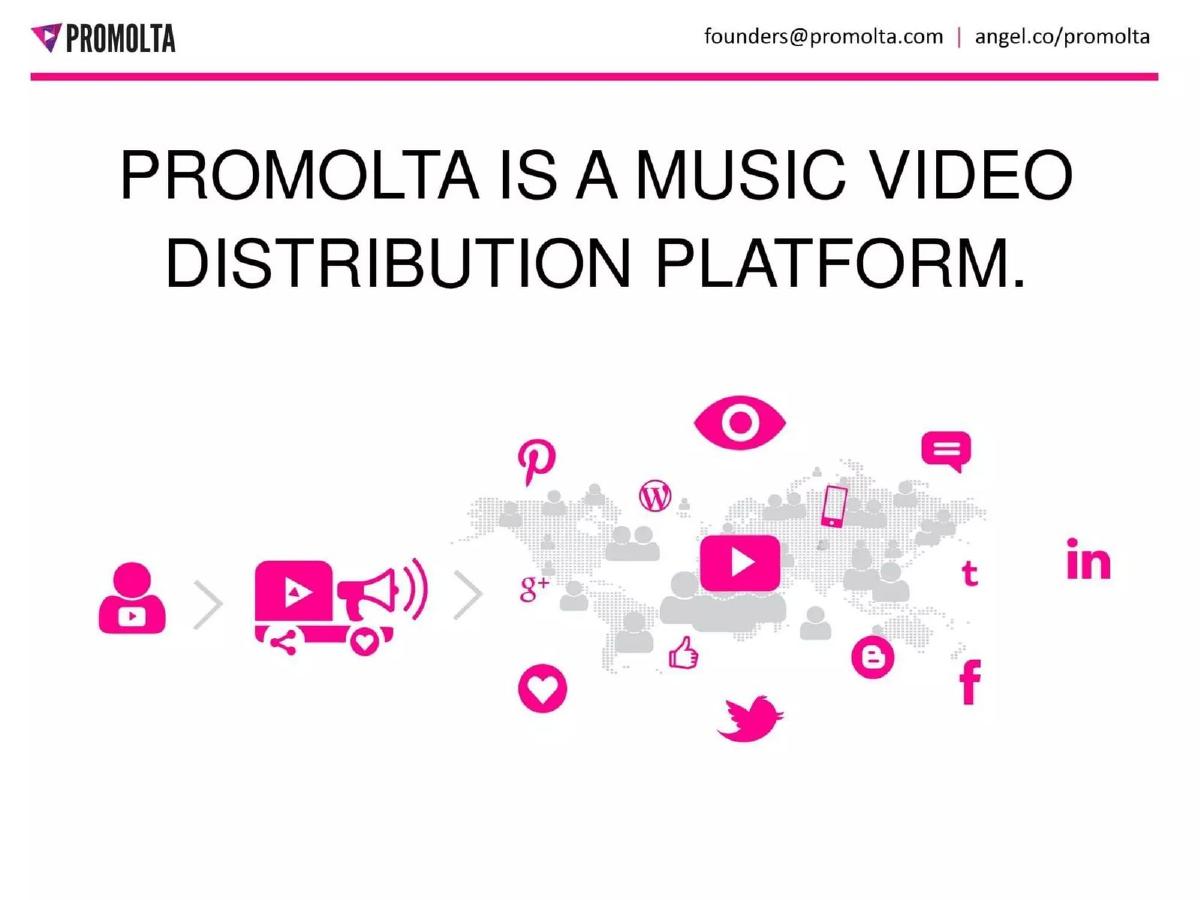
The deck opens with a high-energy image of a concert crowd, immediately grounding the viewer in the music industry. Slide 2 presents the 'Why Now' factor: the sheer volume of content. By stating that "100 hours of video are uploaded to YouTube every minute," Promolta highlights the signal-to-noise problem that every independent artist faces. Slide 3 defines the solution simply: "Promolta is a music video distribution platform." The accompanying graphic shows a user pushing a video through a megaphone out to a global map populated with social media and blogging icons like WordPress, Twitter, and Facebook. This establishes the core mechanic of the business—taking content from the creator and placing it where viewers actually live.
Slides 4-6: Traction and Social Proof
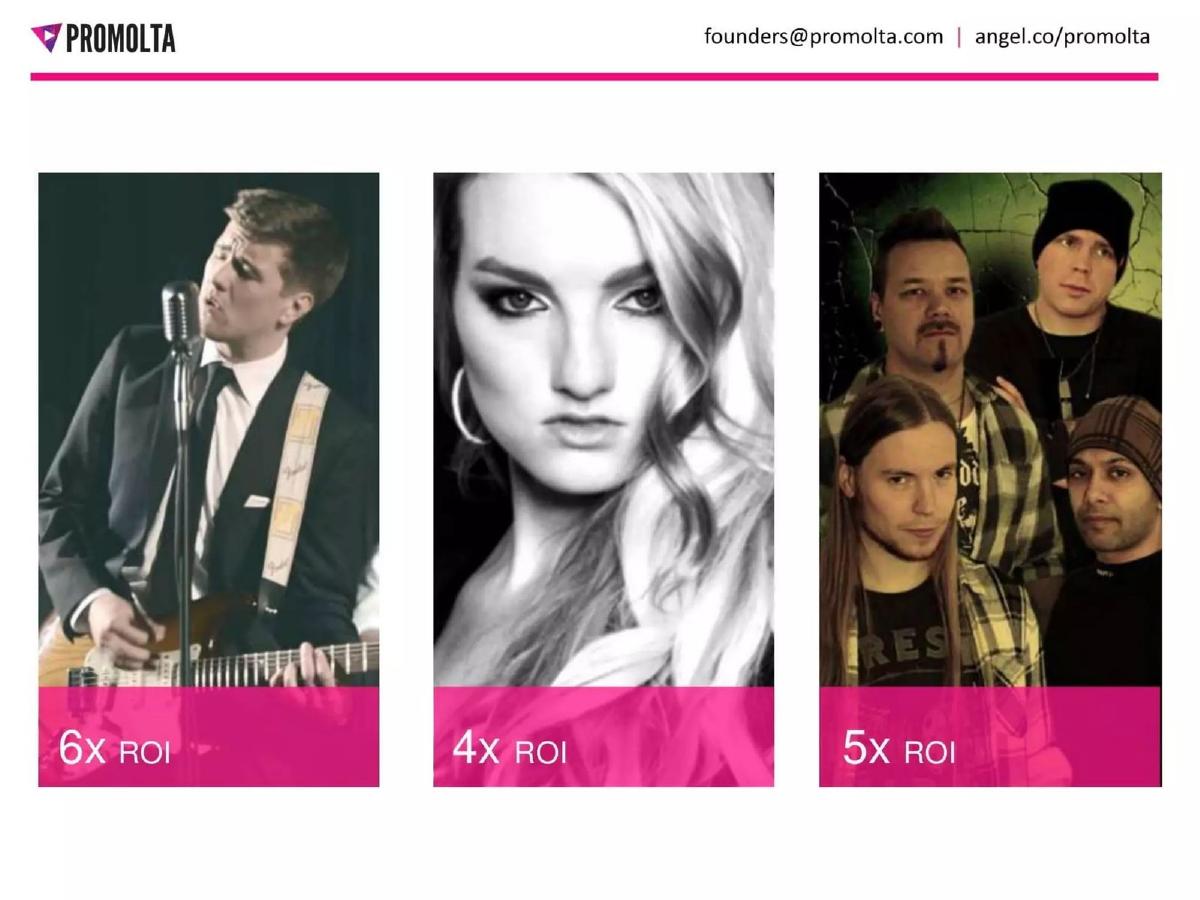
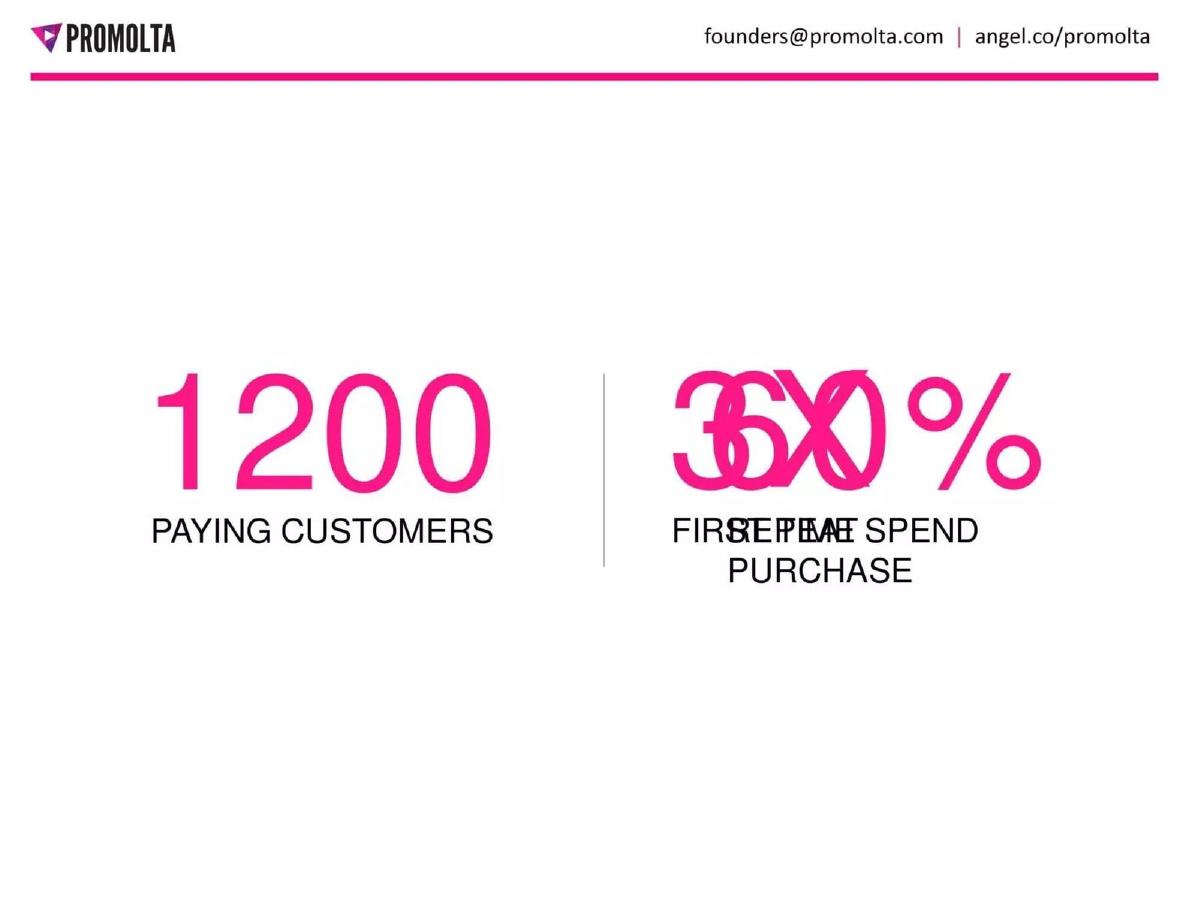
Slide 4 is the most important slide in the deck for an investor. It displays a bar chart showing revenue growth from February to September. The revenue in September is just under $60,000 , and the slide prominently features two key metrics: a "$700K Run-Rate" and a "70% Margin." For a seed-stage company in 2012, these are exceptional numbers. It suggests that the product is not only working but is highly scalable without massive overhead. Slide 5 provides social proof through three artist photos with overlaid ROI figures: "6x ROI," "4x ROI," and "5x ROI." While the deck doesn't define exactly how ROI is measured (views, sales, or followers), the implication of consistent performance is clear. Slide 6 reinforces this with a count of "1200 Paying Customers" and a graphic showing a high repeat purchase rate, though the specific percentage on this slide is obscured by a design choice that was corrected or clarified on the final slide.
Slides 7-8: The Mechanism and the Market
Slide 7 illustrates the 'where' of the distribution: "Blogs, Websites, Social Networks." This is a simple visual representation of their ad network or placement reach. Slide 8 tackles the Market Size. Promolta calculates a "$6B" market based on "22.5M Musicians @ $250/Year." This is a classic bottom-up market sizing. It ignores the traditional 'Top 40' market and focuses on the democratization of music, assuming that millions of hobbyists and independent professionals are willing to spend a modest amount annually to be seen.
Slides 9-11: The Unit Economics Masterclass
Slides 9 and 10 are where the deck makes its strongest case for investment. Slide 9 breaks down the acquisition funnel: a "$20" spend on "Ads" leads to a "$50 First Sale." This is a rare level of transparency for a seed deck. It tells the investor that for every dollar put into the 'marketing machine,' $2.50 comes out immediately. Slide 10 doubles down on this with the phrase "Zero Payback Period." In SaaS or ad-tech, a zero-day payback period is the holy grail, as it means the company can theoretically grow as fast as it can spend on ads without running out of cash, provided the margins hold. Slide 11 summarizes the identity: "Data (Musicians & Viewers) + Distribution (Blogs, Websites, Social Networks) = Next-Generation Record Label."
Slides 12-13: Team and Final Summary
The team slide (Slide 12) lists four key members: Vlad Kachur (Sales), Anjit Anand (Distribution), Igor Polyakov (Tech), and Ace Vu (Design). Rather than listing specific titles or previous exits, the slide uses logos from Deutsche Bank, Citi, Intuit, KPMG, Mint.com, and Priceline.com . This is a common tactic to borrow institutional credibility, suggesting the team has experience in high-stakes corporate and tech environments. The final slide (Slide 13) acts as a summary, re-stating the "$700K Run-Rate," "60% Repeat Purchase," and "70% Margin." It leaves the investor with the three most impressive financial facts about the business.
What Works in the Promolta Deck
The primary strength of this deck is its unwavering focus on unit economics . Many founders shy away from showing exactly how much it costs to acquire a customer, but Promolta makes it the star of the show. By proving that they can acquire a customer for $20 and see a $50 return instantly, they transform the investment ask from a 'bet on an idea' to a 'bet on a machine.' If the machine works, more capital simply means more revenue.
The simplicity of the narrative is also a major asset. The deck doesn't get bogged down in technical explanations of how their distribution algorithm works. Instead, it focuses on the outcome: artists get ROI, and the company gets high-margin revenue. The use of the 'Record Label' analogy is a clever way to frame a tech platform in a way that feels culturally significant and potentially disruptive to a massive, legacy industry.
What is Missing from the Promolta Deck
The most glaring omission is a specific 'Ask' slide . While we know from catalogue facts that they raised $100,000, the deck itself does not state how much they are looking for or what the specific milestones for the next 12-18 months are. This leaves the presentation feeling like a status report rather than a fundraising tool.
Additionally, there is no competitive landscape . In 2012, companies like Vevo, YouTube's own internal promotion tools, and various 'pay-for-play' blog networks were active. Investors would naturally want to know how Promolta's distribution network is proprietary or more effective than simply buying Google AdWords or Facebook Ads directly. The deck also lacks product screenshots . We see icons and abstract representations of blogs and websites, but we never see the actual interface the musician uses to set up a campaign, which leaves the 'ease of use' claim unverified.
What a Founder Should Copy
Founders should emulate Promolta’s clarity on margins and payback periods . If you have a business where the first sale covers the cost of acquisition, that should be on its own slide in giant font. It is the single most attractive metric for a seed investor because it de-risks the go-to-market strategy.
Another takeaway is the bottom-up market sizing . Rather than quoting a generic 'Global Music Industry' report from a major consulting firm, Promolta did the math based on their actual target customer (the independent musician) and a realistic price point ($250/year). This makes the $6 billion TAM feel grounded in reality rather than pulled from a headline. Finally, the repetition of key metrics (Run-rate and Margin) on both the traction slide and the closing slide ensures that even a distracted investor walks away remembering the company's financial health.
Final Thoughts
Promolta’s deck is a 'traction-first' pitch. It assumes that if the numbers are good enough, the 'how' matters less than the 'result.' For a $100,000 seed round, this approach is highly effective. It presents a lean, mean, revenue-generating machine that just needs a little more fuel to accelerate. While it lacks the polish and deep strategic mapping of a Series A deck, it perfectly serves the purpose of a Seed-stage bridge: proving that people want the product and are willing to pay more for it than it costs to find them.
Frequently asked questions
- What is Promolta's core business model?
- Promolta operates as a music video distribution platform. It takes music videos and distributes them across a network of blogs, websites, and social networks to help musicians reach targeted audiences. The deck positions this as an automated alternative to traditional record label promotion, charging musicians for guaranteed reach and engagement.
- How does Promolta acquire customers?
- According to Slide 9, Promolta uses paid advertising (specifically Facebook-style ads) to acquire musicians. They spend $20 on ads to generate a $50 first sale. This 2.5x return on initial spend allows them to claim a 'zero payback period,' meaning the customer is profitable from the very first transaction.
- What is the total addressable market for this service?
- Slide 8 defines the market as $6 billion. This figure is derived from an estimated 22.5 million musicians worldwide, with an assumed average annual spend of $250 per musician on promotion services. This bottom-up calculation focuses on the 'long tail' of independent artists rather than just major label stars.
- What is missing from the Promolta pitch deck?
- The deck is notably missing a specific 'Ask' slide detailing how much capital they are raising and how it will be used. It also lacks a detailed competitor analysis, a product roadmap, and specific case studies beyond ROI percentages. There is no mention of the specific technology or algorithms used to target audiences.
- How much revenue was Promolta making at the time of this deck?
- Slide 4 shows a monthly revenue chart ending in September at approximately $58,000. This monthly performance is extrapolated to a $700,000 annual run-rate, which is highlighted on both Slide 4 and Slide 13. The growth curve shown is exponential, starting from negligible revenue in February.