Teleport’s 2016 deck is a study in visual proof over narrative exposition. Spanning only 9 slides, the presentation skips traditional sections like market size, business model, and competition to focus entirely on use cases and high-tier partnerships. The company positions itself as a 'new interaction paradigm' for media-enriched video, showcasing applications for the International Olympic Committee, Miele, and Chevrolet. While the deck lacks unit economics and a specific financial ask, it leverages the significant pedigree of its founding team—who claim $23m in previous fundraising and multi…
Key takeaways
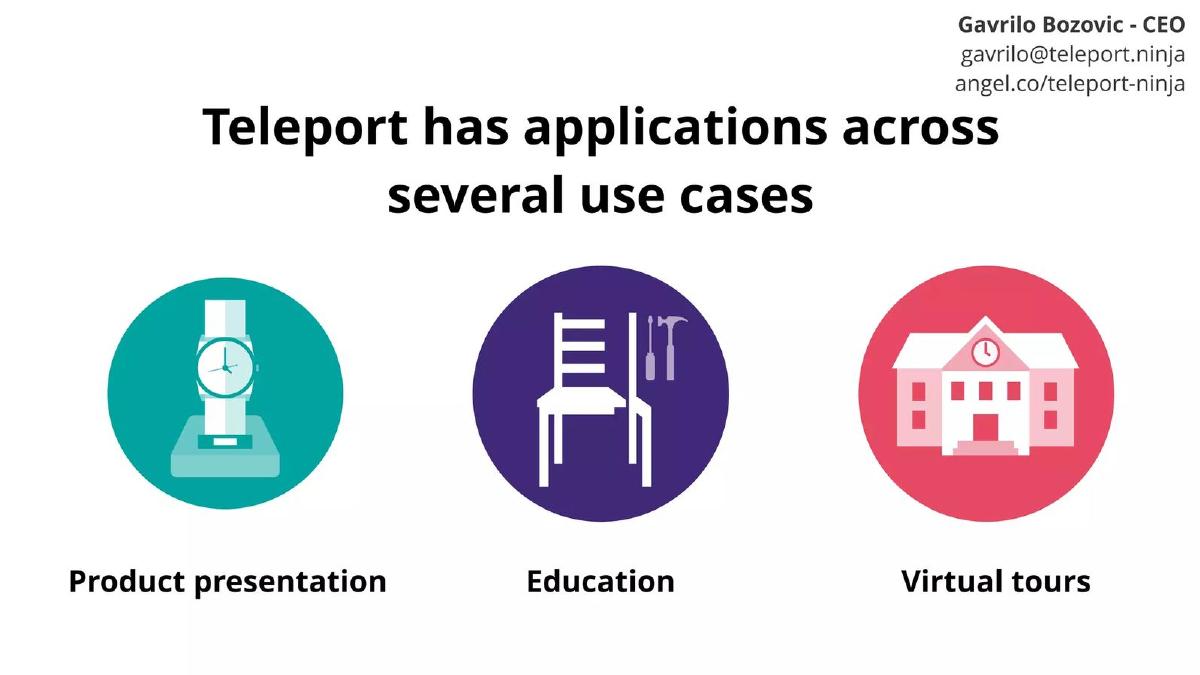
- The deck identifies three primary use cases: product presentation, education, and virtual tours (Slide 3).
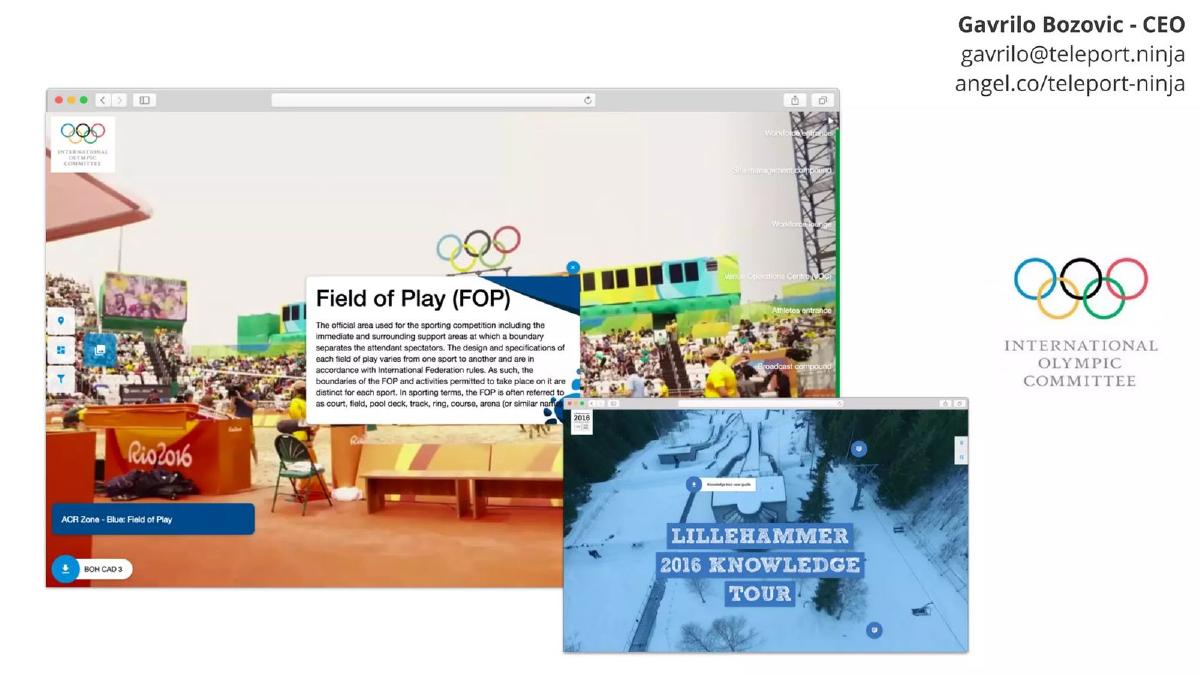
- Teleport demonstrates high-level market penetration with a dedicated slide for the International Olympic Committee's Rio 2016 and Lillehammer 2016 tours (Slide 4).
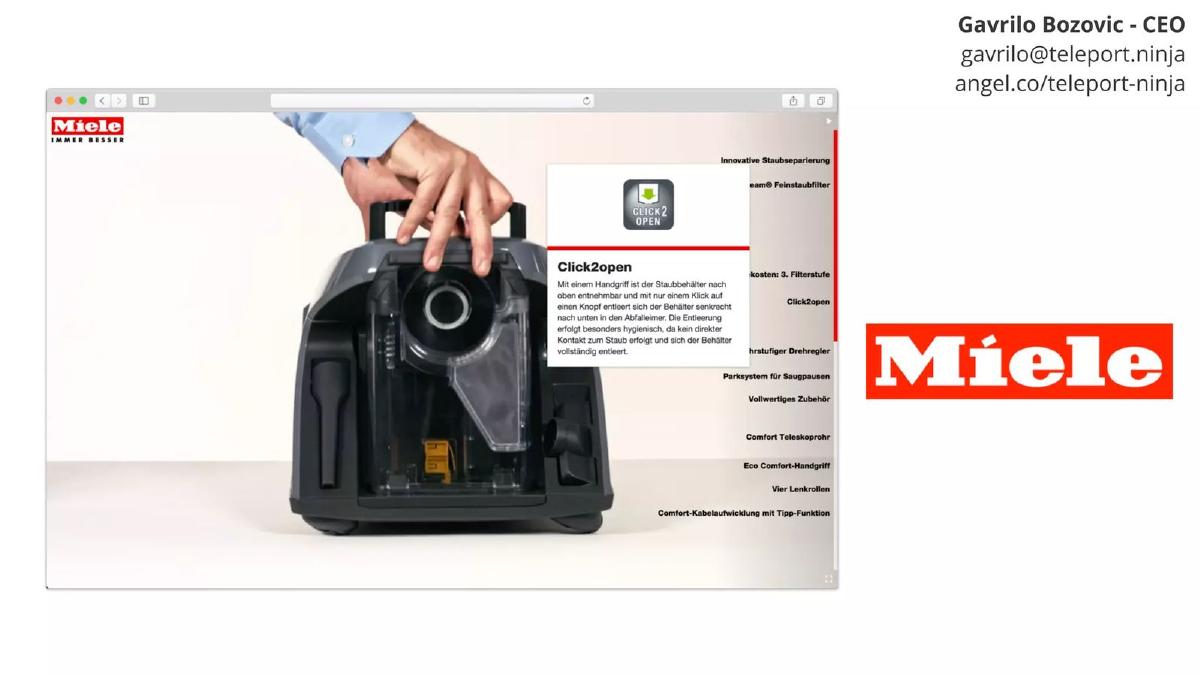
- The product is shown in a B2B context through interactive vacuum cleaner demonstrations for Miele (Slide 5).
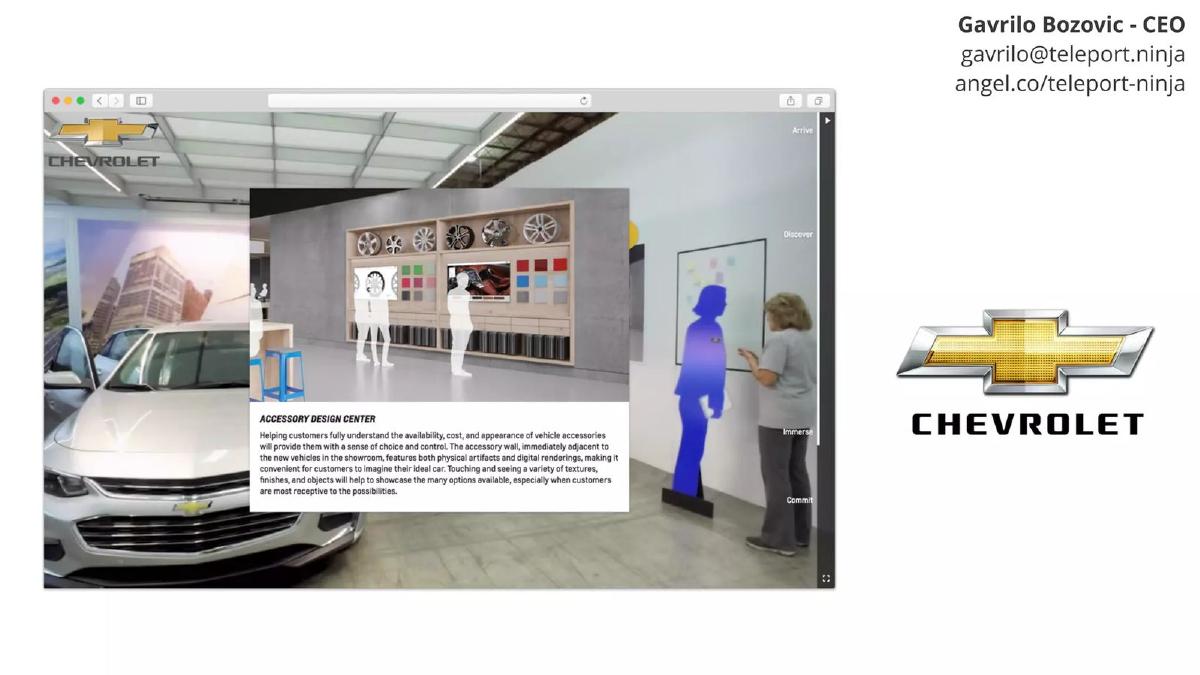
- Automotive applications are highlighted via a Chevrolet 'Accessory Design Center' interactive showroom (Slide 6).
- A massive logo wall features 26 distinct brands and organizations, including LEGO, Braun, and The Economist (Slide 7).
- The founding team has significant experience, with the CEO having raised $23m and the CTO holding 10 years of developer experience (Slide 8).
- The deck omits all financial data, including revenue, burn rate, and the specific terms of the CHF100K debt financing (Catalogue facts).
- There is no mention of the competitive landscape or the underlying technology stack beyond 'media-enriched video' (Catalogue facts).
The Visual-First Strategy: A Teardown of Teleport
Teleport’s pitch deck is an anomaly in the world of startup fundraising. At only 9 slides, it ignores the traditional 12-to-15-slide narrative arc popularized by firms like Sequoia or Andreessen Horowitz. Instead, it functions as a high-impact portfolio. Given that the company was raising CHF100K in debt financing in 2016, the deck's brevity suggests it was likely used as a supplementary piece for investors already familiar with the founders or as a visual aid for a live presentation.
Slide 1: Title and Contact
The deck opens with a minimalist black slide featuring the Teleport logo. The typography in the logo—where the 'P' and 'O' appear to be 'teleporting' or glitching—visually reinforces the company name. Gavrilo Bozovic is identified as the CEO, with his email and AngelList profile provided immediately. This establishes a direct line of communication from the first second of the pitch.
Slide 2: The Hardware Context
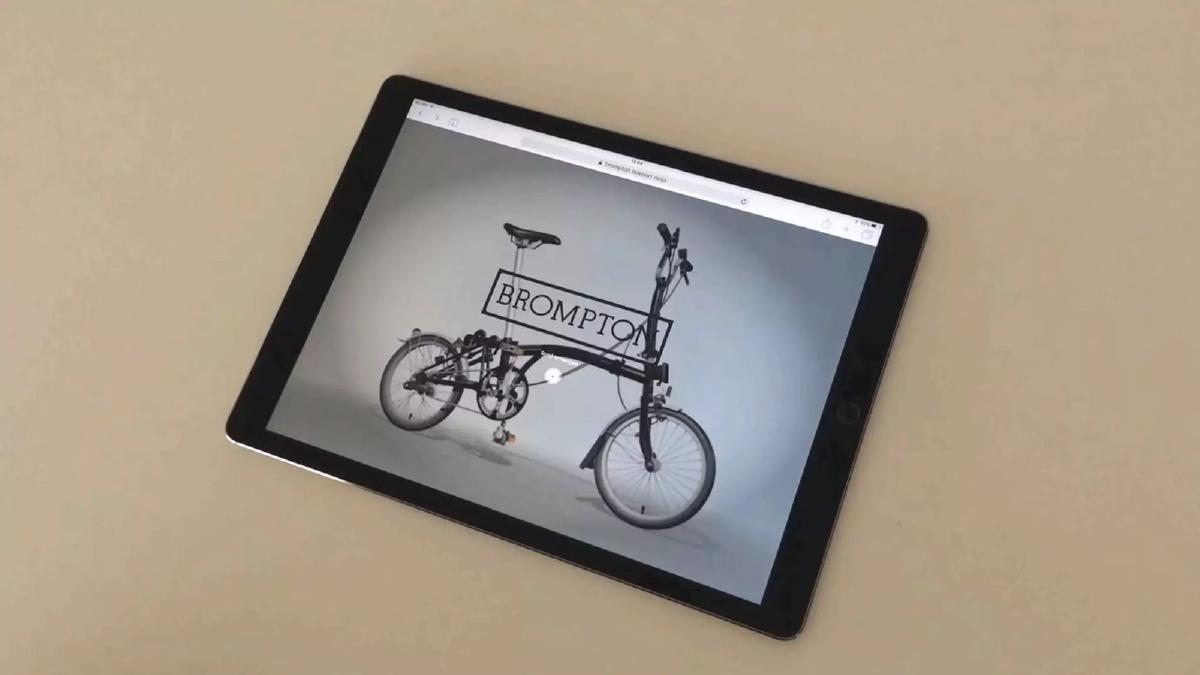
Slide 2 contains no text. It shows an iPad displaying a Brompton bicycle. This is a crucial 'context' slide. It tells the investor two things: the product is mobile-responsive and it is designed for high-end retail/product interaction. By using a Brompton bike—a premium, recognizable brand—Teleport subtly aligns itself with quality design before a single word of the value proposition is uttered.
Slide 3: Defining the Use Cases
Teleport finally introduces text on Slide 3, stating that the platform has applications across 'several use cases.' They categorize these into three buckets: Product presentation , Education , and Virtual tours . The icons are clean and professional, but the slide remains high-level. It doesn't explain how it serves these markets, only that it can.
Slide 4: The Olympic Validation
This is arguably the strongest slide in the deck. It showcases the 'Lillehammer 2016 Knowledge Tour' and a 'Field of Play (FOP)' interactive map for the Rio 2016 Olympics. The inclusion of the International Olympic Committee logo provides massive institutional credibility. For a startup, being trusted by the IOC to handle digital tours for a global event is a significant barrier to entry for competitors.
Slide 5: Industrial and Retail Application (Miele)
Slide 5 moves from sports/events to consumer appliances. It shows a Miele vacuum cleaner with a 'Click2open' interactive overlay. The text is in German, suggesting the company's strong roots in the DACH region (Germany, Austria, Switzerland). This slide demonstrates the 'media-enriched' aspect of the product—turning a standard video into a clickable, educational tool for complex products.
Slide 6: Automotive and Showroom Utility (Chevrolet)
The third specific case study features Chevrolet . The slide shows an 'Accessory Design Center' where users can interact with vehicle accessories. This highlights the platform's ability to bridge the gap between physical showrooms and digital exploration. It positions Teleport as a tool for the 'Phygital' (physical + digital) retail trend that was gaining momentum in 2016.
Slide 7: The Logo Wall
If the previous slides didn't convince the investor of market fit, Slide 7 is designed to finish the job. It features 26 logos, including LEGO, Braun, The Economist, Swisscom, P&G, and Daimler . This is an extraordinary list for a company raising a relatively small debt round. It suggests that Teleport operated more like a high-end agency or a specialized SaaS provider with a very successful sales engine.
Slide 8: The Pedigree of the Founders
The team slide is dense with 'social proof' and hard metrics. Gavrilo Bozovic (CEO) claims to have founded 3 companies, holds 2 patents, and has raised $23m previously. Madhur Agrawal (Bizdev) is linked to a 'top 50 Swiss startup' and Microsoft/MIT accelerators. Daniel Tamburrino (CTO) is noted as a 'touch interfaces pioneer' with patents for Sharp. This team is overqualified for a CHF100K round, which likely made the debt financing an easy sell for the investors.
Slide 9: The Closing Vision
The final slide repeats the logo and adds a tagline: 'A new standard for product presentation, education, virtual tours.' It serves as a summary of Slide 3 and provides the contact information once more. It is a standard, clean exit to the presentation.
What Teleport Does Well
Teleport excels at Brand Association . By placing their product inside the ecosystems of the world’s most recognizable brands (IOC, Chevrolet, Miele), they bypass the need to explain why their product is valuable. The market has already decided it is valuable. The deck is also remarkably uncluttered . There are no complex charts or blocks of text that require the investor to stop listening to the presenter to read the slide.
What is Missing from the Deck
The omissions in this deck are significant and would be a red flag in a standard Seed or Series A equity round. There is no financial data. We do not know if these 26 logos are paying customers, pilot programs, or one-off projects. There is no Business Model slide; it is unclear if Teleport is a SaaS platform with recurring revenue or a services-based business. Furthermore, there is no Market Analysis . While the product looks great, the deck doesn't address how large the 'interactive video' market is or who else is competing for these enterprise contracts.
What Founders Should Copy
Founders should emulate Teleport’s 'Show, Don't Tell' approach to product demos. Instead of describing 'interactive features,' they showed a vacuum cleaner being opened via a digital overlay. This is much more effective than a bulleted list of features. Additionally, the Team Slide is a masterclass in highlighting relevant 'power metrics' (patents, previous funds raised, years of experience) rather than just listing previous job titles. If you have a high-profile client list, making it the centerpiece of your deck—as Teleport did—is the fastest way to build investor trust.
Frequently asked questions
- What is the primary product Teleport is offering?
- Teleport offers an interactive video platform that allows users to engage with 'media-enriched' content. Based on the slides, this includes clicking on specific parts of a video to reveal technical specifications (Miele), navigating 360-degree virtual environments (International Olympic Committee), and exploring digital showrooms (Chevrolet). It is positioned as a new standard for product presentation and education.
- Who are Teleport's most notable customers?
- The deck lists an impressive array of global brands. Key highlights include the International Olympic Committee, Chevrolet, Miele, LEGO, Braun, The Economist, Condé Nast, Swisscom, and Daimler. The presence of these logos suggests that Teleport's business model is likely a B2B enterprise play, providing interactive media services to large corporations.
- What information is missing from the Teleport pitch deck?
- The deck is missing several standard fundraising components. There is no 'Problem' slide defining a market pain point, no 'Market Size' (TAM/SAM/SOM) analysis, no 'Business Model' explaining how they charge, and no 'Competition' slide. Most notably, there is no 'Ask' slide detailing how much capital is being raised or how it will be used.
- What is the background of the Teleport founding team?
- The team consists of Gavrilo Bozovic (CEO), who has founded three companies and raised $23m; Madhur Agrawal (Bizdev Manager), a winner of a TIE Global prize and alumnus of Microsoft and MIT accelerators; and Daniel Tamburrino (CTO), a 10-year developer with two patents for Sharp and a background in touch interfaces.
- How does Teleport demonstrate its value proposition?
- Teleport demonstrates value through visual case studies rather than text-heavy descriptions. By showing the interface used by the Olympics and Chevrolet, they prove the platform can handle complex, high-stakes deployments. This approach relies on the viewer's ability to see the product's utility in real-world scenarios across different industries like retail, sports, and manufacturing.