TelemetryDeck presents a compelling case for a privacy-focused alternative to mainstream analytics tools like Google Firebase and Mixpanel. The deck, used during their 2021 pre-seed phase, emphasizes the friction caused by invasive tracking and complex implementation. By offering anonymized data collection and a developer-friendly SDK, they aim to capture a market increasingly wary of data privacy regulations. The deck is notable for its transparency regarding unit economics, citing a 5% monthly churn and a 7.5% conversion rate from free to paid plans. While the financial projections are aggr…
Key takeaways
- The company identifies a core friction point: analytics software is often 'sneaky' and requires complex user agreements (Slide 2).
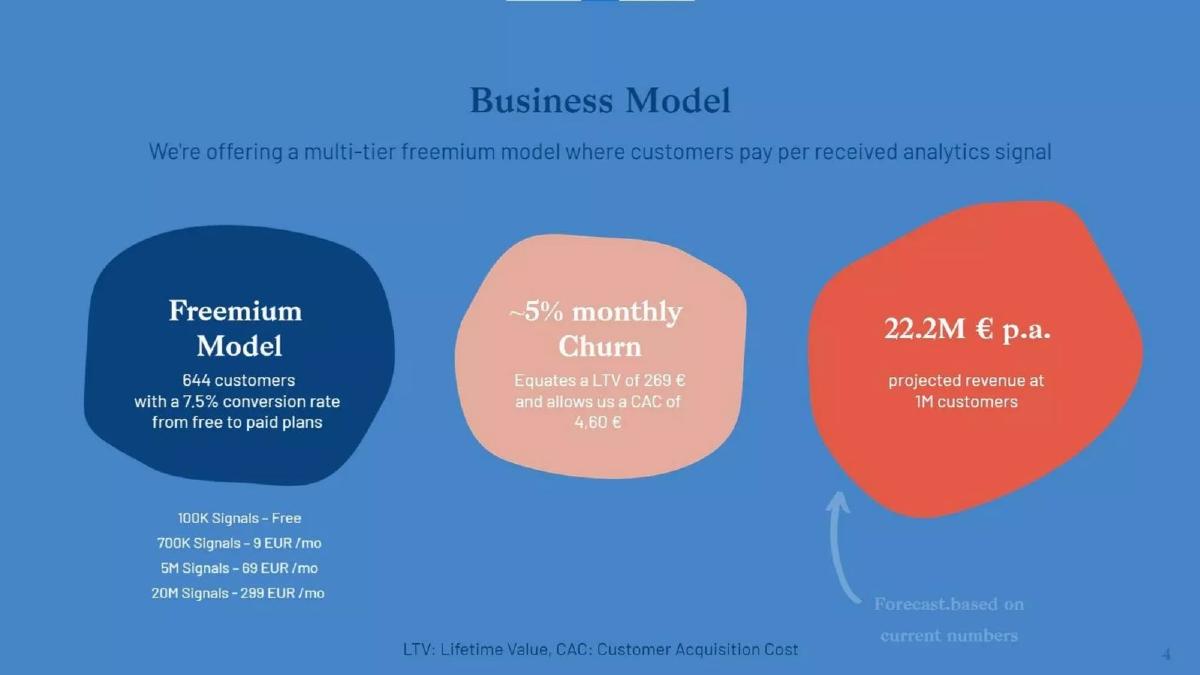
- TelemetryDeck uses a signal-based pricing model, ranging from a free tier to 299 EUR/mo for 20M signals (Slide 4).
- Current traction shows a 7.5% conversion rate from free to paid plans among 644 customers (Slide 4).
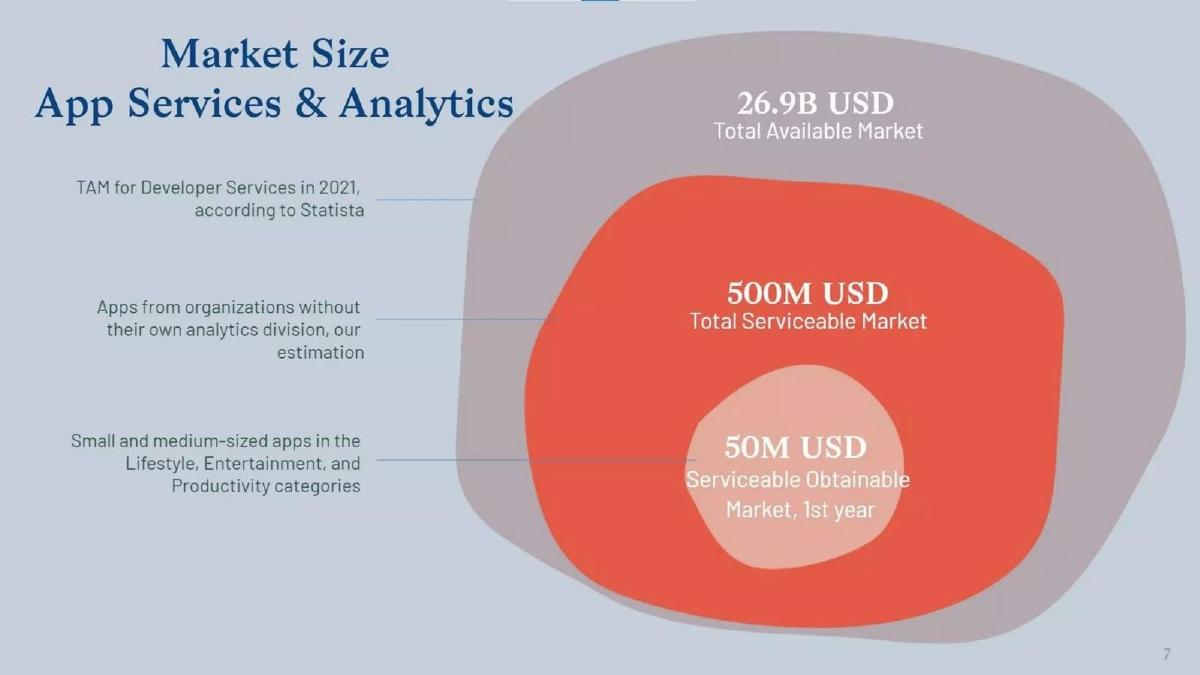
- The Total Available Market is estimated at 26.9B USD based on 2021 Statista data for developer services (Slide 6).
- The competitive landscape positions TelemetryDeck as the only 'privacy aware' solution optimized specifically for apps (Slide 8).
- Traction data shows a significant spike in 'Signals' processed starting in September 2021, reaching over 400 million by year-end (Slide 10).
- The team consists of a privacy expert and a CTO with experience in big data and mobile app development (Slide 11).
- The financial roadmap targets break-even by mid-2023 with a projected revenue of 972,728 EUR in 2024 (Slide 12, 13).
Privacy as a Competitive Advantage
The TelemetryDeck pitch deck is a masterclass in identifying a regulatory and cultural shift—privacy—and building a business model around it. In a post-GDPR world where users are increasingly fatigued by cookie banners and tracking prompts, TelemetryDeck offers a way for developers to get the data they need without the 'sneaky' baggage of traditional SDKs. The deck is clean, data-rich, and focused on the developer experience.
Slide 1: Title and Tagline
The deck opens with a clear, descriptive tagline: "Anonymized user tracking for apps." The illustration depicts a collaborative development environment, immediately signaling that this is a B2B tool for creators. It avoids buzzwords, opting instead for a functional description of the service.
Slide 2: The Problem
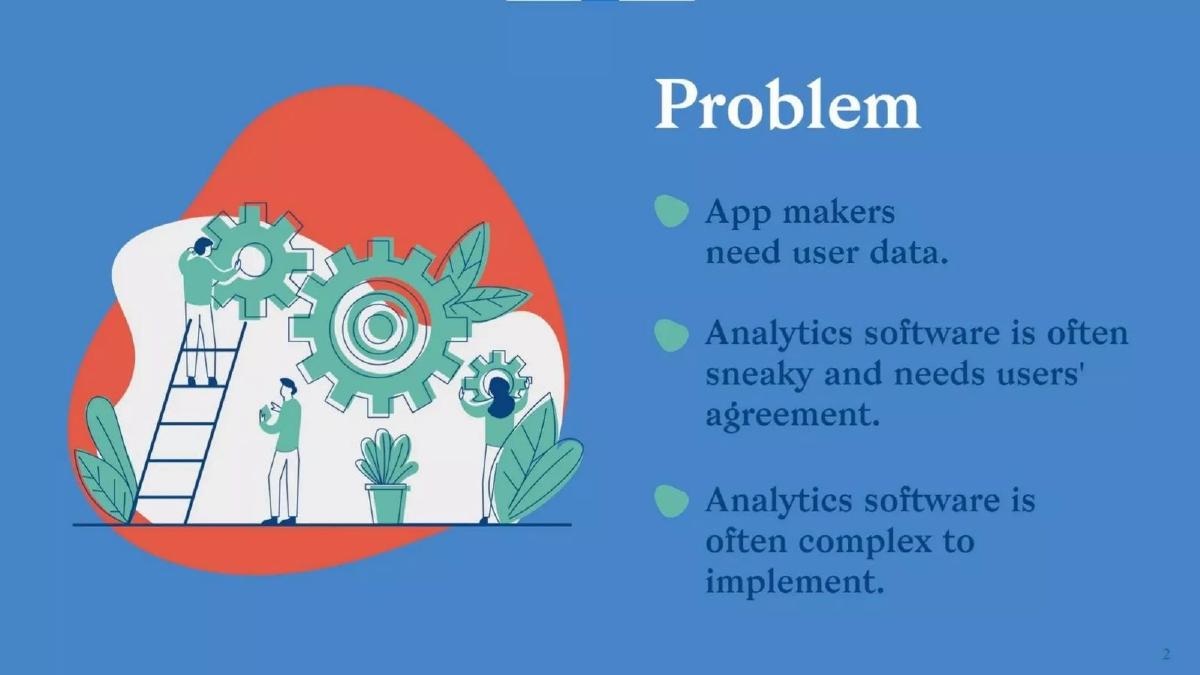
Slide 2 breaks down the problem into three digestible points: app makers need data, current software is 'sneaky' (requiring user agreement), and implementation is often too complex. By using the word 'sneaky,' the founders tap into the growing sentiment that traditional analytics providers are overstepping, creating a moral and technical opening for their product.
Slide 3: The Solution
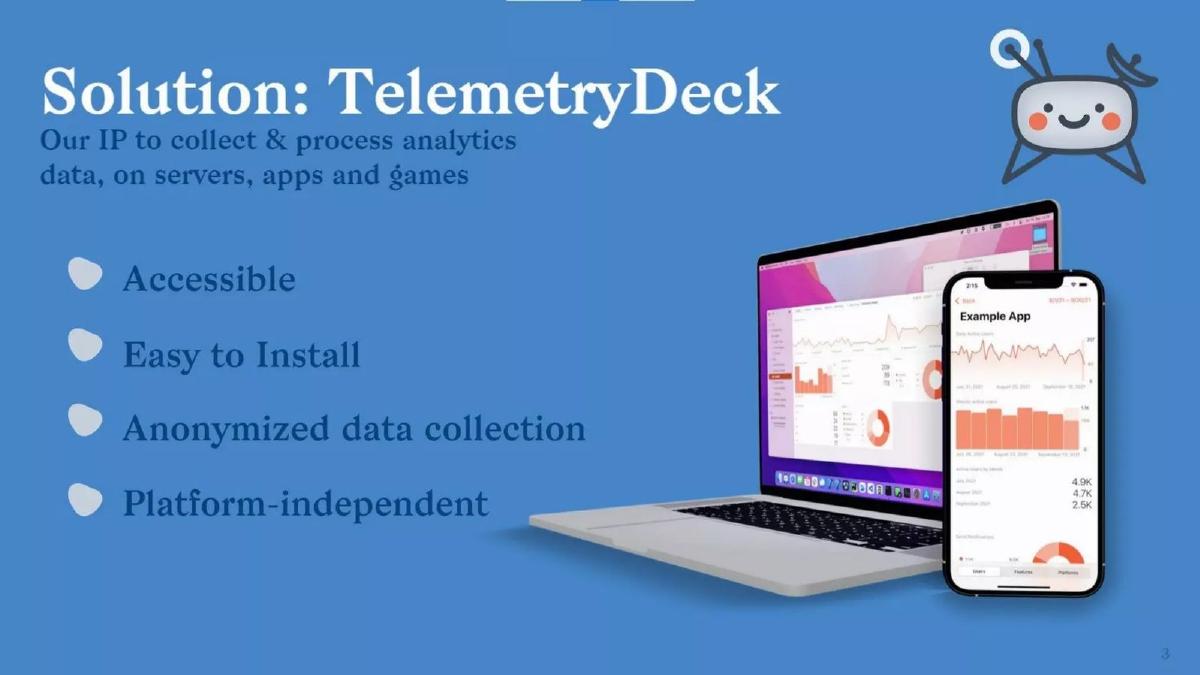
The solution slide introduces TelemetryDeck as IP designed to collect and process analytics on servers, apps, and games. It highlights four key pillars: Accessible, Easy to Install, Anonymized data collection, and Platform-independent. The inclusion of a laptop and smartphone mockup showing a dashboard provides immediate visual proof that the product is functional and ready for use.
Slide 4: Business Model and Unit Economics
This is one of the strongest slides in the deck. It outlines a multi-tier freemium model based on 'signals.' The transparency here is high: they disclose 644 customers , a 7.5% conversion rate , and a 5% monthly churn . They calculate an LTV of 269 EUR against a CAC of 4.60 EUR . These numbers suggest a highly efficient acquisition engine, even at this early stage. The projected revenue of 22.2M EUR at 1M customers sets a clear, if ambitious, North Star.
Slide 5: Go-to-Market Strategy
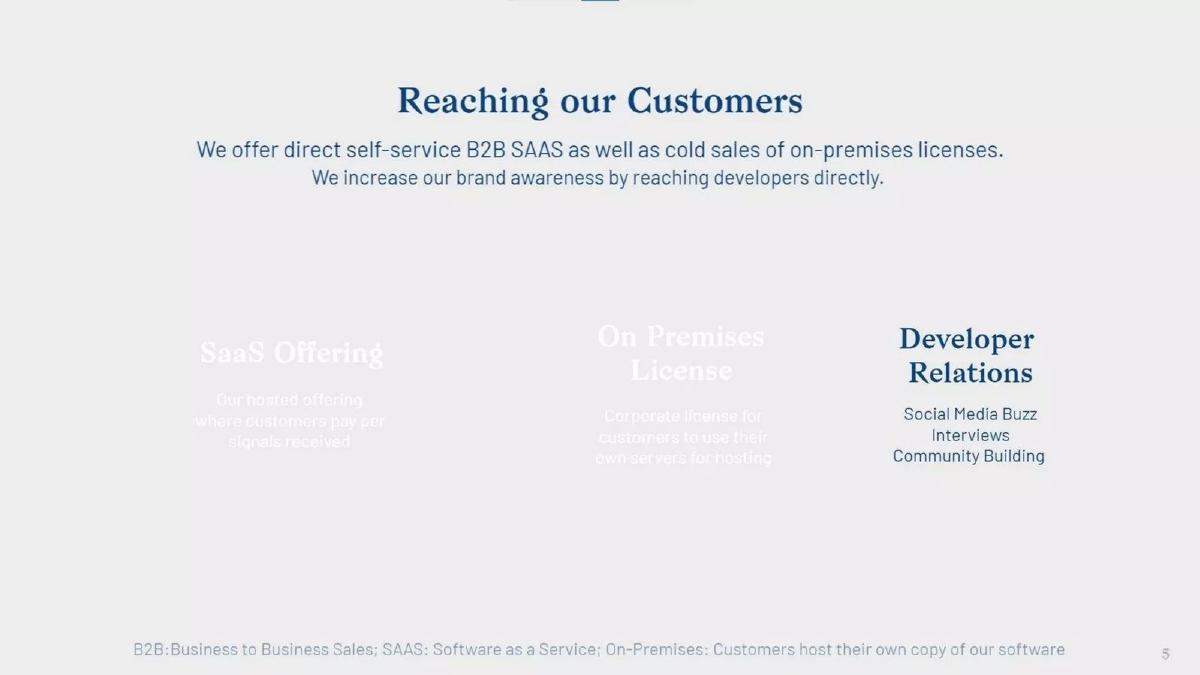
Slide 5, titled "Reaching our Customers," details their distribution channels. They offer a self-service SaaS, on-premises licenses for larger corporations, and a heavy emphasis on Developer Relations . The mention of 'Social Media Buzz' and 'Community Building' aligns with how modern dev-tools are adopted—bottom-up through the engineering ranks rather than top-down through procurement.
Slide 6: Market Size
The market sizing slide uses the standard TAM/SAM/SOM concentric circles. They cite Statista for a TAM of 26.9B USD in developer services. Their SAM targets apps without internal analytics divisions (500M USD), and their first-year SOM targets small to medium apps in specific categories (50M USD). This tiered approach shows a realistic understanding of where they can win immediately versus where they hope to grow.
Slide 7: The Competitive Landscape
Slide 8 (labeled 'Timing') uses a 2x2 matrix to position TelemetryDeck against giants like Google Firebase, Mixpanel, and Amplitude . They place themselves in the top-right quadrant: 'privacy aware' and 'optimized for apps.' By contrasting themselves with 'data-hungry' competitors and 'website-optimized' tools like Matomo, they carve out a specific niche that feels underserved.
Slide 8: Market Capture Strategy
Slide 9 outlines a three-step plan: start with indie apps to iterate quickly, move to 'big players' as a viable Google alternative, and use Open Source to capture the developer mindset. The commitment to open source is a key strategic move, as it allows for community audits of their privacy claims, which is essential for a company selling 'anonymized' tracking.
Slide 9: Traction and Growth
Slide 10 shows a 'Signals' growth chart. The data is impressive, showing a massive inflection point in late 2021, jumping from under 100 million signals in September to over 400 million signals by December. This hockey-stick growth is the primary evidence that their product-market fit is accelerating.
Slide 10: The Team
Slide 11 introduces the founders. Lisa Figas is positioned as the privacy expert with EU-level political engagement, while Daniel Jilg is the technical lead with a background in CTO roles and big data. This pairing covers both the 'why' (privacy regulation) and the 'how' (technical implementation) of the business.
Slide 11: Roadmap and Milestones
Slide 12 provides a timeline from their invitation-only beta in November 2020 to a projected break-even in mid-2023 . Notable milestones include being featured on ProductHunt in May 2021 and winning the 'Start?Zuschuss!' award in October 2021. The timeline shows a consistent cadence of product releases and community recognition.
Slide 12: Financial Projections
Slide 13 presents a detailed financial roadmap through 2024. They project revenue growing from 21,980 EUR in 2022 to 972,728 EUR in 2024 . The personnel costs are the largest expense, scaling from 251k EUR to 824k EUR. This slide demonstrates a disciplined approach to scaling, showing exactly how the investment will be burned to reach profitability.
Slide 13: The Ask
The penultimate slide (Slide 14) clarifies the funding requirement: 900,000 EUR . A donut chart shows that 84.3% of this will go toward salaries. This is typical for a software startup where the primary asset is the engineering team. The remaining 15.7% covers operations, marketing, and licenses.
Slide 14: Contact and Call to Action
The final slide provides contact information and a screenshot of their website, reinforcing the 'Lightweight Analytics That's Not Evil' branding. It invites investors to join the journey by providing a direct email and website URL.
What Works in This Deck
Specific Unit Economics: The inclusion of CAC, LTV, and churn on Slide 4 is rare for a pre-seed deck and provides immediate credibility. It shows the founders are thinking about the business as a machine, not just a product.
Clear Competitive Positioning: The 2x2 matrix on Slide 8 is effective because it uses axes that actually matter to their target audience: privacy and platform optimization. It makes their value proposition feel inevitable rather than optional.
Traction Transparency: The 'Signals' chart on Slide 10 is a great proxy for usage. Even if revenue is still low, the sheer volume of data being processed proves that developers are integrating the SDK into their apps.
What Is Missing
Customer Testimonials: While they mention 'notable influencer developers' on Slide 10, they don't provide any direct quotes or logos of the apps currently using the service. Seeing who these 644 customers are would add significant social proof.
Technical Deep Dive: For a product whose main selling point is 'anonymized data,' a brief explanation or diagram of how they achieve this without losing utility would be beneficial. Investors may worry that 'anonymized' means 'less useful' for marketing purposes.
Retention Data: While they provide churn, they don't show a cohort analysis. Understanding if users stay active after the initial integration is crucial for long-term SaaS viability.
What a Founder Should Copy
The 'Problem' Framing: TelemetryDeck doesn't just say 'analytics are hard.' They frame it as a conflict between the developer's need for data and the user's right to privacy. This creates a 'hero' narrative for the product.
The Financial Roadmap: Slide 13 is an excellent template for showing how investment capital translates into personnel and eventually revenue. It removes the mystery of how the 'Ask' will be spent.
The Signal-Based Pricing: Founders should look at Slide 4 as a way to explain complex pricing models simply. By breaking it down into 'signals,' they make the cost predictable and scalable for the customer.
Conclusion TelemetryDeck’s deck is a strong example of a 'thesis-driven' startup. They are betting on the continued rise of privacy regulation and developer autonomy. By providing hard numbers on their early experiments and a clear path to enterprise adoption, they make a compelling case for a 900k EUR seed round.
Frequently asked questions
- What is the primary value proposition of TelemetryDeck?
- TelemetryDeck provides anonymized user tracking for apps, allowing developers to collect essential usage data without compromising user privacy or requiring invasive consent forms. As stated on Slide 3, the solution is 'accessible, easy to install, and platform-independent,' aimed at solving the complexity and 'sneaky' nature of traditional analytics tools.
- How does the company plan to acquire customers?
- The strategy is three-fold: starting with small indie developers to build trust, moving to larger players as the product matures, and utilizing an open-source approach to capture the 'developer mindset.' Slide 5 also mentions direct self-service B2B SaaS, on-premises licenses for corporate clients, and developer relations through social media and community building.
- What are the key financial metrics shared in the deck?
- Slide 4 reveals a 5% monthly churn rate, a Lifetime Value (LTV) of 269 EUR, and a Customer Acquisition Cost (CAC) of 4.60 EUR. They also report 644 customers with a 7.5% conversion rate to paid plans. These metrics provide a clear picture of their early-stage unit economics and scalability potential.
- Who is the target audience for this product?
- Initially, the target is small and medium-sized apps in the lifestyle, entertainment, and productivity categories, representing a 50M USD Serviceable Obtainable Market (Slide 6). The long-term goal is to serve organizations without their own internal analytics divisions, estimated at a 500M USD market.
- How will the raised funds be utilized?
- According to Slide 14, the company is raising 900,000 EUR. The vast majority of this capital, 84.3%, is dedicated to salaries. The remaining funds are split between business operations (8.8%), marketing (4.8%), and licenses (2.1%), indicating a heavy focus on product development and engineering talent.