Campus Crest Communities utilizes a highly standardized, branded approach to student housing under 'The Grove' moniker. By targeting medium-sized, high-growth markets with a 'resort-style' amenity package, they achieved a 97.8% CAGR in bed count between 2005 and 2010. The deck emphasizes a vertically integrated platform that handles everything from site selection and construction to property management. With a weighted average portfolio age of just 2.5 years and an average distance to campus of 0.6 miles, the company positions itself as a modern alternative to aging university-owned dormitori…
Key takeaways
- The company achieved a 97.8% CAGR in total beds from 2005 to 2010, growing from 448 to 13,580 beds (Slide 14).
- Campus Crest targets medium-sized markets with strong enrollment growth, averaging 7.2% (Slide 4).
- The portfolio is exceptionally young, with a weighted average age of 2.5 years as of early 2011 (Slide 4).
- Properties are universally branded as 'The Grove,' focusing on a 'fully-loaded college living' experience (Slide 10).
- The business model is vertically integrated, covering property management, development, construction, and wholesale supply (Slide 12).
- Total market capitalization stood at $573.1 million as of December 31, 2010, with a 25.1% debt-to-equity ratio (Slide 16).
- The development pipeline identifies over 200 potential markets, with due diligence active on 80 sites (Slide 12).
- Strategic focus is placed on 'bed/bath parity,' meaning every student has a private bathroom, contrasting with communal dorms (Slide 4, Slide 6).
Executive Summary: The Branded Student Housing Play
The Campus Crest Communities presentation is a classic example of a real estate growth story centered on standardization and vertical integration. By moving away from the 'dormitory era' and toward a branded, 'resort-style' experience, the company successfully carved out a niche in medium-sized university markets. The deck focuses heavily on the speed of their scale and the consistency of their product, 'The Grove.'
Slide 1: Title Slide
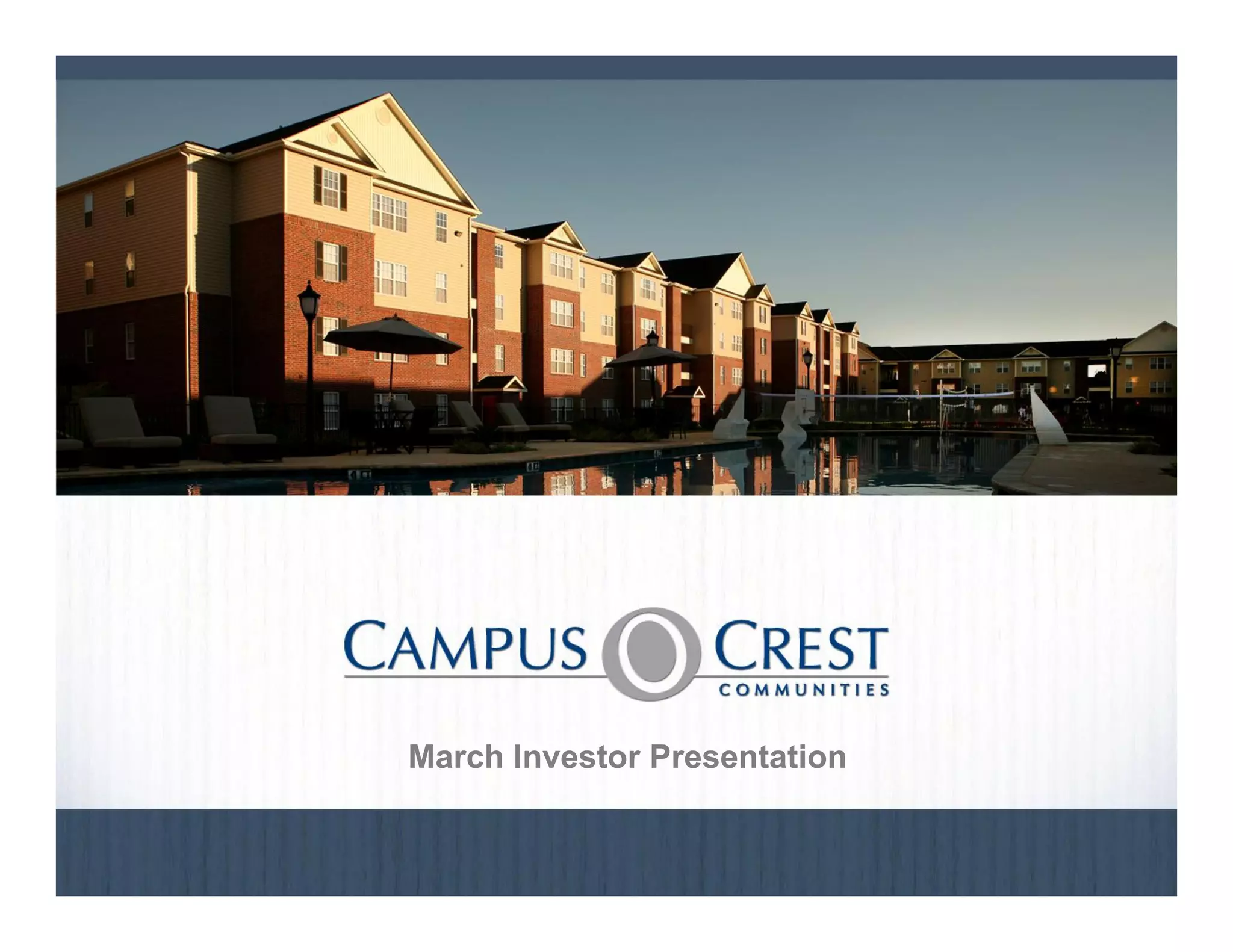
The cover features a high-quality photograph of a 'The Grove' property, showcasing the signature brick architecture and resort-style pool area. The branding for Campus Crest Communities is prominent, and the document is labeled as a 'March Investor Presentation.' The visual choice immediately establishes the asset class: modern, multi-family style student housing.
Slide 2: Investment Highlights
This slide serves as the executive summary, listing five core pillars of the investment thesis: Compelling Market Dynamics; Modern, Well-Located Portfolio; Proven Track Record; Experienced Team; and Conservative Capital Structure. Two photos of 'The Grove' properties in Milledgeville, GA, and Nacogdoches, TX, reinforce the geographic diversity and consistent aesthetic of the portfolio.
Slide 4: Attractive Portfolio and Growth Platform
This is a data-heavy slide that provides a snapshot of the company's footprint as of early 2011. A map of the United States shows the concentration of properties, primarily in the Southeast, Midwest, and Texas. Key metrics include:
Properties: 27 · Total Units / Beds: 5,048 / 13,580 · Weighted Average Age: 2.5 years · Average Distance to Campus: 0.6 miles · Occupancy: 89%
The slide also notes that their target markets have a 7.2% average enrollment growth, justifying the focus on medium-sized, high-growth areas.
Slide 6: The Evolution of Student Housing – The Dormitory Era
This 'Problem' slide uses bleak imagery of traditional on-campus housing. Photos show cramped rooms with twin beds, communal 'gang' showers, and institutional bathrooms. The text describes these as having 'shared rooms, communal bathroom facilities and extremely limited (if any) amenities and parking.' This sets the stage for the Campus Crest solution.
Slide 8: The Evolution of Student Housing – State of the Art Prototype
This is the 'Solution' slide, contrasting the previous imagery with photos of 'The Grove' properties. The images highlight large pools, modern clubhouses with zebra-print furniture, and dining areas that look more like upscale bistros than student cafeterias. It emphasizes the 'Prototype' nature of their builds, suggesting that this high-end experience is repeatable across their portfolio.
Slide 10: Universally Branded 'The Grove'
This slide focuses on marketing and brand identity. It displays various advertisements for 'The Grove' that use edgy, student-focused messaging (e.g., 'Be the only one that uses your deodorant' to highlight private bathrooms). The tagline 'fully-loaded college living' is introduced here, emphasizing that the brand is a lifestyle choice, not just a place to sleep.
Slide 12: Identified Pipeline of Future Development Opportunities
To demonstrate future growth, this slide shows a map dotted with over 200 potential markets. The company states they are conducting due diligence on 80 sites. They reiterate their vertically integrated model, which includes property management, development, construction, and wholesale supply. This integration is presented as a way to 'reduce costs and shorten development periods.'
Slide 14: Proven and Scalable Business Model
This slide contains the most impressive growth charts in the deck. The top chart shows the Total Number of Beds growing from 448 in 2005 to 13,580 in 2010, a 97.8% CAGR . The bottom chart shows the Number of Properties growing from 1 to 27 in the same period, a 93.3% CAGR . They also include a projection for 2011, estimating a jump to 17,064 beds.
Slide 16: Prudent Capital Structure With Fully-Financed Growth
This slide addresses financial stability. As of 12/31/2010, the total market capitalization was $573.1 million . The debt-to-equity ratio is highlighted at 25.1%. The right side of the slide breaks down 'Total Potential Liquidity' of $258 million , which includes a revolving credit facility, construction facilities, and equity commitments. A key takeaway here is the statement: 'Capitalized for growth with no maturities until 2014.'
Slide 18: Investment Highlights (Closing)
The presentation concludes by restating the investment highlights from Slide 2, this time accompanied by an interior shot of a bedroom at 'The Grove at Mobile.' The interior photo emphasizes 'bed/bath parity,' showing a private bedroom that leads into a private living space, further distancing the product from the communal dorms shown earlier.
What Works in This Deck
The 'Before and After' Narrative: Slides 6 and 8 are highly effective. By showing the visceral difference between a 'gang shower' and a resort-style pool, the founders make the demand for their product self-evident without needing complex charts.
Standardization as a Strength: The deck leans into the 'Prototype' and 'Universal Brand' concepts. For investors, this signals that the company has a 'cookie-cutter' model that can be deployed rapidly and efficiently, reducing the risk of bespoke construction projects.
Clear Growth Trajectory: The CAGR figures on Slide 14 are exceptionally strong. Showing a five-year track record of near-100% annual growth in bed count provides significant credibility to their future pipeline claims.
What is Missing
Unit Economics: While the deck mentions 'lower cap-ex requirements' and 'value-maximizing platforms,' it does not provide specific unit economics. There is no mention of the average cost to build a bed versus the average rent per bed, nor is there a breakdown of Net Operating Income (NOI) margins.
Detailed Team Slide: Although an 'Experienced Team' is mentioned as a highlight, the provided slides do not include a dedicated team page with bios or specific track records of the executives. In real estate, the 'jockey' is often as important as the 'horse.'
Competitive Landscape: The deck mentions 'less institutional competition' in medium-sized markets, but it does not name specific competitors or show a comparison of amenities and pricing against other private student housing providers like American Campus Communities.
Founder Takeaways
Use Vertical Integration to Defend Margins: If your startup controls multiple stages of the value chain (like Campus Crest does with construction and management), make that a centerpiece of your scalability argument. It suggests you can grow faster and cheaper than competitors who outsource those functions.
Brand the Experience, Not Just the Product: Campus Crest didn't just sell 'apartments'; they sold 'The Grove.' By creating a lifestyle brand around student housing, they created a recognizable entity that students would look for as they moved or recommended to friends, which is clearly displayed in their marketing slide.
Quantify the Pipeline: Don't just say you plan to grow. Show a map with specific 'identified' opportunities and state exactly how many are currently in the due diligence phase. This turns a vague promise of growth into a tangible work-in-progress.
Frequently asked questions
- What is the primary value proposition of Campus Crest?
- Campus Crest positions itself as the 'evolution' of student housing. Unlike traditional dormitories with shared rooms and communal bathrooms, their 'The Grove' properties offer private bathrooms, resort-style amenities (like pools and fitness centers), and close proximity to campus (averaging 0.6 miles). They target high-growth, medium-sized university markets where institutional competition is lower.
- How fast did the company scale leading up to this presentation?
- The growth was aggressive. Between 2005 and 2010, the number of properties grew from 1 to 27, representing a 93.3% CAGR. In terms of bed capacity, they scaled from 448 beds to 13,580 beds in the same five-year period, a 97.8% CAGR. They projected reaching over 17,000 beds by the end of 2011.
- What does their capital structure look like?
- As of December 31, 2010, the company reported a total market capitalization of $573.1 million. This was composed of approximately 25.1% debt (including pro-rata shares of joint venture debt) and the remainder in equity. They highlighted $258 million in total potential liquidity to fund future developments.
- What is their strategy for future expansion?
- Campus Crest uses a 'prototypical roll-out' strategy to reduce costs and shorten development periods. They have identified over 200 potential markets and were conducting due diligence on 80 sites at the time of the deck. Their criteria include high enrollment growth, limited competing products, and proximity to campus.
- How does the company handle property operations?
- They use a vertically integrated platform. This means they do not just own the assets; they manage the development, construction, and ongoing property/asset management internally. They also utilize a 'wholesale supply' model to maintain consistency and control costs across their universally branded 'The Grove' locations.