Heura’s pitch deck for their 2023 strategic round is a high-energy, data-dense presentation that successfully pivots from a product-focused narrative to a brand-dominance story. The deck relies heavily on market share data in Spain, where they claim a 77% share of voice in social media and a conversion funnel that outperforms global giants like Beyond Meat. By framing their products as 'Meat Successors'—balancing taste, nutrition, and price—they address the common pitfalls of the first wave of plant-based meats. While the deck is light on granular unit economics in the provided slides, it com…
Key takeaways
- Heura positions itself as a 'Meat Successor,' claiming to solve the trade-off between sensorial experience and nutrition that plagues competitors (Slide 3).
- The company demonstrates significant market dominance in Spain, citing a 77% share of voice in social media compared to competitors (Slide 5).
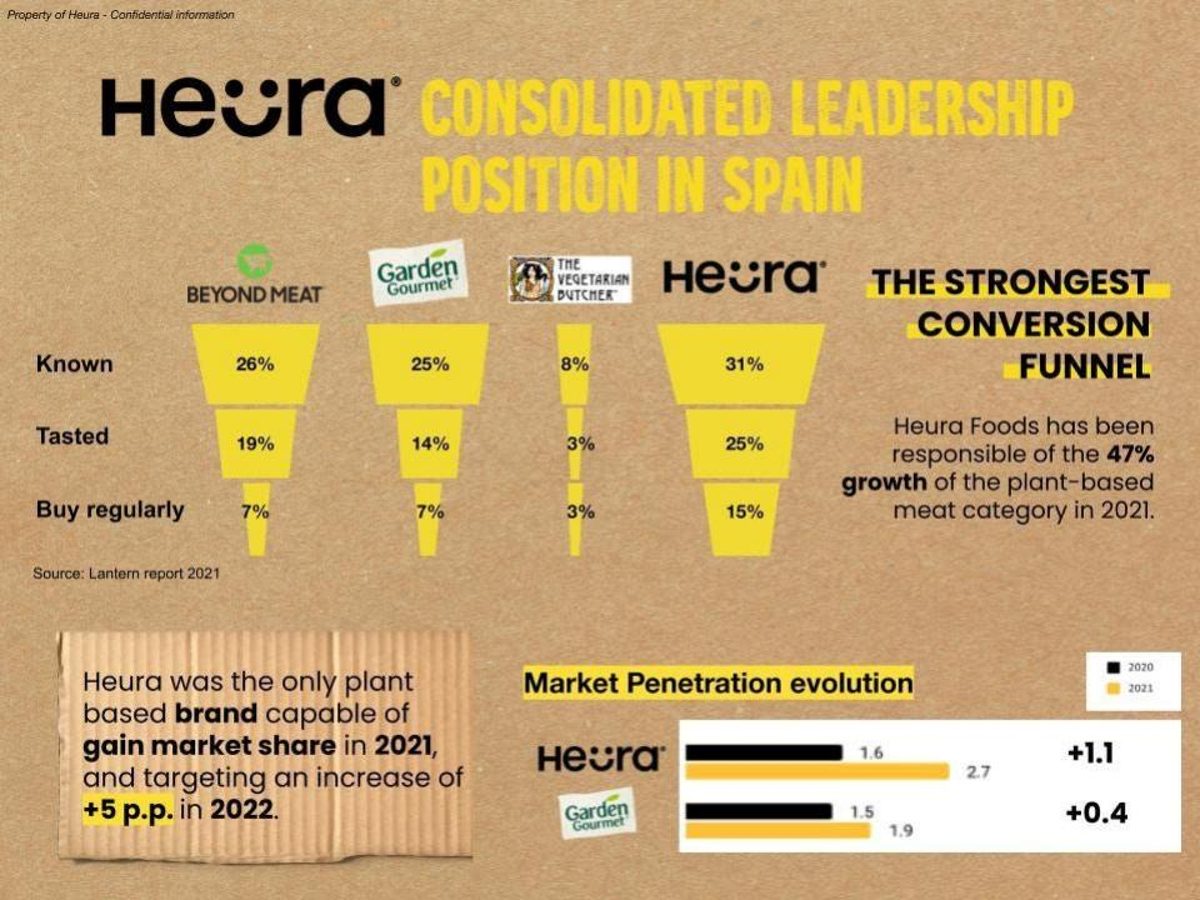
- Heura reports a superior conversion funnel in Spain, with 15% of consumers buying regularly compared to 7% for Beyond Meat and Garden Gourmet (Slide 7).
- The deck highlights a 47% contribution to the growth of the entire plant-based meat category in Spain during 2021 (Slide 7).
- Nutritional superiority is a core pillar, with their chicken alternative containing 49% less fat than other plant-based products (Slide 4).
- The startup has successfully moved into institutional sectors, partnering with over 400 schools to introduce plant-based menus (Slide 6).
- Heura leverages a strong existing investor base, including Unovis, New Crop Capital, and the CEO of Glovo, to signal credibility (Slide 8).
- Financial projections show an aggressive revenue ramp-up from 2020 through 2023, targeting European leadership (Slide 9).
Heura Pitch Deck Analysis: The Rise of the 'Meat Successors'
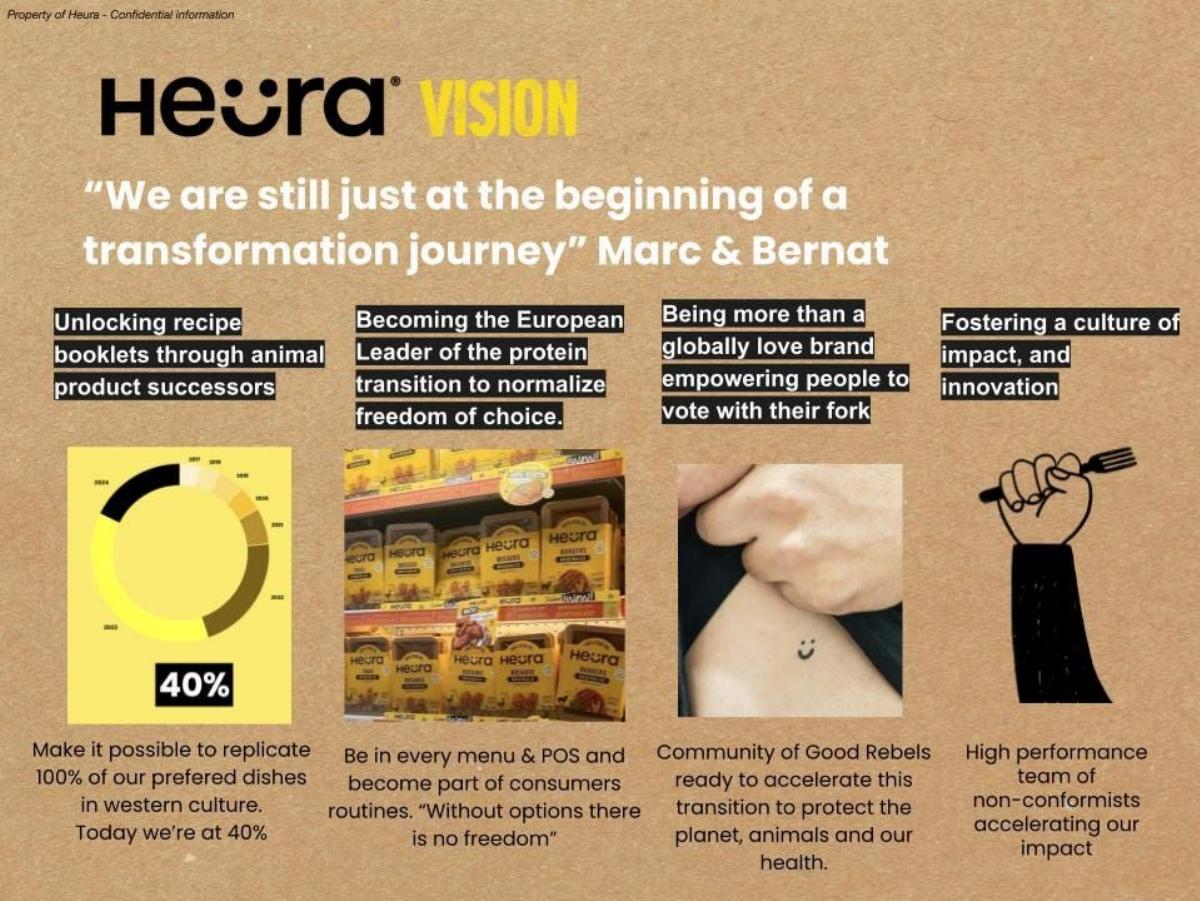
Heura’s pitch deck for their 2023 strategic round, which successfully raised $20M, is a masterclass in regional dominance and brand positioning. Based in Barcelona, the company doesn't just aim to be another vegan option; they position themselves as the 'Meat Successors.' This teardown examines how they used their stronghold in the Spanish market to build a case for European leadership.
Slide 1-2: Brand Identity and Mission
The deck opens with a high-contrast yellow aesthetic that is synonymous with the Heura brand. The tagline 'The Meat Successors' is immediately visible. This is a strategic linguistic choice. By moving away from 'substitute' or 'alternative,' Heura positions itself as the inevitable evolution of the meat industry rather than a niche compromise for vegans.
Slide 3: The Mediterranean Plant-Based Revolution
Slide 3 introduces the core value proposition. Heura categorizes the market into three segments: Traditional Plant-Based Products, Meat Alternatives, and Meat Successors. They argue that traditional products (like tofu or seitan) offer good nutrition but fail the 'sensorial experience.' Conversely, they suggest that modern 'Meat Alternatives' (likely referencing the first wave of high-tech burgers) nail the taste but fail on nutrition. Heura claims the 'Meat Successor' category for itself, promising taste, nutrition, and price that allow consumers to 'eat everyday.'
Slide 4: Product Proof and Nutritional Superiority
Slide 4 focuses on the 'chickeny' experience. It uses a bar chart to show that Heura scores 79% on a 'most chickeny experience' test, compared to 68% and 56% for competitors. More importantly, it provides hard nutritional data: 49% less fat than other plant-based products and 50% less saturated fat than animal meat. They also cite an 'Excellent' score on the Yuka app, a popular consumer tool in Europe for scanning food healthiness. This slide effectively bridges the gap between 'tastes good' and 'is good for you.'
Slide 5: Social Media Dominance and Share of Voice
This is one of the strongest slides in the deck. Heura claims a 77% share of voice in social media within its category. They show a Google Trends-style chart indicating that searches for Heura are 5x higher than other brands in Spain. For a consumer brand, this 'notoriety' is a leading indicator of retail success and bargaining power with distributors. It proves that their 'Food Activist' branding is resonating with the public.
Slide 6: Food Activism and Institutional Partnerships
Slide 6 leans into the 'Rebels with a Cause' narrative. It highlights their partnership with over 400 schools to introduce plant-based menus and their donation of 6,000kg of product to NGOs. This isn't just CSR; it's a market entry strategy. By getting into schools, they are training the palates of the next generation of consumers and building institutional trust that is hard for international competitors to replicate.
Slide 7: The Conversion Funnel and Market Share
Slide 7 provides the 'hard' business case. It compares the conversion funnels of Beyond Meat, Garden Gourmet, The Vegetarian Butcher, and Heura in the Spanish market. Heura leads in every category: 31% brand awareness, 25% trial (tasted), and 15% regular buyers. The most impressive stat is that Heura claims to be responsible for 47% of the entire category's growth in Spain in 2021. This slide tells investors: 'We own our home market, and our model is more efficient than the global giants.'
Slide 8: Investor Pedigree
Slide 8 showcases the €16M previously raised (prior to the 2023 round) from a mix of specialized food-tech VCs and strategic individuals. The inclusion of Unovis and New Crop Capital signals that the 'smart money' in alternative protein is already on board. The mention of Oscar Pierre (CEO of Glovo) adds local tech-scene credibility and suggests potential synergies with delivery platforms.
Slide 9: Financial Highlights and Projections
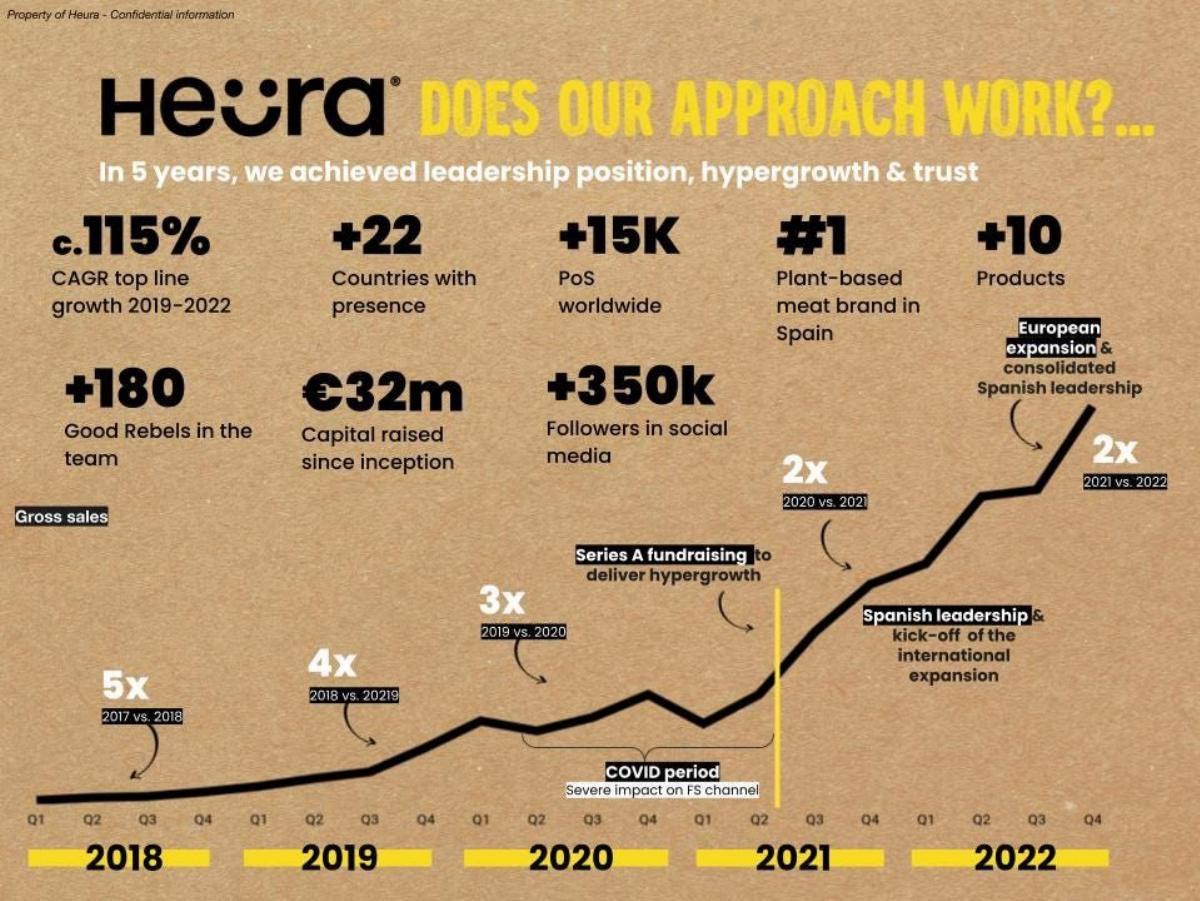
The final slide in this set shows a revenue bar chart from 2020 through 2023. While specific currency figures are obscured in this view, the trajectory is one of 'hyper growth.' The slide lists five strategic pillars: innovation-led growth, leading a social movement, international expansion, R&D as a value driver, and a path to profitability in mature markets. This addresses the common investor concern about the long-term profitability of the plant-based sector.
What Works in the Heura Deck
Clear Categorization: By creating the 'Meat Successor' category, they avoid being compared directly to cheaper, less healthy alternatives. · Hyper-Local Dominance: The deck proves that they have 'won' Spain. For a strategic round, showing a repeatable playbook in one major geography is often more convincing than being mediocre in ten. · Visual Consistency: The deck looks like the product packaging. It feels like a brand that already belongs on a supermarket shelf. · Data-Driven Activism: They balance 'saving the planet' with '47% of category growth.' They don't let the mission overshadow the metrics.
What is Missing from the Provided Slides
Unit Economics: While they mention 'profitability in the spotlight,' the provided slides do not show Contribution Margin or CAC/LTV metrics, which are critical for consumer goods. · Manufacturing and Supply Chain: There is no mention of whether they own their production facilities or use co-packers. In the plant-based space, margin expansion often depends on manufacturing scale. · Detailed International Roadmap: They mention 'European leader,' but the data is heavily skewed toward Spain. Investors would want to see if the 'Heura effect' is translating to France, Italy, or the UK.
Founder's Guide: What to Copy
The Comparison Funnel: Slide 7 is a perfect way to show competitive advantage. Instead of a simple 'check-box' grid, showing the conversion from 'Known' to 'Buy Regularly' proves that your product has better retention than the competition. · Third-Party Validation: Using the Yuka app score and Meltwater social media data adds objective credibility to subjective claims about health and popularity. · The 'Category Creator' Strategy: If you are entering a crowded market, don't just be 'better.' Define a new sub-category (like 'Meat Successors') that makes your competitors look obsolete.
Frequently asked questions
- What is Heura's primary competitive advantage according to the deck?
- Heura identifies as a 'Meat Successor.' Unlike 'Traditional Plant-Based Products' (which they claim have good nutrition but poor sensorial experience) or 'Meat Alternatives' (which have good sensorial experience but poor nutrition), Heura claims to offer both high nutritional value and a superior 'meat-like' experience at an affordable price point.
- How does Heura compare to Beyond Meat in its home market?
- In Spain, Heura claims to outperform Beyond Meat across the entire conversion funnel. According to Slide 7, Heura has higher brand awareness (31% vs 26%), higher trial rates (25% vs 19%), and double the regular purchase rate (15% vs 7%).
- What specific nutritional claims does Heura make?
- On Slide 4, Heura states their plant-based chicken has 49% less fat than other plant-based products and 50% less saturated fat than animal meat. They also highlight high protein content (19g/100g) and high fiber (6.3g/100g).
- What is Heura's strategy for social proof and brand awareness?
- Heura uses a 'Food Activist' narrative. They leverage high social media engagement (77% share of voice) and search volume (5x other brands). They also use institutional partnerships, such as serving plant-based meals in 400+ schools, to build brand trust and 'democratize' the category.
- Who are the key investors mentioned in the deck?
- The deck lists several prominent food-tech and regional investors, including Unovis Asset Management, New Crop Capital, Green Monday, Kale United, and Metro. Notable individual investors include Michiel van Deursen and Oscar Pierre, the CEO of Glovo.