Heyday’s 2019 Seed deck is a masterclass in establishing founder-market fit and social proof. By positioning their 'AI-augmented live chat' as the next step in the evolution of digital distribution, the founders successfully raised $2M. The deck relies heavily on the 'best of both worlds' narrative—combining AI efficiency with human empathy—to solve the omnichannel struggle for major brands. With 25 clients and $750k in bookings at the time of the pitch, the company demonstrated significant early traction for a Seed-stage startup. While the deck is visually dense and lacks a clear 'Ask' slide…
Key takeaways
- The deck positions conversational commerce as the successor to mobile apps and social media on slide 4.
- Heyday reports $750k in bookings and a weighted pipeline of $800k on slide 16.
- The startup had already secured 25 clients including major brands like Danone, LVMH, and Ford by slide 13.
- The product architecture integrates with major platforms like Shopify, Magento, and Salesforce as shown on slide 9.
- Founder Étienne Mérineau highlights 12 years of advertising experience and a Forbes 30 Under 30 accolade on slide 18.
- Founder David Bordeleau brings 18 years of software development experience and R&D leadership on slide 19.
- The market slide projects a $24B global chatbot market by 2024 with a 35% CAGR on slide 15.
- The 'Secret Sauce' slide emphasizes 'Two-way AI' and 'Conversational CRM' as core differentiators on slide 12.
Introduction: The Hybrid Approach to Retail AI
Heyday’s 2019 Seed deck arrived at a time when the initial hype of basic chatbots was fading, replaced by a demand for more sophisticated, brand-aware automation. Raising $2M on the back of this 40-slide presentation (of which 20 are analyzed here), the company focused on a 'human-in-the-loop' philosophy. The deck successfully argues that while AI is efficient, retail requires a level of empathy and brand nuance that only humans can provide—and that Heyday is the bridge between the two.
The Hook and Social Proof
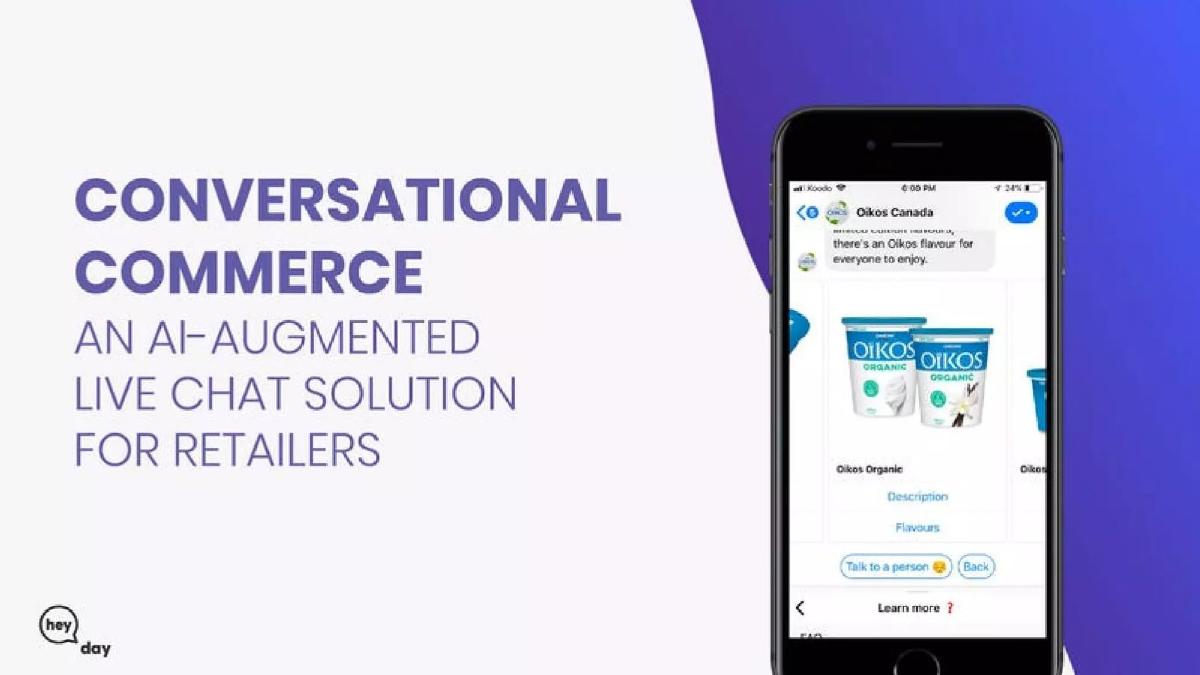
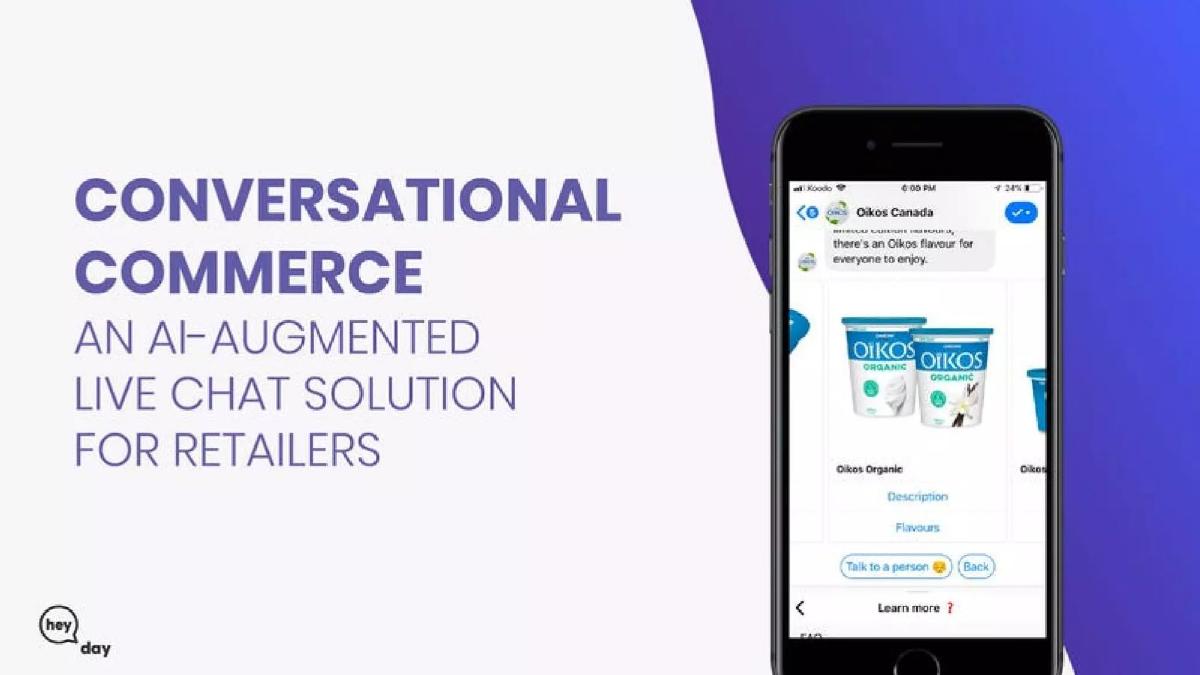
Slide 1 opens with a clear, descriptive title: 'Conversational Commerce: An AI-Augmented Live Chat Solution for Retailers.' It immediately identifies the target audience (retailers) and the product category. The inclusion of a mobile mockup showing a chat interface for Oikos Canada provides instant context.
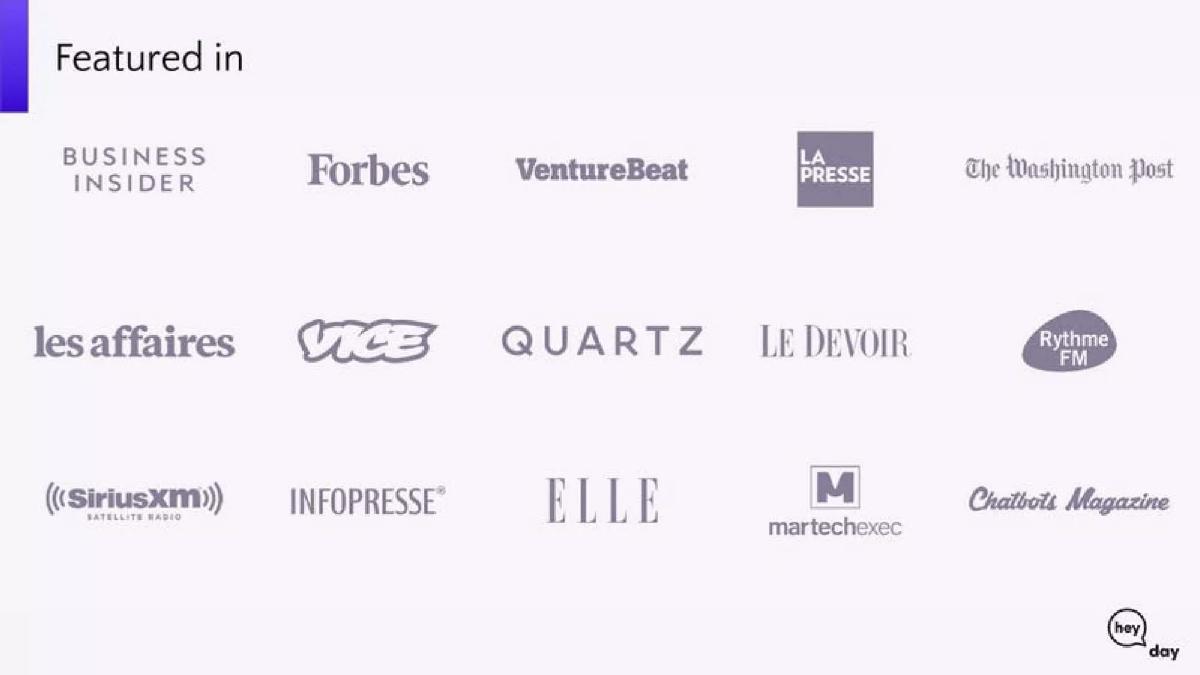
Slide 2 is a pure 'credibility' slide. By listing logos like Business Insider, Forbes, VentureBeat, and The Washington Post under 'Featured in,' Heyday establishes itself as a recognized player in the space before even explaining the problem. This is a common tactic to lower the investor's defensive barriers.
Defining the Paradigm Shift
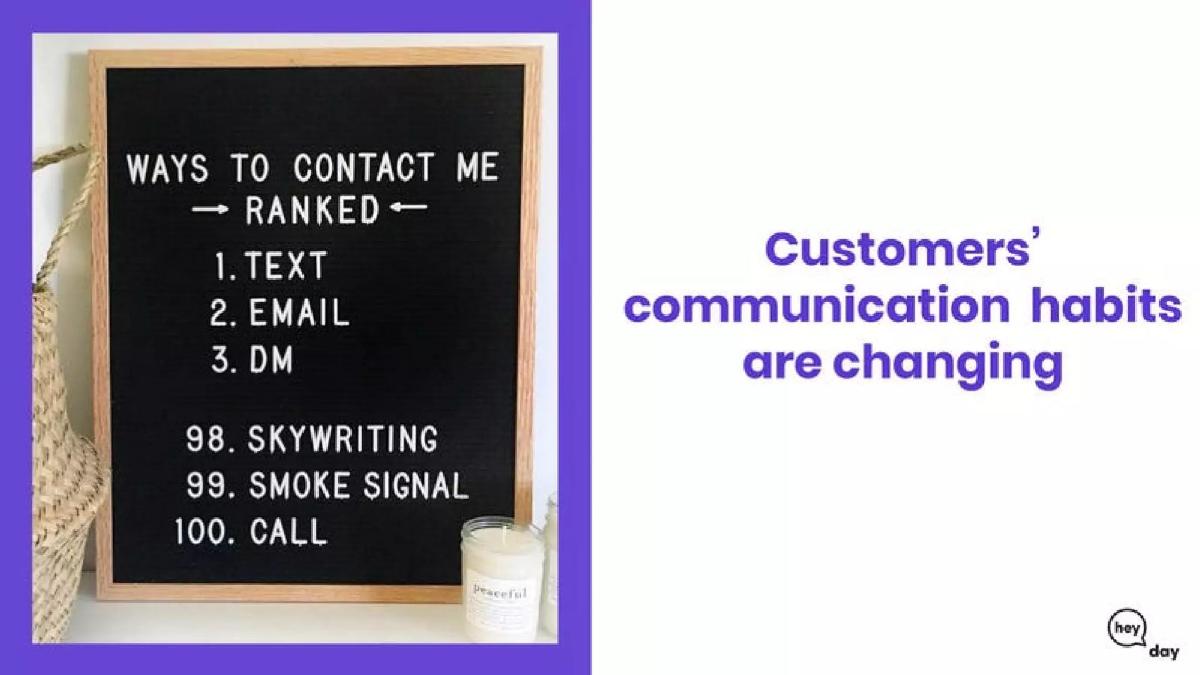
Slide 3 and 4 focus on the 'Why Now?' factor. Slide 3 uses a humorous 'Ways to contact me' list to show that phone calls are dead, while texting and DMs are the preferred communication methods. Slide 4 provides a more academic 'evolution of digital distribution' timeline, placing 'Messaging Apps' and 'Voice' as the current frontier following the eras of Web Portals, Search, Social Media, and Mobile Apps. This framing makes the product feel like an inevitability rather than a luxury.
Slide 5 backs this up with data from Nielsen (2018), stating that 53% of people are more likely to shop with a business they can message directly and 56% would rather message than call customer service. These figures provide the economic justification for retailers to adopt Heyday's technology.
The Problem and The Hybrid Solution
Slide 6 defines the core conflict: 'Brands struggle to deliver a true omnichannel experience and a personalized level of service at scale.' It frames the consequence as customer dissatisfaction and disloyalty. The mission statement at the bottom—'make every customer feel like a VIP'—is a strong emotional hook for a B2B product.
Slide 7 is arguably the most important slide in the deck. It introduces the 'Best of Both Worlds' concept. On the left, a robot icon handles lead gen, FAQs, and triage. On the right, a human icon handles complex/sensitive conversations and trains the AI. This addresses the common fear that AI might 'hallucinate' or damage a brand's reputation by keeping a human safety net in place.
Product Depth and Architecture
Slide 8 shows the platform's reach, illustrating that a single conversation can happen across Facebook Messenger, WhatsApp, Apple Business Chat, WeChat, and even voice assistants like Alexa. This reinforces the 'omnichannel' promise made earlier.
Slide 9 details the 'Software Architecture.' It shows how Heyday sits in the middle of a retailer's ecosystem, pulling data from product databases (Shopify, Magento, Lightspeed) and CRMs (SAP, Salesforce, Oracle) to power conversational touchpoints. This slide is crucial for technical due diligence, proving that the product isn't a standalone silo but a deeply integrated tool.
Slide 10 and 11 provide high-fidelity screenshots of the dashboard. Slide 10 shows 'Product database integration,' where an agent can see and recommend specific items (like cycling helmets) directly within the chat. Slide 11 introduces 'Retargeting (message broadcasts),' showing that the tool isn't just for support, but also for proactive sales and marketing.
The Competitive Edge and Traction
Slide 12 outlines the 'Secret Sauce.' The three points—Two-way AI, Brand-safe learning, and Conversational CRM—are designed to show defensibility. The claim that 'brand clients are locked into the mutually beneficial relationship' is music to a VC's ears, as it implies high switching costs and low churn.
Slide 13 is a 'Logo Wall' of current customers. For a Seed round, this list is exceptionally strong: Danone, LVMH, Ford, Decathlon, and major agencies like Ogilvy and WPP. This proves that the team can sell into complex enterprise environments.
Slide 14 pivots to the 'Ultimate Vision,' which is to 'Become the voice of brands in an AI-powered world.' This expands the scope from a simple chat tool to a foundational data layer for personalization.
Slide 15 addresses the market size. It cites a $24B global chatbot market by 2024 (35% CAGR) and a $248B mobile commerce market by 2020. While these are 'top-down' numbers, they are sufficiently large to justify a venture-scale investment.
Slide 16 delivers the hard metrics. With 25 clients and $750k in bookings, Heyday shows they have moved past the 'idea' phase. The distinction between 'Weighted' ($800k) and 'Raw' ($1.7M) pipeline shows a level of financial maturity and honesty often missing in early-stage decks.
The Team and Thought Leadership
Slide 17, 18, and 19 introduce the founders. The deck gives each founder a full slide, emphasizing their specific pedigree. Étienne Mérineau’s slide (18) focuses on his advertising awards and brand experience, while David Bordeleau’s slide (19) focuses on his 18 years of engineering and R&D leadership. This 'hacker and hustler' duo is a classic venture profile.
Slide 20 concludes the provided set by highlighting 'Thought leaders in Conversational commerce,' showing screenshots of articles written by the founders for VentureBeat. This reinforces the idea that they aren't just building a tool; they are defining the category.
What Works in the Heyday Deck
Exceptional Social Proof: The deck uses logos effectively at every stage. From the 'Featured in' slide at the start to the 'Trusted by' slide in the middle, the founders never let the investor forget that they have already won the trust of global giants like LVMH and Ford.
Clear Product-Market Fit: The integration slide (Slide 9) and the product screenshots (Slides 10-11) show a product that is built for the existing retail workflow. By connecting to Shopify and Salesforce, Heyday proves it is a 'must-have' utility rather than a 'nice-to-have' widget.
Honest Traction Reporting: Reporting both raw and weighted pipelines is a sophisticated way to show momentum. It gives investors a realistic view of the sales cycle and the company's near-term growth potential.
What is Missing from the Heyday Deck
The Ask: In the 20 slides provided, there is no mention of how much money is being raised, the valuation, or the specific milestones the $2M Seed round is intended to hit. While this may be in the latter 20 slides, its absence in the first half is notable.
Unit Economics: While the deck mentions $750k in bookings, it does not disclose the Customer Acquisition Cost (CAC), Lifetime Value (LTV), or average contract value (ACV). For a SaaS business, these are critical metrics for understanding the scalability of the sales motion.
Competitive Landscape: The deck focuses entirely on Heyday. It does not acknowledge competitors like Intercom, Drift, or LivePerson, which were already established in 2019. A 'Competitor Matrix' would have helped define their unique positioning more clearly.
What a Founder Should Copy
The 'Evolution' Narrative: Slide 4 is a perfect example of how to frame your startup as the logical next step in history. If you can convince an investor that your category is the 'new paradigm,' the battle is half-won.
The Hybrid Value Proposition: If you are building in AI, copy the 'Best of Both Worlds' approach from Slide 7. Acknowledging the limitations of AI and showing how your product mitigates them with human oversight builds trust and demonstrates a realistic understanding of the technology.
Individual Founder Slides: Instead of a single 'Team' slide with tiny headshots, give your key founders room to breathe. Heyday’s use of full-page bios (Slides 18-19) allows them to list specific brand names and years of experience that would be lost in a crowded group slide.
Final Verdict: Heyday’s deck is a high-signal, professional presentation that relies on enterprise validation to overcome the 'just another chatbot' stigma. It is a textbook example of how to use early traction to tell a much larger story about the future of commerce.
Frequently asked questions
- What is Heyday's core product offering?
- Heyday offers an AI-augmented live chat solution specifically designed for retailers. As detailed on slide 7, the platform automates lead generation and FAQ handling while seamlessly routing complex or sensitive conversations to human agents. It functions as a hybrid system where AI learns from human interactions to maintain a brand-consistent tone.
- How much traction did Heyday have when raising their Seed round?
- According to slide 16, Heyday had significant traction for a 2019 Seed round, reporting 25 active clients and $750,000 in bookings. Furthermore, they disclosed a raw sales pipeline of $1.7 million ($800,000 weighted), indicating strong market demand and a functioning enterprise sales motion.
- Which industries does Heyday target?
- The deck specifically targets the retail and e-commerce sectors. Slide 13 showcases a diverse range of prestigious clients across luxury (LVMH), automotive (Ford, Bridgestone), food and beverage (Danone), and sports retail (Decathlon). They also list several major advertising agencies like Ogilvy and WPP as partners or users.
- What is the 'Secret Sauce' mentioned in the deck?
- Slide 12 defines their competitive advantage through three pillars: Two-way AI (interplay between bot and human), Brand-safety (AI training on proprietary brand data), and Conversational CRM. The latter is described as a 'compounding effect' where owning the data leads to high client lock-in.
- Who are the founders of Heyday?
- The deck highlights two co-founders: Étienne Mérineau (CPO), a marketing expert with 12 years of experience and a Forbes 30 Under 30 recipient, and David Bordeleau (COO/Head of Engineering), who has 18 years of software development experience and previously led R&D labs at Genband.