The Hims and Hers SPAC deck from October 2020 serves as a masterclass in narrative expansion. While the company began with a focus on 'stigma' categories like erectile dysfunction and hair loss, this deck successfully reframes the business as a comprehensive, digitally native healthcare platform. By showcasing a 128% revenue CAGR and a gross margin jump from 29% to 71% in just two years, the founders demonstrated a scalable, high-margin software-like model applied to physical health. The transaction summary slide explicitly targets a $1.6 billion enterprise value, supported by a veteran leade…
Key takeaways
- The deck positions the company as a 'fully verticalized multi-condition health platform' rather than just a D2C pharmacy (Slide 11).
- Hims and Hers reported a massive jump in gross margin from 29% in 2018 to an estimated 71% in 2020 (Slide 31).
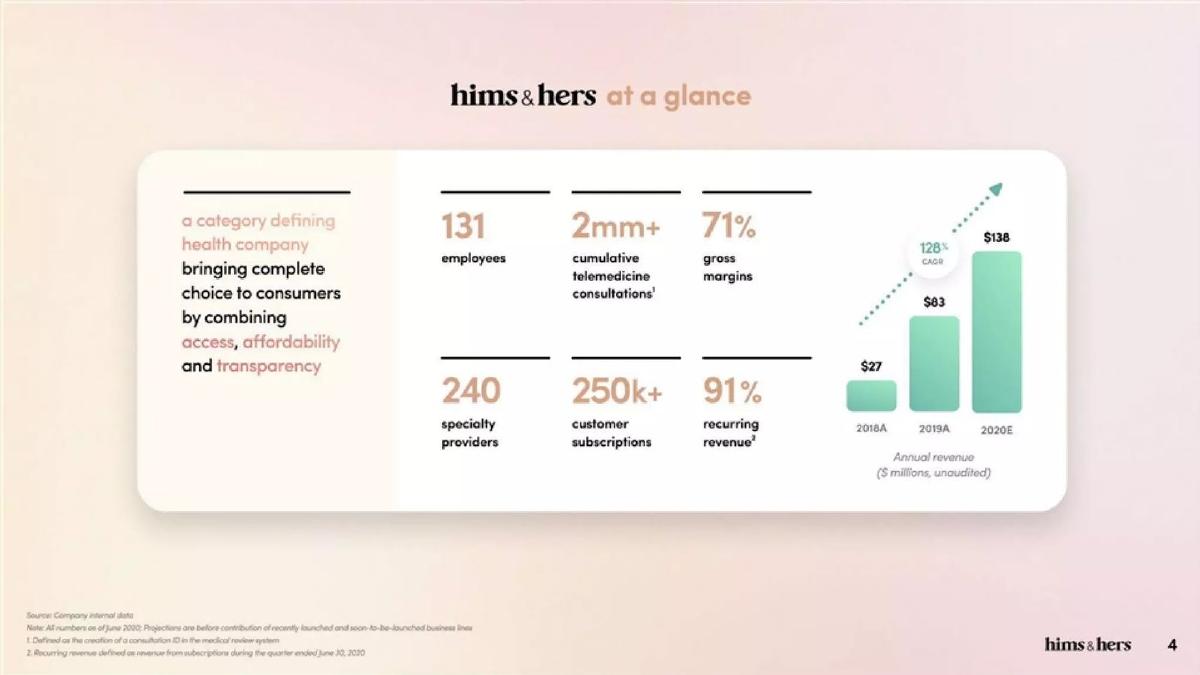
- The company achieved a 128% revenue CAGR, growing from $27M in 2018 to an estimated $138M in 2020 (Slide 31).
- Traction is evidenced by over 2 million telemedicine consultations and 10 million cumulative patient touchpoints since launch (Slide 16).
- The expansion strategy targets massive markets including Primary Care ($280bn) and Diabetes ($70bn) to move beyond their initial niche (Slide 21).
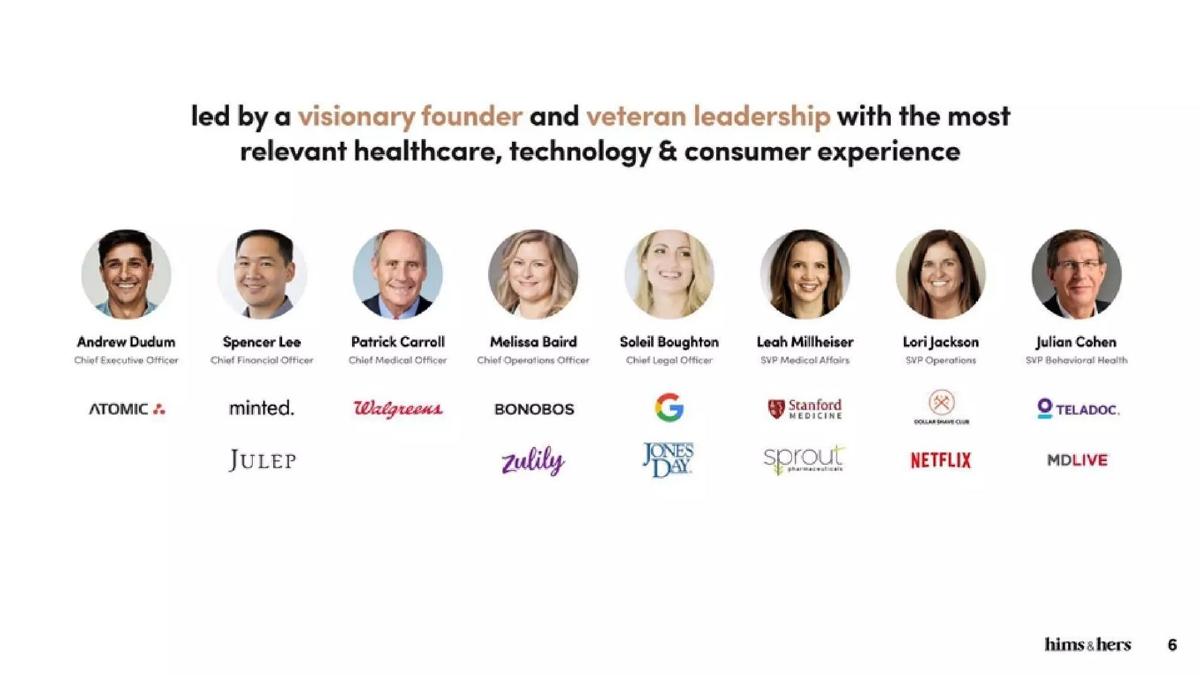
- The leadership team features deep institutional experience from Atomic, Walgreens, Bonobos, and Stanford Medicine (Slide 6).
- The transaction summary explicitly details a $1.592 billion pro forma enterprise value and a $75M PIPE raise (Slide 36).
- The platform includes proprietary infrastructure such as a 'Clinically Focused EMR' and a 'Cloud Pharmacy' (Slide 11).
The SPAC Transition: From D2C Brand to Healthcare Infrastructure
The Hims and Hers SPAC deck, released in late 2020, represents a pivotal moment for the company. It is not a seed deck seeking product-market fit; it is a late-stage growth deck designed to prove that a D2C (Direct-to-Consumer) wellness brand can mature into a robust, verticalized healthcare infrastructure company. The narrative arc moves from the 'who' (leadership) to the 'what' (the platform) and finally to the 'how much' (financials and transaction terms).
Slide 1: Title and Brand Identity
The cover slide features high-quality lifestyle photography of a couple, immediately establishing the brand's aesthetic: inclusive, modern, and approachable. Unlike traditional healthcare companies that use clinical imagery, Hims and Hers leans into the 'wellness' and 'beauty' visual language. The logo is prominent, and the 'Exhibit 99.2' marker in the corner indicates this is a formal SEC filing related to the SPAC merger.
Slide 6: Leadership and Pedigree
This slide is a classic 'trust' builder. By listing eight executives, the company demonstrates it has outgrown its 'startup' phase. Key highlights include Andrew Dudum (CEO) from Atomic, and notably, Patrick Carroll (Chief Medical Officer) who came directly from Walgreens. The inclusion of logos like Google, Netflix, and Stanford Medicine serves as a proxy for quality, suggesting that the company is managed by individuals who have scaled world-class organizations. This is critical for a SPAC deck where public market investors are betting on the management's ability to handle the rigors of being a public company.
Slide 11: The Verticalized Platform
"The first digitally native, fully verticalized multi-condition health platform..."
This is arguably the most important strategic slide in the deck. It breaks down the business into six layers: Consumer Brand, Distributed Provider Network, Clinically Focused EMR, Digital Native Telemedicine Platform, Digital Prescriptions, and Cloud Pharmacy. By framing the business this way, they are telling investors they are not just a 'middleman' or a website selling pills. They are an infrastructure play. Owning the EMR (Electronic Medical Record) and the Cloud Pharmacy allows for the high gross margins (71%) seen later in the deck, as it removes third-party dependencies and costs.
Slide 16: Patient Growth and Traction
Traction is presented as an accelerating curve. The slide shows a jump from 431k consultations in 2018 to 1.2 million in 2019, reaching over 2 million by Q2 2020. The metric '10mm+ Cumulative patient touchpoints' is used to show the depth of their engagement. The photography on the right continues the brand's focus on diverse, real-world users, reinforcing the idea that their 'new paradigm of healthcare' is reaching a broad demographic that traditional systems might ignore.
Slide 21: Market Expansion and Fundamentals
This slide provides the roadmap for future growth. It categorizes their offerings into 'Existing' (Hair Loss, ED), 'Recently Launched' (Anxiety & Depression, Dermatology, Primary Care), and 'Future Opportunities' (Sleep, Fertility, Diabetes, Cholesterol). The table uses checkmarks to show how each category fits their model: Chronic, Generic Medication, Specialty Focus, Stigma, and Telemedicine Enabled. The total addressable market (TAM) figures are massive, with Primary Care alone cited at $280bn. This slide justifies the $1.6B valuation by showing that the company has only scratched the surface of the total healthcare spend.
Slide 26: Enterprise and B2B Strategy
"An inexpensive turnkey telehealth option for cost-conscious employers"
Slide 26 introduces 'Hims & Hers for Enterprise.' This represents a shift from pure D2C to a B2B2C model. They highlight '~500 affordable medications' and '24/7 in-house coverage.' This move is a strategic hedge; by becoming an employer benefit, they can lower customer acquisition costs (CAC) and increase the 'stickiness' of their user base. It signals to investors that the company is diversifying its revenue streams beyond individual subscriptions.
Slide 31: Financial Performance
"Attractive historical revenue growth and significant gross margin expansion"
This is the 'money slide.' It presents two bar charts. The first shows revenue growing from $27M (2018A) to $83M (2019A) to an estimated $138M (2020E), representing a 128% CAGR. The second chart is even more impressive to investors: gross margin expansion. It grew from 29% to 54% to 71%. This 71% margin is the 'holy grail' for a company selling physical goods, as it approaches software-level profitability. It proves that their vertical integration strategy (Slide 11) is working financially.
Slide 36: Transaction Summary
This slide details the mechanics of the SPAC deal. Key figures include:
Implied pro forma enterprise value: $1.6 billion. · Pro Forma EV / 2021E Revenue: 8.9x. · Pro Forma EV / 2021E Gross Profit: 12.2x. · PIPE Investment Proceeds: $75 million. · Existing shareholders: Maintain approximately 84% ownership.
The 'Sources & Uses' table shows exactly where the money is coming from ($205M from OAC trust, $75M from PIPE) and where it is going ($245M to the balance sheet). This transparency is required for SPAC transactions and gives investors a clear picture of the company's post-deal capitalization.
Slide 41: Appendix
The deck concludes with an appendix section, signaled by a close-up image of skin care application. While the specific contents of the appendix are not shown in this selection, its presence indicates a data-heavy backend to the presentation, likely containing detailed GAAP reconciliations, cohort data, and further market research citations.
What Hims and Hers Does Well
The deck is exceptionally strong at narrative scaling . It starts with a very specific, successful niche (ED and Hair Loss) and systematically builds a case for why that success will translate to the entire $280B+ primary care market. The visual design is consistent and high-end, which is a core part of their competitive advantage—making healthcare feel like a consumer lifestyle choice rather than a chore.
Furthermore, the financial transparency regarding margin expansion is excellent. Many D2C companies struggle to prove they can ever be profitable; Hims and Hers uses Slide 31 to show that their margins aren't just high, they are rapidly improving as they scale their internal infrastructure.
What is Missing from the Deck
Despite the 43 slides, there are a few notable omissions in the core narrative:
Customer Acquisition Cost (CAC) vs. LTV: While they show revenue growth, they do not explicitly break down the unit economics of acquiring a customer. In a D2C-heavy model, investors usually want to see the 'payback period' on marketing spend. · Churn and Retention: The deck mentions 'cumulative touchpoints' and 'subscriptions,' but it doesn't provide a cohort analysis showing how many users stay after 6, 12, or 24 months. For a 'chronic' care model, retention is the most important metric. · Competitive Landscape: There is no slide comparing Hims and Hers to direct competitors like Roman (Ro) or traditional incumbents. They position themselves as 'the first,' but the market was already crowded by 2020.
Lessons for Founders
Founders should study how Hims and Hers rebrands a commodity . Generic medications for hair loss are available everywhere, but Hims and Hers built a $1.6B business by owning the brand and the vertical stack. If you are building in a crowded space, your deck must show how you own the customer relationship from 'start-to-finish' (Slide 11).
Additionally, use margin expansion as a proxy for technology . If your margins are increasing while you scale, it proves to investors that your 'platform' is more than just a buzzword—it's a functional efficiency engine. Finally, if you are targeting a massive TAM, follow their lead on Slide 21: don't just list a big number; show the specific 'fundamentals' (stigma, chronic, generic) that make your company the logical winner in those new categories.
Frequently asked questions
- What was the primary goal of this pitch deck?
- This deck was designed to facilitate a SPAC (Special Purpose Acquisition Company) merger between Hims & Hers and Oaktree Acquisition Corp (OAC). Its primary goal was to convince institutional investors and PIPE (Private Investment in Public Equity) participants of the company's long-term viability as a public entity, justifying a $1.6 billion valuation through aggressive growth metrics and margin expansion.
- How does Hims and Hers define its competitive advantage?
- The company defines its advantage through vertical integration. As shown on slide 11, they own the consumer brand, the provider network, the electronic medical record (EMR) system, the telemedicine platform, and the cloud pharmacy. This 'start-to-finish' control allows them to capture more margin and provide a seamless user experience compared to traditional fragmented healthcare providers.
- What are the key financial metrics highlighted in the deck?
- The deck focuses on two primary financial pillars: revenue growth and margin expansion. It highlights a 128% revenue CAGR, moving from $27 million in 2018 to a projected $138 million in 2020. Simultaneously, gross margins improved from 29% to 71%, indicating that the business became significantly more efficient as it scaled its digital infrastructure (Slide 31).
- What is the 'stigma' strategy mentioned in the market expansion slide?
- Hims and Hers identifies 'stigma' as a key market driver. By starting in categories like Hair Loss and ED where patients are often embarrassed to seek in-person care, they built a loyal user base. Slide 21 shows they are applying this same logic to Anxiety, Depression, and Fertility, where the privacy of a digital-native platform provides a distinct advantage over traditional clinics.
- Who are the key members of the Hims and Hers leadership team?
- The team is led by CEO Andrew Dudum (co-founder of Atomic). The executive bench includes veterans from diverse sectors: CFO Spencer Lee (Minted), CMO Patrick Carroll (former Chief Medical Officer at Walgreens), and COO Melissa Baird (Bonobos, Zulily). This mix of retail, healthcare, and tech experience is presented as a 'veteran leadership' core (Slide 6).