Hi-Park is an Israeli startup founded in 2014 that leverages computer vision and machine learning to create a real-time map of available street parking. By crowdsourcing visual data from smartphones mounted in moving vehicles, the company identifies vacant spots without the need for expensive municipal infrastructure. The deck highlights a strong technical team with backgrounds in the IDF's elite 8200 unit and significant experience in cellular cloud solutions. While the presentation effectively communicates the 'how' through a demo-centric structure and clear feature lists, it lacks critical…
Key takeaways
- The company was established in 2014 and is based in Israel, as indicated by the TNUFA grant and founder backgrounds (Slide 6, 7).
- Hi-Park utilizes computer vision and proprietary algorithms to identify parking spots from moving cars (Slide 6).
- The solution is designed to be 'seamless on any smartphone,' suggesting a low barrier to user acquisition (Slide 5).
- The team has high-level technical pedigree, including a founder from the IDF elite intelligence 8200 unit (Slide 7).
- The startup received a 200,000 NIS grant from the Chief Scientist – TNUFA (Slide 6).
- A patent is currently pending for their technology, providing a potential defensive moat (Slide 6).
- The deck is missing a business model, market analysis, competitor landscape, and a clear funding ask (Slide 1-8).
- The '90 / 10' metric is mentioned on the features slide but is not defined, leaving its meaning ambiguous (Slide 5).
Executive Summary: The Vision of the Connected Curb
Hi-Park enters the smart city and navigation space with a purely software-driven approach to a hardware-heavy problem. Traditionally, real-time parking data required expensive sensors embedded in the asphalt or high-altitude municipal cameras. Hi-Park’s deck proposes a shift to the edge: using the devices already present in cars—smartphones and dash cams—to map the world in real-time. This teardown looks at a 15-slide deck (8 slides provided) that prioritizes technical credibility and team pedigree over financial projections.
Slide 1: Title Slide
The title slide introduces the company name, Hi-Park , with the tagline "Automated Crowd-Sourced Parking." The logo incorporates a hand icon pointing, likely symbolizing the act of identifying a spot, and a signal icon suggesting connectivity. It is presented by Ronen Korman , Founder and CEO. The design is clean, using a blue and white color palette that is standard for the technology and automotive sectors. A small city skyline graphic at the bottom reinforces the urban focus of the application.
Slide 2: The Problem Context
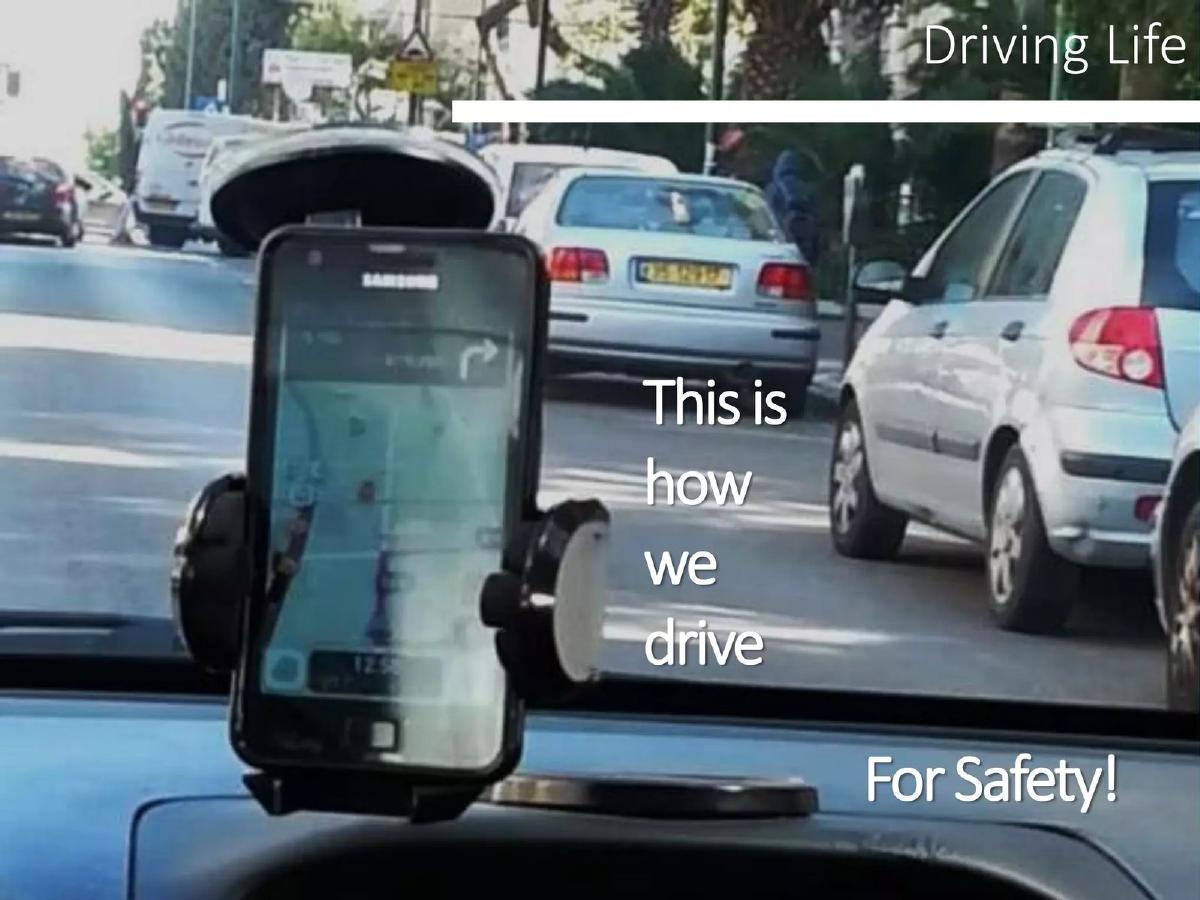
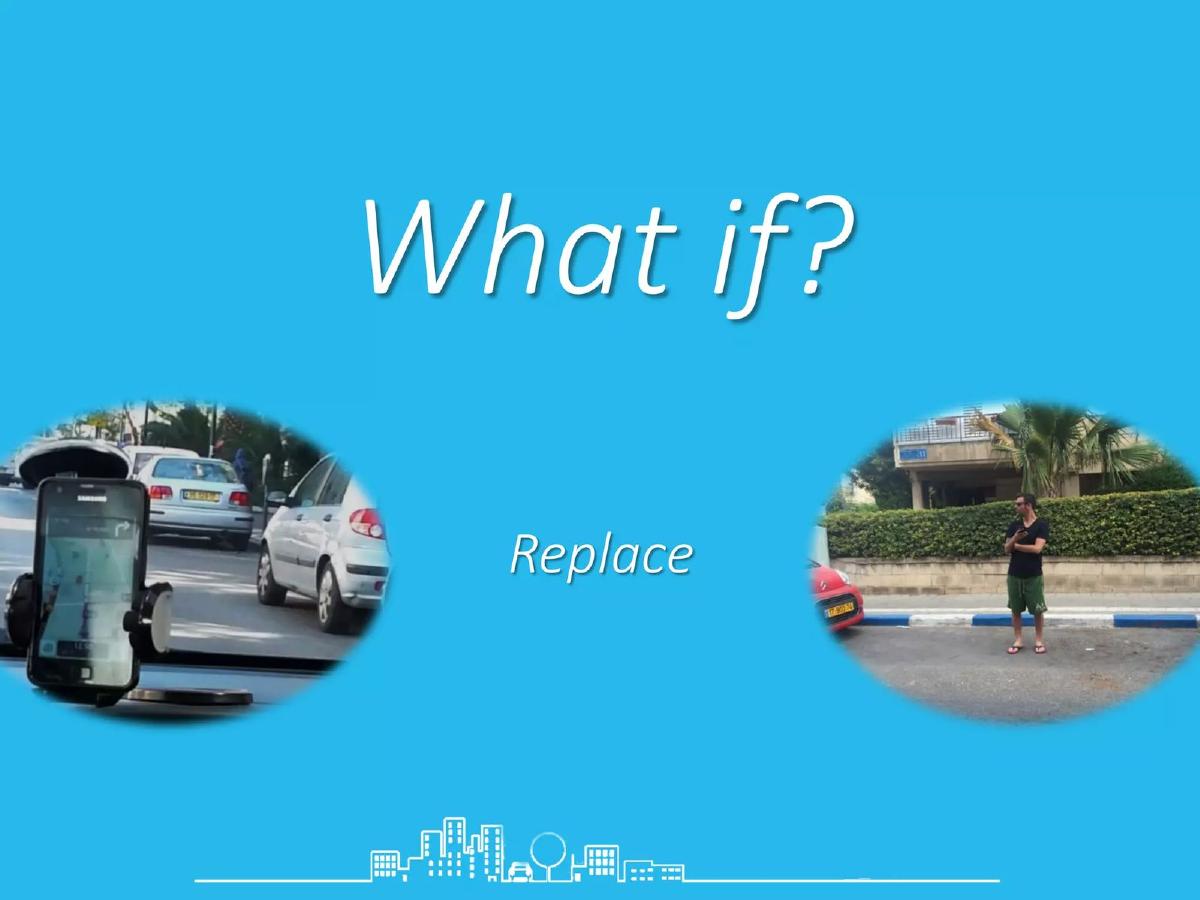
Slide 2 uses a full-bleed photograph of a smartphone mounted on a car dashboard, running a navigation app. The text "Driving Life," "This is how we drive," and "For Safety!" sets the stage. This slide serves as a "day in the life" visual, establishing that the hardware necessary for Hi-Park’s solution (a mounted smartphone with a clear view of the road) is already a standard part of the modern driving experience. It subtly addresses the friction of adoption: users don't need to do anything new; they are already mounting their phones for safety and navigation.
Slide 3: What We Do
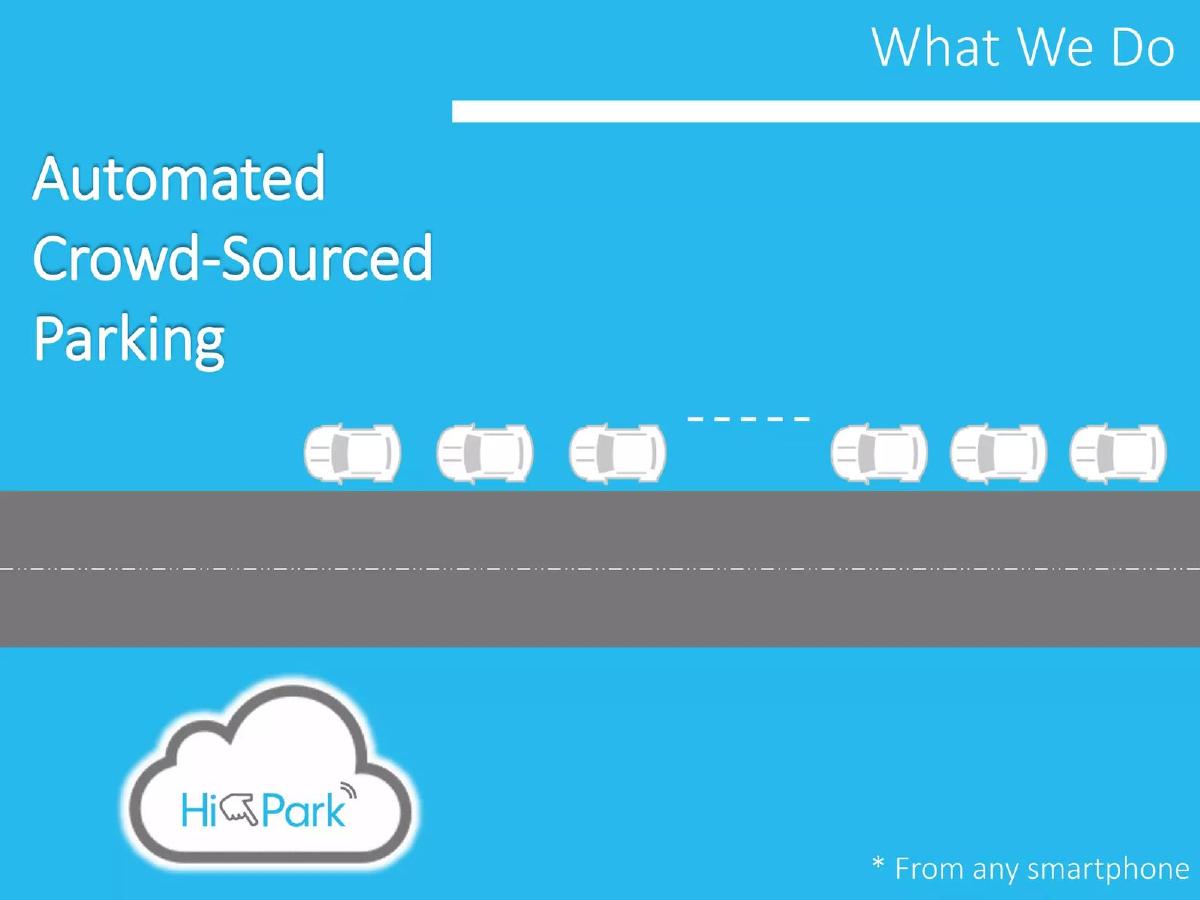
This slide defines the core product: Automated Crowd-Sourced Parking . A simple graphic shows a line of cars on a road, with the Hi-Park cloud icon below. A footnote specifies " From any smartphone." This slide is a high-level conceptual bridge between the problem (finding parking) and the solution (using the crowd). It emphasizes the "automated" nature of the tech, which is a key differentiator—users shouldn't have to manually report spots; the software should do it for them.
Slide 4: The Demo Placeholder
Slide 4 is a simple blue screen with the word "Demo." In a live pitch, this is where the founder would switch to a video or a live app walkthrough. While effective for a presentation, in a static deck sent to investors, this slide represents a missed opportunity to show screenshots of the UI or data visualizations of the computer vision in action. It signals that the product is functional enough to be demonstrated, which is a positive traction signal for an early-stage company.
Slide 5: Features and Capabilities
The Features slide uses a hexagonal graphic to highlight four key points: Real Time Identification , Connected Cars , Seamless on any Smartphone , and a cryptic 90 / 10 . The mention of "Connected Cars" suggests the company is looking beyond just smartphones to OEM integrations. However, the "90 / 10" metric is a significant flaw in the deck—without context, it is meaningless. It could refer to accuracy, market share, or a revenue split, but leaving the viewer to guess is a mistake in a pitch environment.
Slide 6: Current State and Traction
This is one of the most informative slides in the deck, broken into three pillars:
Technology: Mentions moving cars, Machine Learning & Computer Vision, Proprietary algorithms, and crowdsourcing. · Legal: States the company was established in 2014 and has a "Patent Pending." · Funding: Discloses a grant from the Chief Scientist – TNUFA for 200K NIS.
This slide provides the necessary "proof of life." The TNUFA grant is a prestigious early-stage validation in the Israeli ecosystem, and the 2014 founding date suggests the company has had time to move past the mere idea phase.
Slide 7: Team Pedigree
The team slide is exceptionally strong for a seed-stage company. Ronen Korman (CEO) brings 20 years of experience and a background in the IDF elite intelligence 8200 unit , which is a world-renowned incubator for computer vision and cybersecurity talent. Eitan Haimovich (BD) is noted as a serial entrepreneur who has raised over $32 million previously. Ehud Spiegel (Tech) adds 25 years of experience in cellular cloud solutions. The collective experience here suggests a team capable of handling complex technical hurdles and navigating the B2B/B2G sales cycles typical of smart city tech.
Slide 8: Contact and Conclusion
The final slide provides contact information for Ronen Korman, including an Israeli phone number and a company email address. The sign-off "Drive Safe" aligns with the earlier messaging on Slide 2. While it serves its purpose, the lack of a "Next Steps" or a clear "Ask" (e.g., "Seeking $1.5M for Pilot Programs") makes the deck feel more like an informational brochure than a fundraising tool.
What Works in This Deck
The Hi-Park deck excels at establishing technical authority . By highlighting the founder's 8200 unit background and the Chief Scientist grant, the company positions itself as a serious engineering play rather than a simple consumer app. The focus on "Automated" and "Crowd-Sourced" correctly identifies the two biggest hurdles in parking apps: manual data entry (which users hate) and infrastructure costs (which cities hate). The visual of the smartphone in the car immediately makes the solution feel practical and achievable.
What Is Missing
Despite the strong team, the deck leaves several critical questions unanswered: 1. Business Model: How does Hi-Park make money? Do they sell data to navigation companies (Waze/Google), license software to car manufacturers, or charge municipalities? 2. Market Size: There is no mention of the Total Addressable Market (TAM). Investors need to know if this is a billion-dollar opportunity or a niche utility. 3. Competition: The parking space is crowded. Companies like Google (via Waze), Parkopedia, and various sensor-based startups are all vying for this data. Hi-Park fails to explain why their computer vision approach is superior or more defensible. 4. The Ask: A pitch deck is a tool to raise money. This deck does not state how much capital is needed or what that capital will achieve (e.g., "Mapping 5 major cities in 12 months").
Founder's Guide: What to Copy
Use the "Day in the Life" Visual: Slide 2 is a great example of how to ground a high-tech solution in a relatable, everyday image. It proves the hardware is already in place. Highlight Local Validation: If you have received government grants or participated in prestigious accelerators (like TNUFA), give them their own icon. It acts as external due diligence for the investor. Lead with Pedigree: If your team has specific, elite training (like the 8200 unit or a PhD in a relevant field), don't bury it. Hi-Park correctly puts their technical credentials front and center to justify their "proprietary algorithms" claim.
Final Thoughts
Hi-Park presents a compelling technical solution to a universal urban problem. The deck is a masterclass in establishing founder-market fit through professional history. However, to move from a "cool project" to a "venture-scale business," the founders would need to add significant layers regarding their commercial strategy and competitive moat. The absence of these slides in the provided set suggests either a very early stage of development or a deck intended for a technical audience rather than a generalist VC.
Frequently asked questions
- What is the core technology behind Hi-Park?
- Hi-Park relies on computer vision and machine learning to process visual data from moving vehicles. According to slide 6, the company uses proprietary algorithms to crowdsource data, allowing them to identify available parking spaces in real-time. This approach turns standard smartphones or connected car cameras into sensors, eliminating the need for cities to install physical hardware in the pavement.
- Who are the key members of the Hi-Park leadership team?
- The team is led by Ronen Korman (Founder & CEO), who has 20 years of experience in the Israeli Hi-Tech industry and served in the IDF's elite 8200 unit. He is supported by Eitan Haimovich (Director of BD), a serial entrepreneur who previously raised over $32 million, and Ehud Spiegel (Director of Technology), who has 25 years of experience in cellular cloud and computer vision applications (Slide 7).
- How much funding has Hi-Park raised according to the deck?
- Slide 6 notes that the company has received a grant from the Chief Scientist – TNUFA amounting to 200,000 NIS (approximately $50,000–$55,000 USD depending on exchange rates at the time). The deck does not list any private venture capital rounds or a current 'ask' for new investment, suggesting this may be an early-stage or seed-level presentation.
- What is the primary use case for Hi-Park's software?
- The primary use case is 'Automated Crowd-Sourced Parking' (Slide 3). By using the cameras on smartphones mounted for navigation (as shown on Slide 2), the software identifies open curb space and shares that information with other users in the network. This creates a real-time map of parking availability to reduce the time drivers spend searching for spots.
- What critical information is missing from this pitch deck?
- The deck is heavily focused on the team and the technical 'how-it-works.' It completely omits a business model (how they make money), a market slide (TAM/SAM/SOM), a competitor analysis (how they differ from Google Maps or Waze), and a roadmap. Most importantly, it lacks a closing 'ask' slide detailing how much capital they are raising and what the milestones for that capital will be.