Hivebeat's 10-slide deck from 2015 is an example of a 'traction-first' narrative. The company, which provided a membership and events platform for organizations, raised $125,000 by leaning heavily on its growth metrics rather than complex feature lists. The deck highlights a 31% month-over-month growth rate and a monthly Gross Merchandise Volume (GMV) of $100,000. Most notably, it presents a highly efficient customer acquisition model with a $1,000 CAC against a $12,000 LTV. While the deck lacks a formal market size analysis or a specific 'ask' slide detailing the use of funds, the strength o…
Key takeaways
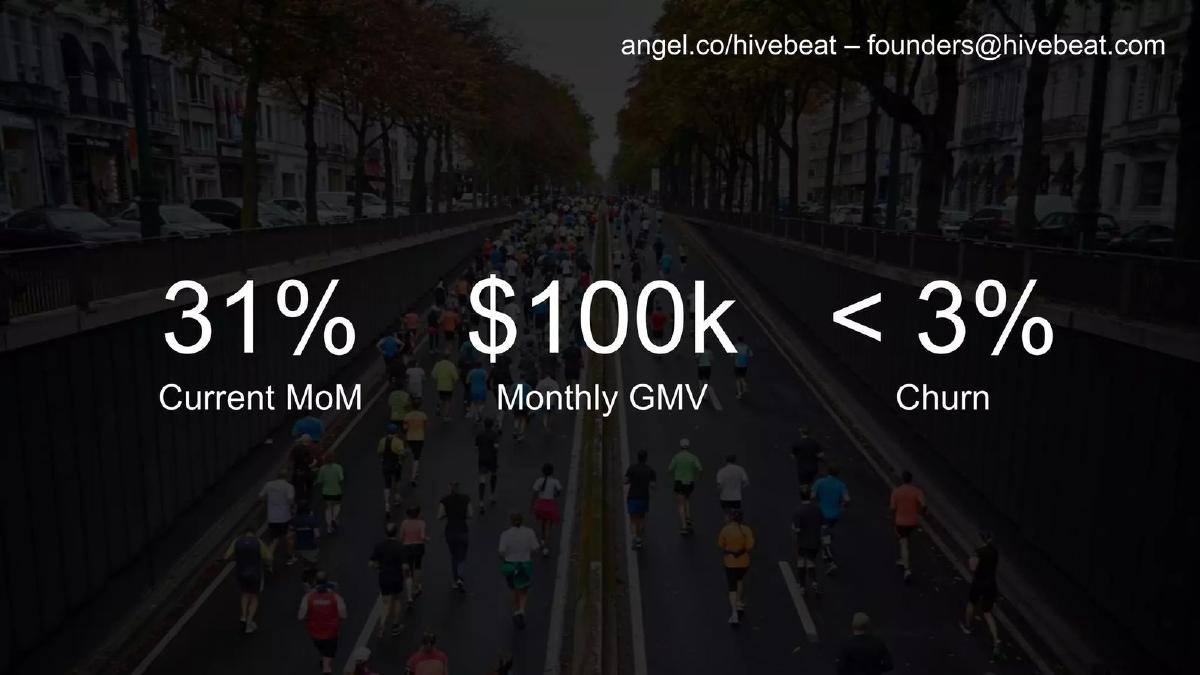
- The company achieved a $100,000 monthly GMV by January 2016, as shown on slide 6.
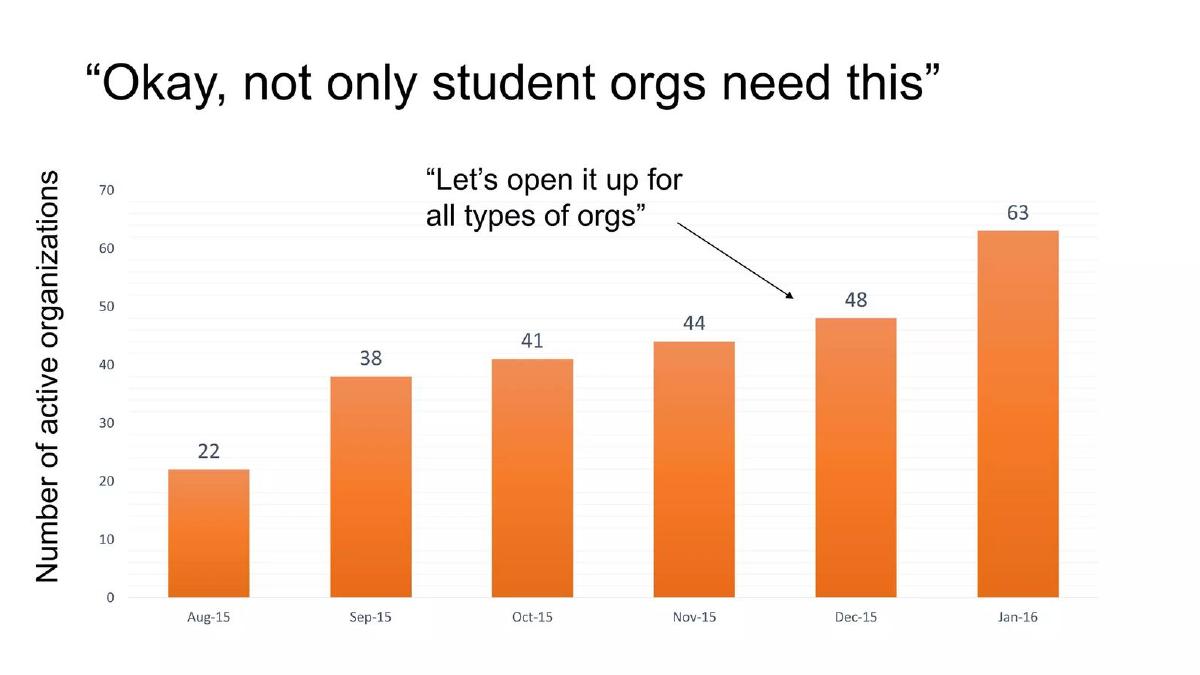
- Growth was significant, with active organizations increasing from 22 in August 2015 to 63 in January 2016 (slide 5).
- The business model is a simple transaction fee of 7% per transaction, making the platform free for organizations to join (slide 7).
- Unit economics are highly favorable, claiming a $1,000 Customer Acquisition Cost (CAC) against a $12,000 Lifetime Value (LTV) on slide 8.
- Retention is a core strength, with the deck reporting a churn rate of less than 3% (slide 6).
- The team consisted of four members at the time of the deck: a CEO, CTO, Sales/Success lead, and a Developer (slide 9).
- The deck completely omits a market size (TAM/SAM/SOM) slide and a specific funding 'ask' or roadmap.
- The product is positioned as a modernization tool for organizations still using paper forms and basic web forms (slide 3).
Introduction: The Minimalist Traction Deck
Hivebeat’s 2015 seed deck is a lean, 10-slide presentation that prioritizes current performance over future speculation. At the time of this deck, Hivebeat was positioning itself as a SaaS solution for student and professional organizations to manage memberships and events. The deck is notable for its lack of fluff; there are no slides dedicated to 'the vision of the future' or 'the changing landscape of the internet.' Instead, it relies on a 12:1 LTV to CAC ratio and a $100,000 monthly GMV to tell the story.
Slide 1: Title Slide
The deck opens with a dark, high-contrast image of a skyscraper. The logo is a simple orange hexagon, and the sub-headline defines the product clearly: "Memberships and events platform for organizations." It is a functional start that immediately categorizes the company as a B2B SaaS tool.
Slide 2 & 3: The Problem
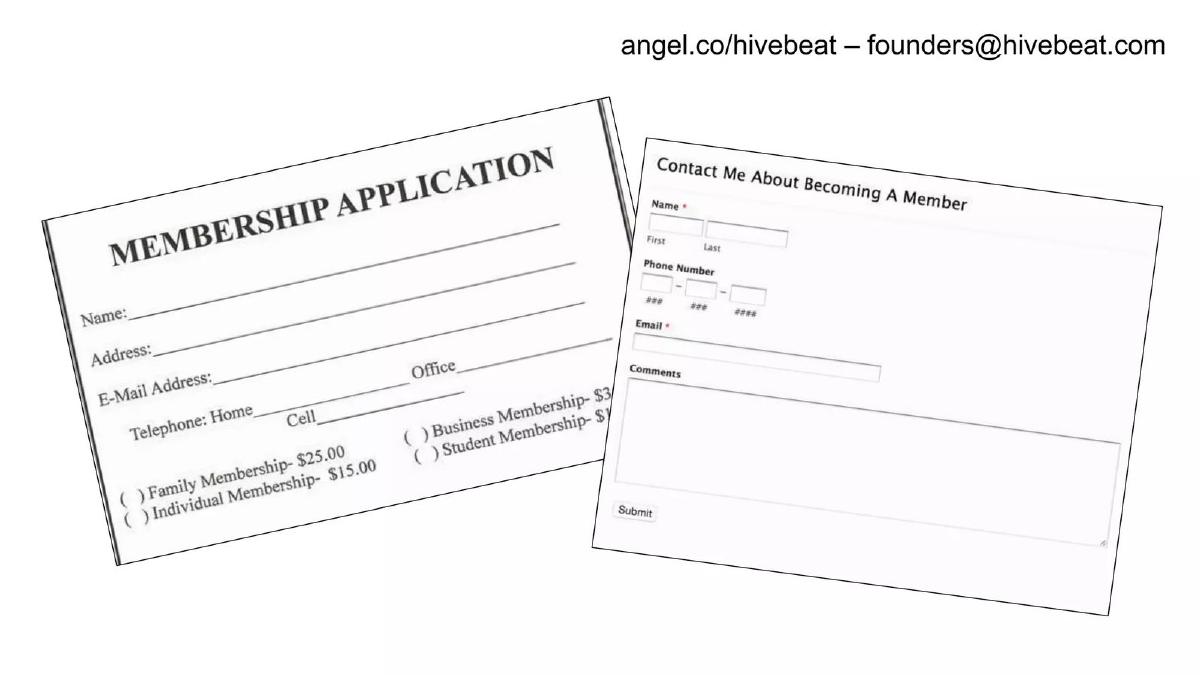
Slide 2 uses a single sentence: "Member organizations handle payments like it’s the 90s." This is followed by Slide 3, which provides visual evidence. It shows a physical, paper 'Membership Application' form and a dated, clunky web form with fields for 'Name,' 'Phone Number,' and 'Comments.' By showing these side-by-side, Hivebeat establishes that the 'status quo' is fragmented and manual. The contact information for the founders is also present in the header of these slides, a recurring theme throughout the deck.
Slide 4: The Solution
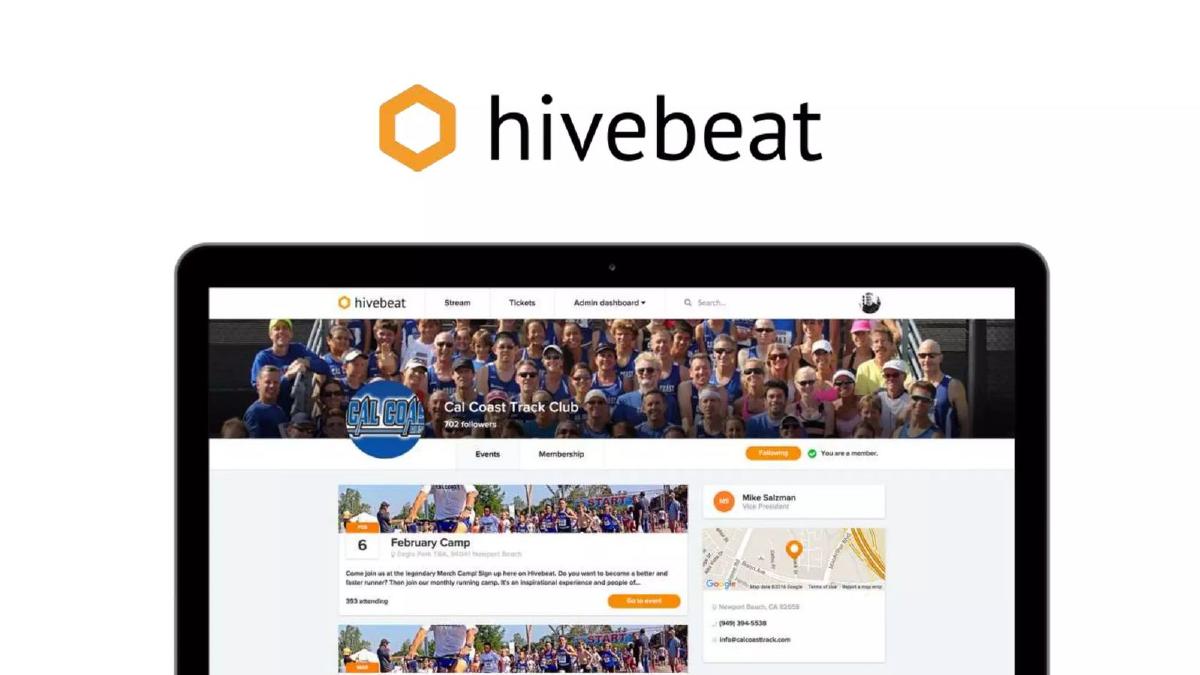
The solution slide is a simple product mockup on a laptop screen. It shows the 'Cal Coast Track Club' profile on Hivebeat. The interface includes a 'Stream,' 'Tickets,' and an 'Admin dashboard.' The visual emphasizes a clean, modern UI that looks like a social network (similar to Facebook or LinkedIn) but is purpose-built for organizational management. It highlights features like event sign-ups ('February Camp') and membership status indicators.
Slide 5: Traction and Pivot
Slide 5 is one of the most important in the deck. It shows a bar chart of 'Number of active organizations' from August 2015 to January 2016. The numbers are:
Aug-15: 22 · Sep-15: 38 · Oct-15: 41 · Nov-15: 44 · Dec-15: 48 · Jan-16: 63
The slide includes a pivotal note: "Okay, not only student orgs need this" and "Let’s open it up for all types of orgs." This indicates that the founders discovered a larger market opportunity during their initial launch and successfully acted on it, leading to the 31% jump in active organizations in the final month shown.
Slide 6: Key Metrics
This slide presents three 'hero' metrics over a background image of a marathon. The figures are:
31% Current MoM (Month-over-Month growth) · $100k Monthly GMV (Gross Merchandise Volume)
These three numbers provide a snapshot of a healthy, growing marketplace. The low churn rate suggests high product-market fit, while the $100k GMV proves that the platform is handling significant financial volume.
Slide 7: Business Model
Hivebeat’s revenue model is stated with absolute clarity: "Hivebeat is free for organizations" and "7% of every transaction." This is a classic 'tax on the economy' model used by platforms like Eventbrite or Shopify. By making the software free, they lower the barrier to entry for small organizations, while the 7% fee ensures they capture upside as those organizations grow.
Slide 8: Unit Economics
Slide 8 focuses on the efficiency of their growth. It lists a CAC of $1,000 and an LTV of $12,000 . A 12:1 LTV to CAC ratio is exceptionally high for a seed-stage company (where 3:1 is often considered the benchmark for a healthy SaaS business). This slide tells investors that for every dollar spent on marketing or sales, the company expects to generate twelve dollars in lifetime revenue, suggesting that the business is ready for a capital infusion to scale acquisition.
Slide 9: The Team
Jonas Bøgh: CEO, co-founder · Emil Hagbarth: CTO, co-founder · Christina Jensen: Sales/Customer Success · Dzhavat Ushev: Developer
The slide is minimalist. It lacks the 'logo soup' of previous employers or universities often seen in Silicon Valley decks. It presents a balanced team of two founders and two functional leads in sales and engineering.
Slide 10: Conclusion
The final slide repeats the branding from the first slide but adds the core metrics: 31% MoM and . It provides the contact email and the AngelList URL. Notably, there is no 'Ask' here. The deck does not state how much they are raising or what the valuation expectations are.
What Hivebeat Did Well
The strength of this deck lies in its data density . In just 10 slides, the founders answered the most critical questions an investor has: Is there a problem? (Yes, paper forms). Is there a solution? (Yes, the platform). Is it working? (Yes, 31% MoM growth). Is it profitable to acquire customers? (Yes, 12:1 LTV/CAC). By focusing on these core pillars, Hivebeat avoided the trap of over-explaining features that might change as the product evolves.
What Was Missing
Despite the strong traction, the deck leaves several stones unturned: 1. Market Size (TAM): There is no mention of how many 'organizations' exist globally or what the total addressable revenue might be. Investors need to know if this is a $10M business or a $1B business. 2. Competitive Landscape: The deck implies the only competition is 'the 90s' (paper forms). In reality, Eventbrite, Meetup, and various NPO management tools were active in 2015. Failing to acknowledge them can make a founder look naive. 3. The Ask: A pitch deck is a sales tool. Not including a slide that says 'We are raising $X to achieve Y' is a missed opportunity to set the terms of the conversation.
Founder's Takeaway
Founders should copy Hivebeat's approach to visualizing the problem . Slide 3 is more effective than five bullet points about 'inefficiency.' Furthermore, if you have a 12:1 LTV to CAC ratio, you should make it a standalone slide just as Hivebeat did. However, founders should ensure they include a clear 'Ask' and a brief nod to the competitive landscape to provide a complete picture of the investment opportunity.
Frequently asked questions
- What was Hivebeat's primary value proposition?
- Hivebeat positioned itself as a modern alternative for member organizations that were still handling payments and registrations using outdated methods. Slide 2 and 3 illustrate this by showing paper 'Membership Application' forms and basic, non-integrated web forms, contrasting them with Hivebeat's integrated memberships and events platform.
- How did Hivebeat generate revenue?
- According to slide 7, the platform was free for organizations to use, removing the barrier to entry. Revenue was generated by taking a 7% fee on every transaction processed through the platform. This aligns the company's success directly with the volume of tickets and memberships sold by its users.
- What was the growth trajectory shown in the deck?
- Slide 5 shows a bar chart of active organizations over a six-month period. The count grew from 22 in August 2015 to 63 in January 2016. The slide notes a strategic shift in December 2015 to 'open it up for all types of orgs,' which preceded their largest single-month jump in users.
- Who were the key members of the Hivebeat team?
- Slide 9 identifies four team members: Jonas Bøgh (CEO, co-founder), Emil Hagbarth (CTO, co-founder), Christina Jensen (Sales/Customer Success), and Dzhavat Ushev (Developer). The deck does not provide professional backgrounds or prior company experience for these individuals.
- What critical information is missing from this pitch deck?
- The deck is missing several standard components: a Market Size slide (TAM), a Competitor Analysis slide, a Roadmap/Product Vision slide, and a formal 'Ask' slide. Investors are not told how much money is being raised or how that capital will be deployed to scale the 31% MoM growth.