Intercom’s 2011 seed deck is a masterclass in category creation, moving beyond fragmented tools to propose a unified 'SaaS 2.0' communication platform. By leading with a high-credibility team and a strategic narrative focused on customer relationships rather than just features, the founders successfully de-risked their vision. The deck’s brilliance lies in its 2x2 competitive matrix, which visually carved out a new software category, proving that a disciplined, staged approach to product-market fit can build a multi-billion dollar unicorn.
Key takeaways
- Lead with your unfair advantage by using the team slide to prove founder-market fit and deep domain expertise.
- Frame a market by using competitive slides to define a new category rather than just showing 10% improvements.
- Sell a strategic narrative that connects product features to higher-order business goals like building relationships.
- Match your ask to your stage by focusing seed capital on finding product-market fit rather than aggressive scaling.
- Embrace brevity by creating a deck that acts as a conversation starter and can be understood in under two minutes.
The Moment in Time: SaaS 2.0 and the Communication Chasm
To understand why this deck worked, you have to transport yourself back to 2011. The first wave of Software-as-a-Service (SaaS) had proven the model. Salesforce was a giant, but a new generation of companies—what some called 'SaaS 2.0'—was emerging. These were product-led businesses, often started by developers and designers, targeting other tech companies. Think Stripe, Twilio, and their contemporaries. The dominant growth model was land-and-expand, fueled by freemium tiers and a focus on user experience.
However, the toolset for managing customer relationships in this new world was a Frankenstein's monster. A typical SaaS company would use:
Google Analytics or Mixpanel to see what users were doing (anonymous or event-based data). · A CRM like Salesforce or Highrise to manage sales leads or high-touch accounts (manual data entry). · MailChimp or Campaign Monitor to send infrequent, impersonal email blasts. · Zendesk or Get Satisfaction for reactive, ticket-based customer support.
Each tool was a silo. The data was disconnected. You knew what users were doing, but not who they were. You could email all your users, but you couldn't easily message just the ones who had used a specific feature in the last week. Support was a cost center, disconnected from product development and customer success. The result was a communication chasm between the web app and its users. Founders, especially product-focused ones like the Intercom team, felt this pain acutely. They were building beautiful software only to communicate with their users through clunky, out-of-context email. Intercom’s deck landed on investors' desks at the perfect moment to solve this widely felt, deeply frustrating problem.
The $600k they raised in this seed round from investors like 500 Startups and Biz Stone wasn't about building a massive sales team; it was about validating a thesis: that a single, integrated platform for customer communication was the future for internet businesses.
Slide-by-Slide Walkthrough
The Team: Instant Credibility
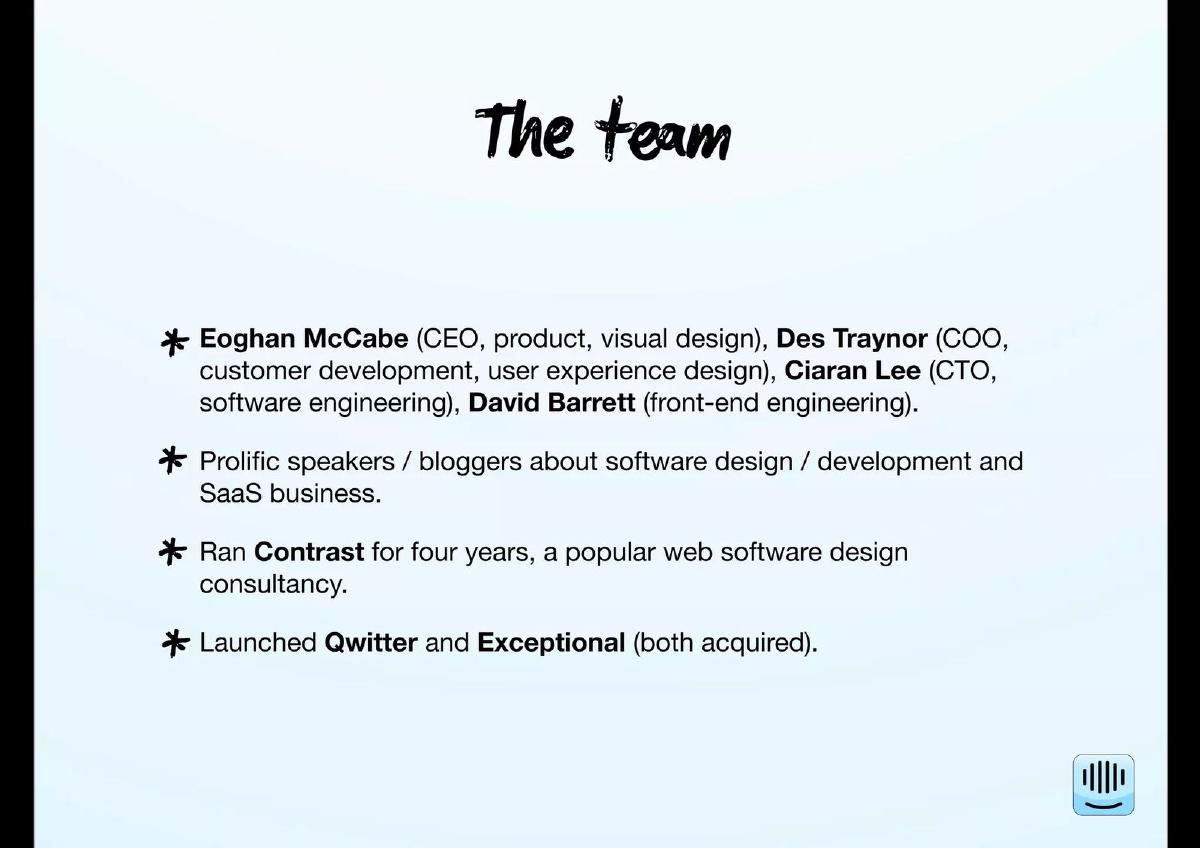
The deck wisely opens with the team, because for a seed-stage company, the team is the asset. This isn't a slide with four smiling headshots and university logos. It's a testament to founder-market fit. It communicates three critical points:
They've Succeeded Together: The founders ran Contrast, a web design consultancy, for four years. This tells an investor they have a history of working together under pressure and shipping product. The risk of co-founder implosion is significantly lower. · They've Built and Exited: They launched and sold two products, Qwitter and Exceptional. Even if these were small acquisitions (Exceptional was acquired by Rackspace), it proves they can complete the full cycle from idea to product to exit. They know how to create value. · They're Domain Experts: The line "Prolific speakers / bloggers about software design / development and SaaS business" is genius. It positions them as thought leaders. Investors could Google their names and find a trail of articles and talks from their blog, 'Inside Intercom,' demonstrating deep thinking about the very problems they aimed to solve. This pre-sold their expertise before the first meeting even started.
For an early-stage investor, this slide de-risks the investment significantly. It's not a bet on an idea; it's a bet on a proven, expert team that has personally experienced the problem they are about to describe.
The Problem: Aspiration Meets Frustration
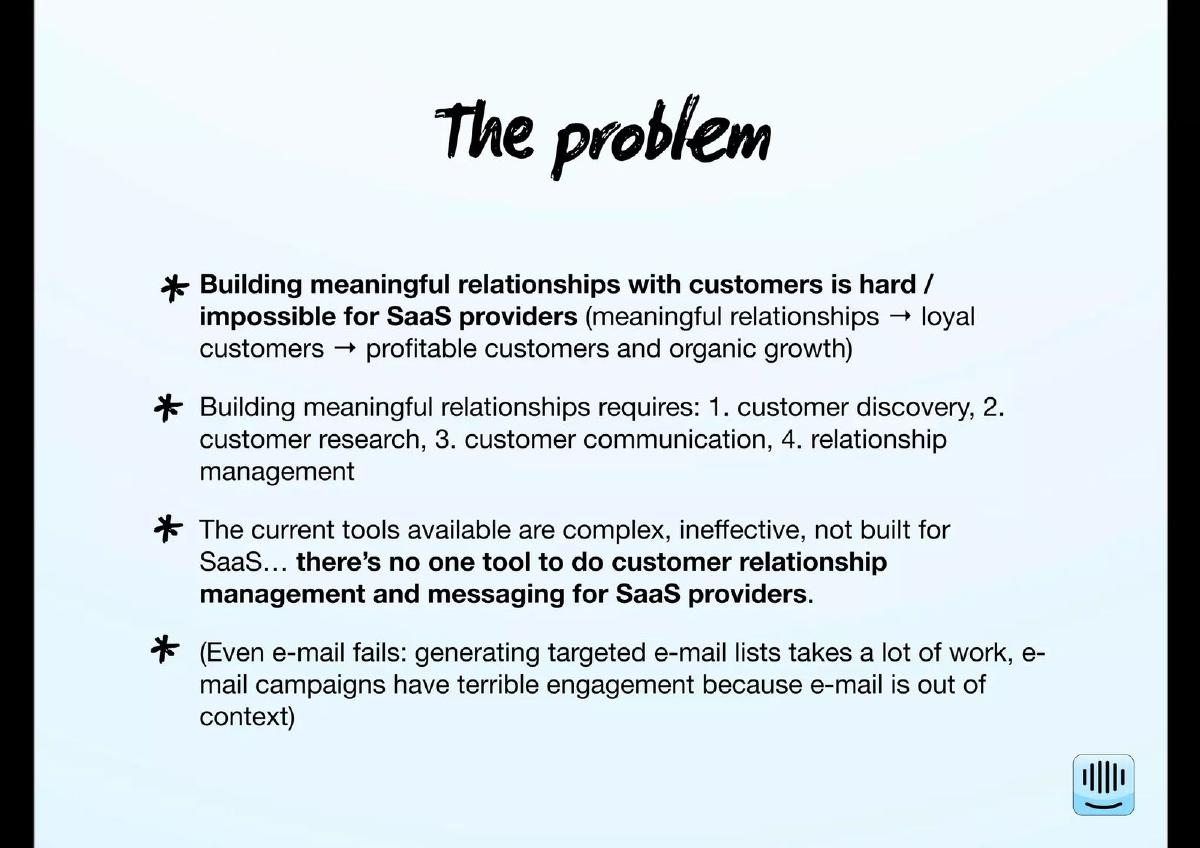
Intercom doesn't say "the problem is fragmented tools." They elevate the narrative. The problem is that "building meaningful relationships with customers is hard / impossible for SaaS providers." This frames the problem around a core business goal, not a technical one. Every founder wants loyal, profitable customers, and the deck connects that desire directly to the pain point.
The slide then breaks this down into four necessary activities: customer discovery, research, communication, and relationship management. This provides a structured framework that they will use to anchor their solution. Finally, they attack the status quo. Existing tools are "complex, ineffective, not built for SaaS." Email, the default communication channel, gets a special mention for its poor context and terrible engagement. It's a concise, relatable, and well-structured diagnosis of a pain every SaaS founder in 2011 knew intimately.
The Solution: A Unified and Elegant Vision
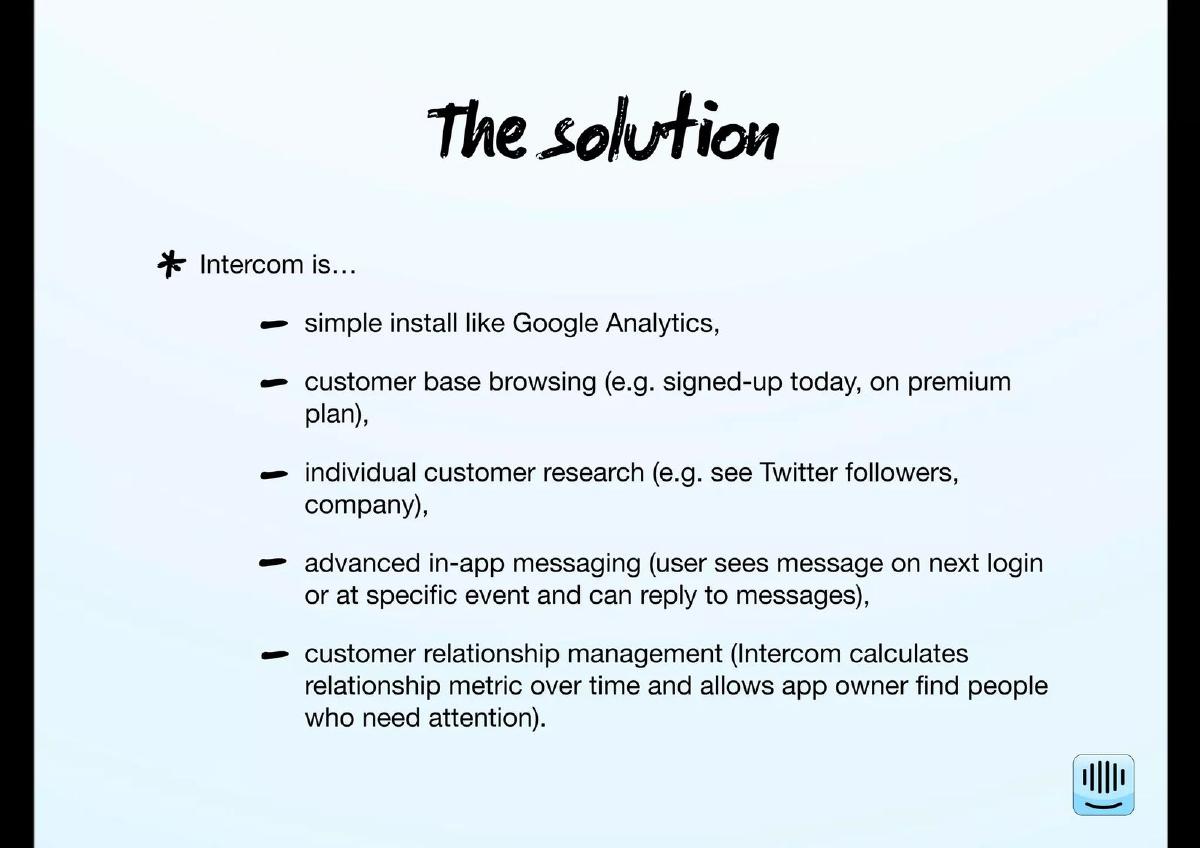
The solution slide directly mirrors the problem slide's structure, which is a classic and effective storytelling technique. It presents Intercom as a single, holistic answer to the previously defined chaos. Let's look at how each feature directly addresses a stated pain point:
Problem: Complexity. Solution: "Simple install like Google Analytics." This immediately frames the product as easy to adopt. · Problem: Customer Discovery. Solution: "Customer base browsing (e.g. signed-up today, on premium plan)." This is live user segmentation, a holy grail for product managers. · Problem: Customer Research. Solution: "Individual customer research (e.g. see Twitter followers, company)." This is data enrichment, turning anonymous users into real people. · Problem: Ineffective Communication. Solution: "Advanced in-app messaging." The key is "in-app," solving the context problem of email. · Problem: Relationship Management. Solution: "Customer relationship management... Intercom calculates a relationship metric over time." This is the most forward-looking part, hinting at a proactive, data-driven approach to customer success.
This slide isn't a laundry list of features. It’s the blueprint for a new workflow. It sells a cohesive product vision where the whole is greater than the sum of its parts. By integrating these functions, Intercom promises to unlock capabilities that were previously impossible.
The Market: Big Enough to Matter
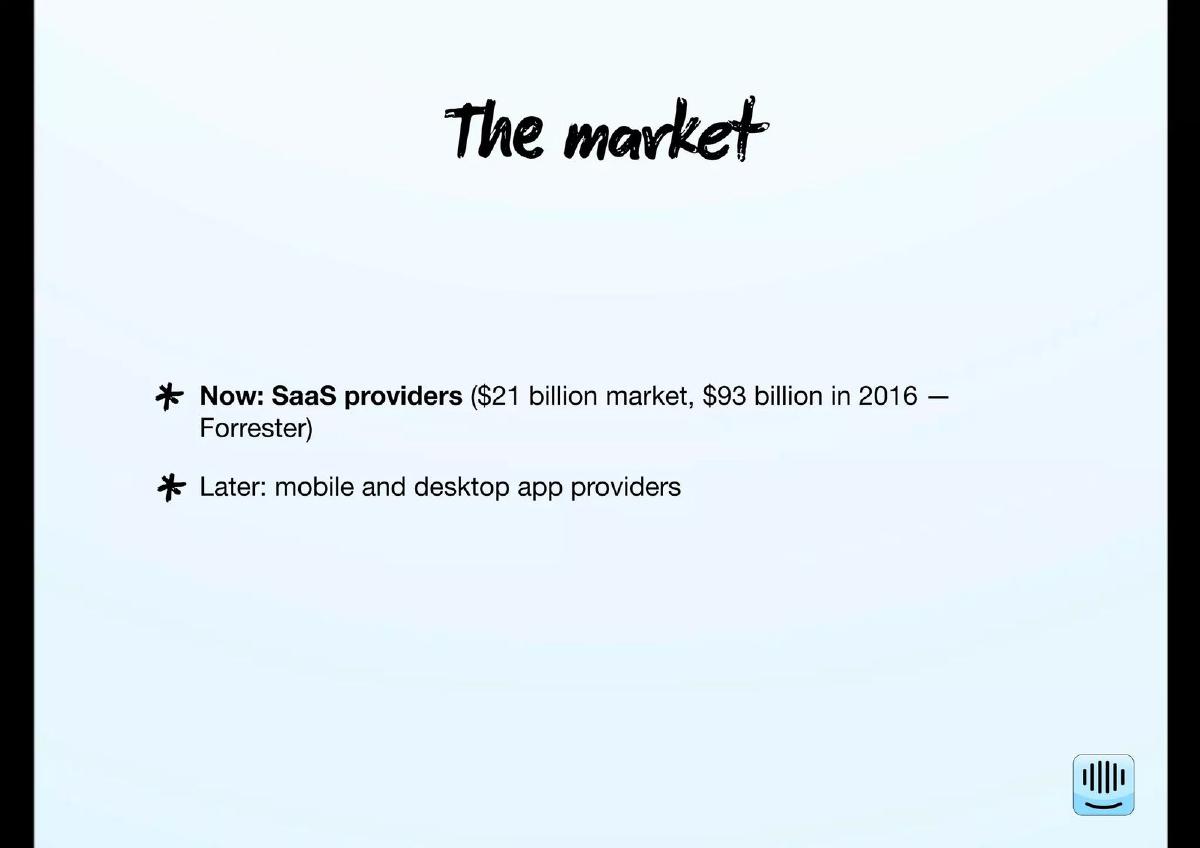
For a seed-stage deck, the market slide is simple and effective. It uses a third-party statistic from a reputable source (Forrester) to establish a large and growing Total Addressable Market (TAM): the SaaS market, valued at $21 billion and projected to grow to $93 billion by 2016. This is a top-down approach, and while later-stage decks would require a more granular, bottoms-up analysis, it serves its purpose here: to show that this is not a niche product. The problem is big enough to support a venture-scale business. The follow-up line, "Later: mobile and desktop app providers," is a crucial piece of future-pacing. It signals to investors that the founders are thinking beyond the initial beachhead market and have a vision for a much larger platform play.
The Competitive Landscape: Creating a New Category
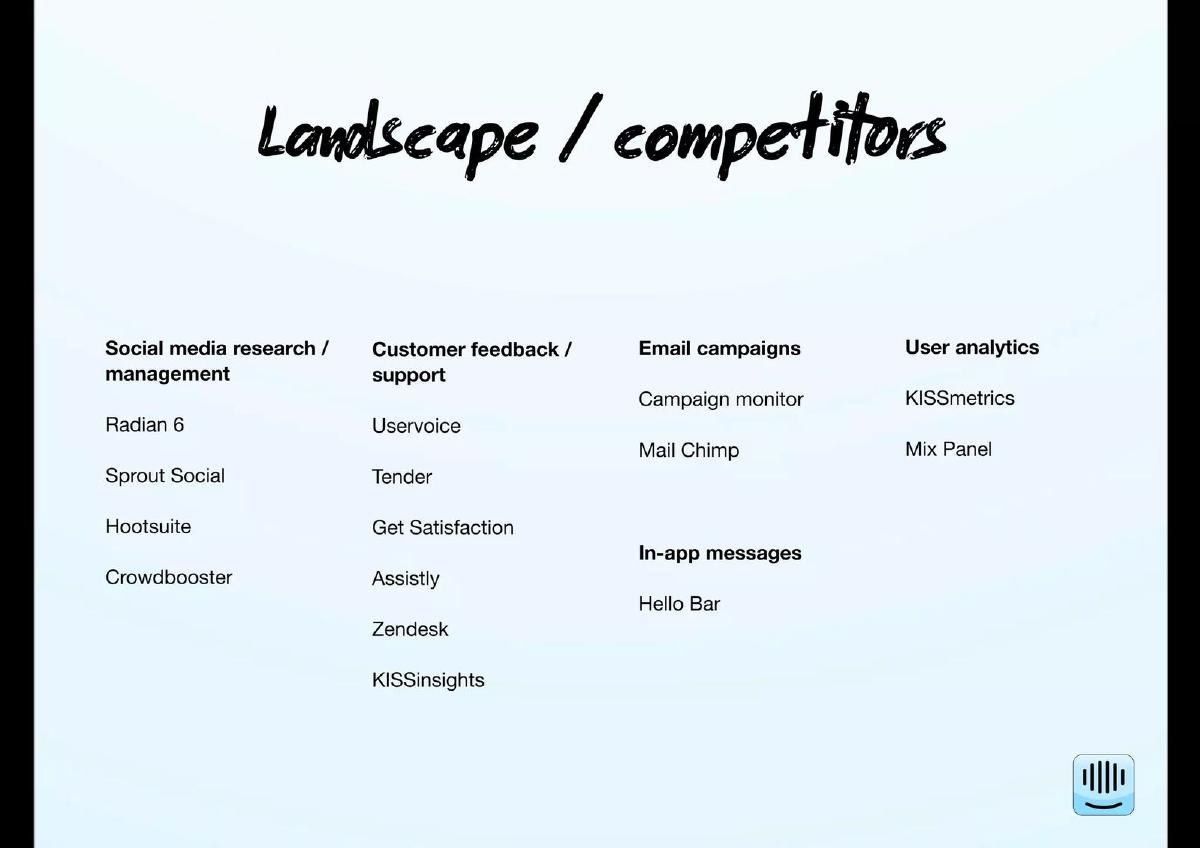
This is arguably the most brilliant slide in the deck. Instead of a typical feature-by-feature grid where they inevitably check all the boxes, Intercom re-frames the entire market. They present a 2x2 matrix with quadrants for 'Social media research,' 'Customer feedback/support,' 'Email campaigns,' and 'User analytics.' They then place their well-known competitors (Radian6, Uservoice, MailChimp, KISSmetrics) squarely inside these boxes.
The genius is what isn't on the slide: Intercom. By leaving the center of the diagram empty, they visually declare a new category. The implicit message is: "All these tools are point solutions that live in silos. We are the fabric that connects them all. We are the missing piece in the middle." This strategy does two things. First, it avoids a direct feature comparison with any single player, which they might lose at this early stage. Second, it positions Intercom not as a better version of an existing tool, but as a fundamentally new and different type of tool. It’s an act of marketing judo, using the weight of the existing market to create space for themselves. It tells investors they are funding category creation, which implies a winner-take-all outcome and massive potential returns.
Progress: From Idea to Reality
The traction slide is, by today's standards, very light on metrics. There are no MRR, DAU, or retention charts. However, it accomplishes what it needs to for a seed round led by a strong team. It shows progress and de-risks the execution. They have been building since January, which shows commitment. The product is "ready for public beta," which means there's a real, tangible thing to invest in, not just an idea. They have a live URL and a demo ready to go.
The most important line is: "Private beta testers love the product, many are psyched to try it." This is qualitative social proof. For a seed investor betting on this team, knowing that other smart founders and product people (the likely beta testers) are excited is a powerful signal. In the live pitch, this slide would have been the cue for a live product demo, which would have been the ultimate proof point.
The Ask: A Disciplined Plan for PMF
The final slide outlines the ask: a $600k convertible note. This was a standard seed-stage instrument in 2011, designed to get capital in the door quickly without debating valuation. The 18-month runway demonstrates thoughtful financial planning. But the most impressive part is the stated use of funds. They are not asking for money to hire a huge sales team or run Super Bowl ads. The money is for:
Product-market fit · Customer development · Early marketing efforts · Profitability
This shows incredible discipline and a deep understanding of the startup lifecycle. They are telling investors, "We are going to use your capital to find a repeatable, scalable business model. We will focus on product and customers until we nail it." The plan to raise a further round in 12-18 months "to turn up the heat on marketing" is the payoff. It promises that once they find PMF, they will be ready to scale aggressively. This is exactly what a seed investor wants to hear: capital efficiency now, aggressive growth later.
What Worked & Why Investors Said Yes
1. Untouchable Founder-Market Fit: The team's background as product builders, consultants, and thought leaders meant they were the perfect people to solve this specific problem. They had lived the pain and had the credibility to build the solution. 2. A Compelling, Elevated Problem: They didn't sell a tool; they sold a solution to a higher-order problem: building relationships. This resonated on a strategic level. 3. Masterful Category Creation: The competitive landscape slide was a storytelling masterstroke that instantly carved out a unique and valuable position for Intercom. 4. An Elegant, Unified Vision: The "one tool to rule them all" concept was powerful. It promised to simplify a complex, fragmented workflow, creating immense value. 5. Disciplined, Staged Approach: The modest ask and its focus on finding product-market fit before scaling showed tactical maturity and built investor confidence.
What Was Weak or Missing?
While the deck was highly effective, it's worth noting what it lacked, especially through a modern lens:
Quantitative Traction: There are zero hard metrics. Today, a seed-stage company would likely be expected to show some early user numbers, engagement stats, or even pre-revenue traction from its beta. · Business Model Details: The deck never mentions how Intercom plans to make money. Is it per seat? Per contact? Usage-based? While common to omit in 2011 seed decks, this is a major question left unanswered. · Product Mockups/UI: The deck is all text. While this was likely supplemented by a live demo, including a few key product screenshots would have made the solution more tangible within the deck itself. · Go-to-Market Specifics: "Early marketing efforts" is vague. A bit more detail on how they planned to leverage their blog and reputation to acquire the first 1,000 customers would have strengthened the plan.
5 Lessons for Founders Raising Today
Lead with Your 'Unfair Advantage': Intercom's was its team. If you have exceptional domain expertise, a unique technical insight, or proprietary data, make it the first thing an investor sees. Your team slide is your first proof point. · Frame a Market, Don't Just Enter One: Don't show how you're 10% better than an existing player. Show how you're fundamentally different. Use your competitive slide to teach the investor your worldview and create a category where you are the default leader. · Sell the Strategic Narrative: Connect your product's features to a higher-order, strategic goal for your customer. Intercom sold 'meaningful relationships,' not 'in-app messaging.' This makes your value proposition stickier and more valuable. · Match Your Ask to Your Stage: Be clear about what you'll achieve with the capital. A seed round is for de-risking and finding product-market fit. A Series A is for scaling. Showing you understand this distinction builds immense credibility. · Embrace Brevity: This deck could be read and understood in two minutes. It's a conversation starter, not an encyclopedia. It respects the investor's intelligence and time, leaving them wanting to learn more in a meeting. Cut every word that doesn't serve the core narrative.
Intercom: Then vs. Now
The 2011 pitch deck was a remarkably accurate prophecy. The vision was to create a single platform for SaaS businesses to communicate with their customers, replacing a patchwork of siloed tools. Today, Intercom is that platform.
What the deck called "customer base browsing" is now Intercom's powerful segmentation engine. "Individual customer research" has become the rich, automatically-updated contact profiles. "Advanced in-app messaging" has evolved into the iconic Intercom Messenger, a cornerstone of product-led engagement. And the conceptual "relationship metric" has materialized as a suite of sophisticated tools for proactive support and lifecycle marketing automation.
They have executed on the initial vision with incredible focus, raising over $240 million in subsequent funding and achieving a multi-billion dollar valuation. They did precisely what the last slide promised: they used the seed money to find product-market fit, then raised follow-on rounds to "turn up the heat." The core idea presented in this sparse 8-slide deck not only built a unicorn but also defined an entire software category—conversational relationship platforms—that is now a standard part of the modern tech stack. It's a powerful testament to the long-term value of a clear, compelling, and disciplined founding vision.
Frequently asked questions
- Could a deck this sparse and text-heavy succeed in today's fundraising environment?
- It would be more challenging. Investors today have higher expectations for early traction metrics (users, engagement, early revenue) and visual polish (product screenshots, better design). However, the core principles—an exceptional team, a clear problem, a compelling vision, and strategic positioning—are timeless. For a team with Intercom's 2011-era credibility, it could still open doors, but they would be pressed for more data in the first meeting.
- Why did Intercom use a convertible note?
- A convertible note was (and still is) a common instrument for seed rounds. It allows companies to raise capital quickly without having to set a formal valuation. This defers the difficult valuation negotiation until a later, priced round (like a Series A), by which time the company will have more data to justify a specific price per share. It prioritizes speed and simplicity, which is key at the earliest stages.
- What is the single biggest lesson to take from the competitive landscape slide?
- Reframe, don't just compare. Instead of fighting for market share in a pre-existing category, create a new one where you are the undisputed leader. By mapping competitors into buckets, Intercom defined the problem (silos) and presented themselves as the only logical solution (the unifying layer). It's a powerful positioning strategy that every founder should study.
- How crucial was the team's existing blog and public profile?
- Critically important. It served as 'social proof' and pre-diligence for investors. It demonstrated deep, authentic expertise in the problem space long before they built the product. This thought leadership built a gravitational pull, attracting early investors, hires, and customers. It was their earliest and most effective marketing channel.
- The 'relationship metric' concept seemed vague. Did that matter?
- In this case, it was a strength. For a seed-stage deck, you are selling a vision of the future. The idea of a 'relationship metric' was aspirational and intriguing. It signaled that Intercom was thinking beyond simple messaging and toward proactive, intelligent customer management. While they didn't explain the 'how,' the 'what' and 'why' were compelling enough to make investors lean in and want to learn more.