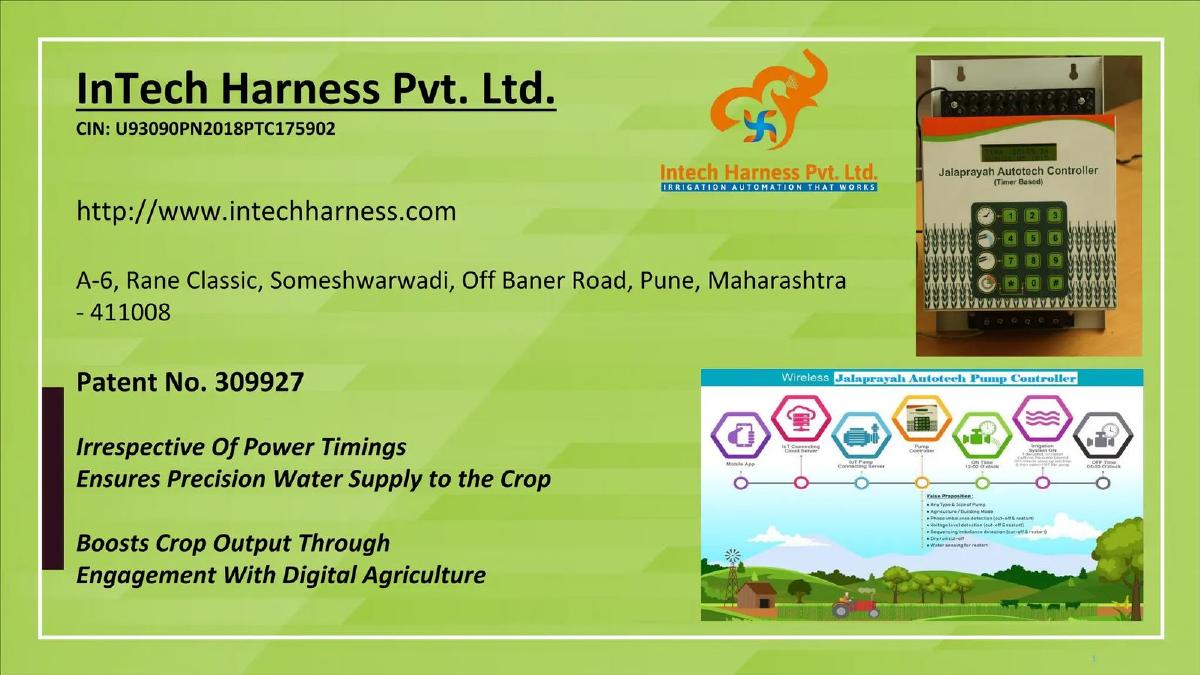
Intech Harness addresses the critical agricultural challenge of inefficient irrigation caused by erratic power and manual pump operations in India. Their core product, the Jalaprayah Autotech Pump Controller, is backed by India Patent No. 309927, which covers a system that automatically adjusts pump run-times to compensate for power outages. The deck outlines a clear transition from hardware sales to a SaaS-based model involving IoT services and data-driven farming. With a Total Addressable Market of 29 million pumps valued at USD 3 billion, the company demonstrates significant traction throu…
Key takeaways
- The company holds India Patent No. 309927, granted in March 2019 and valid until December 2030, for its automatic motor controller (Slide 5).
- The product addresses erratic power and water scarcity, which currently leads to water usage 1.6 to 2 times higher than necessary (Slide 2).
- The revenue model is structured in three phases: hardware sales (Version 1), IoT-based subscription services (Version 2), and data-driven farming integration (Version 3) (Slide 10).
- The Total Addressable Market (TAM) is cited as 29 million pumps in India, representing a USD 3 billion market opportunity (Slide 9).
- Precision irrigation via their controller is shown to increase chickpea yields by an average of 47.08% across multiple Indian states (Slide 12).
- The startup has secured significant non-dilutive funding, including an INR 20 lakh grant from MoA&FW and an INR 40 lakh grant from MeitY (Slide 16).
- A recent funding round raised INR 40 lakhs at a post-money valuation of INR 10.24 crores (Slide 16).
- The team combines over 60 years of collective experience in sales, business development, and electronic product engineering (Slide 6).
Executive Summary and Value Proposition
Slide 1: Title and Overview
The opening slide introduces InTech Harness Pvt. Ltd. and its core product, the Jalaprayah Autotech Controller. It immediately establishes credibility by listing Patent No. 309927 and the company's registration details (CIN). The value proposition is clearly stated: ensuring precision water supply regardless of power timings and boosting crop output through digital agriculture. The slide includes a photo of the hardware unit, which features a physical keypad and LCD display, alongside a high-level IoT architecture diagram.
Slide 2: The Problem Statement
The problem is divided into 'Main Problems' and 'Spin Off Problems.' The primary drivers are erratic power and water sources running dry. These lead to inefficient farming, requiring farmers to be 'extra vigilant' and resulting in soil nutrient loss. The 'Spin Off' section quantifies the pain: water usage is 1.6 to 2 times higher than necessary, and agriculture accounts for 18% of energy consumption. It also notes micro-level issues like wildlife challenges at night and pump burn-out due to manual operations.
Slide 3: The Solution
The solution slide explains the functional logic of the Jalaprayah controller. It uses a specific scenario: if a farmer sets a 4-hour irrigation window (12:00 to 16:00) and a power outage occurs at 13:00, the controller automatically restarts when power resumes at 13:30. Crucially, it adjusts the operation to 16:30 to make up for the lost 30 minutes. This ensures the crop receives the exact intended volume of water. The slide includes photos of the unit installed in rugged, real-world farm environments.
Slide 4: The Urgent Need
This slide categorizes the 'Need' and the 'Why.' It emphasizes resource optimization (water, power, soil nutrients) and the elimination of human intervention. The 'Why' section links these needs to broader goals: reducing the carbon footprint and increasing the life of the pumps. It positions the product not just as a convenience tool, but as a 'wholistic pump automation' system.
Slide 5: Intellectual Property
Dedicated to India Patent No. 309927 , this slide provides the technical description of the grant. The patent was applied for in 2010 and granted in March 2019, with validity until December 2030. The text highlights the 'exclusive rights from Hi Hill Technology' and details the micro-controller's ability to sense resources (voltage, current, phase) and automatically extend operation time to recover lost irrigation time.
Team and Competitive Landscape
Slide 6: The Team
The team is split into 'Execution' and 'Advisory.' Tarang Patel (Co-Founder & CEO) brings 29 years of sales and business development experience. Priya Patel (Co-founder - Technical) is an E&TC Engineer with 16 years in product development. Satyen Deshmukh handles embedded coding with 12 years of experience. The advisory team includes experts from KSB Pumps, Mahindra Group, and IIM-A, providing a mix of technical, marketing, and financial oversight.
Slide 7: Competition Matrix
The company compares its Jalaprayah controller against AutoStarters, GSM-based controllers (L&T, Crompton, KisanRaja, Samarth Agro), and manual operations. The matrix claims that only Jalaprayah offers Patent Protection, Auto Start on Normalisation, and Auto Stop on Attainment of Time . Most competitors are marked as lacking these features or only offering them 'on power availability,' whereas Intech Harness claims to solve for the disruption itself.
Slide 8: The Irrigation Cycle
This slide maps the 'Data Driven Irrigation Activity' flow: Data Acquisition (Sensors/Satellite) -> Data Analysis -> Decision (Irrigation Schedule) -> Execution. It identifies other players in the acquisition space (Fyllo, Fasal, Ecozen) and positions Intech Harness as the 'Farmer Obedient Pump Operator' that handles the final 'Execution of Decision' phase, suggesting a partnership-based business opportunity through 3rd party integration.
Market Opportunity and Business Model
Slide 9: Market Potential
Using the TAM/SAM/SOM framework, the slide cites the Indian Pump Manufacturers Association (IPMA) 2018 as a source. The TAM is 29 million pumps (USD 3 billion). The SAM targets 4 states with 6 million pumps (USD 600 million), and the SOM focuses on Maharashtra with 1.9 million pumps (USD 200 million). The market is noted to be growing at 7-8% annually.
Slide 10: Revenue Model
Version 1: Hardware Sale Revenue (Patented Operator currently selling in market). · Version 2: SaaS Based Revenue (IoT services, subscription for irrigation services). · Version 3: Data From Farm (Subscription for data-driven farming via 3rd party integration).
The slide includes UI mockups of the mobile app showing crop categories like Chana, Cotton, and Maize.
Slide 11: Business Channels
This slide details the go-to-market strategy through various entities:
FPO: Channel sales with 3 dealer agreements. · NGO: Joint market entry with ACT, Cummins Foundation, and ITC Foundation. · Pump OEM: Licensed sales with 2 technical evaluations completed. · Agritech IoT Advisory: 1 LOI received and 1 pilot in progress. · B2G: Implementation partnership with various state governments (Gujarat, TN, UP, etc.).
Impact and Validation
Slide 12: Social Impact
The company presents data on yield increases for Chickpeas. In Sardargarh, Rajasthan, they claim an 87.92% yield increase . The average increase across four states is 47.08%. They calculate that precision irrigation can increase income by INR 11,988 per 1.15-hectare land holding. The total impact size is estimated at 38 million people based on 7.6 million marginal farms.
Slide 13: Environmental Impact
Impact metrics include a GHG mitigation potential of 0.475 Tonnes p.a. , water savings of 12,000 liters per irrigation instance, and energy savings of 72 kWh per pump per month. The slide aligns the company with several UN Sustainable Development Goals (2, 9, 11, 12, 13, 15) and Indian government schemes like Atal Bhujal Yojana.
Slide 14: Cost & Water Economics
This slide provides a granular breakdown of water loss. For a 1-acre drip irrigation setup, a 15-minute extra pump operation extracts 30,000 liters of excess water. For flood irrigation, the same 15 minutes extracts 12,500 liters. This slide uses a handwritten diagram to illustrate the calculation, emphasizing the scale of waste that their precision controller prevents.
Slide 15: Visibility
Evidence of traction and public recognition is shown through features in 'Agriculture Today,' local newspaper publications, and a profile by the US Embassy in New Delhi. It mentions being ranked among the Top 20 Most Innovative MSMEs in India by ET Rise.
Slide 16: Achievements and Funding
Grant in Aid of INR 20 Lakhs from MoA&FW under RKVY-RAFTAAR. · Grant in Aid of INR 40 Lakhs from MeitY. · MoU with ICAR-IIRR for technology deployment in paddy farming. · Raised INR 40 Lakhs at an INR 10.24 Crore valuation via an initiative of IIT Guwahati and DST.
Slide 17: Contact Information
The deck concludes with a simple 'Thank you' slide containing the CEO's email and phone number.
Analysis of Omissions and Structure
What is missing: The deck lacks a clear 'Ask' slide detailing how much capital they are currently seeking and how those funds will be allocated. There is no detailed financial projection (P&L) or unit economics (CAC/LTV) for the hardware or the proposed SaaS model. While the team is strong, there is no mention of a dedicated sales or operations team beyond the founders and advisors.
What works: The use of a granted patent as a core moat is very effective. The company does an excellent job of quantifying the problem (Slide 2 and 14) and the impact (Slide 12 and 13). The transition from hardware to SaaS is a logical progression that addresses the 'scalability' concerns often associated with hardware startups. The validation from government bodies and NGOs provides significant de-risking for potential investors.
Founder Takeaway: Founders in the agritech or hardware space should emulate how Intech Harness translates technical features into economic outcomes for the end-user (Slide 12). The 'make-up time' logic is a simple way to explain a complex automated system. Furthermore, citing specific government grants and third-party market data (IPMA) builds a level of authority that generic claims cannot match.
Frequently asked questions
- What is the core technology behind Intech Harness?
- The core technology is the Jalaprayah Autotech Pump Controller, a patented IoT-enabled device. Unlike standard timers, it features logic that reinitializes and restarts pumps after power outages, extending operation time to ensure the full scheduled irrigation volume is delivered despite disruptions. This 'make-up time' logic is the primary differentiator protected by their Indian patent.
- How does the company plan to generate recurring revenue?
- While the initial phase relies on hardware sales, the company's revenue model (Slide 10) outlines a transition to SaaS. Version 2 introduces subscriptions for IoT-based irrigation services, and Version 3 focuses on selling data insights from the farm through third-party integrations, moving the business from a one-time sale to a recurring service model.
- What is the social and environmental impact of the solution?
- The deck quantifies impact through yield increases (up to 87.92% in some regions) and resource savings. Environmentally, the controller saves approximately 12,000 liters of water per irrigation instance and reduces energy consumption by 72 kWh per pump per month. Socially, they aim to impact 38 million people by targeting marginal and small farms.
- Who are the competitors and how does Intech Harness differentiate?
- Competitors include major players like L&T and Crompton, as well as startups like KisanRaja. Intech Harness differentiates by offering 'Auto Start on Normalisation' and 'Auto Stop on Attainment of Time'—features they claim competitors lack. Their patent protection and ability to eliminate human intervention entirely are highlighted as key competitive advantages.
- What is the current financial status and valuation of the company?
- As of the deck's publication, the company has raised INR 40 lakhs at a valuation of INR 10.24 crores. They have also been highly successful in securing government support, with grants totaling INR 60 lakhs from the Ministry of Agriculture and the Ministry of Electronics and Information Technology (MeitY).