Apricity's 2020 pitch deck presents a sophisticated 'Virtual Fertility Clinic' model aimed at solving the logistical and emotional friction of IVF. Developed within AXA's Kamet venture studio, the startup utilizes a B2B2C strategy, distributing its services as an employer benefit through AXA PPP Healthcare. The deck outlines a clear shift from clinic-centric care to patient-centric care, claiming to reduce required clinic visits to just two by decentralizing diagnostics and monitoring. With a revenue model based on all-inclusive contracting and a mid-term goal to capture 5% of the UK market (…
Key takeaways
- Apricity positions itself as a 'Virtual Fertility Clinic,' decentralizing the IVF process to improve patient experience.
- Strategic partnership with AXA PPP Healthcare provides a direct B2B2C distribution channel through employer benefits.
- Revenue is generated through all-inclusive pricing where Apricity acts as the main contractor/merchant for the patient.
- The platform aims to reduce physical clinic visits to just two, utilizing at-home blood tests and local partner clinics for scans.
- The company acquired Altrui (an egg donation leader) in 2018 to bolster its service capabilities.
- Future growth is centered on AI integration to improve clinical success rates and international expansion into Spain, France, and Germany.
What this deck actually is
The Apricity pitch deck is a Series A-stage presentation (dated July 2020) for a "virtual fertility clinic" that combines digital-first patient management with physical clinical partnerships. It is a strategic hybrid deck—half healthcare services and half health-tech—designed to show how a fragmented, clinic-centric industry can be consolidated and improved through a centralized patient platform and B2B2C distribution (specifically via employer benefits).
The single most important finding in this deck is its unusual provenance and distribution model : Apricity was incubated within Kamet (AXA’s venture studio) and has a locked-in commercial partnership with AXA PPP Healthcare. This effectively de-risks the "GTM" (Go-To-Market) section, as the startup isn't just seeking customers in the wild; it is integrated into the insurance provider's corporate benefit offerings. This relationship is both its greatest strength (instant scale and credibility) and its greatest potential question mark (long-term independence and platform neutrality).
Slide-by-slide walkthrough
Slide 1: Title Slide
The title slide introduces Apricity with the tagline "Disrupting the fertility experience." The visual choice—a couple looking at a laptop together—immediately signals that this is a consumer-facing digital health solution. The date, 07.04.20, places the deck at the height of the global shift toward telemedicine, making the "virtual clinic" proposition highly timely.
For an investor, this slide sets a clear tone of empathy and modernization. Fertility is a sensitive, often clinical subject, but the branding (dark blue and pink) and the photography aim for a "lifestyle tech" feel rather than a cold medical one. The tagline is bold, though "disruption" is a buzzword that requires immediate backing by data in the subsequent slides.
The strongest version of this slide would include a one-sentence value proposition that defines what the "virtual fertility clinic" actually does (e.g., "The digital platform streamlining IVF through AI and at-home care"). As it stands, it is a clean, professional entry point but relies entirely on the brand name to do the heavy lifting.
Slide 2: Contents
This is a standard table of contents slide divided into three sections: "Why?", "Apricity," and "What makes Apricity different?" It uses stylized medical illustrations to maintain the healthcare theme. It is functional but adds little to the narrative arc other than signaling a structured, logical presentation flow.
Investors usually skip these slides, as the narrative should be self-evident. However, the breakdown suggests a heavy focus on the "How" and the "Moat" (Section 3), which is appropriate for a company operating in a space with high regulatory and clinical hurdles.
The strongest version of this slide would be deleted entirely. In a 20-slide deck, every page is premium real estate. The headers could have been integrated into the section dividers (Slides 3, 7, and 12), saving a page for more detailed financial projections or clinical outcomes data.
Slide 3: Section 01 | Why?
This is a section divider featuring a woman in a professional blazer holding a folder. The intent is to transition into the market problem and the "Why now?" of the fertility industry. The dark blue background provides a high-contrast break from the white-background data slides that follow.
The visual choice here is interesting; the woman looks more like a healthcare administrator or a patient-navigator than a patient. This subtly reinforces the "medical excellence" and "organized care" aspects of their value proposition. It signals that we are moving away from the emotional "couple" image of Slide 1 and into the business and operational "Why."
The strongest version of this slide would include a "Bottom Line Up Front" (BLUF) statement. For example: "The $16B fertility market is fragmented, expensive, and fails 73% of UK patients on their first cycle." This would turn a transition slide into a hook.
Slide 4: Infertility is a major concern for employees
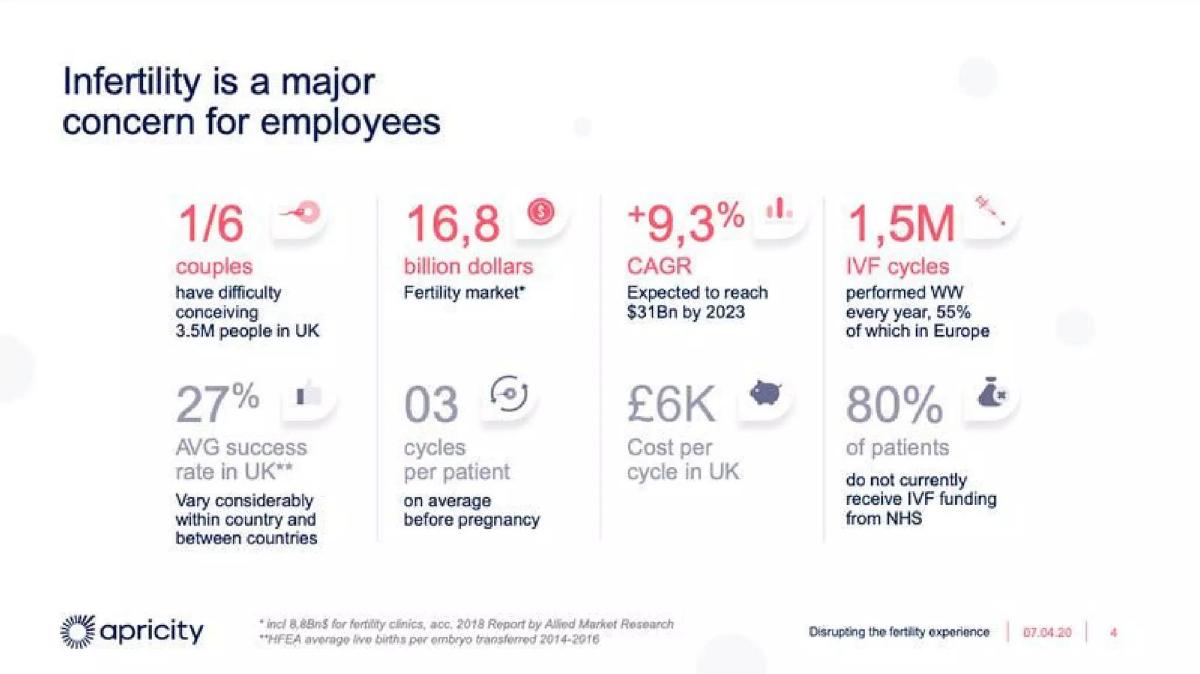
This slide is a data-dense grid of eight statistics establishing the market size and the clinical "failure" of the status quo. It cites a $16.8 billion global market growing at a 9.3% CAGR, 3.5 million people in the UK affected, and a low average success rate of 27% per cycle. It also highlights the financial barrier: £6,000 per cycle with 80% of patients receiving no NHS funding.
Investors read this as a "Classic Market Inefficiency" slide. The combination of high cost, high emotional stakes, and low success rates creates a massive opportunity for a player who can optimize the process. By including the NHS funding gap, the deck identifies a clear "Out of Pocket" or "Employer Benefit" market—people who are desperate for a solution but are not being served by the public health system.
The strongest version of this slide would focus less on general market stats (which most VCs in this space already know) and more on the specific economic wastage Apricity solves. If the average patient takes 3 cycles to get pregnant at £6k each, the "Lifetime Value of a Patient" or the "Total Waste per Patient" is the real metric to highlight.
Slide 5: Fertility treatments affect patients' professional life
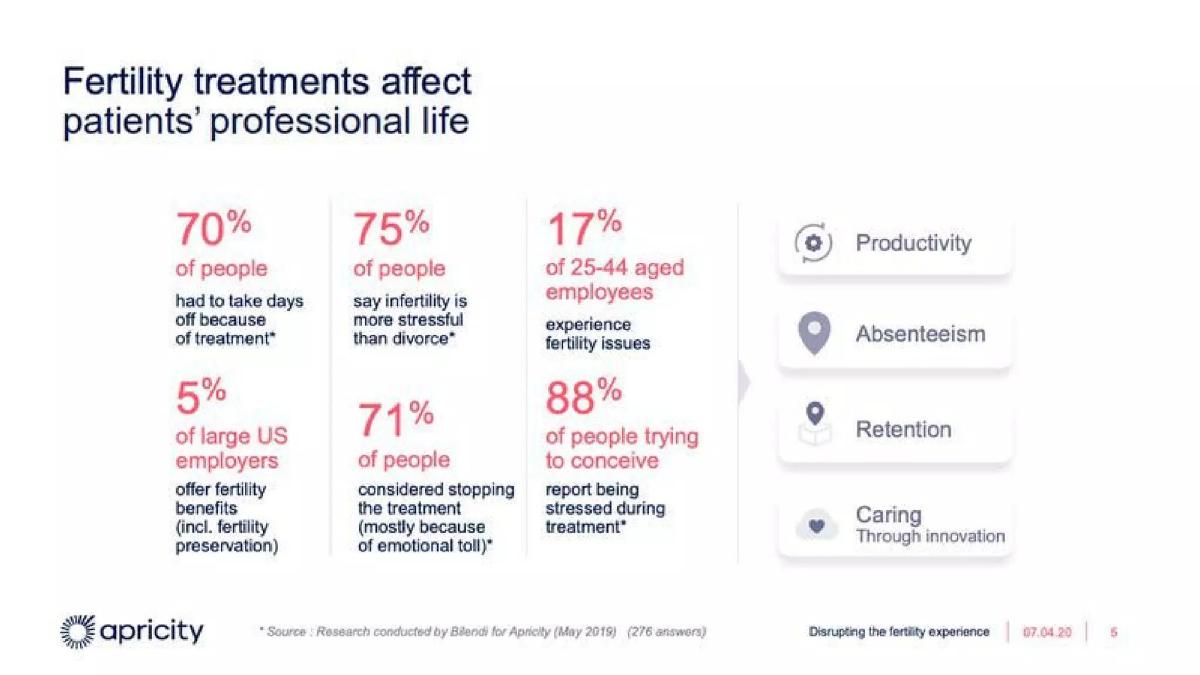
This slide pivots from clinical stats to the impact on the workplace. It highlights that 75% of people find infertility more stressful than divorce and 70% take time off work. It also notes that only 5% of US employers offer benefits, suggesting a massive untapped B2B market. The slide connects these pains to four corporate categories: Productivity, Absenteeism, Retention, and Caring.
This is the "Sales Hook" for the employer-benefit model. By framing infertility as a productivity and retention issue, Apricity is positioning itself not just as a medical provider, but as a corporate HR tool. The inclusion of the "71% considered stopping treatment due to emotional toll" statistic justifies the need for the "human care" and "fertility advisor" aspects of their product.
The strongest version of this slide would provide a "Cost of Inaction" for a typical 1,000-employee company. If 17% of employees in the 25-44 age bracket have issues, an investor wants to see the quantified loss in retention and productivity that Apricity’s platform claims to mitigate.
Slide 6: Clinic-centric vs. Patient-centric
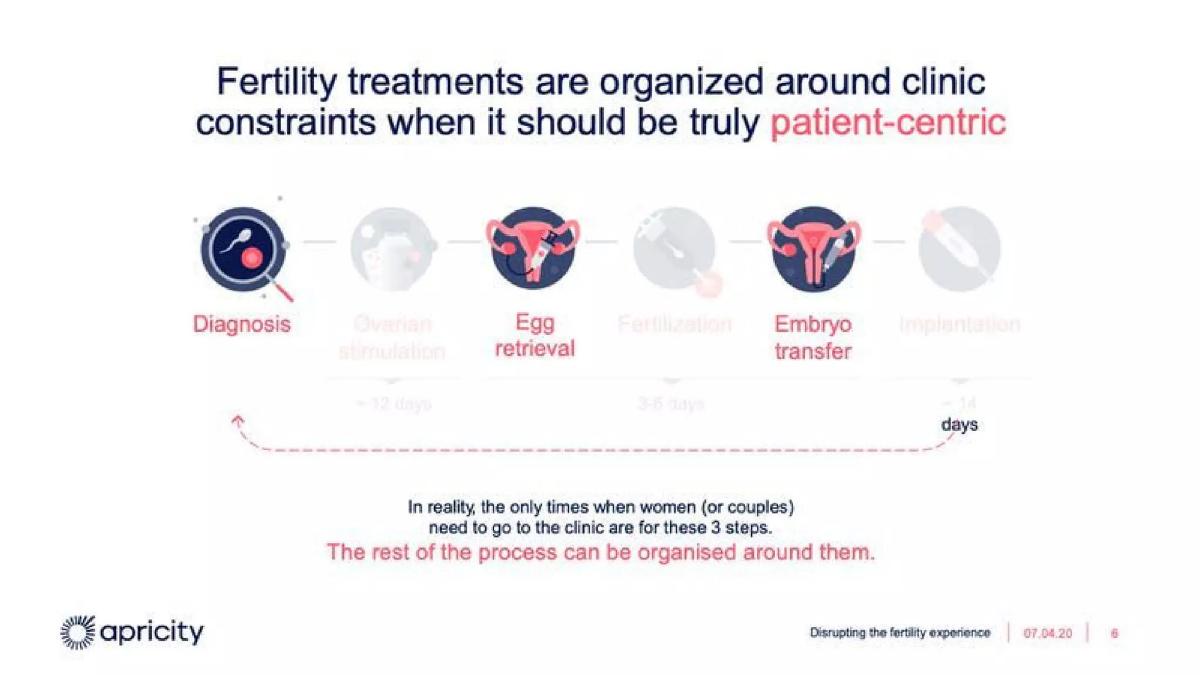
This slide uses a 6-step timeline (Diagnosis to Implantation) to show that while the medical process takes weeks, the patient only needs to be physically in the clinic for three steps: Egg Retrieval, Fertilization, and Embryo Transfer. The other steps (Diagnosis, Stimulation, Implantation monitoring) are shown as delegable to the home or local centers.
This is the core "product insight" of the deck. It argues that the current model is built for the convenience of the clinic, not the patient. By identifying that ~60% of the process can be "virtualized" or decentralized, Apricity justifies its existence as a virtual clinic. It promises to remove the friction of constant travel and clinic visits.
The strongest version of this slide would quantify the time and travel savings. "Reducing clinic visits from 10 to 3" or "Saving patients 20 hours of travel time" is a more powerful metric than a conceptual timeline. It would also explicitly state who performs the "faded out" steps in the Apricity model.
Slide 7: Section 02 | Apricity
This is a section divider intended to introduce the solution. The imagery is of a calm, confident woman. This marks the transition from "The Problem" to "The Solution."
The visual consistency—dark blue background, high-quality photography—signals a well-funded, brand-conscious company. For an investor, this represents "Stage Appropriateness." The company has moved past the "scrappy MVP" look and is building a brand meant to inspire trust in a medical context.
The strongest version of this slide would include a one-sentence summary of the company’s mission. "Building the first AI-powered virtual clinic to double IVF success rates" would give the investor a lens through which to view the following technical slides.
Slide 8: The Meaning of Apricity
This slide explains the brand name: "Apricity means ‘the warmth of the sun in winter’." It is a full-page hero image of a snowy forest. This is a pure branding play, designed to evoke the emotional warmth and hope associated with a successful fertility journey.
While aesthetically pleasing, some investors may view this as "fluff." In a pitch deck, every slide should ideally move the needle on the business case. However, in the fertility space, brand and emotional resonance are legitimate competitive advantages (moats), as patients are often choosing based on trust and "feel" rather than just clinical stats.
The strongest version of this slide would combine this brand sentiment with a mission statement. "The warmth of the sun in winter: Bringing light and clarity to the complex world of fertility." This connects the poetic name to the functional utility of the platform.
Slide 9: The World’s First Virtual Fertility Clinic
This is a bold, minimalist slide that claims the "World's First" title. It serves as a declarative "Flag in the Sand."
Claiming to be the "first" is a high-risk, high-reward strategy. It demands that the founder back up what "virtual clinic" actually means. Is it just a portal? Or is it a licensed medical entity? The deck needs to prove that this isn't just a marketing layer on top of existing clinics, but a fundamental shift in the delivery of care.
The strongest version of this slide would define the "Virtual Clinic" in three bullet points: 1. Remote monitoring, 2. Distributed diagnostics, 3. Centralized AI coordination. This would move the claim from marketing jargon to an architectural reality.
Slide 10: Digital Interaction Photo
This slide shows a woman using a smartphone with a pink case. It reinforces the digital-first, mobile nature of the service. It essentially acts as a second cover slide or a transition into the product features.
The repetition of imagery (Slide 1, Slide 10, and others) starts to feel slightly redundant by this point. The deck has already established that this is a digital health product. Investors are now looking for the "How"—the app interface, the backend, the data flow.
The strongest version of this slide would be a "Product in Action" shot. Instead of a generic photo of a woman holding a phone, show the actual Apricity app interface being used in a real-world setting (e.g., at a pharmacy or in a living room). Show, don't just tell, the "virtual" nature.
Slide 11: The Four Pillars of the Journey
This slide identifies the service components: Bespoke Journey, Fertility Advisor, Mobile App, Best Medical Team, and Artificial Intelligence. It claims to "tailor fertility journeys to match patients' specific needs."
This is the "Secret Sauce" slide, but it is somewhat generic. Every health-tech startup claims to have "AI" and a "Best Medical Team." The most interesting piece here is the "Fertility Advisor"—suggesting a human-in-the-loop model that provides emotional and navigational support, which correlates back to the "emotional toll" mentioned in Slide 5.
The strongest version of this slide would provide evidence for these claims. For example: "AI: Our algorithms predict embryo viability with X% higher accuracy than manual selection." Without these specifics, these are just buzzwords. It should also clarify what "Bespoke Journey" means in terms of clinical protocols.
Slide 12: Section 03 | What makes Apricity different?
This section divider introduces the competitive advantage. The imagery is of a woman working on a laptop in a casual setting, reinforcing the "care anywhere" theme.
At Slide 12, the investor is finally getting to the meat of the differentiation. The previous 11 slides have focused heavily on the problem and the brand; the deck now needs to deliver on the "How" and the "Moat."
The strongest version of this slide would be a competitive matrix. If they are the "world's first virtual clinic," how do they compare against traditional clinics (CRM, IVF Spain) and other fertility apps (Kindara, Clue)? Defining the competitive landscape is crucial at this stage.
Slide 13: Fertility Advisors and Testimony
This slide focuses on the human element. It features a testimonial from Blair McPhee (CEO, Fertility Network) and lists the duties of the advisors: 7/7 availability, arranging appointments, and emotional support. It emphasizes "support and transparency."
The testimonial is a strong piece of social proof. Having the head of a major patient network endorse the platform gives Apricity immediate clinical and ethical credibility. The "7/7 availability" is a concrete operational promise that differentiates them from traditional clinics that often operate on strict 9-5 hours and are notoriously difficult to reach.
The strongest version of this slide would include a metric on advisor impact. For example: "Advisors reduce patient inquiry response time from 24 hours (industry average) to 15 minutes." This quantifies the "support" being promised.
Slide 14: The Bespoke Journey & Pricing Options
This is one of the most important slides in the deck. It breaks down the "Bespoke Journey" into specific logistics: blood tests at home (£180) vs. at the clinic (included), ultrasound locations, and drug delivery. It claims that patients only need "Just 2 visits to the clinic."
This slide proves the "Virtual Clinic" model. By unbundling the components of IVF (blood tests, scans, drugs) and offering them via a distributed network, Apricity creates a tangible value proposition for anyone living outside of a major metro area. The mention of "Just 2 visits" is a powerful hook for the rural or busy urban patient.
The strongest version of this slide would include a "Total Cost Comparison." It lists several "add-ons" (+£180, +£300), which might worry an investor about "nickel and diming" the patient. Showing a "Standard vs. Bespoke" total price comparison would clarify the affordability story.
Slide 15: The Mobile App Interface
This slide shows four UI mockups: Journey Overview, Medication Reminders, Advisor Chat, and Educational Content. It aims to show how the app "lowers risk of errors" and "reduces stress."
The UI is clean and follows modern design patterns. The "Trigger injection" reminder is a critical feature, as timing is everything in IVF; a missed injection can ruin a £6,000 cycle. Highlighting this shows the founders understand the specific clinical pain points of the patient.
The strongest version of this slide would mention the "Compliance Rate." If the app increases medication adherence by X%, that is a direct lead-in to higher success rates—which is the ultimate metric in fertility. It should also show how data from the app feeds back to the "Medical Team" mentioned earlier.
Slide 16: Transparency in Pricing
Apricity explains its billing model: The patient contracts with Apricity directly, prices are all-inclusive (meds, scans, consultations included), and they charge everything in advance. The price is described as "similar to the clinic price."
For an investor, this slide explains the "Revenue Model." Apricity is not just a lead-gen tool for clinics; it is the "Merchant of Record." This is a significant business model choice. It means Apricity controls the cash flow and the customer relationship, treating the clinics as sub-contracted service providers. This gives Apricity much higher gross margins and platform power.
The strongest version of this slide would explicitly state the margin. If Apricity charges the patient the "clinic price" but pays the clinic a "wholesale/partner rate," the spread is their revenue. Clarifying this unit economics would be highly beneficial.
Slide 17: The AXA PPP Healthcare Partnership
This slide details the B2B offering: A fertility benefit for employers, powered by Apricity and AXA. It includes bundled coverage, no payment upfront for employees, and "lifestyle coaching" to reduce systematic treatment (presumably to save the insurer money).
This is the most "derisking" slide in the deck. The partnership with AXA PPP Healthcare provides a massive distribution channel and immediate "enterprise grade" validation. It changes the company from a B2C play (which is expensive to acquire) to a B2B2C play with a built-in audience of millions of insured employees.
The strongest version of this slide would mention the status of the rollout. Is this a pilot with 5 companies, or is it live for all AXA corporate clients? Identifying the "Number of Covered Lives" is the key metric for any insurance-linked health-tech startup.
Slide 18: Ambition and Growth Roadmap
Apricity sets a target for 2022 in the UK: 4,000 cycles a year, 5% market share, and 10 partner clinics. It also shows a geographic expansion roadmap (Spain, France, Germany) and a move into "Natural fertility" and "Donor eggs."
The target of 4,000 cycles is ambitious. Given the UK performs ~70k cycles a year (from Slide 4), 4,000 is indeed ~5-6%. However, the deck doesn't explain how they get from "Current" to 4,000. It also shows an "AI project" aimed at improving success rates in the values/mid-term section, which suggests the AI is still in development, not a current driver of results.
The strongest version of this slide would include a historical growth chart. Since the deck is dated July 2020 and mentions 2018/2019 as the "MVP + Launch" phase, showing the number of cycles completed in 2019 would prove the growth trajectory toward that 4,000-cycle goal.
Slide 19: The Team and Altrui Acquisition
The team is led by Caroline Noublanche (CEO). The slide notes that Apricity is a startup of "Kamet, AXA insurtech start-up studio." It also mentions the 2018 acquisition of Altrui, a UK leader in egg donation. The team is 30 people across London and Paris.
The "Kamet/AXA" connection is the most vital piece of information here. It explains how they were able to acquire a market leader (Altrui) so early in their lifecycle and how they secured the AXA partnership. The team appears to have a good balance of growth, medical, and tech leadership, though specific past exits or fertility-specific medical credentials for the leadership team (other than the Altrui mention) are not detailed.
The strongest version of this slide would highlight the medical advisory board. In a virtual clinic, the "Chief Medical Officer" or a board of renowned embryologists is crucial for credibility. While Altrui provides the "egg donation" expertise, the broader clinical oversight needs more spotlight.
Slide 20: Contact Slide
A standard thank you slide with social handles and the CEO’s contact information. It uses the dark blue brand color and the "sun" logo graphic.
It is functional and consistent with the branding. Including a French phone number (+33) despite the UK focus of the deck highlights the dual-location nature of the startup (London and Paris).
The strongest version of this slide would include a "Final Call to Action." For example: "Join us in redefining the fertility experience. Raising £Xm to scale to 4,000 cycles." This leaves the investor with a clear understanding of what the company wants next.
Concrete fixes in priority order
Quantify Clinical Outcomes: The deck mentions "Medical Excellence" and "AI" repeatedly but never states Apricity's current success rate versus the 27% UK average. Success rate is the #1 metric for patients and insurers. · Clarify the AI Moat: Slide 18 places the "AI project" in the mid-term (2020-2022). If the AI isn't currently improving outcomes, the "Advanced Technology" pillar on Slide 11 is aspirational. Be honest about the current tech stack versus the roadmap. · Detail the AXA Economics: The AXA partnership is the company's "unfair advantage." The deck needs to explain the revenue share or licensing model. Is Apricity a "Preferred Provider," or is the service exclusive? · Show Traction to Date: The deck lists future goals (4,000 cycles) but omits current progress. Investors need to see the "0 to 1" journey (cycles performed in 2019) to believe the "1 to 10" journey. · Streamline Branding: Slides 2, 8, 9, and 10 are largely "mood" slides. In a professional pitch, these could be condensed to make room for a "Unit Economics" or "Competitive Landscape" slide, which are currently missing. · Explain the Altrui Integration: You acquired a leader in egg donation in 2018. How much of your current revenue or cycle volume comes from Altrui vs. the new "Virtual Clinic" model? This helps investors understand if this is a "Tech-Enabled Services" play or a "SaaS-Enabled Marketplace."
Frequently asked questions
- What is a virtual fertility clinic?
- Apricity is a 'virtual fertility clinic' that handles diagnostics, monitoring, and medication coordination remotely or at the patient's home, requiring only two physical clinic visits for specialized procedures (egg retrieval and transfer).
- How does Apricity work with insurance companies?
- The deck states that Apricity has a partnership with AXA PPP Healthcare to offer fertility benefits to employers, including bundled coverage, concierge support, and no upfront payments for employees.
- What is the business model and how does Apricity make money?
- Apricity acts as the primary contractor for the patient. They charge an all-inclusive price (similar to traditional clinics) that covers all medical, logistical, and advisory components, then manage the payments to partner clinics.
- How does Apricity differentiate itself from traditional IVF clinics?
- The deck highlights 7/7 advisor support, an AI-driven approach to improve success rates (mid-term goal), and a 'bespoke journey' that reduces physical clinic visits from the industry average to just two.
- What is Apricity's relationship with AXA?
- Apricity was incubated within Kamet, which is AXA's insurtech startup studio. This provides the company with deep ties to AXA's insurance distribution networks.