WellTrack’s 7-slide deck is an exceptionally lean presentation that prioritizes institutional validation over narrative fluff. At the time of this Seed round in 2011, the company reported a significant $400,000 in Annual Recurring Revenue (ARR), a figure that immediately anchors the pitch in reality. The deck identifies a clear wedge in the university market, listing Penn State, UC San Diego, and Boston College as active clients. While it lacks a formal 'Ask' slide or detailed financial projections, it compensates with a strong team profile led by a Professor of Psychology. This teardown expl…
Key takeaways
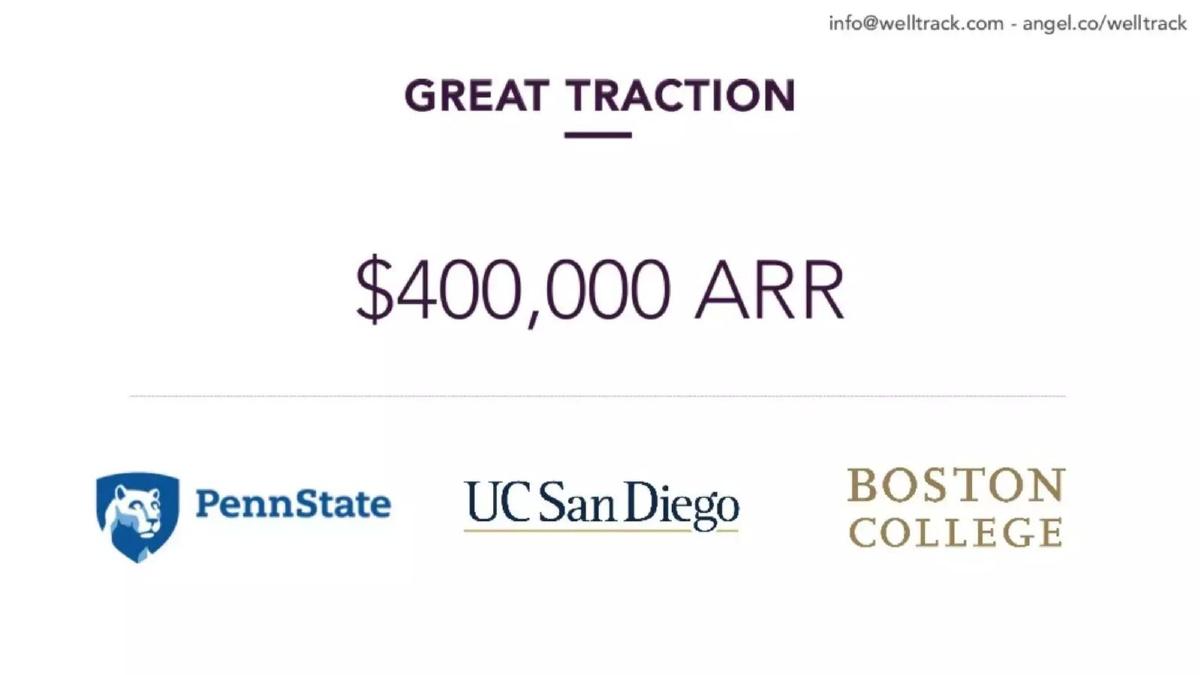
- The company reports $400,000 in Annual Recurring Revenue (ARR) on slide 4.
- Institutional validation is established through logos from Penn State, UC San Diego, and Boston College on slide 4.
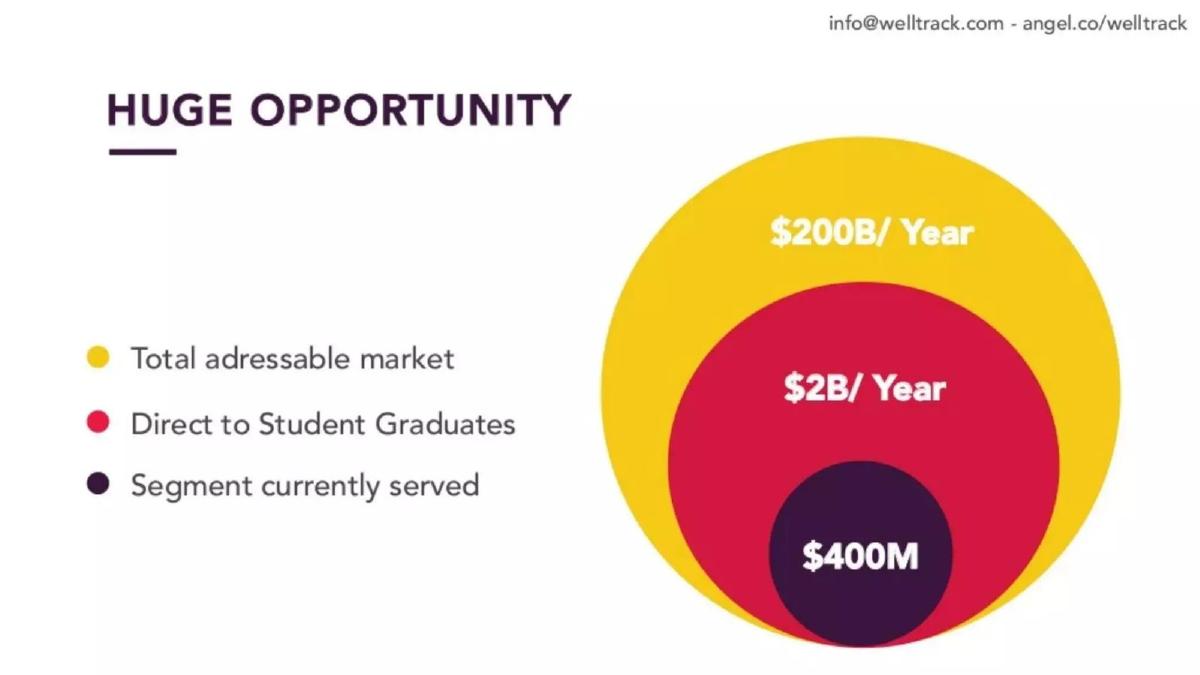
- The Total Addressable Market (TAM) is valued at $200B per year on slide 5.
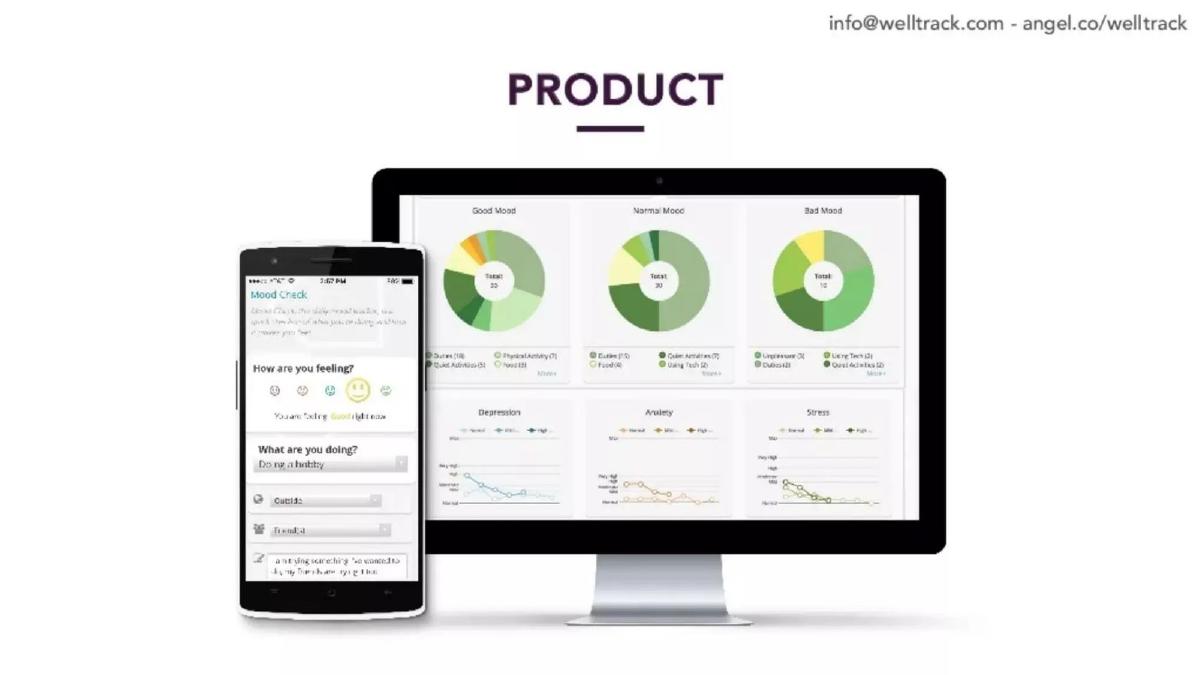
- The product interface includes a 'Mood Check' feature and data visualization for depression, anxiety, and stress as shown on slide 3.
- The leadership team includes a PhD-level psychologist and a full-stack developer, providing both clinical and technical credibility on slide 6.
- The deck identifies 'Direct to Student Graduates' as a $2B annual opportunity on slide 5.
- The presentation completely omits a funding ask, use of funds, or financial roadmap.
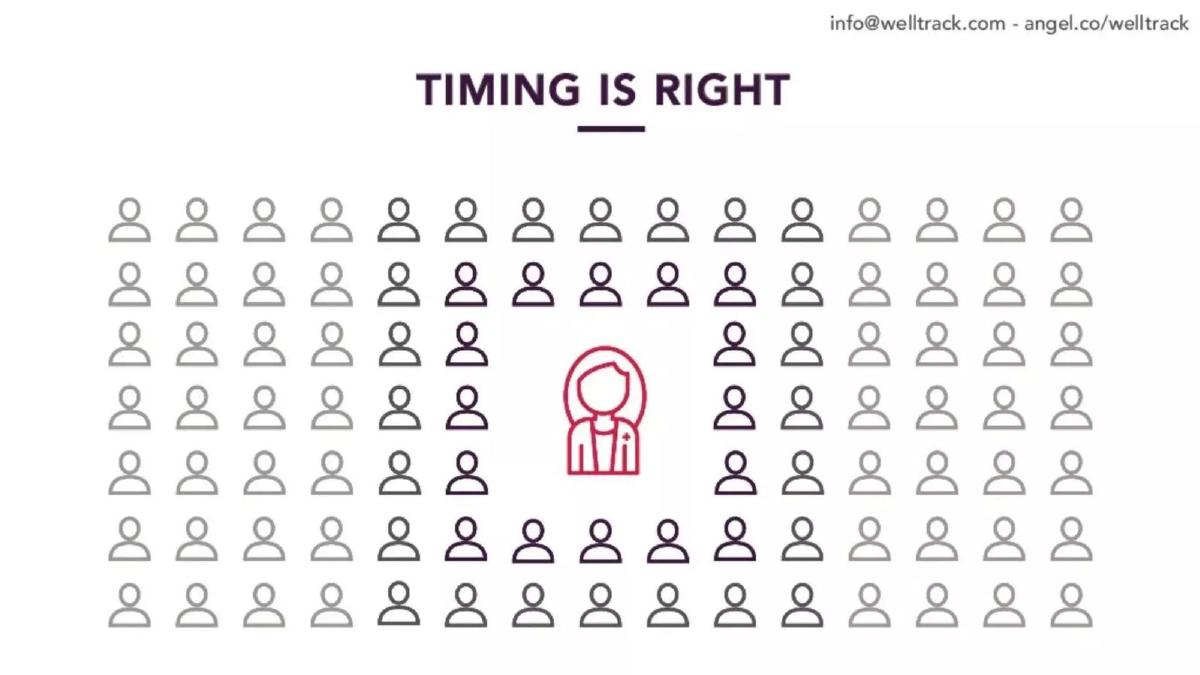
- The 'Timing is Right' slide (slide 2) uses a minimalist graphic to imply a shortage of mental health professionals relative to the population.
The 7-Slide Seed Deck: High Signal, Low Noise
WellTrack’s pitch deck is a rare example of extreme minimalism in the fundraising world. With only seven slides, the company manages to convey a compelling story of clinical expertise, technical readiness, and—most importantly—significant market traction. Founded in 2011, WellTrack entered the digital health space at a time when 'on-demand therapy' was still a nascent concept. This teardown examines how they used a lean presentation to secure seed funding by focusing on the metrics that matter most to investors.
Slide 1: Title and Tagline
The deck opens with a clean, white title slide featuring the WellTrack logo and the tagline: "Interactive Self-Help Therapy." The contact information in the top right corner includes an angel.co link, signaling that this deck was likely used for early-stage outreach on the AngelList platform. The branding is professional and clinical, avoiding the overly 'techy' aesthetic of many 2011-era startups.
Slide 2: The Problem and Timing
Slide 2 is titled "TIMING IS RIGHT." It uses a simple but effective infographic: a large grid of grey icons representing the general population, with a single red icon in the center representing a healthcare professional. The visual gap between the professional and the crowd illustrates the shortage of mental health resources. There is no text on this slide explaining the 'why'—it relies entirely on the visual metaphor of a bottleneck in care delivery. This is a bold choice that assumes the investor is already aware of the mental health crisis.
Slide 3: Product Interface
The "PRODUCT" slide provides a high-fidelity look at both the mobile and desktop versions of the platform. The mobile screen shows a "Mood Check" feature where users answer questions like "How are you feeling?" and "What are you doing?" The desktop view displays a dashboard with pie charts for 'Good Mood,' 'Normal Mood,' and 'Bad Mood,' alongside line graphs tracking Depression, Anxiety, and Stress . This slide proves that the product is not just a concept but a functional tool capable of data visualization and user tracking.
Slide 4: Traction and Institutional Validation
This is the 'money slide' of the deck. Titled "GREAT TRACTION," it features a large-font figure: "$400,000 ARR." Below this, it displays the logos of three major institutions: Penn State, UC San Diego, and Boston College . For a seed-stage company in 2011, $400k in recurring revenue is an exceptionally strong signal. By leading with university logos, WellTrack demonstrates that they have successfully navigated the difficult B2B sales cycle of higher education, which serves as a significant moat against competitors.
Slide 5: Market Opportunity
The "HUGE OPPORTUNITY" slide uses a nested circle diagram to define the market. It identifies three distinct tiers:
Total Addressable Market: $200B / Year · Direct to Student Graduates: $2B / Year · Segment currently served: $400M
This slide suggests that while WellTrack is currently dominating a $400M niche (likely the university counseling center market), there is a clear path to a $2B market by following students after they graduate, and eventually a $200B global mental health market.
Slide 6: The Team
The "TEAM" slide introduces three key players. Darren Piercey, PhD , is the CEO and is identified as a Professor of Psychology , which provides the necessary clinical authority for a health-tech startup. Natasha O’Brien (COO) is credited with Sales & Marketing , likely the driver behind the $400k ARR. Jeremie Bourque (CTO) is described as a Full Stack Developer , confirming that the technical build was handled in-house. The team is balanced, covering the three pillars of a successful startup: domain expertise, sales, and engineering.
Slide 7: Closing Visual
The final slide returns to the logo and tagline, overlaid on a lifestyle image of a person using a smartphone. This reinforces the 'on-demand' nature of the product. Like the first slide, it contains the contact email and AngelList URL. Notably, there is no 'Ask'—no mention of how much they are raising or what the valuation is. This suggests the deck was intended to start a conversation rather than close a deal on its own.
What Works in This Deck
The primary strength of the WellTrack deck is its unwavering focus on traction . Many seed decks spend 10 slides explaining the problem; WellTrack spends one. By putting the $400,000 ARR and the university logos front and center, they answer the investor's most important question: "Does anyone want this?"
The clinical credibility is also a major plus. Having a PhD and Professor of Psychology as the CEO mitigates the risk that the 'therapy' provided by the app is scientifically unsound. In the mental health space, this 'medical' validation is often as important as the code itself.
What Is Missing
The most glaring omission is the Fundraising Ask . We don't know if they are looking for $500k or $5M. Furthermore, there is no Competitive Landscape slide. In 2011, other players were entering the digital health space, and failing to acknowledge them can sometimes make a founder look disconnected from the market.
The deck also lacks Unit Economics . While $400k ARR is great, investors would want to know the Customer Acquisition Cost (CAC) for a university versus the Lifetime Value (LTV) of that contract. Without these details, it's hard to judge the scalability of the business model.
What a Founder Should Copy
Founders should emulate the visual hierarchy used on slide 4. If you have revenue and recognizable logos, do not bury them in a bulleted list on slide 12. Make them the hero of the presentation. WellTrack’s use of large, bold text for their ARR figure is a masterclass in 'showing, not telling.'
Additionally, the market sizing approach on slide 5 is excellent. Instead of just claiming a $200B TAM, they show the 'Segment currently served' ($400M). This makes the larger numbers feel more attainable because the company has already proven it can capture a piece of the smaller, immediate market.
Frequently asked questions
- How much money was WellTrack raising in this deck?
- The deck does not specify a fundraising goal. There is no 'Ask' slide or 'Use of Funds' breakdown included in the 7-slide presentation. This is unusual for a pitch deck and suggests the deck may have been used as a teaser or that the terms were being discussed in person rather than documented in the static slides.
- What is WellTrack's primary business model based on the deck?
- While the deck doesn't explicitly detail pricing tiers, slide 4 shows $400,000 ARR and lists three major universities. This strongly implies a B2B SaaS model where institutions (like colleges) pay a recurring fee to provide the 'Interactive Self-Help Therapy' to their student populations.
- Who are the key members of the WellTrack team?
- The team consists of three core members: Darren Piercey, PhD (CEO and Professor of Psychology), Natasha O’Brien (COO, focused on Sales & Marketing), and Jeremie Bourque (CTO and Full Stack Developer). This combination covers clinical expertise, business development, and technical execution.
- What specific mental health issues does the product address?
- According to the product mockups on slide 3, the platform tracks and visualizes data for three specific conditions: Depression, Anxiety, and Stress. It also features a 'Mood Check' tool that allows users to log their current feelings and activities.
- What is the market size for WellTrack's solution?
- Slide 5 breaks the market into three tiers: a $200B/year Total Addressable Market, a $2B/year 'Direct to Student Graduates' market, and a $400M 'Segment currently served.' This indicates the company sees significant room for expansion beyond its initial university-focused niche.