Wellspent’s 2022 Seed deck is a masterclass in using scientific validation to de-risk a consumer-facing healthcare app. By leading with a randomized controlled trial (RCT) conducted with the Freie Universität Berlin, the company moves beyond the 'wellness' category into 'digital therapeutics.' The deck identifies a massive $24 billion market opportunity based on an $81 Average Revenue Per Paying User (ARPPU) across 310 million affected individuals. While the deck is visually minimalist and lacks a detailed financial roadmap or specific 'Ask' slide, the strength of its team—featuring experienc…
Key takeaways
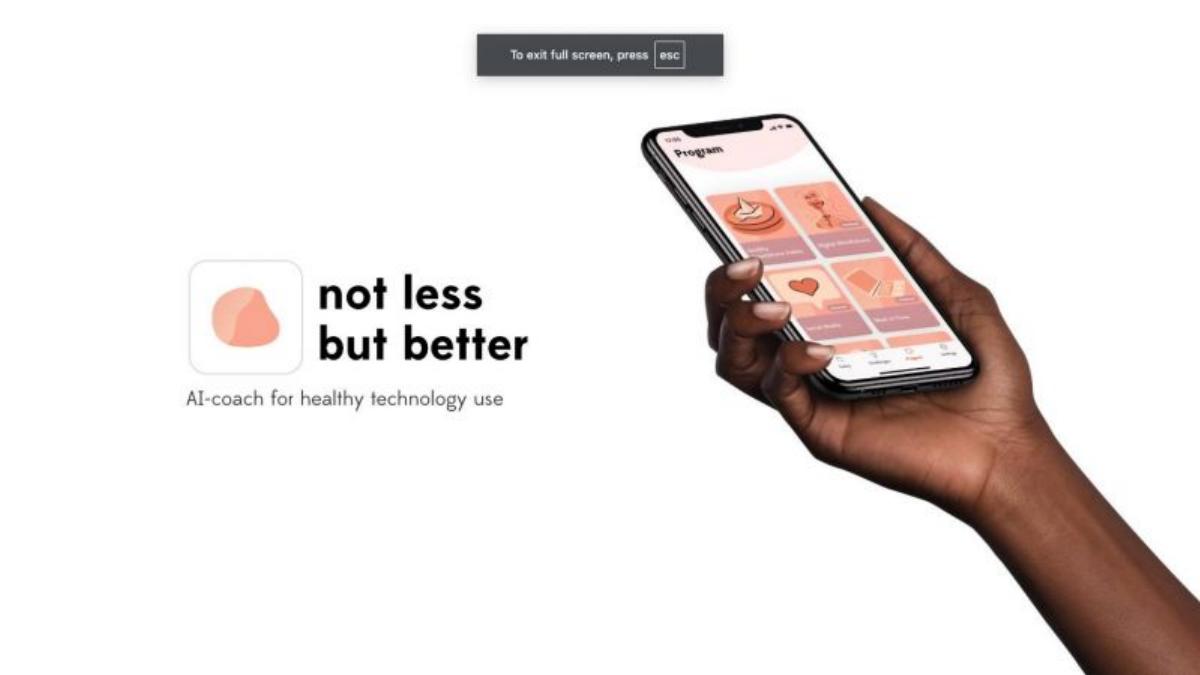
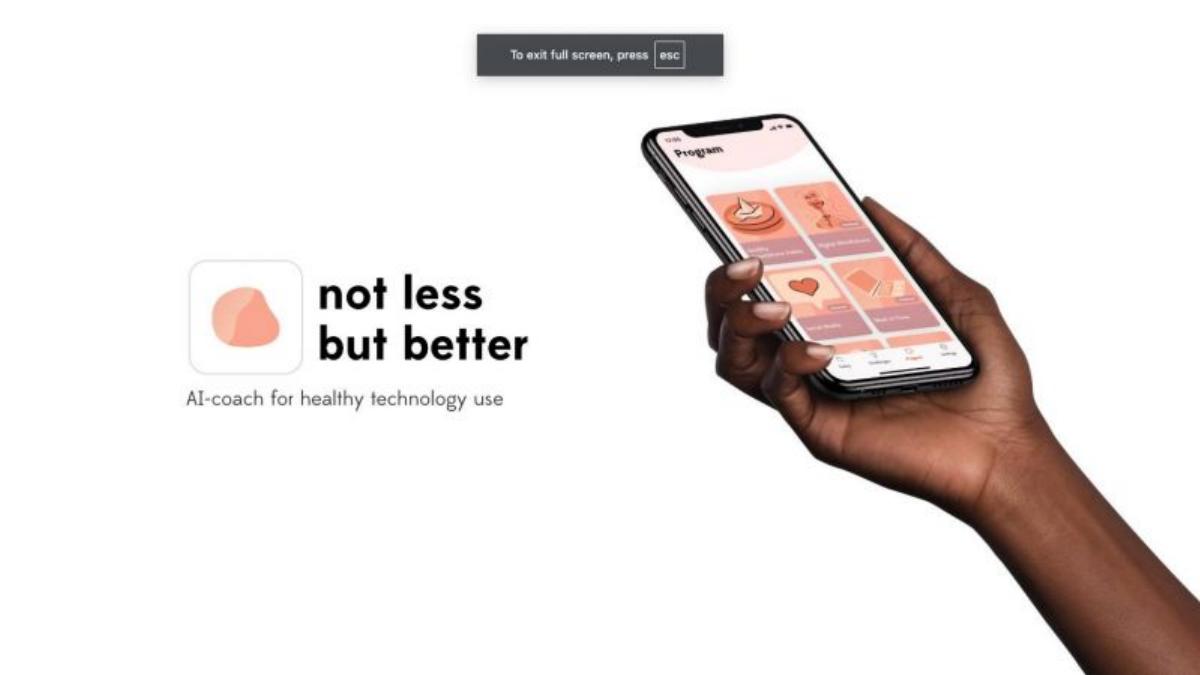
- The company positions itself as an 'AI-coach for healthy technology use' on Slide 1.
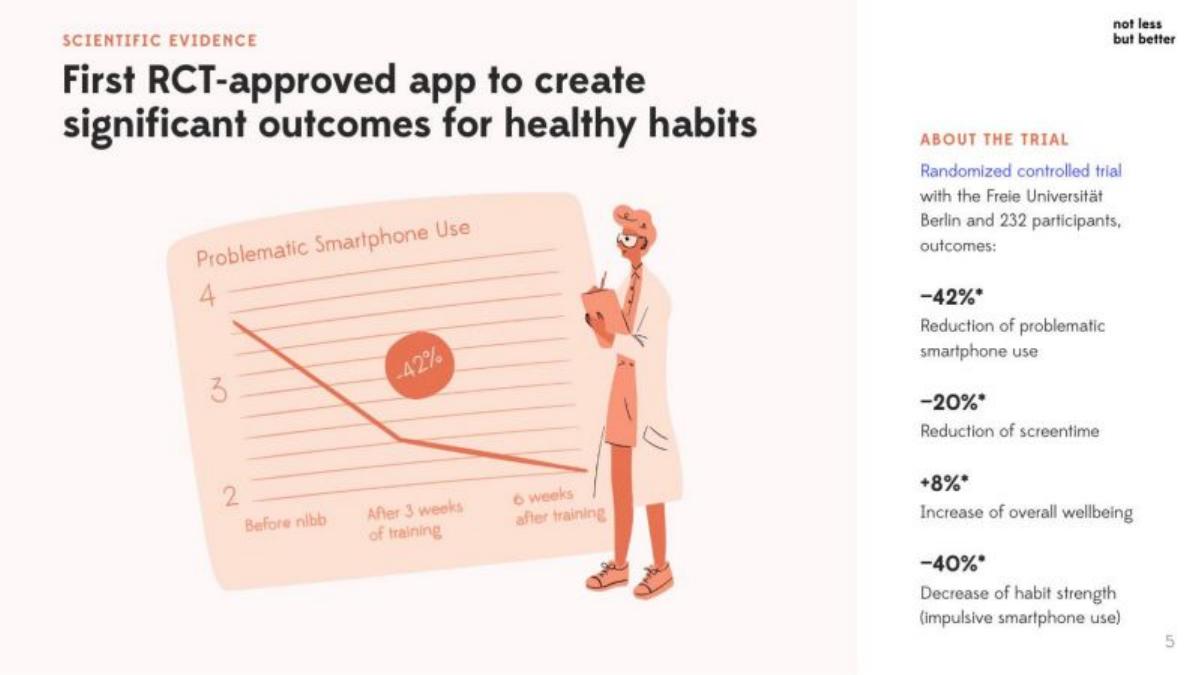
- A randomized controlled trial with 232 participants showed a 42% reduction in problematic smartphone use (Slide 5).
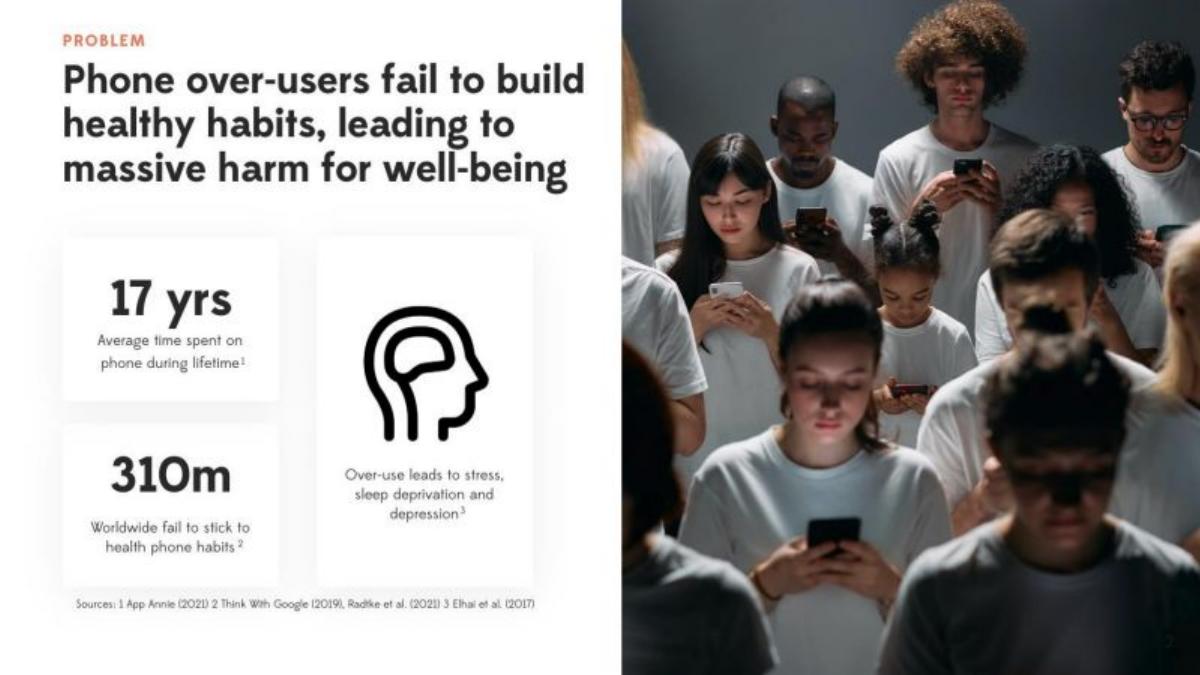
- The deck claims 310 million people worldwide fail to stick to healthy phone habits (Slide 2).
- Market potential is calculated at $24 billion based on 310 million affected users and an $81 ARPPU (Slide 8).
- One premium subscriber reported reducing screen time from 7.5 hours per day to 2.5 hours (Slide 9).
- The founding team includes a CTO with experience at Calm and Keepsafe, and a CEO who is a 2x founder (Slide 10).
- The deck lacks a specific 'Ask' slide detailing the amount of capital sought or the planned use of funds.
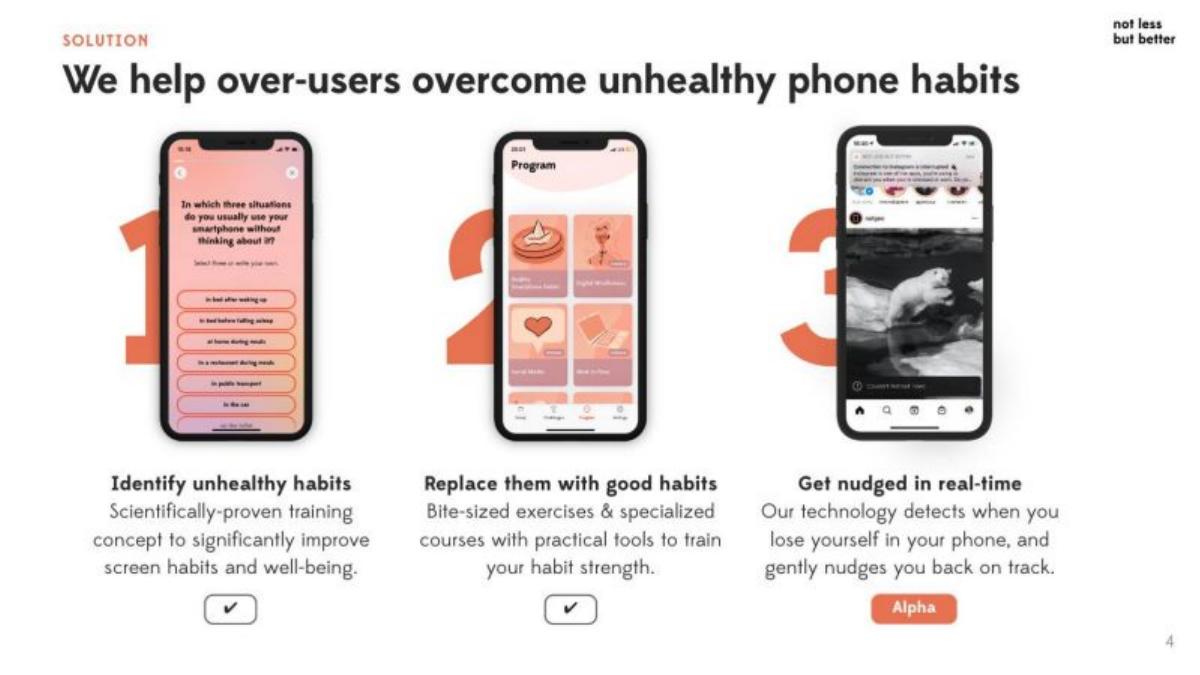
- The product uses real-time 'nudges' to interrupt users when they lose themselves in their phones (Slide 4).
The Scientific Approach to Digital Wellness
Wellspent (operating under the brand 'not less but better' at the time of this deck) entered the market during a period of intense scrutiny regarding 'The Attention Economy.' While many apps attempt to solve screen addiction through simple timers or blockers, Wellspent’s pitch deck focuses on behavioral psychology and clinical validation. This teardown examines how a 13-slide deck successfully navigated the transition from a wellness app to a digital health platform.
Slides 1-3: The Macro Problem
Slide 1 introduces the brand 'not less but better' and defines the product as an 'AI-coach for healthy technology use.' The imagery is clean, featuring a hand holding a smartphone with a soft, peach-toned UI. This immediately distances the product from 'punitive' screen blockers, suggesting a more supportive, coaching-based relationship.
Slide 2 quantifies the problem with staggering figures. It claims the average person spends 17 years on their phone during their lifetime, citing App Annie (2021). It also notes that 310 million people worldwide fail to stick to healthy phone habits. By linking over-use to 'stress, sleep deprivation and depression,' the deck establishes the 'Healthcare' sector classification early on.
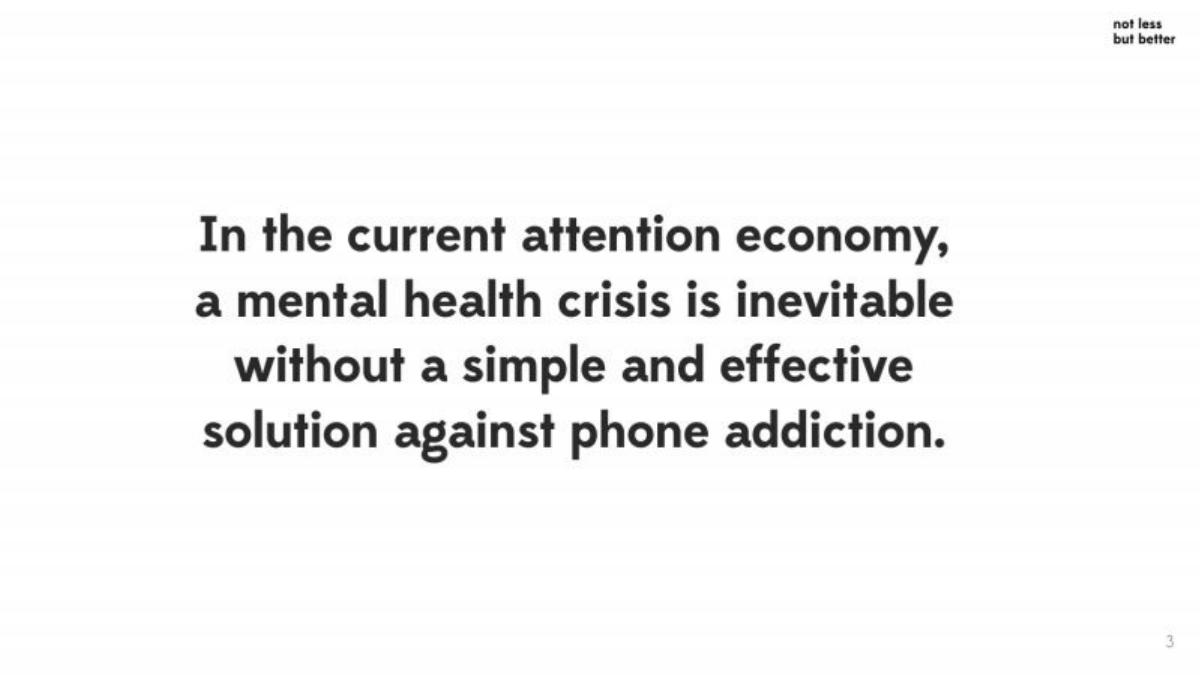
Slide 3 serves as a transition, stating that in the current attention economy, a mental health crisis is 'inevitable' without a simple solution. It is a high-stakes claim designed to create urgency for the solution that follows.
Slides 4-5: The Solution and The Proof
Slide 4 breaks down the product into three pillars: Identify, Replace, and Nudge. The 'Nudge' feature is particularly notable as it is labeled 'Alpha.' It describes technology that detects when a user 'loses themselves' in their phone and provides a real-time intervention. This suggests a level of technical sophistication beyond standard iOS Screen Time settings.
Slide 5 is the 'money slide' for this deck. It presents the results of a Randomized Controlled Trial (RCT) with Freie Universität Berlin. For a Seed stage startup, having a study with 232 participants is a significant de-risking factor. The slide claims a 42% reduction in problematic smartphone use and a 20% reduction in screen time. In the world of digital health, clinical proof is the primary differentiator between a 'nice-to-have' app and a reimbursable medical tool.
Slides 6-8: Market Dynamics and Opportunity
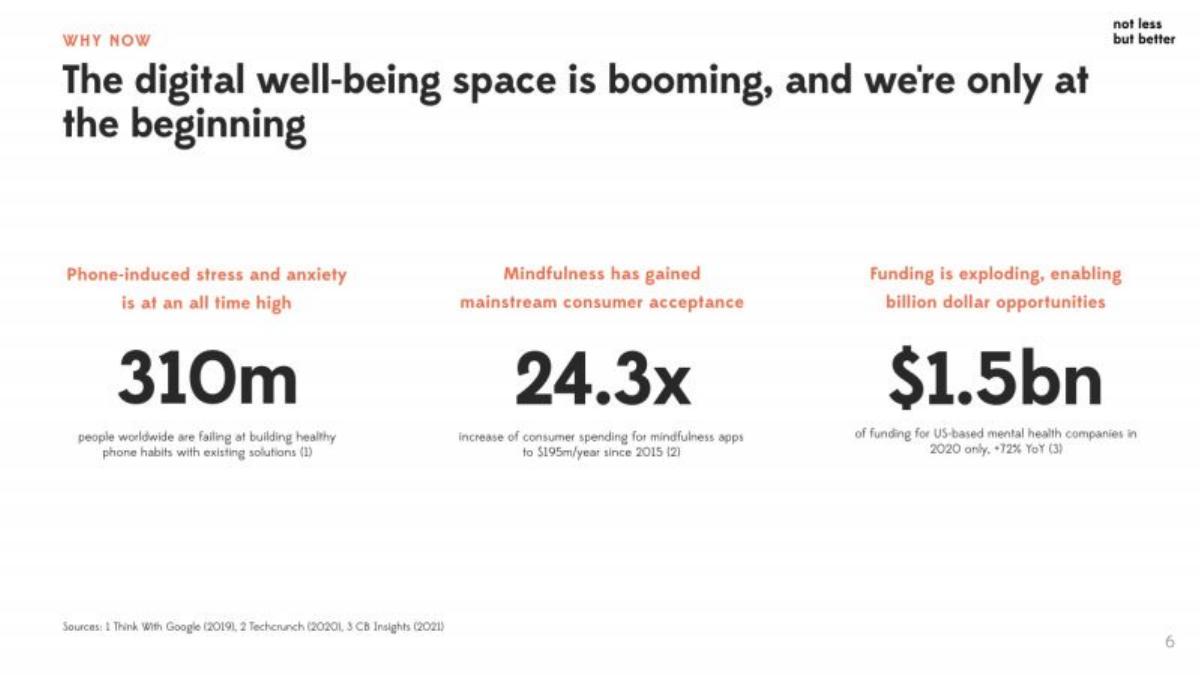
Slide 6 focuses on 'Why Now.' It highlights that mindfulness consumer spending has increased 24.3x to $195M/year since 2015 and that $1.5bn was funded for US-based mental health companies in 2020 alone. This slide is intended to show that the 'Digital Well-being' space is no longer a niche interest but a venture-scale category.
Slide 7 uses a 'Potential' framework to compare Wellspent to other billion-dollar apps. It lists Coursera ($5bn), Calm ($2bn), and Noom ($4bn). By placing Wellspent in the same context as these giants, the founders are signaling their ambition to move from a simple app to a platform-level company.
Slide 8 provides the actual TAM (Total Addressable Market) calculation. They estimate a $24bn market potential. This is derived from the 310 million affected individuals multiplied by an $81 ARPPU (Average Revenue Per Paying User). This is a bold figure, as $81 is a high price point for a consumer app, suggesting they are either targeting high-intent users or looking toward B2B/employer-sponsored models.
Slides 9-13: Traction, Team, and Vision
Slide 9 is a simple testimonial from a premium subscriber who reduced their screen time from 7.5 hours to 2.5 hours. While anecdotal, it puts a human face on the 20% reduction metric mentioned earlier.
Slide 10 introduces the team. The pedigree is strong: Marius (CTO) has experience with Calm and Keepsafe; Christina (CPO) brings psychology and design thinking from Bosch and DB; Selcuk (CEO) is a 2x founder. The slide also mentions '6 Add. Team Members' with experience at Blinkist and The New York Times. This slide effectively communicates that the team has the 'product-market fit' experience required to scale a consumer app.
Slide 11 and Slide 12 close the deck with a vision statement: 'We are redistributing attention... back to the owners: the people.' Slide 12 provides a contact for Christina Roitzheim and a call to action to 'Join us.'
What Wellspent Does Well
The strongest element of this deck is the Clinical Validation . Most wellness startups rely on 'vibe-based' marketing. Wellspent’s reliance on a Randomized Controlled Trial (RCT) on Slide 5 immediately elevates the conversation from 'we have a cool app' to 'we have a proven intervention.' This is likely what attracted Masawa, an impact fund focused on mental wellness.
The Market Mapping on Slide 8 is also highly effective. Instead of a standard 'X/Y' axis chart where the startup is magically in the top-right corner, they categorize the market by 'Habit Building,' 'Habit Regulation,' and 'Habit Elimination.' This shows a sophisticated understanding of the behavioral change landscape.
What is Missing from the Wellspent Deck
The Business Model: While the catalogue listing identifies this as a B2B model, the deck is almost entirely focused on the consumer experience and the 'App Store' review. There is no mention of how they sell to enterprises, what the B2B pricing looks like, or if they have any corporate pilots in progress.
The Financials and Ask: The deck is remarkably light on numbers. There is no slide showing current MRR (Monthly Recurring Revenue), churn rates, or CAC (Customer Acquisition Cost). Furthermore, there is no 'Ask' slide. Investors usually want to see exactly how much is being raised and what milestones that capital will unlock over the next 18-24 months.
The Roadmap: The 'Nudge' technology is mentioned as being in 'Alpha,' but there is no timeline for when this or other AI-driven features will be fully integrated. This leaves a gap in the 'Product' narrative.
What Founders Should Copy
The 'Proof' Slide: If you have any data that resembles a clinical trial or a large-scale user study, make it the centerpiece of your deck. Wellspent’s Slide 5 is the reason they raised $1M+.
Minimalist Design: The deck uses a consistent color palette and avoids cluttered slides. This makes the heavy data points (like the 17 years spent on phones) stand out more effectively.
The 'Why Now' Context: Slide 6 does a great job of linking a specific startup to a broader economic trend (the explosion of mental health funding). It makes the startup feel like an inevitable part of a larger movement rather than an isolated project.
Final Thoughts
Wellspent’s deck is a 'Signal' deck. It doesn't provide the 'Noise' of complex financial modeling or long feature lists. Instead, it provides three high-strength signals: a massive, painful problem; a scientifically proven solution; and a team that has built similar products before. For a Seed round, those three signals are often more persuasive than a 30-slide deck full of unproven projections.
Frequently asked questions
- How much did Wellspent raise with this deck?
- According to the catalogue listing, Wellspent raised $1.07M in a Seed round in 2022. The lead investor was Masawa, with participation from angels like Christian Rebernik and Ina Schlie. Interestingly, the deck itself (Slide 10) obscures the previous pre-seed amount with a placeholder '€x', suggesting this version was used during the transition to their Seed raise.
- What is Wellspent's core product functionality?
- The product, as described on Slide 4, follows a three-step process: identifying unhealthy habits through training, replacing them with bite-sized exercises and specialized courses, and providing real-time 'nudges.' These nudges detect when a user is distracted by their phone and provide an intervention to get them back on track.
- What scientific evidence does Wellspent provide?
- Wellspent leans heavily on a randomized controlled trial (RCT) conducted with the Freie Universität Berlin involving 232 participants. Slide 5 highlights four key outcomes: a 42% reduction in problematic smartphone use, a 20% reduction in screen time, an 8% increase in overall wellbeing, and a 40% decrease in impulsive habit strength.
- Who are the competitors mentioned in the deck?
- The deck does not feature a traditional competitive matrix. Instead, it maps the landscape by category on Slides 7 and 8. It lists 'Habit Building' apps like Fabulous and Forest, 'Habit Regulation' apps like Noom, and 'Habit Elimination' tools like Quit Genius and Pear Therapeutics, positioning Wellspent in the 'Screen Time Management' niche.
- What is missing from the Wellspent pitch deck?
- The deck is missing several standard components: a detailed financial forecast, a specific 'Ask' slide (amount and milestones), a roadmap of future features, and a clear explanation of the B2B business model mentioned in the catalogue. It relies almost entirely on the problem's scale and the product's proven efficacy to carry the narrative.