WellTrack’s deck is a study in brevity, utilizing only seven slides to communicate a value proposition centered on interactive self-help therapy. The company demonstrates significant early-stage validation with $400,000 in Annual Recurring Revenue (ARR) and a client list featuring major institutions like Penn State and UC San Diego. The narrative follows a classic problem-solution-market-team structure, though it lacks a specific financial ask or a detailed roadmap for future product development. By positioning itself at the intersection of psychology and technology, WellTrack targets a massi…
Key takeaways
- The company reports a specific traction figure of $400,000 ARR on slide 4.
- WellTrack identifies its core product as 'Interactive Self-Help Therapy' on the title slide.
- The university sector is the primary beachhead, with Penn State, UC San Diego, and Boston College listed as clients on slide 4.
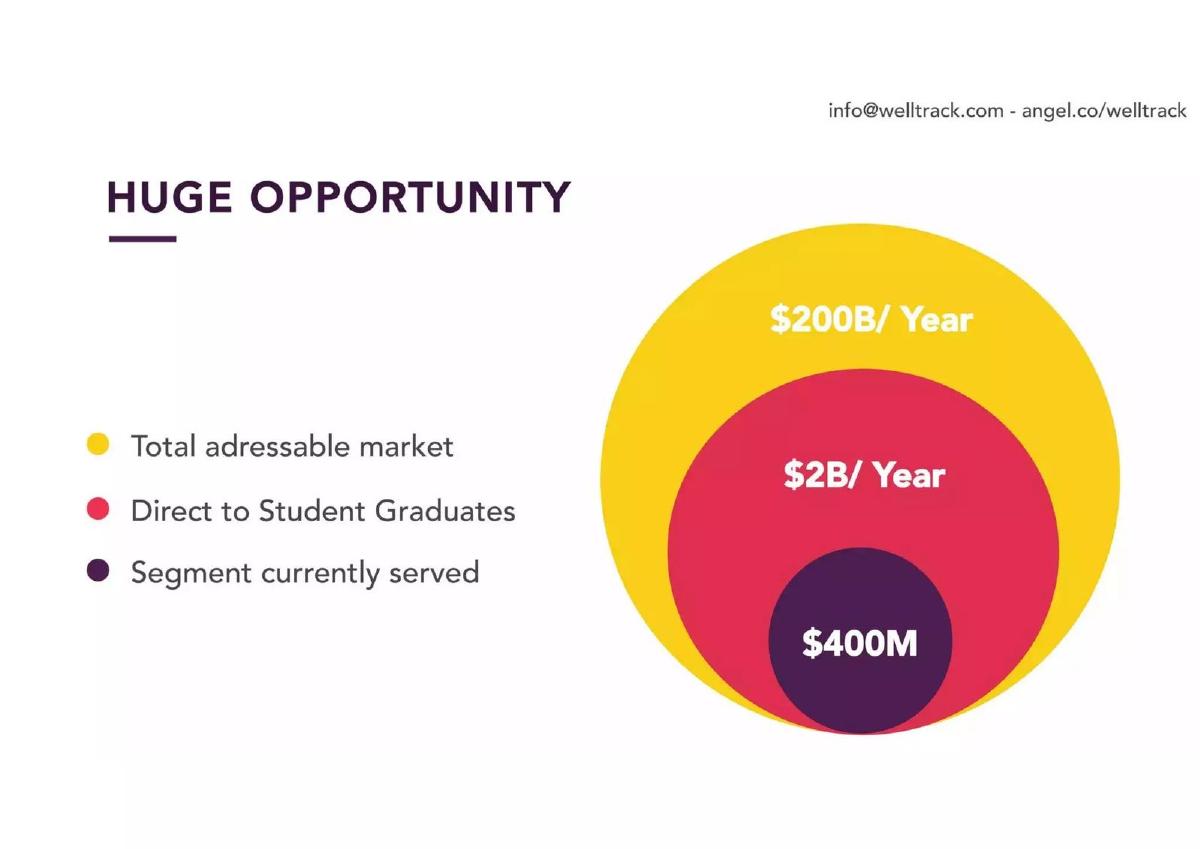
- The Total Addressable Market (TAM) is estimated at $200B per year, according to slide 5.
- The 'Segment currently served' is valued at $400M, representing the initial target market on slide 5.
- The team is led by Darren Piercey, PhD, a Professor of Psychology, providing academic and clinical credibility on slide 6.
- The deck completely omits a business model slide, leaving the pricing structure and sales cycle unexplained.
- There is no 'Ask' slide, meaning the funding amount sought and the intended use of funds are not disclosed in this version of the deck.
WellTrack Pitch Deck Analysis
WellTrack’s pitch deck is an exercise in minimalism. With only seven slides, it attempts to move from the problem of mental health accessibility to a $400,000 ARR proof-of-concept. The deck relies heavily on the credibility of its academic founder and its early success in the university market. However, the brevity comes at a cost, as several critical components of a standard venture pitch are missing.
Slide 1: Title Slide
The title slide introduces the WellTrack brand and its core descriptor: "Interactive Self-Help Therapy." The logo is a colorful, geometric sunburst, and the slide includes a contact email and an AngelList (now Wellfound) URL. This immediately signals that the company is in a fundraising or networking phase. The tagline is clear and avoids jargon, positioning the product as a digital health tool rather than a traditional clinical service.
Slide 2: Timing is Right
Slide 2 uses a visual metaphor to address the problem and timing. It shows a grid of grey icons representing people, with a single red icon in the center representing a doctor or therapist. The red icon is surrounded by a void, suggesting that the demand for mental health professionals far outstrips supply. The heading "TIMING IS RIGHT" suggests a macro trend—likely the growing mental health crisis and the shortage of available practitioners—though the slide lacks specific data points or citations to back up the visual claim.
Slide 3: Product
The product slide provides a high-level look at the user interface across mobile and desktop. The mobile screen shows a "Mood Check" feature where users can input how they are feeling (using emojis) and what they are doing (e.g., "Doing a hobby," "Outside"). The desktop dashboard displays data visualization tools, including pie charts for mood distribution and trend lines for Depression, Anxiety, and Stress . This slide effectively demonstrates that the product is built and functional, focusing on data-driven self-monitoring.
Slide 4: Great Traction
This is the strongest slide in the deck. It lead with a bold figure: "$400,000 ARR." Below this, it lists three prestigious university clients: Penn State, UC San Diego, and Boston College . For a startup in the EdTech or HealthTech space, showing six-figure recurring revenue and enterprise-level institutional adoption is a major validator. It proves that the "Interactive Self-Help Therapy" model has a willing buyer in the university system.
Slide 5: Huge Opportunity
WellTrack uses a nested circle diagram to illustrate its market size. The Total Addressable Market (TAM) is cited at "$200B / Year." The middle tier, "Direct to Student Graduates," is valued at "$2B / Year." The innermost circle, the "Segment currently served," is valued at "$400M." This slide provides a logical expansion path: starting with the $400M university market where they already have traction, then moving to graduates, and eventually the broader $200B mental health market. However, the source for these valuations is not provided.
Slide 6: Team
The team slide highlights three key roles. Darren Piercey, PhD , is the CEO and a Professor of Psychology , which gives the product clinical weight. Natasha O'Brien serves as COO, handling Sales & Marketing —a critical role given the $400k ARR already achieved. Jeremie Bourque is the CTO and Full Stack Developer , suggesting the technical build was handled in-house. The team appears balanced between clinical expertise, commercial execution, and technical development.
Slide 7: Closing Slide
The final slide repeats the logo and tagline over a lifestyle image of a person using a smartphone. It reiterates the contact information. Like the rest of the deck, it is clean but lacks a final "call to action" or a summary of why an investor should reach out immediately.
What WellTrack Does Well
WellTrack excels at clarity and focus . By highlighting a specific revenue figure ($400,000 ARR) and naming high-profile clients, they bypass the need for long explanations about their value proposition. The traction speaks for itself. The deck is also visually consistent, using a professional color palette and avoiding the "wall of text" trap that many early-stage founders fall into. The inclusion of a PhD founder as CEO is a strong move for a health-related startup, as it mitigates concerns about the efficacy of the "self-help" aspect of the software.
What is Missing from the WellTrack Deck
The most glaring omission is the Business Model . While we know they have $400k in ARR, the deck doesn't explain if this is a per-student license, a flat institutional fee, or a freemium model. Investors need to know how the company scales—does doubling revenue require doubling the sales team, or is it a self-serve platform?
No Competition Slide: The deck does not mention competitors like Calm, Headspace, or institutional players like SilverCloud. · No Ask: There is no mention of how much capital is being raised or what the milestones for the next 18 months are. · No Unit Economics: There is no mention of Customer Acquisition Cost (CAC) or Lifetime Value (LTV), which are vital for a SaaS-style business. · No Roadmap: The deck shows what exists now but offers no vision for what the product will become in 2-3 years.
Founder Takeaways: What to Copy
Founders should emulate WellTrack’s Traction Slide (Slide 4) . If you have revenue and recognizable logos, put them front and center. Do not bury your success in a 20-slide deck. The use of a Market Expansion Slide (Slide 5) is also a good template for showing how a niche start (universities) leads to a massive opportunity (general mental health). Finally, the Product Slide (Slide 3) is a great example of showing the product in action across multiple devices without over-explaining every feature; it lets the UI speak to the user experience.
Frequently asked questions
- What is WellTrack's current revenue?
- According to slide 4, WellTrack has reached $400,000 in Annual Recurring Revenue (ARR). This is a significant milestone for an early-stage startup, especially one targeting the often slow-moving higher education sector. It suggests they have found a repeatable sales motion within university counseling centers or student health services.
- Who is the target customer for WellTrack?
- Based on the traction slide (Slide 4), the current target customers are large universities. The slide lists Penn State, UC San Diego, and Boston College. Slide 5 further clarifies that their current segment is a $400M market, likely representing the broader higher education mental health services space before expanding into 'Direct to Student Graduates.'
- What does the product actually do?
- Slide 3 shows a dashboard and mobile interface. The product includes a 'Mood Check' tracker where users log feelings and activities. The dashboard displays pie charts for 'Good Mood,' 'Normal Mood,' and 'Bad Mood,' along with line graphs tracking Depression, Anxiety, and Stress levels over time. It is described as 'Interactive Self-Help Therapy.'
- Who leads the company?
- The leadership team consists of three individuals: CEO Darren Piercey, PhD (a Professor of Psychology), COO Natasha O'Brien (Sales & Marketing), and CTO Jeremie Bourque (Full Stack Developer). The presence of a PhD in Psychology as CEO suggests a product-led approach rooted in clinical validity.
- How much money is WellTrack raising?
- The deck does not specify a fundraising goal. There is no 'Ask' slide or 'Use of Funds' slide included in these seven pages. While the deck provides contact information and an AngelList link, it functions more as a high-level teaser than a complete investment memorandum.