WeTipp’s 19-slide deck from 2016 is a masterclass in identifying a specific pain point—the 'too many tools' problem—and offering a data-driven solution. The company addresses the struggle of community-based organizations to engage members by mapping interests and skills to facilitate 'collaboration at scale.' The deck is particularly strong on traction, citing $600,000 in recently closed deals paid in advance from high-profile clients like the European Commission and the Italian Ministry of Education. While it lacks a traditional 'Ask' slide or detailed financial projections, the pedigree of…
Key takeaways
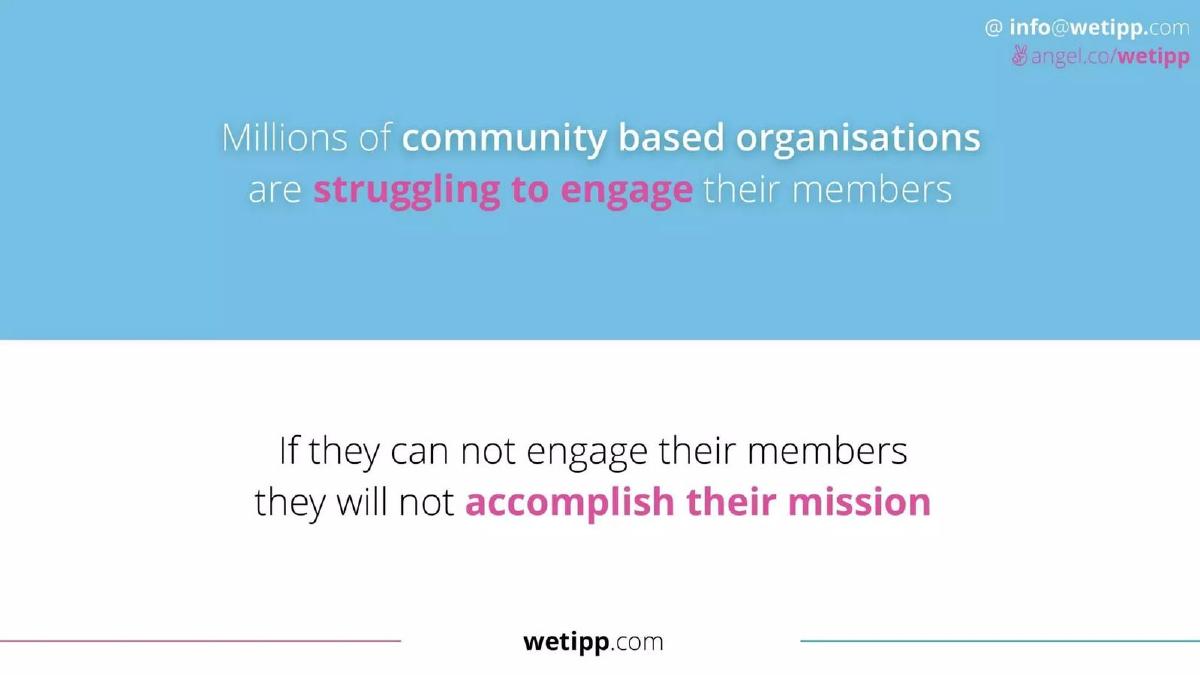
- The problem is framed as an existential threat: failure to engage members means failure to accomplish the mission (Slide 3).
- WeTipp identifies 'too many tools' and 'too many accounts' as the primary friction points for community managers (Slide 7).
- The solution relies on four pillars: interest/skill profiling, trend data, personalized notifications, and chat-based collaboration (Slides 9-12).
- The platform positions itself as a central hub by replacing fragmented apps with 'WeTipp Apps' and API integrations (Slide 14).
- Founder pedigree is a core asset, with the CEO and CTO coming from Talent Garden, described as Europe's top WeWork competitor (Slide 16).
- The deck claims a massive total addressable market of over 10 million membership-based organizations worldwide (Slide 17).
- Traction is the deck's strongest point, highlighting $600,000 in upfront payments from two major deals (Slide 18).
- The deck omits a specific funding request, use of funds, or a detailed competitive landscape matrix.
The Engagement Gap: Solving the Community Management Crisis
WeTipp’s 2016 pitch deck is a focused narrative on the friction inherent in modern community management. At the time, the 'SaaS explosion' had left community managers juggling dozens of disconnected tools. WeTipp’s value proposition was simple: stop managing tools and start managing people through data-driven interest mapping. This teardown examines how the team leveraged their experience at Talent Garden to secure pre-seed funding.
Slides 1-4: The Existential Problem
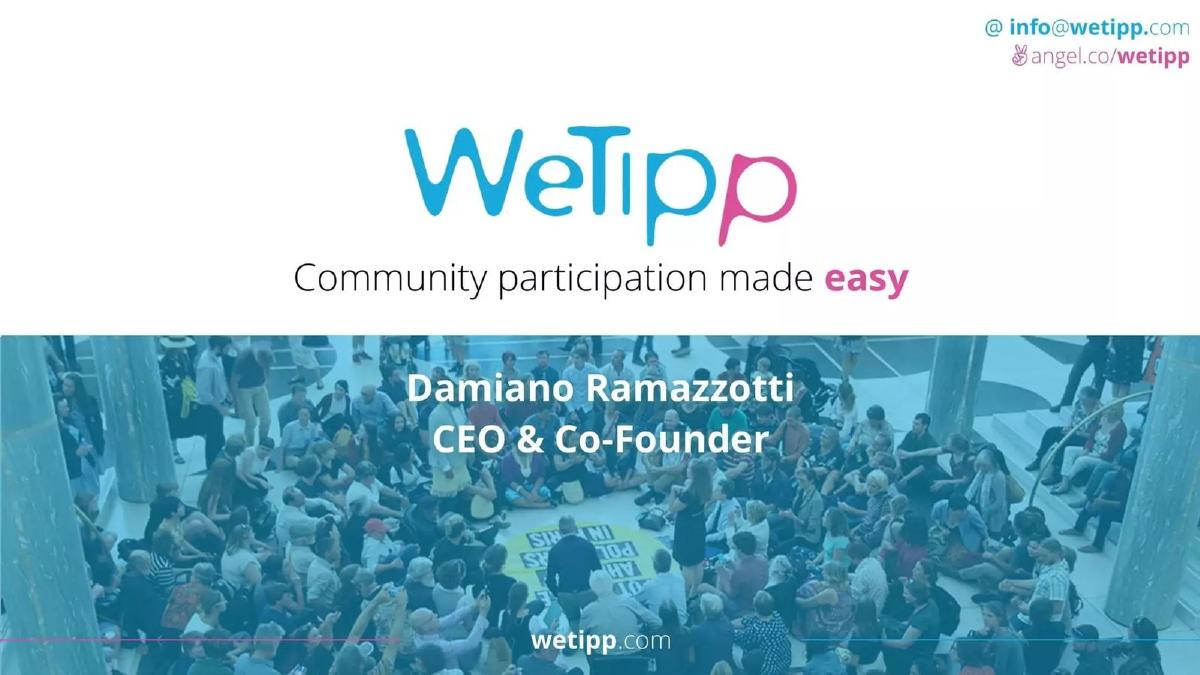
The deck opens with a clear mission statement on Slide 1 : "Community participation made easy." It immediately moves into a problem-centric narrative. Slide 2 identifies that "Millions of community based organisations are struggling to engage their members."
Slide 3 raises the stakes, claiming that if these organizations cannot engage members, "they will not accomplish their mission." This is a classic 'fear-based' opening that positions the software not as a luxury, but as a necessity for survival. Slide 4 poses the rhetorical question: "Why is it so hard to engage a community?" which sets the stage for the product deep-dive.
Slides 5-8: The Friction of Fragmentation
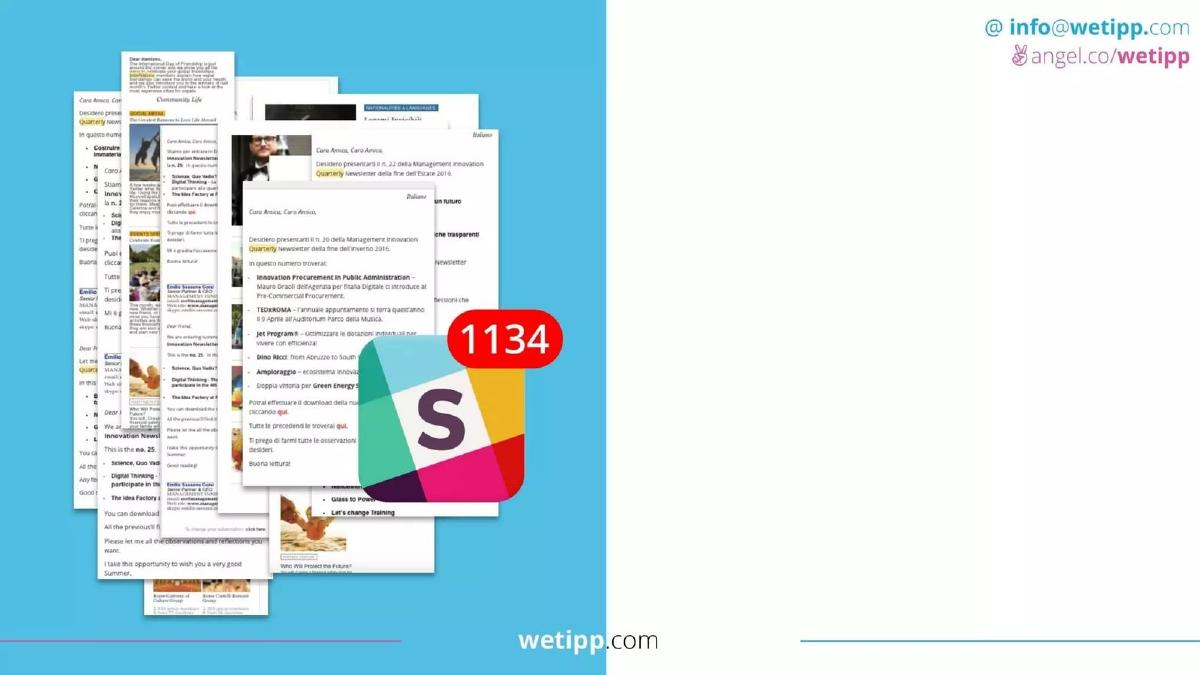
Slides 5 and 6 use visual metaphors—piles of newsletters and a Slack icon with 1,134 unread notifications—to illustrate the 'noise' problem. This leads to Slide 7 , which explicitly states the core pain point: "too many tools, too many accounts." The slide features logos for Slack, LinkedIn, Dropbox, Mailchimp, and Wild Apricot, suggesting that the current ecosystem is overwhelming for both managers and members.
Slide 8 introduces the solution with a MacBook mockup of the WeTipp interface, asking, "So what do we do differently?" This transition is effective because it has spent the previous six slides building a visceral sense of frustration that the product is now promised to solve.
Slides 9-12: The Four-Step Solution
WeTipp breaks its solution down into a logical flow across four slides under the heading "1. Collaboration at scale."
Slide 9: Shows a user profile (John Smith) with specific tags for "HTML," "UX/UI," and "Tennis." This establishes the 'Interest & Skills' mapping. · Slide 10: Demonstrates how individual profiles aggregate into "Data on trends of interests," visualized as a bar chart. · Slide 11: Shows how this data triggers "Personalised Notifications." · Slide 12: Concludes with "Chat based collaboration," showing the end result of the data-driven matching.
This sequence is vital because it explains how the engagement happens. It isn't just a chat room; it's a matching engine that uses member skills to drive relevant interactions.
Slides 13-14: The Platform Play
Slide 13 revisits the fragmented logo cloud from earlier. Slide 14 shows a 'red X' over the competitors and introduces "WeTipp Apps" and "API Integrations." The goal is a "single place with a single account." This positioning is ambitious; WeTipp isn't just another tool in the stack; it wants to be the operating system for the community, either by replacing existing tools or wrapping them in a single interface.
Slides 15-16: Pedigree and Team
After explaining the product, Slide 15 asks, "What do we know about communities?" This leads to the team slide on Slide 16 . The founders, Damiano Ramazzotti (CEO) and Tiziano Esposito (CTO), emphasize their history as the COO and CTO of Talent Garden. They describe Talent Garden as "our investor and Europe’s top WeWork competitor." This is a high-signal slide; it proves the founders have built and scaled community-centric infrastructure before, significantly de-risking the investment.
Slides 17-19: Market Size and Massive Traction
Slide 17 defines the market: "There are over 10 million membership based organisations around the world." It also displays the logos of the European Commission and the Italian Ministry of Education (Piano Nazionale Scuola Digitale), implying these are current or pilot users.
Slide 18 provides the 'knockout' punch for investors: "Recently closed 2 deals: (paid in advance) $600K." For a pre-seed company, $600,000 in upfront revenue is an extraordinary metric. It validates that large, bureaucratic institutions are willing to pay significant sums for this solution. Slide 19 concludes with contact information and a repeat of the cover imagery.
What Works in This Deck
The Traction Slide: Slide 18 is the strongest part of the deck. Mentioning $600,000 in upfront payments from public institutions immediately separates WeTipp from the thousands of 'social network for X' startups that have no revenue model. It proves product-market fit in a difficult-to-penetrate sector (government and large associations).
Logical Flow: The deck follows a very tight narrative. It identifies a problem (Slide 2), explains why it's hard (Slide 5-7), shows the solution (Slide 9-12), and then proves the team is capable of executing it (Slide 16).
Visual Simplicity: The slides are not cluttered. They use large text, clear icons, and consistent branding. The use of the Slack notification 'red dot' on Slide 6 is a clever way to evoke a specific, modern anxiety that their target audience feels daily.
What is Missing
The Ask: There is no slide stating how much money they are raising, what the terms are, or what the milestones will be for the next 18 months. While we know from catalogue data they raised $150,000, an investor viewing this deck in isolation would not know the 'deal.'
Business Model: While Slide 18 mentions $600k in deals, the deck doesn't explain the pricing model. Is it per-member, per-month? Is it a flat annual fee? Investors need to know if the $600k is a repeatable SaaS revenue stream or a one-off consulting/integration fee.
Competition: Slide 7 hints at the competition (Slack, Wild Apricot), but there is no dedicated competitive matrix. WeTipp claims to replace these tools, but a more detailed breakdown of why a community would switch from a 'free' Facebook group to a paid WeTipp instance is missing.
What a Founder Should Copy
The 'Pedigree' Connection: If you have worked at a major player in your industry, highlight it exactly like Slide 16. They didn't just say they worked at Talent Garden; they called it "Europe’s top WeWork competitor," giving immediate context to investors who might not be familiar with the European co-working scene.
The 'How it Works' Sequence: Slides 9 through 12 are a perfect example of how to explain a complex data process simply. Instead of a technical architecture diagram, they used a four-step visual story: Profile -> Data -> Notification -> Collaboration. This is much easier for a non-technical investor to digest.
Upfront Revenue as Validation: If you have managed to get customers to pay in advance, make that the centerpiece of your traction. It is the ultimate proof of 'value' and 'need,' especially in the pre-seed stage where most companies only have 'letters of intent' or 'pilot programs.'
Frequently asked questions
- How does WeTipp differentiate itself from Slack or Facebook Groups?
- According to the deck, WeTipp differentiates by mapping specific skills and interests (Slide 9) to generate 'data on trends of interests' (Slide 10). Unlike generic chat tools, it uses this data to send personalized notifications (Slide 11) that connect members based on what they can actually contribute, rather than just providing a space for conversation.
- What kind of traction did WeTipp have at the time of this deck?
- The deck reports significant early traction, specifically mentioning that they 'recently closed 2 deals: (paid in advance) $600K' (Slide 18). The catalogue facts and Slide 17 also identify the European Commission and the Italian Ministry of Education (Piano Nazionale Scuola Digitale) as key users.
- Who are the founders and what is their background?
- The founders are Damiano Ramazzotti (CEO) and Tiziano Esposito (CTO). They were previously the COO and CTO of Talent Garden, which the deck describes as an investor in WeTipp and Europe's largest network of co-working spaces (Slide 16).
- What is the 'WeTipp Apps' strategy mentioned in the deck?
- WeTipp aims to reduce friction by consolidating various third-party services. Slide 14 shows them replacing a scattered ecosystem (LinkedIn, Slack, Mailchimp, etc.) with 'WeTipp Apps' and 'API Integrations' to provide a 'single place with a single account' for community management.
- Is there a clear financial ask in the deck?
- No. The 19-slide deck concludes with traction and contact information but does not include a slide detailing the amount of capital being raised, the valuation, or how the funds will be allocated. The $150,000 raise is known from external catalogue data.