WeStrive’s March 2021 deck positions the company as a comprehensive SaaS platform for the fragmented health and wellness industry. At the time of the deck, the company reported $1K in MRR with 60 paying trainers and 300+ clients. The narrative focuses on expanding from a personal training tool into a broader marketplace including nutritionists, physical therapists, and chiropractors. Seeking $500K, the company projected an aggressive leap to $4.2M MRR by the end of 2023. While the deck excels at showing product UI and a clear roadmap, it relies heavily on future projections and lacks a detail…
Key takeaways
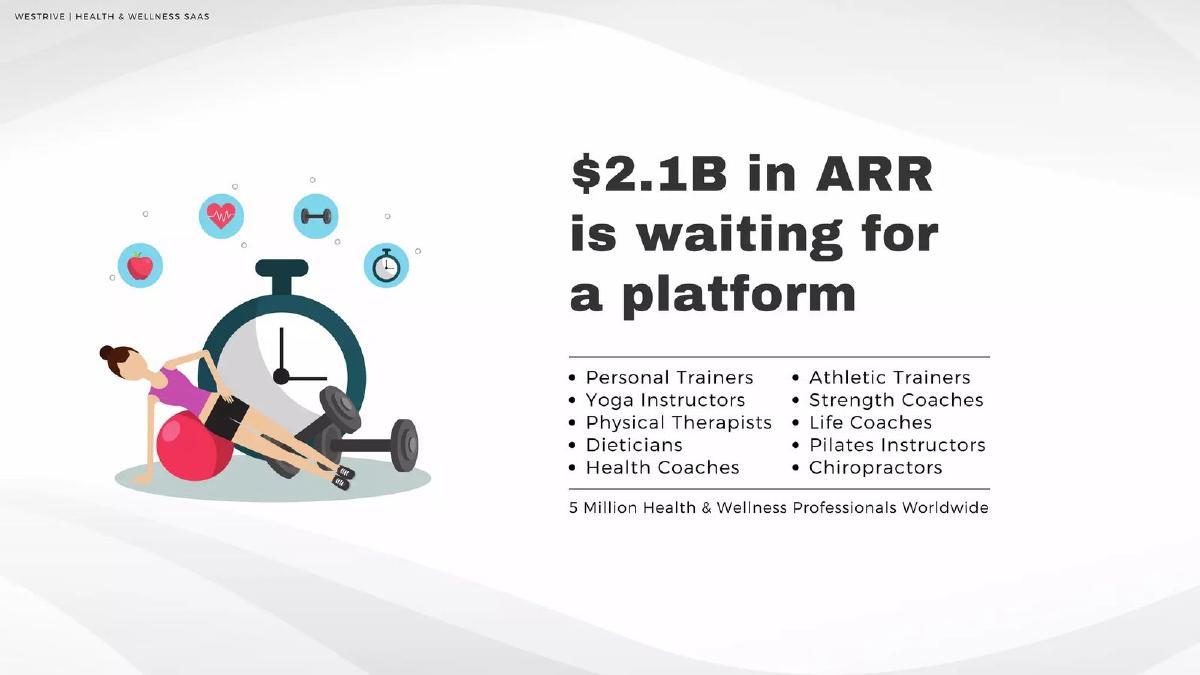
- The company identifies a $2.1B ARR market opportunity across 5 million health and wellness professionals worldwide (Slide 2).
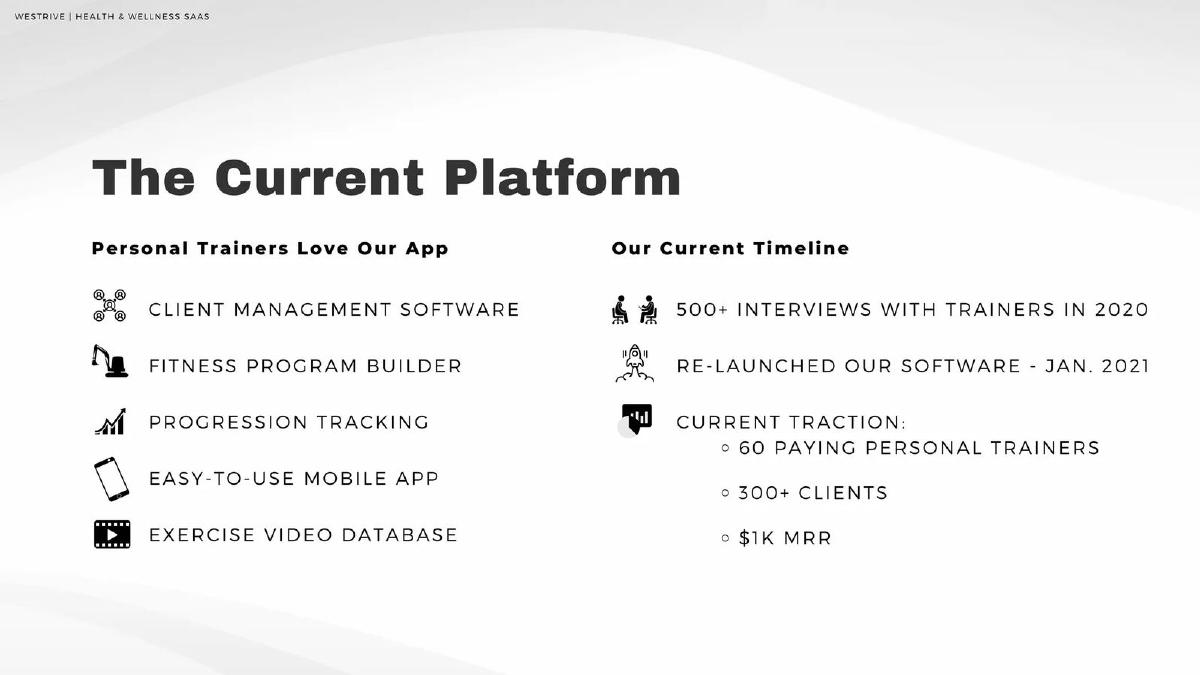
- Current traction at the time of the deck was $1K MRR with 60 paying trainers and zero ad spend (Slide 8).
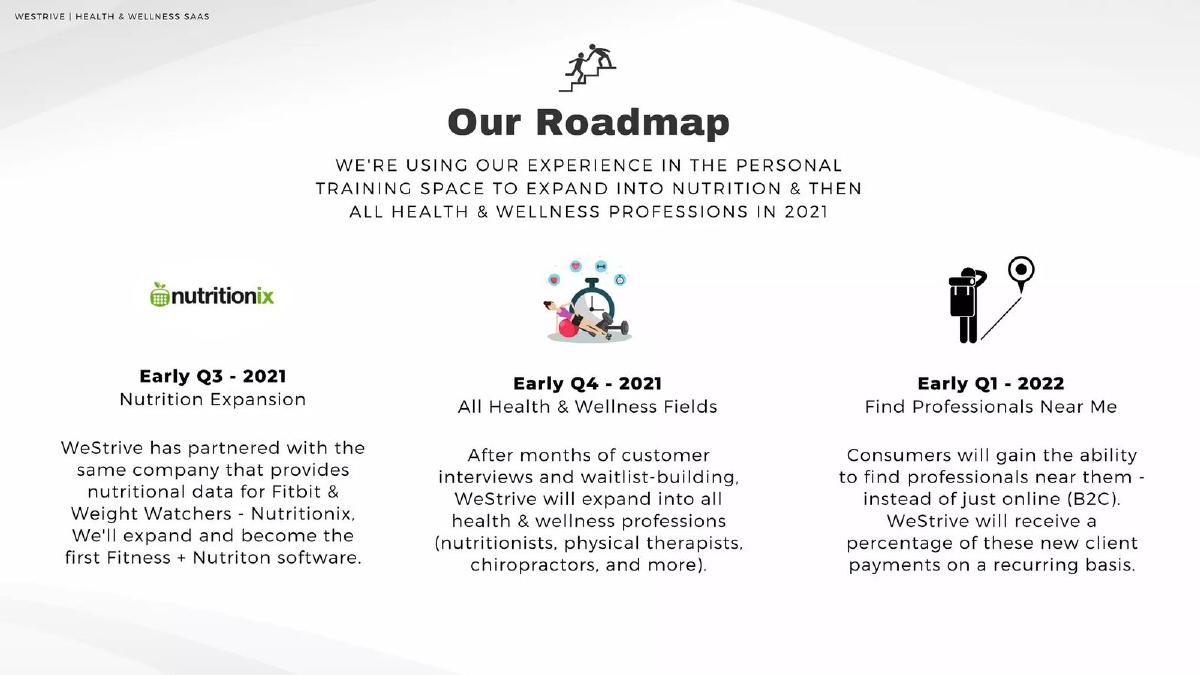
- The product roadmap includes a partnership with Nutritionix to launch a fitness and nutrition software integration in Q3 2021 (Slide 4).
- WeStrive aims to transition from a B2B tool to a B2C marketplace, allowing consumers to find professionals 'near me' by Q1 2022 (Slide 4).
- The growth strategy relies on revenue-sharing with 'Fit-Pro Business Coaches' and partnerships with exercise science programs at colleges (Slide 5).
- The CEO, Cory McKane, claims to have personally conducted over 500 customer interviews during 2020 to inform product development (Slide 6).
- Financial projections are highly aggressive, targeting a jump from $1K MRR to $38K MRR within nine months (Slide 8).
- The $500K ask is intended to reach a milestone of 5,500 fitness professionals and $120K MRR (Slide 9).
Executive Summary: The Wellness Operating System
WeStrive’s March 2021 investor deck is a focused, 18-slide presentation (9 of which are analyzed here) that attempts to bridge the gap between a niche fitness tool and a broad health-tech platform. The company brands itself as the "Operating System for Health & Wellness Professionals," a high-level positioning statement that suggests they want to be the Salesforce or Shopify for trainers and therapists. At the time of this deck, they were operating at a very early stage with $1,000 in monthly recurring revenue (MRR), making this a classic seed-stage pitch focused on vision and roadmap over historical performance.
Slide 1: Title and Product Preview
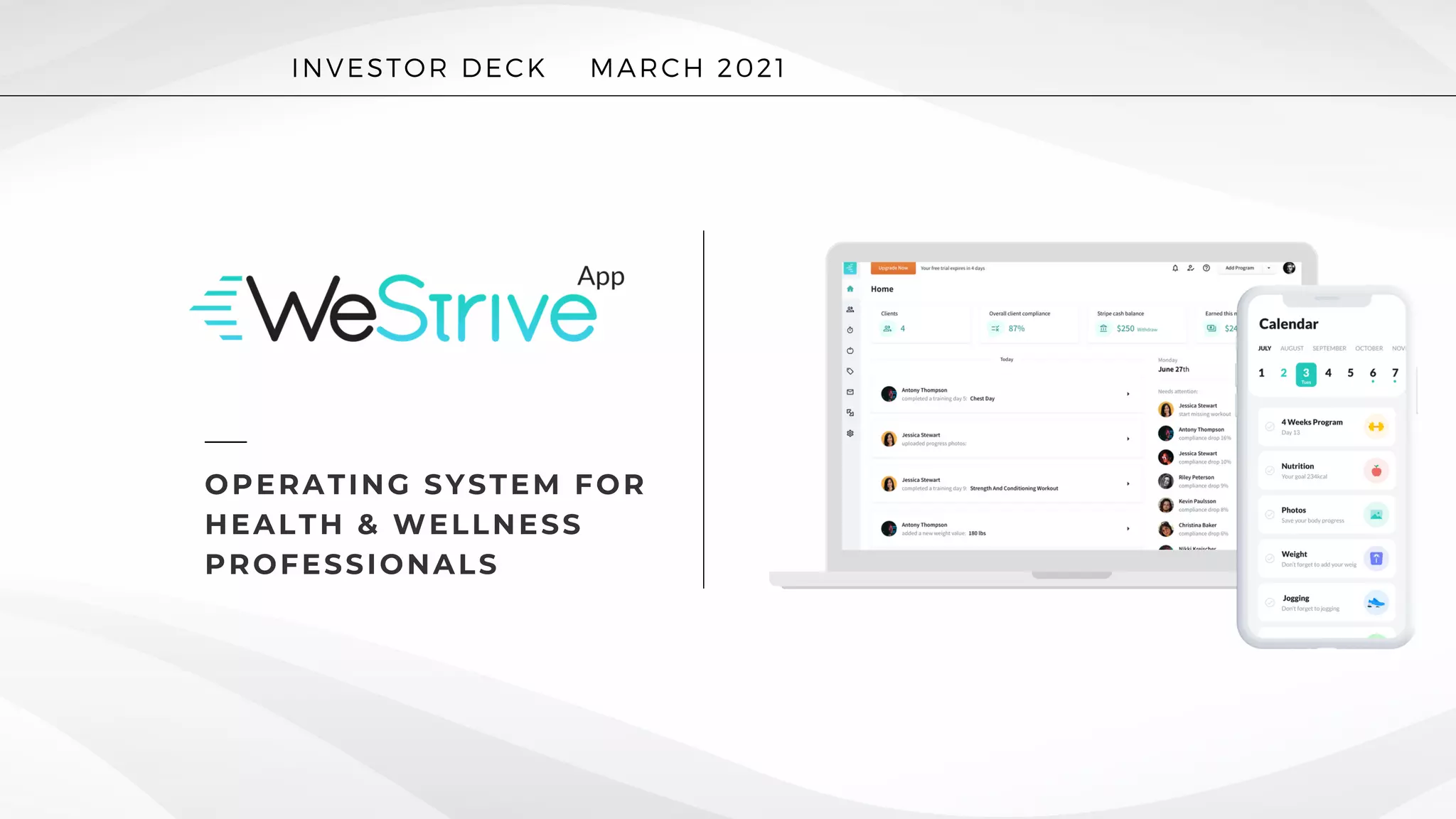
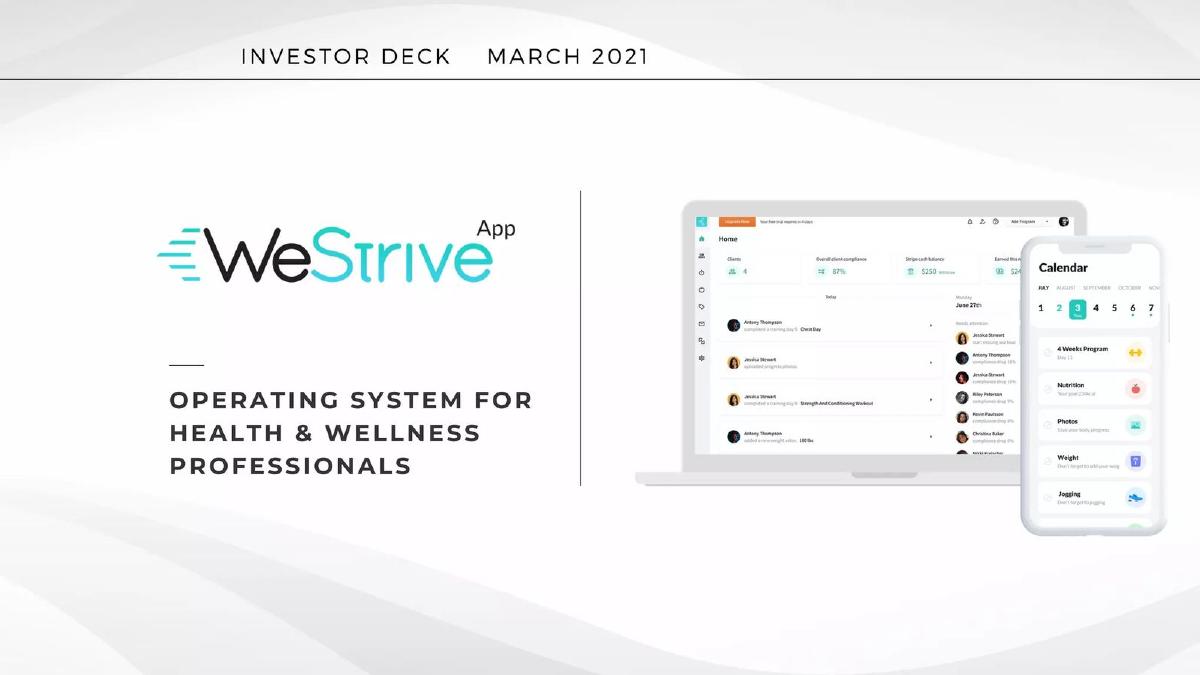
The cover slide establishes the brand identity and immediate product context. It features the WeStrive App logo and the tagline "Operating System for Health & Wellness Professionals." Crucially, it includes high-fidelity mockups of both the desktop dashboard and the mobile app. The dashboard shows metrics like "Overall client compliance" (87%) and "Stripe cash balance" ($250), signaling that the platform handles both client management and payments. The date, March 2021, sets the timeline for the traction and projections that follow.
Slide 2: Market Opportunity
WeStrive quantifies the market not by total addressable market (TAM) in terms of consumer spend, but by potential platform revenue. They state that "$2.1B in ARR is waiting for a platform." This figure is derived from their target audience of 5 million health and wellness professionals worldwide. The slide lists ten specific verticals, including Personal Trainers, Yoga Instructors, Physical Therapists, Dieticians, and Chiropractors. This list is important because it justifies the "Operating System" claim—they aren't just for gym rats; they are for the entire medical-adjacent wellness economy.
Slide 3: The Workflow ("How It Will Work")
This slide uses a circular flow diagram to explain the ecosystem. It follows a Physical Therapist who signs up, imports data, and uses the "fitness plan builder" to track client journeys. The unique value proposition appears in the second half of the circle: the ability for professionals to collaborate. A client can request a nutrition plan, and the therapist can use the WeStrive marketplace to find and grant a nutritionist access to that client's health info. This suggests a B2B2C model where the platform facilitates professional referrals and data sharing.
Slide 4: The Roadmap
The roadmap is divided into three phases for 2021 and early 2022. Early Q3 2021 focuses on the "Nutrition Expansion," specifically highlighting a partnership with Nutritionix (the data provider for Fitbit and Weight Watchers). Early Q4 2021 marks the expansion into all wellness fields after "months of customer interviews." Early Q1 2022 introduces the "Find Professionals Near Me" feature, which represents the company's pivot into a consumer-facing (B2C) marketplace where they take a percentage of new client payments on a recurring basis.
Slide 5: Growth Strategy
Fit-Pro Business Coaches: A revenue-share model to tap into existing networks of trainers. · College Partnerships: Partnering with exercise science programs to capture professionals at the start of their careers. · Earned & Paid Media: A combination of social content and Facebook ad spend. · Analytics: A generic claim about being "obsessed with data" to optimize the platform.
The college partnership strategy is particularly notable as a low-cost customer acquisition cost (CAC) play, though no specific colleges are named.
Slide 6: Competitive Advantages ("Why We'll Win")
This slide lists six differentiators. The most concrete claims are "Ease-of-Use" (UX/UI focus) and "Customer Outreach," where the CEO claims to have conducted over 500 interviews in 2020. They also reiterate their goal to be the "First H&W Marketplace" and the first platform to serve both professionals and consumers simultaneously. While "Customer Service" is listed as a win, it is framed as a CEO focus rather than a structural advantage.
Slide 7: The Team
The team slide features six members. Cory McKane (CEO) is credited with 10+ years in the fitness industry. Chase Adams (Operations/Growth) brings experience from Fandango. The technical side is led by Nick Smazheliuk (Lead Developer) with 6+ years of experience. The team is rounded out by leads in Customer Success, Social/Design, and a Fitness Project Manager with a degree in Exercise Science. The team appears balanced between industry expertise and functional roles, though it lacks a heavy-hitting technical co-founder or previous exit experience.
Slide 8: Traction & Projections
This is the most data-heavy slide in the deck, showing a steep growth curve. Today (March 2021): $1K MRR, 60 paying trainers, 300+ clients, and $0 ad spend. EOY 2021: Projections jump to $38K MRR and 2,036 paying pros. EOY 2023: The goal is $4.2M MRR with 225K paying pros and 346K clients. The jump from 2021 to 2022 ($38K to $813K MRR) is exceptionally aggressive and assumes a highly successful transition into the B2C marketplace and in-person training segments.
Slide 9: The Ask
WeStrive is "Raising $500K." The funds are earmarked for hiring key roles, scaling ad spend, R&D, and launching the nutrition software. The slide explicitly states the milestone this funding is intended to achieve: 5,500 fitness professionals and $120K MRR. This provides investors with a clear target to measure the success of the seed round.
What WeStrive Does Well
The deck is visually clean and avoids the clutter common in early-stage pitches. By leading with the "Operating System" concept, they successfully frame the business as a scalable SaaS play rather than just another fitness app. The inclusion of the Nutritionix partnership (Slide 4) adds significant credibility to their product roadmap, showing they aren't building everything from scratch but are integrating industry-standard data. Furthermore, the CEO's claim of 500+ interviews (Slide 6) demonstrates a level of founder sweat equity and market validation that investors look for at the seed stage.
What is Missing from the Deck
The most glaring omission is a Competitor Analysis . The fitness SaaS space is crowded with incumbents like Trainerize, TrueCoach, and Mindbody. WeStrive claims they will be the "first" in several categories, but without a direct comparison to these established players, the claim feels unsupported. Additionally, there is no mention of Unit Economics . While they show MRR projections, they don't disclose their churn rate, CAC, or Lifetime Value (LTV). For a $1K MRR company, these metrics might be early, but some indication of the cost to acquire those first 60 trainers would provide more confidence in the $500K raise's ability to scale the business. Finally, the Problem Slide is missing from this selection; while the solution is clear, the specific pain point they are solving for the professional (e.g., time lost, lost revenue, poor client retention) is only implied.
Founder Takeaways: What to Copy
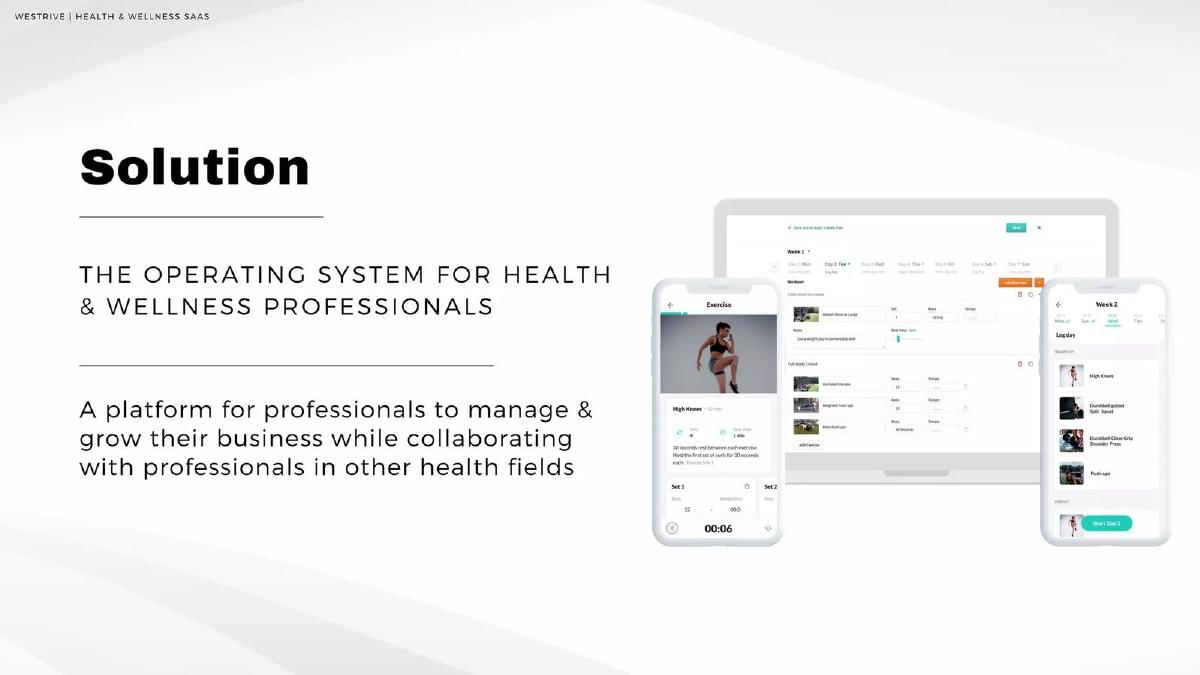
1. Clear Milestone Mapping: Slide 9 is a model for how to present an 'Ask.' Don't just say what you will spend the money on; say exactly where that money will take the company in terms of hard metrics ($120K MRR). 2. Vertical Expansion Logic: Slide 2 and 3 do a great job of showing how a product built for one niche (trainers) can logically expand into adjacent markets (PTs, nutritionists) to increase the TAM. 3. High-Fidelity Mockups: Using real dashboard screens on the title slide immediately grounds the pitch in reality, proving that the product exists and has a professional aesthetic. 4. Strategic Partnerships: If you are a small team, highlighting a partnership with a larger entity (like Nutritionix on Slide 4) acts as a powerful proxy for technical validation.
Frequently asked questions
- What is the core problem WeStrive is solving?
- While a specific 'Problem' slide is missing from this selection, Slide 2 implies the problem is fragmentation. It notes that $2.1B in ARR is 'waiting for a platform' across ten different wellness professions, suggesting these professionals currently lack a unified operating system to manage clients, programs, and nutrition in one place.
- How does WeStrive plan to acquire users?
- According to Slide 5, the company uses a multi-pronged approach: revenue-sharing with business coaches who already have trainer networks, partnering with hundreds of colleges via exercise science programs, and utilizing a mix of social media content and paid Facebook advertising.
- What is the significance of the Nutritionix partnership?
- Slide 4 highlights this as a key differentiator. By partnering with the data provider used by Fitbit and Weight Watchers, WeStrive aims to become the 'first Fitness + Nutrition software,' moving beyond simple workout tracking into holistic health management.
- Is the $500K raise sufficient for their goals?
- Slide 9 states the $500K will fund hiring, R&D, and ad spend to reach $120K MRR. However, Slide 8 projects an EOY 2023 marketing budget of $1.1M alone. This suggests the $500K is a bridge or seed round intended to prove the model before a larger Series A would be required to meet the $4.2M MRR target.
- What is the 'Marketplace' component mentioned in the deck?
- Slide 3 and Slide 4 describe a shift from a pure management tool to a lead-generation platform. Professionals can find new clients through the marketplace, and different specialists (like a PT and a nutritionist) can collaborate on a single client's profile, creating a network effect.