Secureframe’s Series B pitch deck is notable for its brevity and aggressive problem-framing. In just 11 slides, the company articulates a shift from manual, stress-inducing compliance to automated, scalable security. The deck leans heavily on the 'why now'—citing 2021 as a record year for data breaches and the rise of AI-driven business models as catalysts for increased data generation. While the deck lacks a traditional team slide, financial projections, or a specific use-of-funds breakdown, it compensates with strong social proof from customers like AngelList and Lob. The core narrative suc…
Key takeaways
- The deck frames compliance as a sales accelerator, noting that achieving it can take months and 'hinder sales' (Slide 6).
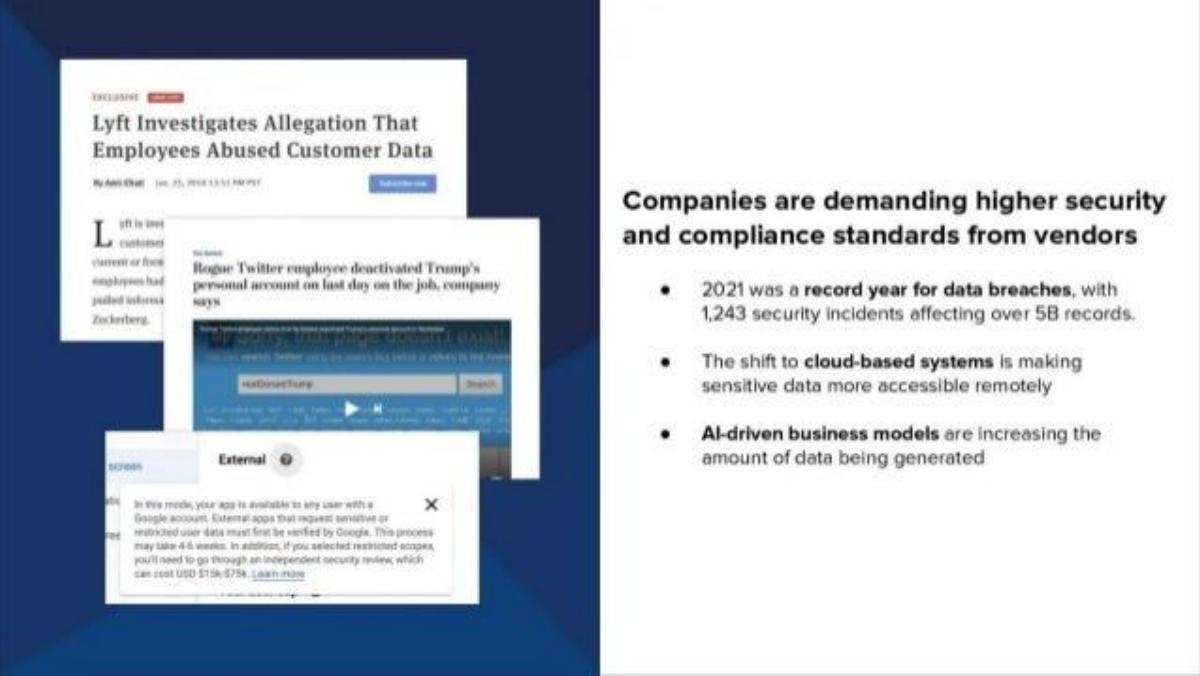
- It leverages macro urgency by citing 1,243 security incidents affecting over 5B records in 2021 (Slide 2).
- Secureframe claims to be the 'only platform' supporting multiple cloud data systems and accounts across integrations simultaneously (Slide 8).
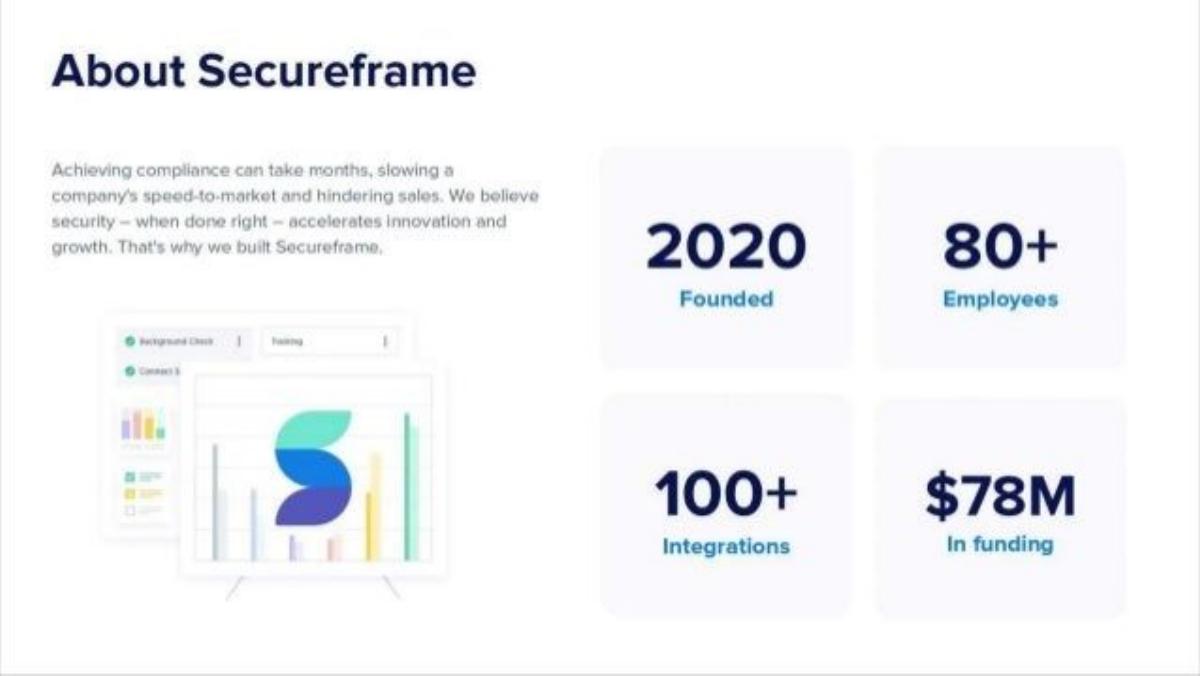
- The company highlights significant scale with 80+ employees and $78M in total funding prior to the round's completion (Slide 6).
- Market validation is presented as a $36B+ Total Addressable Market (TAM) driven by specific regulations like GDPR and CCPA (Slide 10).
- The product promise is a reduction in timeline from months to 'weeks' for achieving compliance (Slide 7).
- Social proof is established through a logo wall featuring high-growth tech companies such as AngelList, Stream, and Dooly (Slide 9).
- The deck completely omits a team slide, detailed financial history, and a specific 'Ask' or use-of-funds breakdown (Slides 1-11).
The Series B Narrative: From Cost Center to Revenue Driver
Secureframe’s Series B deck is a masterclass in narrative-driven fundraising. In the world of B2B SaaS, compliance is often viewed as a necessary evil—a checkbox exercise that drains engineering resources. Secureframe flips this script, positioning their platform as a growth engine. By focusing on the 'sales friction' caused by a lack of SOC 2 or ISO 27001 certification, they make the investment case about top-line growth rather than just bottom-line efficiency.
Slide 1: Title Slide
The deck opens with a minimalist title slide. It features the Secureframe logo and the text Series B . There is no tagline or mission statement here, which is common for later-stage rounds where the brand already carries some weight with the target investor list.
Slide 2: The Macro Environment
Secureframe immediately establishes the 'Why Now?' factor. They use news clippings regarding data abuses at Lyft and Twitter to create a sense of urgency. The slide lists three critical drivers: 2021 was a record year for data breaches (1,243 incidents), the shift to cloud-based systems , and AI-driven business models . This slide justifies the existence of a massive market by showing that data is becoming more plentiful, more vulnerable, and more regulated.
Slide 3: The Problem – Compliance is Demanding
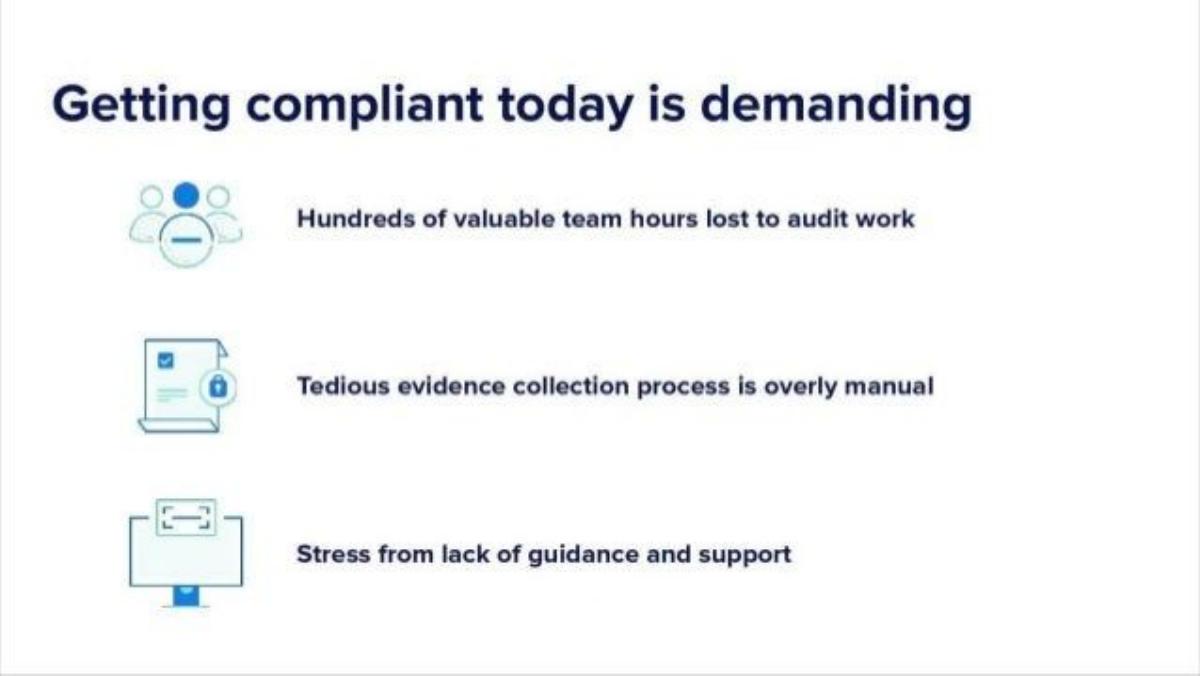
This slide moves from the macro to the micro, focusing on the internal pain of the customer. They highlight hundreds of valuable team hours lost and a tedious evidence collection process that is 'overly manual.' By mentioning 'stress from lack of guidance,' they tap into the emotional burden placed on CTOs and security leads who are often navigating these audits for the first time.
Slide 4: The Failure Rate
In a bold, single-sentence slide, Secureframe states: Most startups starting the SOC 2 or ISO 27001 process won’t end up finishing. This creates a 'fear of failure' narrative. It suggests that the manual approach isn't just slow—it's ineffective. This sets the stage for a solution that guarantees an outcome, not just a tool that assists in the process.
Slide 5: The Vision
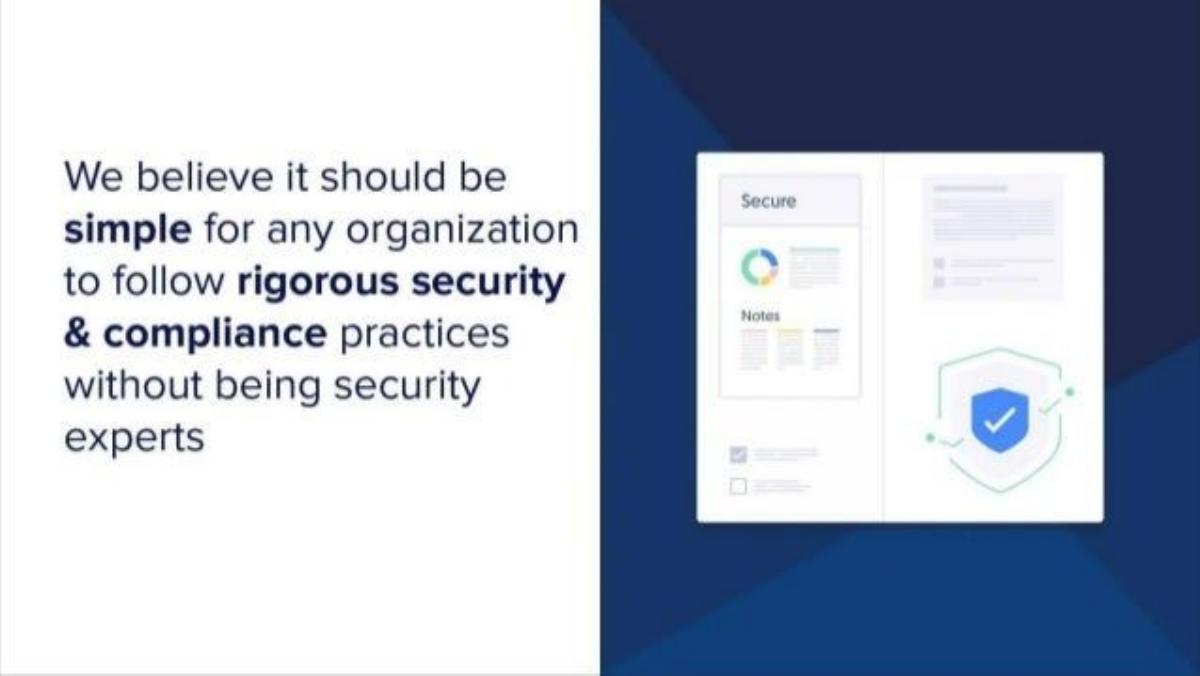
The vision slide is simple: simple for any organization to follow rigorous security & compliance practices without being security experts. This is a classic 'democratization' play. They are promising to turn a complex, expert-level task into a software-guided workflow that a generalist can manage.
Slide 6: Company Traction and Stats
This is the 'meat' of the company's current state. It lists four key pillars: 2020 Founded , 80+ Employees , 100+ Integrations , and $78M in funding (noting this is the cumulative total including previous rounds). The text on the left reinforces the sales-enablement angle, stating that compliance 'accelerates innovation and growth' rather than slowing it down.
Slide 7: The Solution – Automation
Secureframe defines itself as the only platform purpose-built to automate security and compliance. The diagram shows various inputs—Integrations, Cloud Infrastructure, Vendors, Risk, and Compliance Reports—feeding into the Secureframe 'S' logo. The core promise is to get compliant within weeks, rather than months.
Slide 8: Product Differentiation
This slide gets technical, claiming to be the only platform that supports multiple cloud data systems all at once. It shows a UI mock-up of Google Cloud and AWS connections. This addresses a specific enterprise pain point: multi-cloud environments. By emphasizing 'multiple accounts across integrations,' they are signaling that their software can handle the complexity of large-scale organizations, not just small startups.
Slide 9: Social Proof and Customer Success
The deck features a logo wall including AngelList, Lob, Dooly, Stream, and TopFunnel. The quotes are strategically chosen. One quote explicitly mentions that Secureframe is a 'key unlock to target markets' like U.S. enterprises. This validates their earlier claim that compliance is a sales tool. The second quote highlights specific product features like automated alerts for S3 bucket encryption, proving the product's utility beyond just the initial audit.
Slide 10: Market Size and Growth
Secureframe claims a $36B+ TAM . The bar chart compares 'Today' to '2022,' showing a massive projected spike in the security compliance market. They attribute this to an increase in breaches (citing SolarWinds and Colonial Pipeline) and an increase in regulation (GDPR and CCPA). This slide is designed to show that even with a high valuation, the ceiling for growth is still significantly higher.
Slide 11: Closing Slide
The deck ends with a simple Thank You and an illustration of SOC 2 and ISO 27001 reports. There is no contact information or 'The Ask' on this slide, which is typical for a deck intended for a guided presentation rather than a cold send.
What Secureframe Does Exceptionally Well
The most impressive aspect of this deck is its problem-solution mapping . Every pain point mentioned in Slide 3 (manual processes, lost hours, lack of guidance) is directly answered by a feature or benefit in Slides 7 and 8 (automation, weeks instead of months, guided integrations). This creates a tight, logical loop that is very difficult for an investor to argue against.
Furthermore, the positioning of compliance as a revenue driver is brilliant. Most compliance tools sell 'safety.' Secureframe sells 'speed to market.' For a Series B investor looking for high-growth potential, a tool that helps a company close enterprise deals faster is much more attractive than a tool that simply prevents a hypothetical fine.
What is Missing from the Deck
For a $56M round, this deck is surprisingly light on data. There are several standard slides missing that most founders would be expected to include:
The Team Slide: There is no mention of the founders' backgrounds or the executive team. At Series B, investors usually want to see the 'bench strength' of the leadership team. · Financial Projections: There are no charts showing Revenue, ARR growth, or Net Revenue Retention (NRR). While these were likely shared in a data room, their absence from the deck is notable. · Competition: The deck claims Secureframe is the 'only' platform to do several things, but it doesn't acknowledge competitors like Vanta or Drata. A competitive matrix is a standard expectation in this sector. · The Ask: There is no slide detailing how much they are raising or how they plan to use the capital (e.g., hiring, international expansion, R&D).
What Founders Should Copy
1. Use Macro Trends to Create Urgency: Don't just say your product is good; show why the world has changed in a way that makes your product necessary . Secureframe’s use of breach statistics and regulatory dates (Slide 2 and 10) does this perfectly.
2. Lead with Social Proof: If you have recognizable customers, put them front and center. The quotes on Slide 9 aren't just 'we like this software'; they are 'this software helped us enter the US enterprise market.' Those are the types of testimonials that move the needle.
3. Simplify the Product Message: Even for a technical product, the explanation should be simple. Slide 7 uses a basic input/output diagram that anyone can understand. Save the deep technical specs for the due diligence phase.
4. Focus on the 'Unlock': Identify the one thing your product allows a customer to do that they couldn't do before. For Secureframe, it's not 'being secure'—it's 'getting compliant in weeks to close deals.'
Frequently asked questions
- How much did Secureframe raise with this deck?
- Secureframe raised $56M in a Series B round in 2022. According to the catalogue facts, the round was led by Venture Capital (VC) investors. Slide 6 of the deck notes that the company had already secured $78M in funding, suggesting this deck was used to bridge or finalize the total capital structure for that stage of growth.
- What is the primary value proposition of Secureframe?
- The primary value proposition is the automation of security and compliance. Slide 7 explicitly states that the platform helps companies 'get compliant within weeks, rather than months.' It focuses on removing manual processes, such as tedious evidence collection, and replacing them with automated integrations into cloud infrastructure and HR tools.
- Who are Secureframe's target customers?
- While the deck mentions 'any organization' on Slide 5, the customer testimonials on Slide 9 specifically highlight a focus on U.S. enterprises. One quote notes that Secureframe is a 'key unlock' for targeting the enterprise market, with future expansion planned for healthcare, government, and international sectors.
- What market trends does the deck use to justify the investment?
- The deck identifies three major tailwinds on Slide 2: a record number of data breaches in 2021, the shift to cloud-based systems making data more accessible, and the rise of AI-driven business models increasing data volume. Slide 10 further links market growth to regulatory increases like GDPR and CCPA.
- What is missing from the Secureframe pitch deck?
- This is a remarkably lean deck for a Series B. It lacks a team slide featuring the founders' backgrounds, a detailed competition slide, a financial 'pro-forma' or revenue growth chart, and a specific slide detailing how the $56M will be spent. It relies almost entirely on market momentum and product differentiation.