Selfbook’s Series A deck is a lean, metric-driven presentation that prioritizes traction over technical complexity. By focusing on a specific friction point—the inability of hotels to accept digital wallets due to legacy rate complexities—Selfbook positioned itself as the essential API layer for the travel industry. The deck’s strength lies in its growth visualization, showing a vertical climb in projected Annual Contracted Value (ACV) from just $13,172 in April 2021 to over $4.3 million by August 2021. While the deck completely omits a team slide and detailed unit economics, the sheer veloci…
Key takeaways
- The deck identifies a specific technical bottleneck: hotels cannot accept digital wallets like Apple Pay due to legacy rate complexities (Slide 2).
- Product value is categorized into three pillars: Simplify (Apple Pay acceptance), Verify (fraud prevention), and Unify (add-on service checkout) (Slide 3).
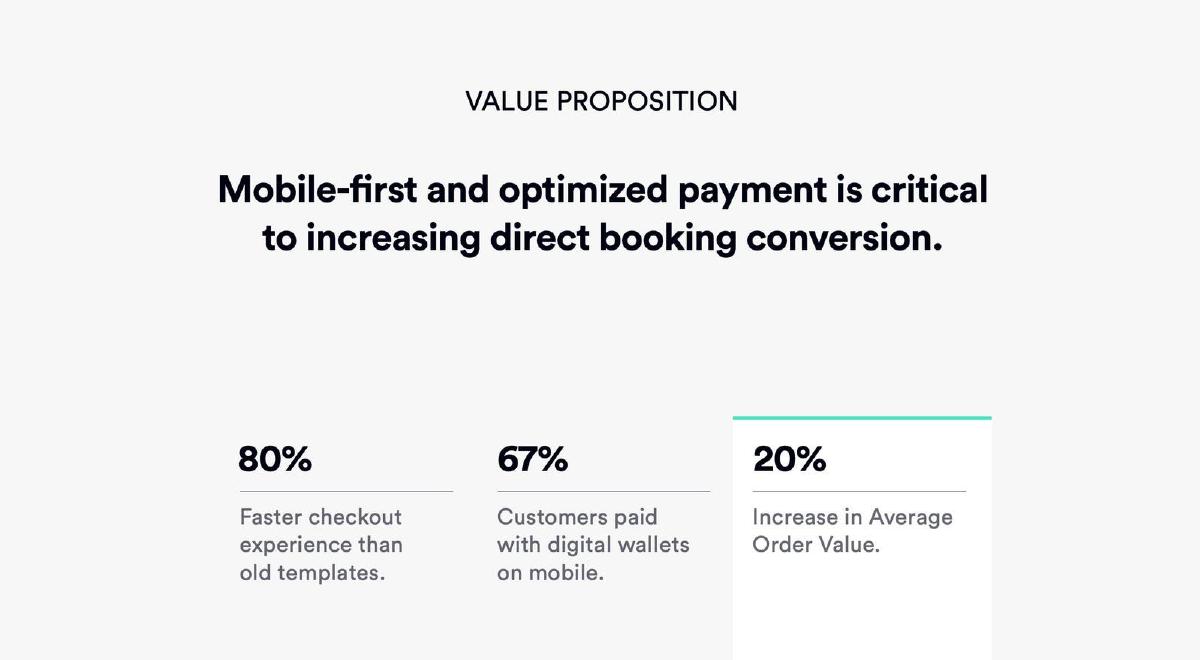
- Selfbook claims an 80% faster checkout experience compared to old templates and a 20% increase in Average Order Value (Slide 4).
- Revenue growth is the focal point, showing a jump from $13,172 in April 2021 to a projected $4,338,565 by August 2021 (Slide 5).
- The customer strategy targets high Average Daily Rate (ADR) hotels, featuring logos like Lotte New York Palace with a projected ACV of $388,839 (Slide 6).
- Strategic partnerships are used as a moat, citing a co-selling agreement with Affirm and global distribution planning with Sabre (Slide 7).
- The original ask in the deck was for $15 million, despite the publisher reporting a final raise of $25 million (Slide 8).
- The deck omits a team slide, competitive landscape analysis, and a detailed breakdown of the technology stack.
The Power of Vertical Traction
Selfbook’s pitch deck is a masterclass in using a single, powerful metric to drive a fundraising narrative. In the travel tech space, where legacy systems often stifle innovation, Selfbook identified a high-friction point—payments—and demonstrated an almost vertical growth trajectory over a five-month period. The deck, used for their Series A, focuses heavily on the transition from a proof-of-concept to a multi-million dollar revenue engine.
Slide 1: Title Slide
The deck opens with a minimalist title slide featuring the company logo and the tagline: Hotel Payments, Simplified. It clearly marks the context as a Series A pitch from Q3 2021. The branding is clean and professional, signaling a modern fintech approach to a traditional industry.
Slide 2: The Problem
Selfbook identifies a very specific technical hurdle: "Due to rate complexities, hotels around the world are unable to accept digital wallets." Below this statement, they list icons for Apple Pay, Google Pay, PayPal, and Affirm under a red 'Currently not accepted' banner. This slide is effective because it doesn't just say 'payments are hard'; it identifies the specific missing features that modern travelers expect but hotels cannot provide.
Slide 3: The Product Solution
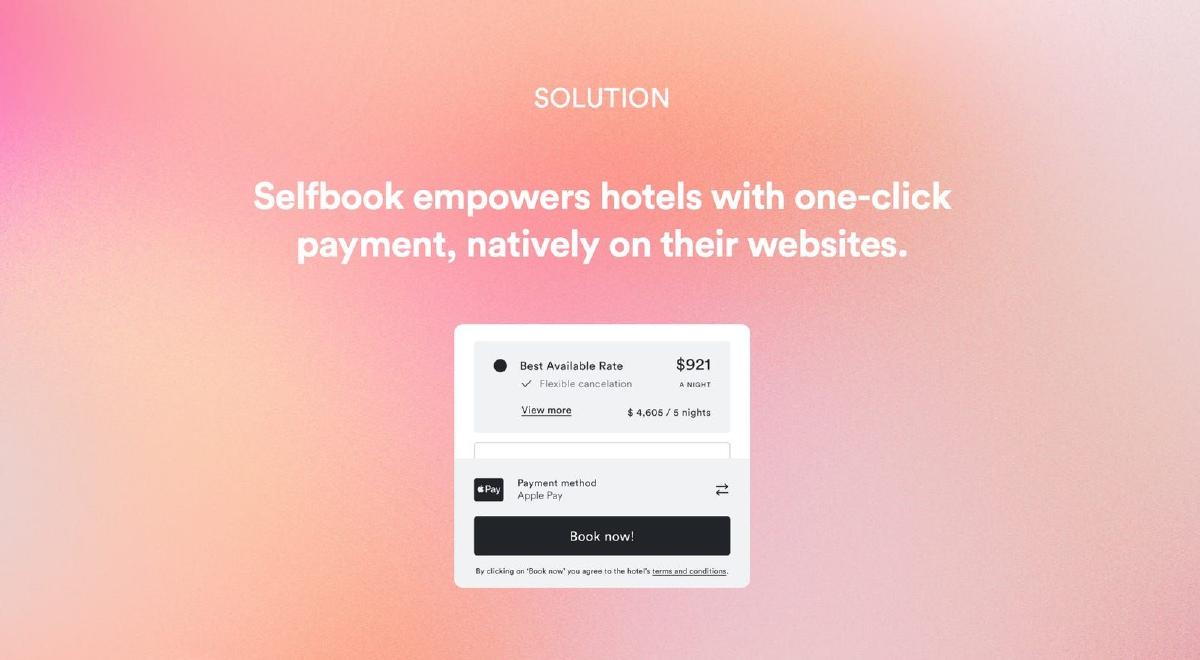
The product is broken down into three functional pillars: Simplify, Verify, and Unify. Simplify focuses on enabling Apple Pay. Verify highlights secure payments to prevent fraud. Unify showcases a single checkout flow for add-on services like dining and spa treatments. The slide includes mobile mockups showing a $921/night room rate and an add-on menu for a $55 picnic basket, illustrating how the software looks in a real-world booking scenario.
Slide 4: Value Proposition and Metrics
This slide moves from features to outcomes. It claims that a mobile-first payment experience is "critical to increasing direct booking conversion." Three key metrics are highlighted: an 80% faster checkout experience than old templates, 67% of customers paying with digital wallets on mobile, and a 20% increase in Average Order Value (AOV). These figures provide the economic justification for a hotel to integrate Selfbook.
Slide 5: The Growth Curve
This is arguably the most important slide in the deck. It tracks Projected Annual Contracted Revenue from April 2021 to August 2021. The growth is staggering:
April 2021: 2 contracts, $13,172 ACV · May 2021: 2 contracts, $14,616 ACV · June 2021: 22 contracts, $1,510,894 ACV · July 2021: 38 contracts, $2,992,781 ACV · August 2021: 70 contracts, $4,338,565 ACV
The visualization of 70 signed contracts and a $4.3M run rate achieved in less than half a year creates a powerful sense of FOMO (fear of missing out) for investors.
Slide 6: Customer Profile
Selfbook clarifies its market positioning by stating an "Initial focus on hotels and groups with high Average Daily Rate for volume." It showcases five high-end customers with their specific projected ACV:
Eden Rock St. Barths: $79,241 · Palm Heights: $44,413 · Lotte New York Palace: $388,839 · Nemacolin: $175,419 · S/G: $473,241
By showing six-figure annual values for single properties, Selfbook proves that their TAM (Total Addressable Market) is lucrative even if they only capture the luxury segment initially.
Slide 7: Partnerships as a Moat
To address the 'defensibility' question, Slide 7 positions the API as the "missing link between digital wallets and legacy systems." It lists three major strategic wins: Apple introducing Selfbook to large chains, a proposed co-selling agreement with Affirm, and global distribution planning with Sabre’s sales teams. These aren't just integrations; they are active go-to-market partnerships with industry titans.
Slide 8: The Ask
The final slide in this sequence states: "We are raising $15 million in Series A." It also notes that $2.9M had been raised previously from investors including 10110, Abstract Ventures, BTV, Sweet Capital, and 9Yards Capital. While the deck asks for $15M, publisher data indicates the round eventually reached $25M, suggesting the traction shown in Slide 5 was highly effective at driving up the round size.
What Selfbook Does Well
The primary strength of this deck is its clarity of traction. Many Series A decks spend too much time on the 'vision' and not enough on the 'velocity.' Selfbook does the opposite. By dedicating a full slide to the month-over-month growth of contracted ACV, they prove product-market fit through hard dollars. The specific call-out of luxury hotel logos also helps investors visualize the brand's prestige and the high-margin nature of the business.
Furthermore, the deck identifies a clear technical bottleneck. By framing the problem as 'rate complexities' preventing digital wallet adoption, they make the solution seem like a necessary infrastructure upgrade rather than a 'nice-to-have' marketing tool. This positioning is common in successful fintech-enabled SaaS companies.
What is Missing from the Deck
The most glaring omission is a Team Slide. In a Series A, investors typically want to see the pedigree of the founders and their ability to navigate the complex world of travel distribution and payment processing. Without this, the deck relies entirely on the metrics to carry the weight of the pitch.
There is also a lack of Competitive Analysis. The travel tech space is crowded with booking engines (like Sabre, which they list as a partner) and payment processors. The deck doesn't explicitly explain why a hotel wouldn't just wait for their existing Property Management System (PMS) to add Apple Pay support, or how Selfbook protects its margins against larger incumbents.
Finally, the deck lacks Unit Economics. While we see projected ACV, we don't see the cost of acquisition (CAC) or the implementation time for these 70 hotels. If it takes six months to onboard a hotel, that $4.3M ACV might be harder to realize than the chart suggests.
Founder Takeaways
Visualize Velocity: If your growth is vertical, make it the centerpiece of the deck. Selfbook’s Slide 5 is the 'hero' of the presentation. Founders should look for the one metric that shows the most aggressive growth and give it its own dedicated space.
Focus on High-Value Segments: Instead of claiming to serve every hotel in the world, Selfbook focused on high-ADR luxury properties. This allowed them to show impressive revenue figures with a relatively small number of customers (70). For B2B startups, showing a path to high ACV is often more attractive than showing a high volume of low-value users.
Leverage Strategic Partnerships: Don't just list integrations; list how those partners help you sell. Mentioning that Apple is 'introducing' them to chains and Sabre is 'planning distribution' shows that the company has external validation from the biggest players in the ecosystem.
Frequently asked questions
- How much did Selfbook actually raise compared to the deck's ask?
- Slide 8 states the company was seeking $15 million for their Series A. However, business reporting from the time indicates they successfully closed $25 million in 2022, suggesting significant investor oversubscription or a follow-on extension shortly after the initial pitch.
- What is the primary problem Selfbook solves for hotels?
- According to Slide 2, the core problem is that 'rate complexities' prevent hotels from accepting digital wallets. Selfbook acts as an API 'missing link' (Slide 7) that connects these modern payment methods to legacy hotel management systems.
- What kind of revenue growth did Selfbook demonstrate?
- The growth was exceptionally rapid. Slide 5 shows that in April 2021, they had 2 contracts worth $13,172 in projected ACV. By August 2021, this scaled to 70 hotels and $4,338,565 in projected ACV.
- Who are Selfbook's target customers?
- They focus on luxury and high-volume properties. Slide 6 lists specific high-ADR (Average Daily Rate) customers including Eden Rock St. Barths, Lotte New York Palace, and Nemacolin, with projected ACV per hotel ranging from $44k to over $473k.
- What major omissions are in the Selfbook deck?
- The deck is missing several standard slides: there is no Team slide to validate founder expertise, no Competitor slide to address market positioning, and no detailed 'Use of Funds' breakdown beyond the round size.