The Seat14a (Seedo) pitch deck from 2013 is a study in extreme minimalism. Spanning just 11 slides, it relies heavily on high-quality photography and bold, sparse text to communicate a value proposition of 'designer quality' at '4x cheaper' prices. The business model centers on curated, made-to-measure outfits delivered to a user's inbox, leveraging vertical integration to achieve 50%+ margins. While the deck succeeds in establishing a clear brand aesthetic and a strong financial hook—specifically the mention of negative working capital—it lacks traditional data slides. There is no market siz…
Key takeaways
- The company positions itself as a simplifier of men's fashion through curated, trend-based outfits (Slide 1, 5).
- A core value proposition is price disruption, claiming to be 4x cheaper than comparable designer brands (Slide 7, 8).
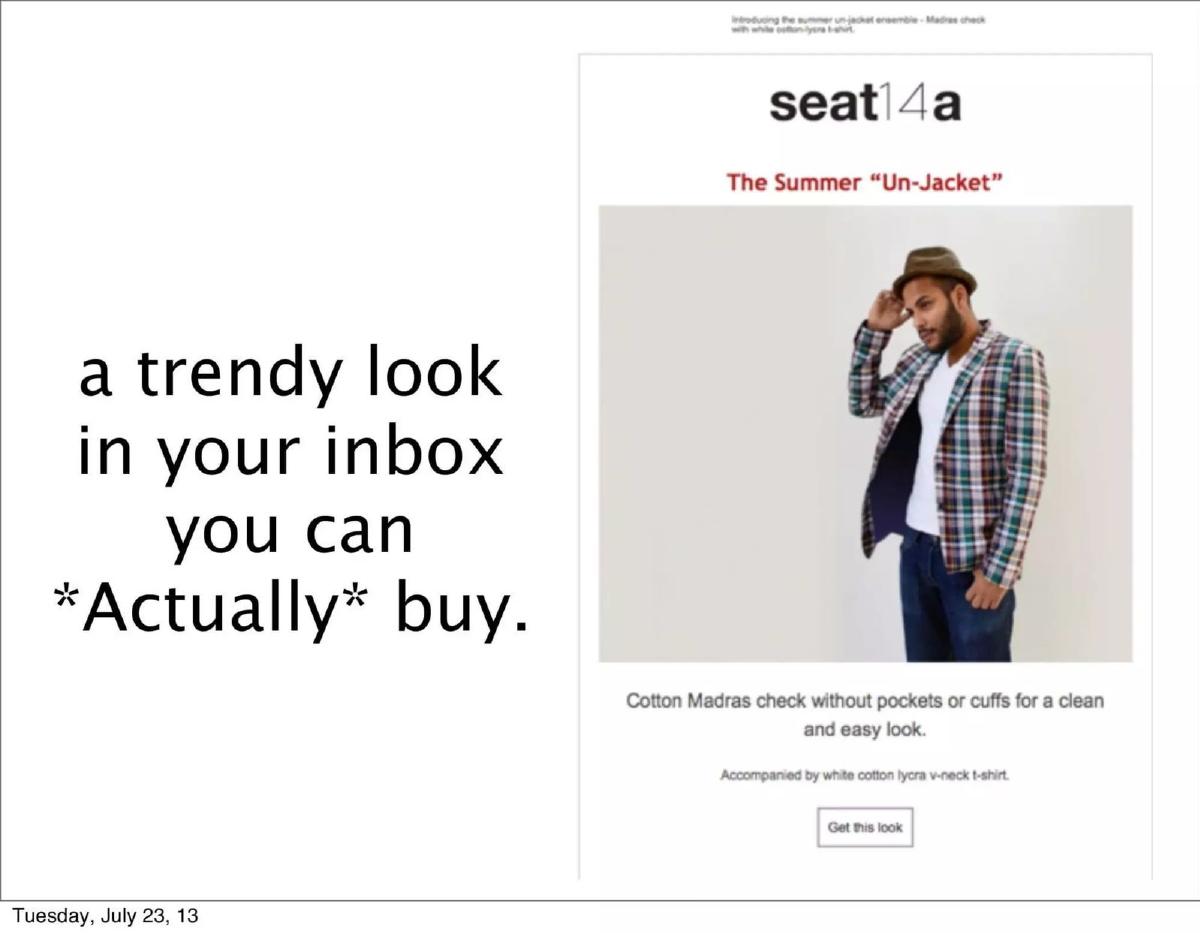
- The product is delivered as a 'trendy look in your inbox' that users can buy directly, emphasizing ease of purchase (Slide 3).
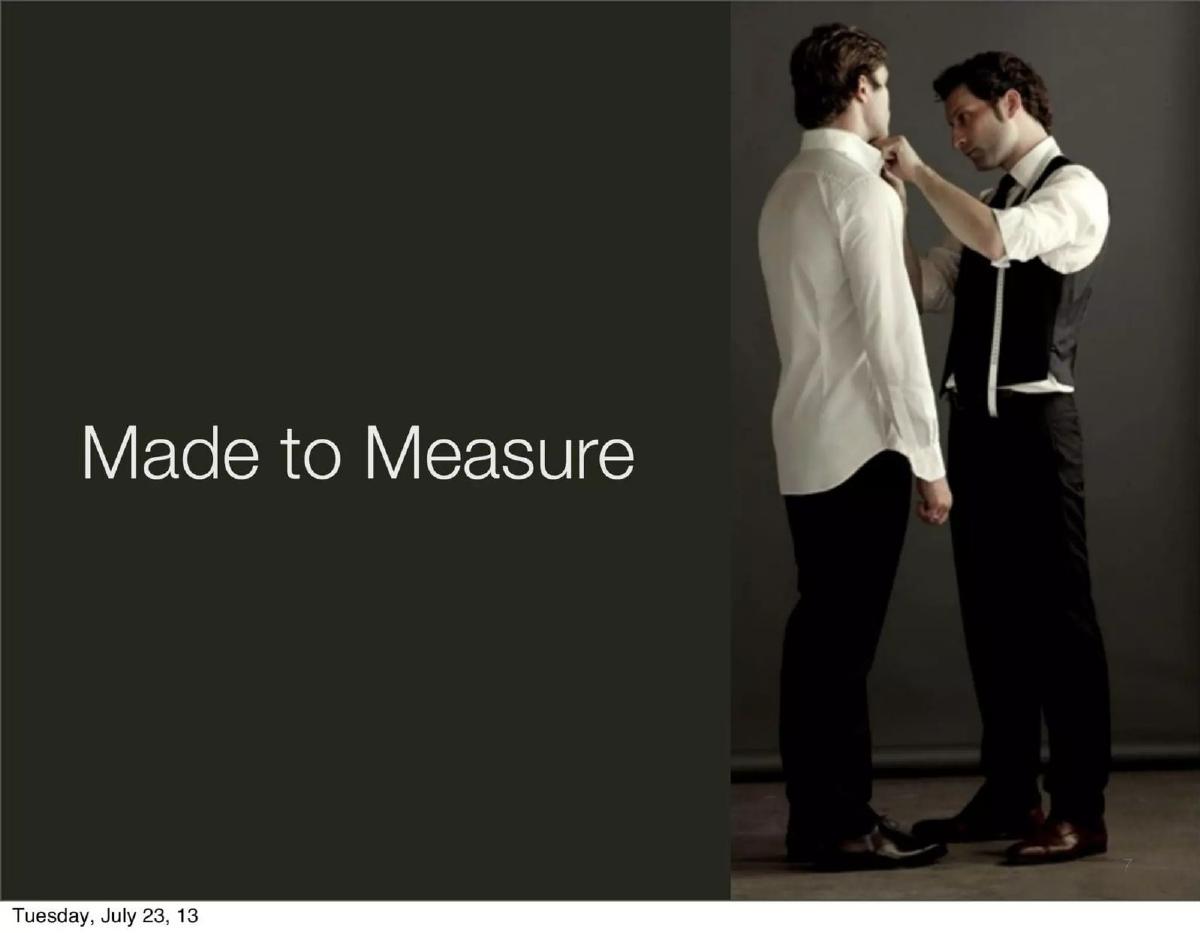
- The business model utilizes 'Made to Measure' tailoring to ensure a 'perfect fit,' differentiating it from standard off-the-rack e-commerce (Slide 6, 8).
- Financial efficiency is highlighted through vertical integration and negative working capital, aiming for 50%+ margins (Slide 9).
- The team slide relies on logos from prestigious institutions like Penn, Microsoft, and Oracle to establish credibility without detailed bios (Slide 10).
- The deck concludes with a specific funding ask of $500k, though it does not specify the use of funds (Slide 11).
- There is a total absence of market data, user growth metrics, or revenue traction figures throughout the 11 slides.
Introduction: The Minimalist Fashion Pitch
The pitch deck for Seat14a (later associated with Seedo) is a product of its time, reflecting a 2013 aesthetic that favored high-resolution imagery over dense data. With only 11 slides, the deck attempts to sell a lifestyle and a logistical advantage rather than a complex technological breakthrough. The company describes itself as a solution for men who find fashion overwhelming, offering curated, made-to-measure outfits at a significant discount compared to traditional retail brands.
The Hook and the Problem
Slide 0: Title Slide The deck opens with the brand name 'seat14a' and the name of the CEO and Co-founder, Jas Banwait. It includes contact information and an AngelList link, immediately signaling that this is a fundraising document. The design is clean and white, setting the tone for the 'simplified' experience promised in the following slides.
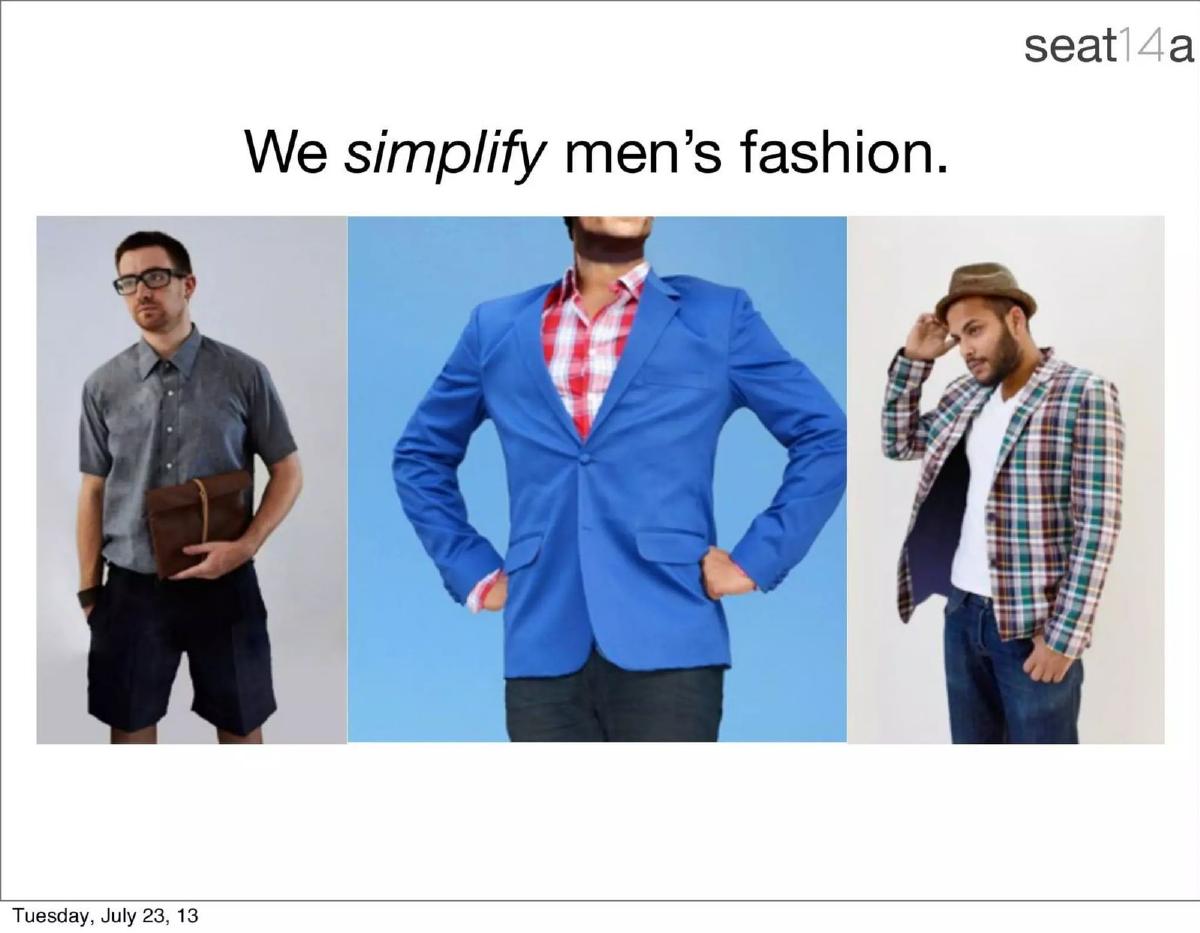
Slide 1: The Mission Statement 'We simplify men’s fashion.' This slide features three photos of men in various outfits—a short-sleeved button-down, a bright blue blazer, and a plaid jacket with a fedora. The imagery is intended to show the range of styles the platform covers, though it doesn't yet explain how the simplification happens.
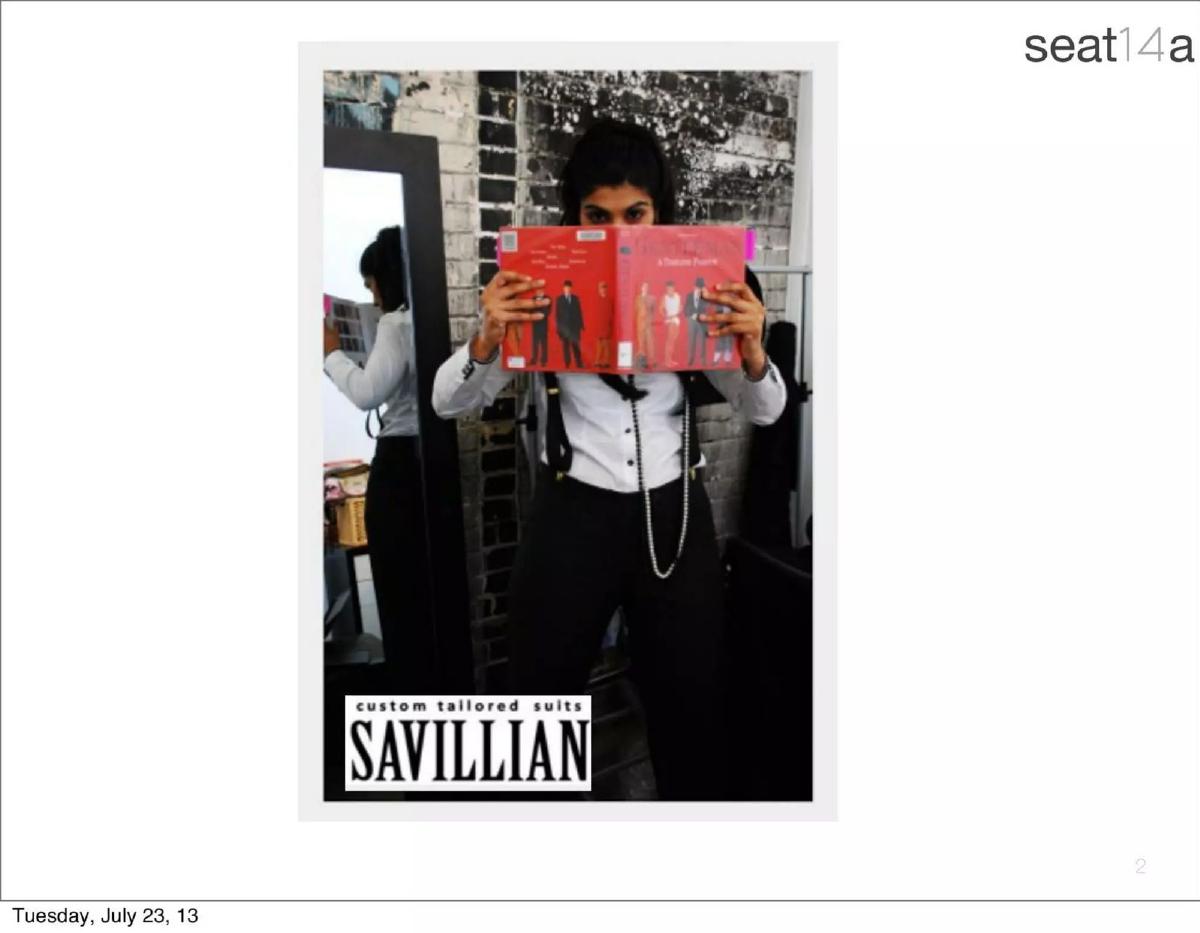
Slide 2: Brand Association This slide features a photo of a woman holding a book titled 'Gentleman' with the logo for 'Savillian' at the bottom. This suggests a partnership or a sub-brand focused on custom-tailored suits. It reinforces the 'Made to Measure' aspect of the business, moving away from standard sizing.
The Product and User Experience
Slide 3: The Delivery Mechanism The text 'a trendy look in your inbox you can Actually buy' is paired with a screenshot of a marketing email. The email features 'The Summer Un-Jacket' and a 'Get this look' button. This slide defines the product: it is not just a store, but a curated push-marketing service that reduces the friction of shopping.
Slide 4: Trend Matching A close-up of a shirt and a leather clutch is accompanied by the text 'Matching outfits based on current trends.' This slide emphasizes the curation aspect. The company isn't just selling clothes; it is selling the expertise of knowing what matches, targeting the 'fashion-challenged' male demographic.
Slide 5: The Fit Factor 'Made to Measure' is the sole text on this slide, accompanied by a photo of a tailor measuring a client. This is a critical part of the value proposition. In 2013, the 'perfect fit' was a major pain point for online apparel shopping, and Seat14a positions itself as a solution to the high return rates associated with standard sizing.
The Economic Disruption
Slide 6: Price Comparison This is the most 'data-heavy' slide in the deck, though it remains highly visual. It compares a three-item outfit (shirt, pants, belt). 'Other Brands' are listed at $800, while 'seat14a' is listed at $150. The slide claims the product is '4X CHEAPER, DESIGNER QUALITY.' Note: The typography on the slide overlaps the numbers ($80 and $15 with a vertical 0), which is a minor design flaw, but the message of price disruption is clear.
Slide 7: The Value Proposition Summary This slide aggregates the previous points into three pillars: 'complete OUTFITS / CURATED STYLE,' '4X CHEAPER / comp. brands,' and 'HIGH QUALITY / with PERFECT FIT.' It uses a full-bleed image of a model in a teal blazer to maintain the 'lifestyle' feel of the deck.
Slide 8: The Business Model This slide features a dog in a scarf (a nod to the 'Menswear Dog' internet meme of the era) and lists three key financial points: 'negative WORKING CAPITAL,' 'Vertically integrated,' and '50%+ MARGINS.' For an investor, this is the most important slide. It explains that the company owns its supply chain (vertical integration), makes a healthy profit on each sale (50%+ margins), and likely gets paid by customers before paying for the goods (negative working capital).
The Team and the Ask
Slide 9: The Team The team slide features four black-and-white photos. Below them are logos for the University of Waterloo, IIT Roorkee, UPenn, Microsoft, Oracle, and Radbox. This is a classic 'prestige' slide. It doesn't list titles or specific achievements, but it uses the reputation of these institutions to imply a high-caliber founding team capable of handling the logistics and technology required for a vertically integrated startup.
Slide 10: The Ask The final slide is a simple grey background with '$500k' in large white text. Below it are the company's social handles and email address. There is no breakdown of how the $500k will be spent (e.g., marketing, inventory, hiring), which is a significant omission for a seed-stage pitch.
What Works in This Deck
Clarity of Value Proposition: The deck does an excellent job of explaining exactly what the customer gets: a curated outfit, delivered to their inbox, that fits perfectly and costs less than the mall. It avoids jargon and focuses on the 'why.'
Financial Hooks: Mentioning 'negative working capital' and '50%+ margins' on a single slide is a powerful way to signal to investors that the founders understand the unit economics of retail. It suggests a business that can scale efficiently without needing massive amounts of capital to sit in inventory.
Visual Consistency: The deck looks like a fashion brand. The use of high-quality photography and a clean layout helps build the 'designer quality' narrative that the text promises.
What is Missing
Market Size (TAM): There is no mention of how large the men's fashion market is or what percentage of it Seat14a hopes to capture. Investors usually want to see that the 'prize' is large enough to justify the risk.
Traction: The deck is entirely forward-looking or theoretical. There are no charts showing month-over-month growth, number of subscribers, or current revenue. Even for a seed round, some proof of concept or 'beta' data is usually expected.
Competition: The deck ignores the existence of competitors like Trunk Club, Indochino, or even J.Crew. A slide explaining why Seat14a's model is superior to existing 'box' or 'custom' services would have strengthened the case.
Use of Funds: While the $500k ask is clear, the lack of a 'Use of Funds' breakdown is a missed opportunity to show that the founders have a strategic plan for growth.
What a Founder Should Copy
The 'Inbox' Slide: Slide 3 is a great example of showing the product in the context of the user's life. Instead of just saying 'we have an email list,' they show the email and the 'buy' button, making the user journey tangible.
The Price Comparison: Slide 6 is a very effective way to visualize a 'disruptive' price point. By showing the actual items and the price gap, the founders make the '4x cheaper' claim feel real rather than just a marketing slogan.
Minimalism: For a brand-heavy startup, less is often more. This deck proves that you can communicate a business model and a brand identity with very few words, provided the images and the core financial metrics are strong.
Frequently asked questions
- What is the primary business model described in the deck?
- The model is a vertically integrated, direct-to-consumer fashion platform. It focuses on sending curated 'looks' to customers via email. By handling the 'Made to Measure' production process internally, the company claims to eliminate middleman markups, offering designer-quality outfits at a fraction of the cost while maintaining high margins.
- How does the company justify its '4x cheaper' claim?
- Slide 7 provides a direct price comparison. It shows a shirt, trousers, and belt from 'Other Brands' totaling $800 (represented by the number 80 with a vertical 0), while the Seat14a equivalent is priced at $150 (represented by 15 with a vertical 0). The deck attributes this price point to vertical integration and a lack of traditional retail overhead.
- What are the most significant omissions in this pitch deck?
- The deck omits almost all standard analytical slides. There is no mention of the total addressable market (TAM), no competitive analysis against other fashion subscription or e-commerce services, and no historical growth data or traction metrics. Additionally, the 'Ask' slide mentions $500k but fails to explain how that capital will be deployed.
- What does 'negative working capital' mean in this context?
- In the context of Slide 9, negative working capital suggests that the company collects payment from customers before it has to pay its suppliers or production costs. This is common in 'made-to-order' models where inventory is not held in advance, significantly reducing the amount of external cash needed to fund day-to-day operations.
- Is the team qualified based on the information provided?
- The deck uses 'logo-dropping' to signal qualification. Slide 10 features four founders alongside logos for the University of Waterloo, IIT Roorkee, UPenn, Microsoft, Oracle, and Radbox. While this suggests a high level of technical and business education, the deck does not explicitly state the founders' specific roles or previous experience in the fashion or logistics industries.