Securter Systems is a Toronto-based fintech startup seeking $1.5M to finalize its 'Tap-on-Phone' fraud prevention technology. The deck positions the company as a bridge between the security of physical EMV chip transactions and the convenience of mobile commerce. By allowing users to tap physical cards onto their own phones to authenticate online purchases, Securter claims to mimic the physical presence of a cardholder, significantly reducing fraud. The financial projections are aggressive, scaling from $687k in Year 1 to over $559M in Year 5, primarily driven by partnerships with platforms l…
Key takeaways
- The company is seeking $1.5M USD in new capital to finalize development and acquire certifications (Slide 9).
- Securter has already raised $610K USD and received over $530K USD in in-kind investments (Slide 9).
- The core technology allows cardholders to tap credit/debit cards onto cell phones and input a bank PIN to mimic physical presence (Slide 3).
- Revenue projections are extremely aggressive, forecasting a jump from $29.2M in Year 2 to $559.4M in Year 5 (Slide 9).
- The business model relies on three streams: direct sales to high-risk merchants, website builder integrations (WooCommerce/Shopify), and payment processor partnerships (Slide 13).
- The team includes seven named members and advisors, including a CEO with experience in public company financing and a CTO with 18 years in IT service management (Slide 15).
- The deck identifies Mobeewave (acquired by Apple for $100M) as a primary competitor in the Tap-on-Phone space (Slide 5).
- Market data cites the global digital payments market growing to $5.8 trillion by 2030 (Slide 7).
Securter Systems Pitch Deck Analysis
Slide 1: Title Slide
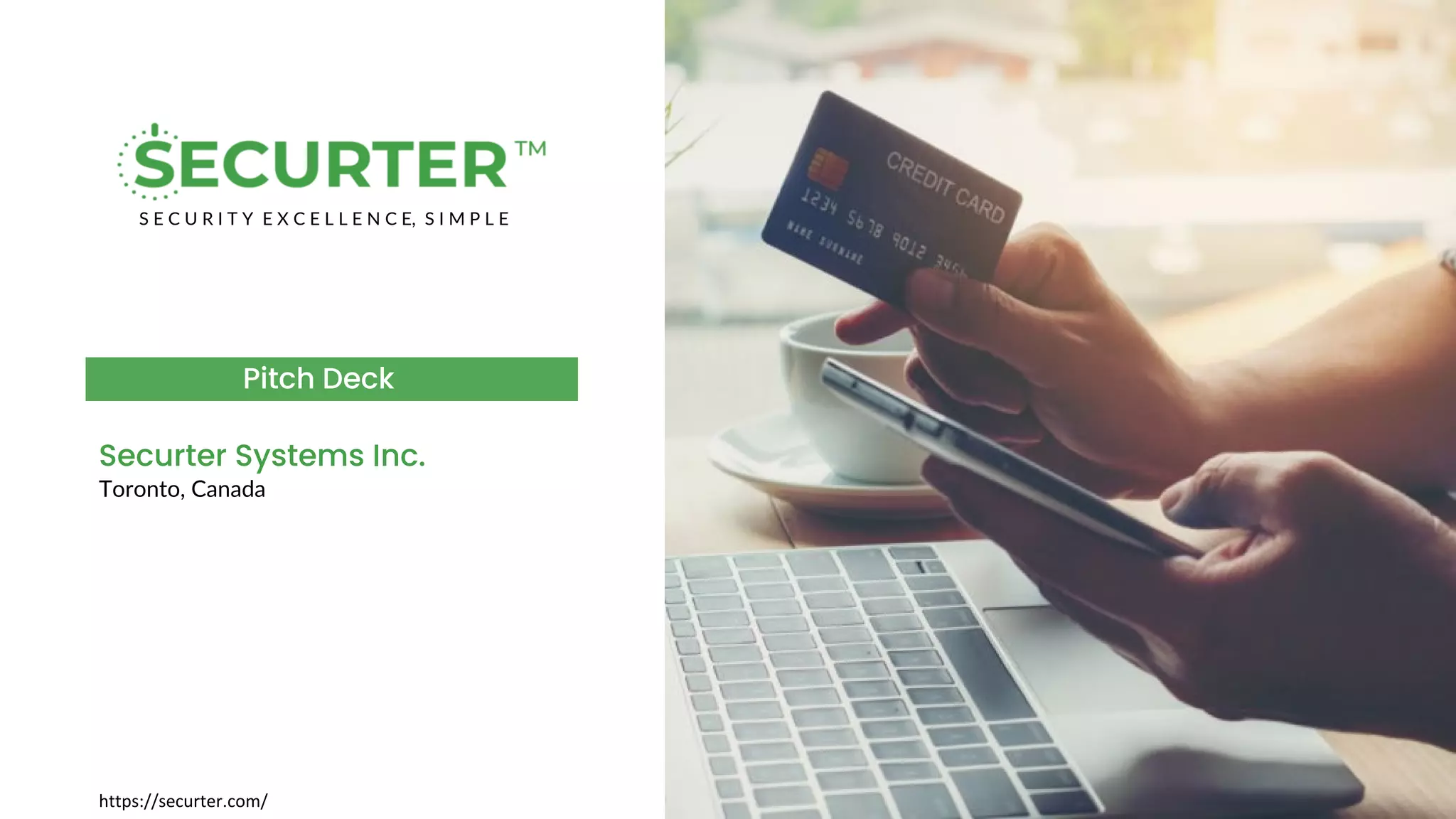
The deck opens with a clean, professional title slide featuring the Securter logo and the tagline "Security Excellence, Simple." It identifies the company as Securter Systems Inc., based in Toronto, Canada. The visual of a person holding a credit card next to a laptop and smartphone immediately establishes the context: the intersection of physical cards and digital commerce.
Slide 3: Technology and the "Crown Jewel"
Slide 3 dives straight into the technical value proposition. Securter describes its "Tap-on-phone" feature as the "crown jewel" of its assets. The technology utilizes the EMV payment method, which is the global standard for chip-based cards. Key points include the ability for cardholders to tap cards onto phones and input a bank PIN, effectively mimicking a physical card-present transaction. The slide notes that the technology is patent-pending and will be certified upon completion. A link to a demo video is provided at the bottom, which is a strong tactical move for a technical product.
Slide 5: The Competitive Landscape
This slide addresses the competition with notable transparency. It mentions Mobeewave Inc., which was acquired by Apple for $100 million, and Global Payments. It also acknowledges the hardware-level security of Apple's Secure Enclave and Android's Trusted Execution Environment (TEE). Securter differentiates itself by stating its app can be integrated into existing wallets or function as a standalone wallet. A footer note mentions a specific unpatchable flaw in older iPhone Secure Enclaves, likely intended to suggest that hardware-only solutions have vulnerabilities that Securter might mitigate.
Slide 7: Market Opportunity
Securter uses macro-market data to justify the scale of the problem. They cite the Global Digital Payments Market growing to $5.8 trillion by 2030 (14.3% CAGR) and the Fraud Detection and Prevention Market growing to $182.66 billion by 2030 (22.6% CAGR). While these numbers are large, they are standard industry figures that don't necessarily speak to Securter's specific addressable market (SAM), but rather the general tailwinds of the industry.
Slide 9: Capital Needed and Use of Funds
This is the most data-dense slide in the deck. Securter is seeking $1.5M USD. They disclose prior funding of $610K USD in cash and $530K USD in-kind. The revenue table is highly ambitious, showing a total revenue climb from $687,083 CAD in Year 1 to $559,430,845 CAD in Year 5. The "Use of Funds" section lists five priorities: finalizing the Tap-on-Phone feature, certification acquisition, hiring staff, system upgrades, and marketing/sales. The inclusion of CAD and USD figures on the same slide requires careful reading to avoid confusion.
Slide 11: Appendix for Q&A
A simple transition slide indicating the end of the main presentation and the beginning of supplemental materials. This is a common practice to keep the core pitch concise while having data ready for deeper due diligence.
Slide 13: The Business Model
The business model is broken down into three revenue streams. The first is direct fraud prevention services for high-risk customers like online gaming platforms. The second is partnerships with website builders like WooCommerce, Wix, and Shopify (noting 6.5 million users on WordPress/WooCommerce). The third is partnerships with payment processors like Global Payments, Stripe, and Moneris. This "partnership-first" approach is logical for a security layer that needs to be where the transactions are already happening.
Slide 15: The Team
The final slide introduces the leadership and advisory board. The team is heavy on experience: Steve Epstein (COO) has 20 years in entrepreneurship; James D. Romano (CEO) has experience with public company financing; Vitaly Vlasenko (CTO) has 18 years in IT; and Michael Shmulevich (VP Engineering) has expertise in fintech and blockchain. The inclusion of a dedicated CFO (David Edmunds) and a Cyber Security Consultant (Evgeniy Kharam) adds significant weight to the company's professional and technical standing.
What Securter Systems Does Well
The deck excels at identifying a specific, high-value technical problem: the gap between physical card security (EMV) and mobile commerce. By focusing on "Tap-on-Phone" as a fraud prevention tool rather than just a payment method, they target a massive pain point for merchants (chargebacks and fraud). The transparency regarding Apple's acquisition of Mobeewave shows they understand the market's movements. Furthermore, providing a link to a functional demo on the technology slide helps bridge the gap between a theoretical concept and a viable product.
What Is Missing from the Deck
The most glaring omission is a detailed breakdown of the unit economics. While the revenue projections are massive, there is no mention of the cost per transaction, licensing fees, or the margin structure of the three revenue streams. Additionally, the deck lacks a clear "Go-to-Market" timeline. While they mention Year 1 through Year 5, they don't specify where they currently are in that timeline or what the specific milestones are for the next 12 months beyond "finalizing development." The competitive slide also fails to explain why a merchant would choose Securter over a native Apple or Google solution, other than a brief mention of a hardware flaw.
What a Founder Should Copy
Founders should emulate the way Securter categorizes its revenue streams. By breaking the business model into direct sales, platform integrations, and processor partnerships, they show a multi-pronged approach to scaling. The "Use of Funds" section is also well-structured, clearly linking the $1.5M ask to specific operational goals like certification and hiring. Finally, the team slide is a good example of how to highlight relevant, long-term industry experience to build investor confidence in a complex technical field like cybersecurity.
Frequently asked questions
- What is Securter's unique value proposition?
- Securter's primary innovation is bringing EMV (Europay, Mastercard, and Visa) security standards to mobile-based online transactions. By allowing a user to tap their physical card against their smartphone to authenticate a purchase, the system mimics a 'card-present' transaction environment. This is intended to make it significantly harder for fraudsters to use stolen card information for online purchases, as it requires the physical card and the bank PIN.
- How does Securter plan to make money?
- The company outlines a three-pillar revenue strategy. First, they target high-risk early adopters like online gaming platforms. Second, they are developing integrations for major e-commerce website builders like WooCommerce, Wix, and Shopify. Third, they aim to partner with established payment processors such as Stripe, Global Payments, and Moneris to offer their fraud prevention services as a bundled feature.
- What are the biggest risks identified in the deck?
- The competitive landscape is the most significant hurdle. Slide 5 explicitly mentions Apple's acquisition of Mobeewave and the existence of Apple's Secure Enclave and Android's Trusted Execution Environment. Securter must prove its third-party software can offer superior security or better cross-platform compatibility than the native hardware-level security features being built by the world's two largest mobile OS providers.
- Are the financial projections realistic?
- The projections on Slide 9 are exceptionally high for an early-stage startup. Predicting a rise from $687,083 in Year 1 to $559,430,845 in Year 5 represents a growth rate that assumes near-total market dominance or massive-scale adoption by global partners. Investors would likely scrutinize the 'Year 2' jump to $29M, which requires immediate, large-scale integration success.
- Who is leading the company?
- The leadership team is led by James D. Romano (President & CEO), who has a background in financing public companies. The technical side is managed by Steve Epstein (Co-Founder & COO) and Vitaly Vlasenko (CTO), who brings 18 years of IT experience. The team is rounded out by Michael Shmulevich (VP of Engineering) and David Edmunds (CFO), suggesting a heavy emphasis on corporate structure and technical execution.