Seedtag’s 9-slide Series B deck from 2021 is a masterclass in positioning a company against a massive industry shift: the death of the third-party cookie. By framing their 'LIZ' AI technology as the primary alternative to privacy-restricted targeting, Seedtag successfully raised $40M. The deck leans heavily on performance data, showcasing CTRs and viewability rates that significantly outperform industry averages. While it lacks a traditional team slide or a detailed financial breakdown, it compensates with high-impact case studies from global brands like Dell and Lipton. The narrative is tigh…
Key takeaways
- The deck positions the removal of 3rd party cookies as a primary market tailwind for contextual advertising (Slide 8).
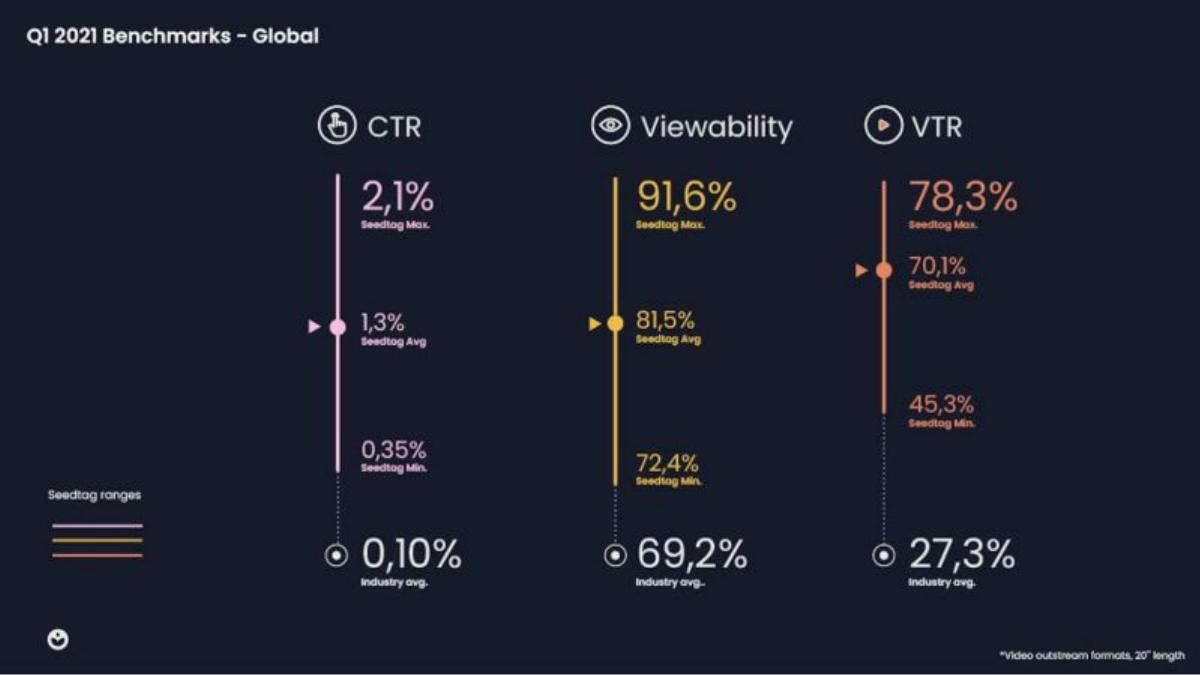
- Seedtag claims a 1.3% average CTR, which is 13x higher than the stated industry average of 0.10% (Slide 5).
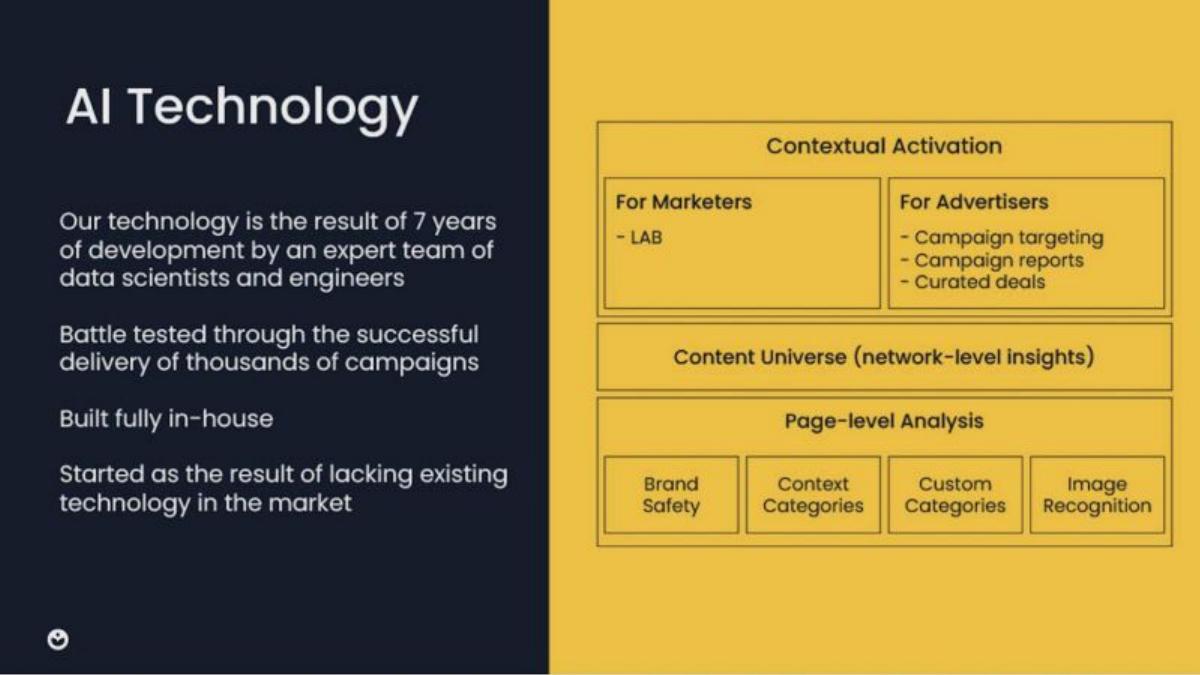
- The proprietary AI, named LIZ, is described as the result of 7 years of in-house development by data scientists and engineers (Slide 3).
- Performance metrics are categorized into three core KPIs: CTR, Viewability (81.5% avg), and VTR (70.1% avg) (Slide 5).
- Case studies demonstrate significant brand lift, including a +314% uplift in message association for a major car manufacturer (Slide 7).
- The technology stack is divided into three layers: Page-level Analysis, Content Universe, and Contextual Activation (Slide 3).
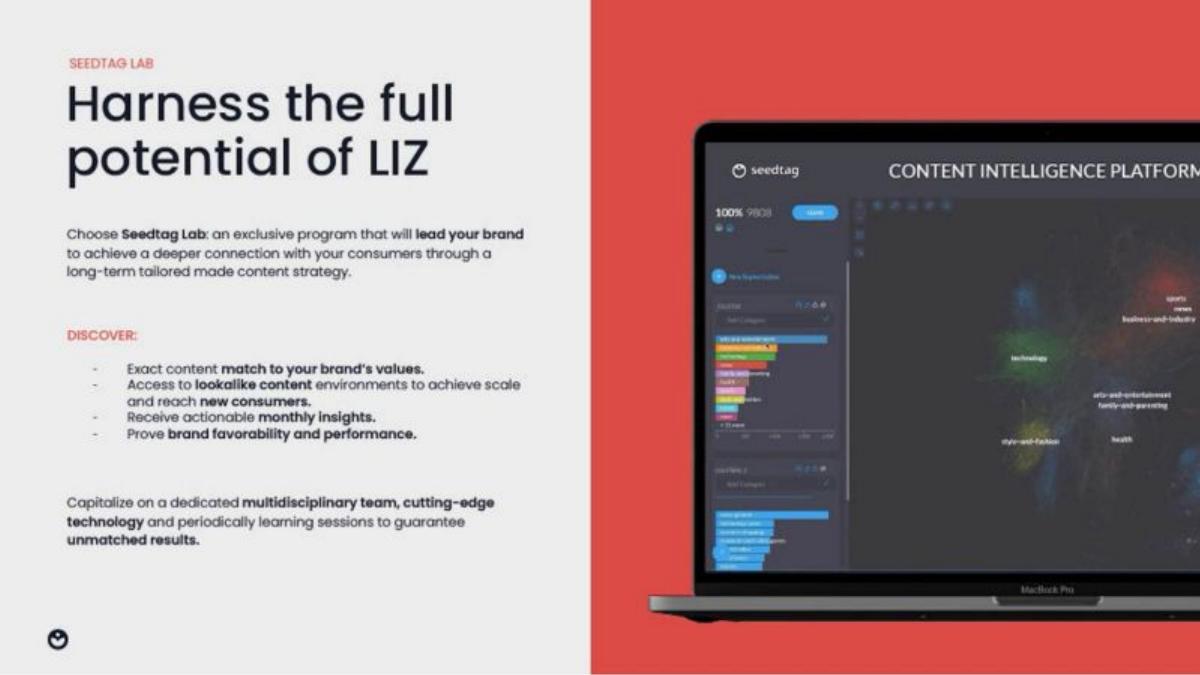
- Seedtag Lab is marketed as an exclusive program for brands to develop long-term tailored content strategies (Slide 4).
- The deck omits a team slide, a formal funding 'ask,' and a detailed competitive landscape analysis (Slides 1-9).
The Contextual Pivot: A Series B Teardown
Seedtag’s 2021 pitch deck arrived at a pivotal moment for the adtech industry. With privacy regulations tightening and the 'cookie-pocalypse' looming, the company sought to capitalize on the resurgence of contextual advertising. This $40M Series B deck is notable for its brevity and its heavy reliance on performance data. Rather than selling a dream, Seedtag sells a proven engine that outperforms industry standards.
Slide 1: The Vision Statement
The cover slide is minimalist, featuring the company logo and the bold claim: "The leading contextual advertising company." It sets an immediate tone of market leadership. There is no fluff here; the branding is clean, and the focus is entirely on the category they intend to own.
Slide 2: The Three Pillars of Contextual AI
Slide 2 introduces the "Contextual AI pillars." These are defined as:
Understand consumer interest. · Design contextual creatives that resonate with your consumers. · Deliver your messages into the most valuable content.
This slide serves as a high-level conceptual framework for how their technology bridges the gap between raw data and ad delivery. It moves the conversation from 'what' they do to 'how' they create value.
Slide 3: The Technology Stack
On Slide 3, Seedtag dives into the "AI Technology." They emphasize that the tech is the result of "7 years of development by an expert team of data scientists and engineers" and is "built fully in-house." The right side of the slide features a block diagram of their architecture:
Page-level Analysis: Covering Brand Safety, Context Categories, Custom Categories, and Image Recognition. · Content Universe: Providing network-level insights. · Contextual Activation: Split between 'LAB' for marketers and campaign targeting/reports for advertisers.
This slide is crucial for establishing a 'moat.' By highlighting the 7-year development cycle, they signal to investors that this isn't a wrapper on someone else's API; it is proprietary infrastructure.
Slide 4: Seedtag LAB and LIZ
Slide 4 introduces "LIZ," their Content Intelligence Platform. The slide positions "Seedtag Lab" as an exclusive program. The key features of LIZ include:
Exact content match to brand values. · Access to "lookalike content environments" to achieve scale. · Actionable monthly insights. · Proof of brand favorability and performance.
The inclusion of a laptop mockup showing the platform interface provides a tangible sense of the product, moving the deck from abstract concepts to a functional software tool.
Slide 5: The Data Powerhouse
This is arguably the most important slide in the deck. Slide 5 presents "Q1 2021 Benchmarks - Global." It compares Seedtag’s performance against industry averages across three metrics:
CTR (Click-Through Rate): Seedtag Avg of 1.3% vs. Industry Avg of 0.10% . · Viewability: Seedtag Avg of 81.5% vs. Industry Avg of 69.2% . · VTR (Video Through Rate): Seedtag Avg of 70.1% vs. Industry Avg of 27.3% .
By showing a CTR that is 13 times higher than the industry average, Seedtag makes a compelling mathematical case for their platform's efficacy. The use of 'Max' and 'Min' ranges adds a layer of transparency to the data.
Slides 6 & 7: Proof of Concept (Case Studies)
These two slides provide six mini-case studies featuring global brands. Notable results include:
Football Women’s World Cup: +40% uplift in Unaided Brand Awareness. · Hybrid SUV Launch: +44% greater purchase intent. · B2B Electronics: +58% unaided brand awareness and +90% impressions delivered on target. · Major Car Manufacturer: +314% uplift in "Why not now" message association. · Lipton: +60% stronger association with favorability. · Dell: +55% uplift in brand favorability.
The variety of industries—CPG, Automotive, Tech, and B2B—demonstrates the versatility of the contextual engine. It proves that 'context' works as well for selling laptops as it does for selling iced tea.
Slide 8: The Market Tailwind
Slide 8 addresses the "3rd party cookie impact." It frames Google's removal of cookies as a "positive tailwind" for Seedtag. The slide dismisses competitors like Unified IDs, noting they "rely on users creating separate logins" and provide "limited reach." This slide is the 'Why Now?' of the deck, explaining why a 7-year-old company is suddenly a hyper-growth investment opportunity.
Slide 9: The BestPitchDeck.com Placeholder
The final slide in this set is a promotional slide for the source library and does not contain Seedtag company information.
What Works in This Deck
The Data-First Approach: Seedtag doesn't just claim to be better; they show a 13x improvement in CTR. For Series B investors, these performance benchmarks are the primary driver of the valuation.
Strategic Timing: By dedicating a full slide to the death of the cookie, they align their success with an unstoppable industry trend. They aren't just a 'nice to have' tool; they are a necessary replacement for a dying technology.
Brand Validation: Mentioning Dell and Lipton by name, alongside specific percentage uplifts, provides massive social proof. It shows that the world's largest spenders have already vetted and found value in the platform.
What Is Missing
The Team: There is no mention of the founders or the leadership team. At Series B, investors want to see the 'expert team' mentioned on Slide 3. Who are the data scientists? What is their pedigree?
The Financials: The deck is entirely focused on campaign performance, but it lacks business performance. There is no mention of ARR, churn, net dollar retention, or margins. While this might have been in a separate data room, its absence in the pitch deck is notable.
The Ask: The deck never explicitly states how much they are raising or how they intend to use the capital. According to catalogue facts, they raised $40M, but the slides themselves don't detail the expansion plan (e.g., US market entry, R&D, or sales hiring).
Founder's Playbook: What to Copy
Benchmark Against the Industry: If your product is better than the status quo, don't just say it—graph it. Slide 5’s comparison of 'Seedtag Avg' vs. 'Industry Avg' is a powerful visual that stays in an investor's mind.
Own a Narrative Shift: Seedtag didn't invent contextual advertising, but they successfully branded themselves as the solution to the 'cookie-pocalypse.' Founders should identify the biggest 'pain point' in their industry's current transition and position their product as the only logical bridge to the future.
Keep it Visual: The deck uses high-quality imagery and clean diagrams. Even the technical architecture on Slide 3 is simplified into a digestible flow. This ensures the 'expert' nature of the tech is communicated without drowning the reader in jargon.
Frequently asked questions
- What is Seedtag's core value proposition?
- Seedtag positions itself as the leading contextual advertising company. Their core value proposition lies in using proprietary AI (LIZ) to analyze web content—specifically editorial images—at a page level. This allows brands to deliver ads that are relevant to the immediate context of the user's reading experience without relying on invasive tracking methods like 3rd party cookies.
- How does Seedtag compare its performance to the rest of the industry?
- On slide 5, Seedtag provides global benchmarks from Q1 2021. They report an average Click-Through Rate (CTR) of 1.3% against an industry average of 0.10%. They also claim an average viewability of 81.5% (industry avg: 69.2%) and a Video Through Rate (VTR) of 70.1% (industry avg: 27.3%), suggesting their contextual placement is significantly more engaging than standard display ads.
- What is 'LIZ' and why is it important in the deck?
- LIZ is the name of Seedtag's proprietary AI and Content Intelligence Platform. It is the centerpiece of their technological moat. According to the deck, LIZ enables 'lookalike content environments' and provides actionable monthly insights. It represents the '7 years of development' mentioned in the deck, serving as the automated engine that matches brand values to specific editorial content.
- How does the deck address the changing privacy landscape?
- Slide 8 is dedicated to the '3rd party cookie impact.' It explicitly mentions Google's removal of cookies and critiques 'Unified IDs' for having limited reach and requiring separate logins. By framing these industry changes as a 'positive tailwind,' Seedtag positions its contextual solution as the most viable, privacy-compliant alternative for agencies and brands.
- What essential pitch deck elements are missing from this presentation?
- This is a very lean deck. It lacks a Team slide, which is unusual for a Series B. It also omits a clear 'Ask' slide (how much they are raising and what for), a detailed Financials/Projections slide, and a Competitor Matrix. It functions more as a high-level product and performance overview than a comprehensive business plan.