Senmotion's 2019 pitch deck focuses on the massive economic burden of musculoskeletal disorders (MSD), citing €34 billion in annual costs in Germany alone. The company proposes a '360° Solution' that combines IoT wearable insoles with AI/ML analytics to provide high-precision diagnostics and personalized therapy. While the deck successfully establishes a strong academic team—featuring two professors specializing in biomechanics and training science—and highlights a significant gap in current wearable accuracy, it lacks critical business details. There is no mention of unit economics, manufact…
Key takeaways
- The company targets musculoskeletal disorders (MSD), which they claim affect 80% of people at least once in their lives (Slide 4).
- Senmotion identifies a €34 billion annual cost for MSD in Germany and over 1.1 million knee and hip procedures per year in the US (Slide 4).
- The technical solution relies on high-precision sensors in wearables combined with a 'Scientific Pattern Database' for AI/ML analytics (Slide 6).
- A performance graph compares Senmotion's accuracy against the 'Goldstandard' AMTI and competitors Pedar and Moticon, suggesting existing systems are inaccurate (Slide 8).
- The team is heavily academic, featuring two CEOs, one of whom is a Professor for Biomechanics and Motion Science (Slide 2).
- Senmotion positions itself in the high-quality, high-medical-relevance quadrant, above competitors like Fitbit, Apple, and Withings (Slide 10).
- The deck provides no financial projections, revenue model, or go-to-market strategy beyond general 'telemedicine care' mentions (Slide 6).
- There is no specific investment ask or information regarding the current stage of product development or clinical trials (Slide 13).
Slide-by-Slide Teardown
Slide 1: Title Slide
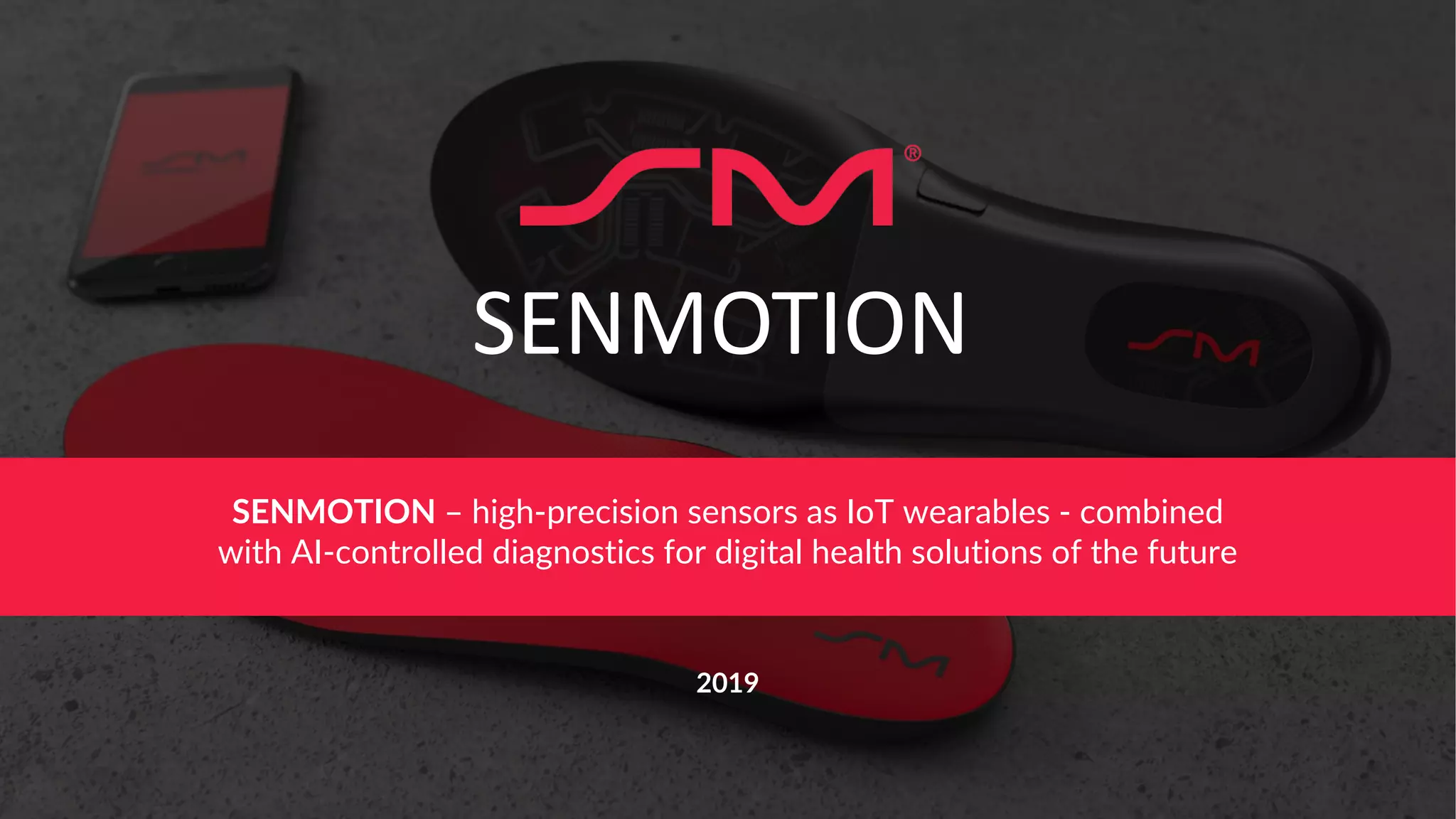
The title slide introduces Senmotion with a clear subtitle: "high-precision sensors as IoT wearables - combined with AI-controlled diagnostics for digital health solutions of the future." The background image shows the physical product—a pair of red and black insoles—alongside a smartphone displaying the company logo. This immediately establishes the company as a hardware-enabled software play (MedTech/IoT). The year 2019 is clearly marked at the bottom.
Slide 2: Excellent Team
The team slide highlights a strong academic and technical foundation. It features four key members: Ilja Solomonovs (CEO, Dipl. BWL), Prof. Dr. Thomas Ertelt (CEO, Prof. for Biomechanics & Motion Science), Prof. Dr. Thomas Gronwald (Intervention and Therapie), and Dimitri Biermann (CTO, Senior Software Architect). The inclusion of two professors suggests a deep focus on the scientific validity of the data analytics, which is crucial for a medical-grade wearable. However, having two CEOs can sometimes be a red flag for investors regarding decision-making clarity.
Slide 4: MSD - Musculoskeletal disorders
This is the "Problem" slide. It uses high-level statistics to quantify the market opportunity. Key figures include: 80% of people get sick with MSD at least once, there are more than 150 clinical pictures , and it is the second leading cause of early retirement . The most striking figure is the €34 billion p.a. cost in Germany alone. By citing over 1,167,000 knee & hip TEP procedures per year in the US, the deck establishes a massive Total Addressable Market (TAM) for diagnostic and post-operative monitoring tools.
Slide 6: Our 360° Solution
This slide outlines the workflow of the Senmotion ecosystem. It starts with Wearables: Motion Data combined with Individual data and Scientific studies . These feed into a Scientific Pattern Database , which is then processed by AI/ML Analytics . The output is categorized into three buckets: Unique data & high-precision diagnostics , Personalized Therapy & Prevention , and Telemedicine care and effectiveness . This slide effectively explains how the hardware (insoles) serves as the data entry point for a larger software platform.
Slide 8: No accurate system available today
This is a technical validation slide. It features a graph comparing Kraft [N] (Force) against Zeit [s] (Time). The red line (presumably Senmotion, though not explicitly labeled as such in the legend) is shown tracking closely with the AMTI (Goldstandard) , while competitors Pedar and Moticon are shown as significantly less accurate or having different force profiles. This slide is intended to prove that existing mobile solutions are insufficient for clinical use, creating a "moat" based on data precision.
Slide 10: Excellent opportunity
This is the competitive positioning matrix. The Y-axis represents Sensors/Data Quality and the X-axis represents Medical relevance. Senmotion places itself in the top-right corner. Competitors like Huawei and Xiaomi are in the bottom-left (consumer/low quality). Apple , Fitbit , and Withings are in the center (consumer/medium quality). dorsaVi , Verily , and Evidation are positioned closer to the medical axis but lower in sensor quality than Senmotion. This is a bold claim that would require significant technical backing during due diligence.
Slide 13: Contact
The final slide repeats the product imagery and provides contact information for Ilja Solomonovs , including an email, mobile number, and website. Notably, there is no "Ask" on this slide or the preceding ones. Investors are left not knowing how much capital the company is seeking or what the specific milestones for the next round of funding would be.
What Works Well
Clear Problem Quantification: Slide 4 does an excellent job of using hard numbers (€34 billion cost, 1.1M procedures) to prove that the problem is worth solving. · Academic Credibility: The presence of two professors in relevant fields (Biomechanics and Training Science) on Slide 2 gives the "AI/ML Analytics" claims much-needed weight. · Visual Product Identification: The deck consistently shows the product, making it clear that this is a tangible hardware solution, not just a theoretical software concept. · Technical Comparison: Using a force/time graph (Slide 8) to compare against a laboratory gold standard (AMTI) is a highly effective way to communicate technical superiority to a technically-literate investor.
What Is Missing
The Ask: The most significant omission is the lack of a funding request. There is no mention of how much money is being raised, the valuation, or the use of proceeds. · Business Model: The deck explains what the product does but not how the company makes money. Is it a hardware sale, a SaaS subscription for clinics, or a per-patient diagnostic fee? · Regulatory Roadmap: For a product claiming "high-precision diagnostics" and "medical" relevance, the absence of CE Mark or FDA clearance status is a major gap. · Traction: There are no mentions of pilot programs, hospital partnerships, or current user numbers. The deck feels very early-stage/pre-revenue. · Go-to-Market Strategy: While it mentions telemedicine, it doesn't explain how they will acquire customers in a notoriously difficult healthcare sales environment.
What a Founder Should Copy
The 2x2 Matrix Logic: Even if the positioning is aggressive, the axes chosen (Data Quality vs. Medical Relevance) are exactly what a MedTech investor cares about. · Problem-Solution Alignment: The transition from Slide 4 (the cost of MSD) to Slide 6 (the 360° solution) is logical and easy to follow. · Professional Design: The deck uses a consistent color palette (red, black, white) and high-quality product photography, which helps build brand trust. · Focus on Data Integrity: In the crowded wearable space, focusing on accuracy relative to a lab standard (Slide 8) is a better differentiator than focusing on features .
Frequently asked questions
- What is the core product of Senmotion?
- Based on the visual evidence on Slide 1 and Slide 13, the core product is a sensor-embedded shoe insole. This hardware is designed to capture high-precision motion data, which is then transmitted to a smartphone and processed via an AI/ML analytics engine to provide diagnostics and therapy recommendations for musculoskeletal disorders.
- How does Senmotion differentiate itself from consumer wearables like the Apple Watch?
- Slide 10 uses a 2x2 matrix to position Senmotion in the top-right quadrant, representing the highest 'Sensors/Data Quality' and 'Medical' relevance. The deck argues that consumer brands like Apple, Fitbit, and Huawei lack the medical specificity and data precision required for clinical diagnostics in musculoskeletal health.
- What is the primary market pain point addressed in the deck?
- The deck focuses on the economic and clinical burden of Musculoskeletal Disorders (MSD). Slide 4 notes that MSD is the second leading cause of early retirement and the largest cost center in rehabilitation, resulting in €34 billion in annual costs in Germany alone.
- Who are the key members of the leadership team?
- The team is led by co-CEOs Ilja Solomonovs (Management/Strategy) and Prof. Dr. Thomas Ertelt (Biomechanics/Data Analytics). They are supported by Prof. Dr. Thomas Gronwald, who handles intervention and therapy, and CTO Dimitri Biermann, a Senior Software Architect (Slide 2).
- What information is missing from this pitch deck?
- The deck is missing several standard venture capital requirements: a clear revenue model, a go-to-market strategy, unit economics for the hardware, a roadmap for regulatory approval, and a specific funding ask. It functions more as a clinical and technical overview than a complete investment proposal.