Lindus Health’s seed deck is a masterclass in product-led service positioning. By branding their internal tools as the 'Citrus' suite, they differentiate themselves from traditional Contract Research Organizations (CROs) which they characterize as slow and opaque. The deck successfully highlights a massive industry pain point—86% of clinical trials are delayed—and presents a modular solution that spans recruitment, clinical data management, and monitoring. While the deck is light on financial projections and specific customer case studies, it leans heavily on a high-pedigree team with backgro…
Key takeaways
- The deck identifies a critical industry failure: 86% of clinical trials face delays due to manual processes (Slide 3).
- Lindus Health positions itself as a technology-first alternative to traditional CROs, which they label as 'slow, expensive, and opaque' (Slide 3).
- The product is broken down into a modular suite called 'Citrus,' including Recruit, Clinical, and Sentry, providing a clear roadmap of their tech stack (Slide 5).
- They offer three distinct delivery models—fully decentralized, hybrid, and traditional site-based—to accommodate varying trial needs (Slide 7).
- The platform emphasizes regulatory compliance, citing 21 CFR part 11 and CDISC SDTM data export formats mandated by the FDA (Slide 11).
- The team slide is exceptionally strong, featuring a CTO with 15 years of experience at Google and a Co-Founder who advised the UK Prime Minister (Slide 17).
- The deck omits a specific 'Ask' slide, financial forecasts, and a competitive landscape matrix, focusing instead on product capabilities.
- Reported by Business Insider, this deck helped secure $1M in seed funding in 2024 for the London-based startup.
Slide 1: Title Slide
The deck opens with a clean, professional title slide featuring the Lindus Health logo and the tagline: "Accelerating clinical research for biotech and healthtech pioneers." The inclusion of a contact email (hello@lindushealth.com) at the bottom is a standard but effective call to action for investors reviewing the deck asynchronously.
Slide 2: Branding Placeholder
Slide 2 is a minimalist branding slide featuring the "LH" monogram. In a live presentation, this serves as a visual break; in a sent deck, it reinforces the brand identity before diving into the problem statement.
Slide 3: The Problem Statement
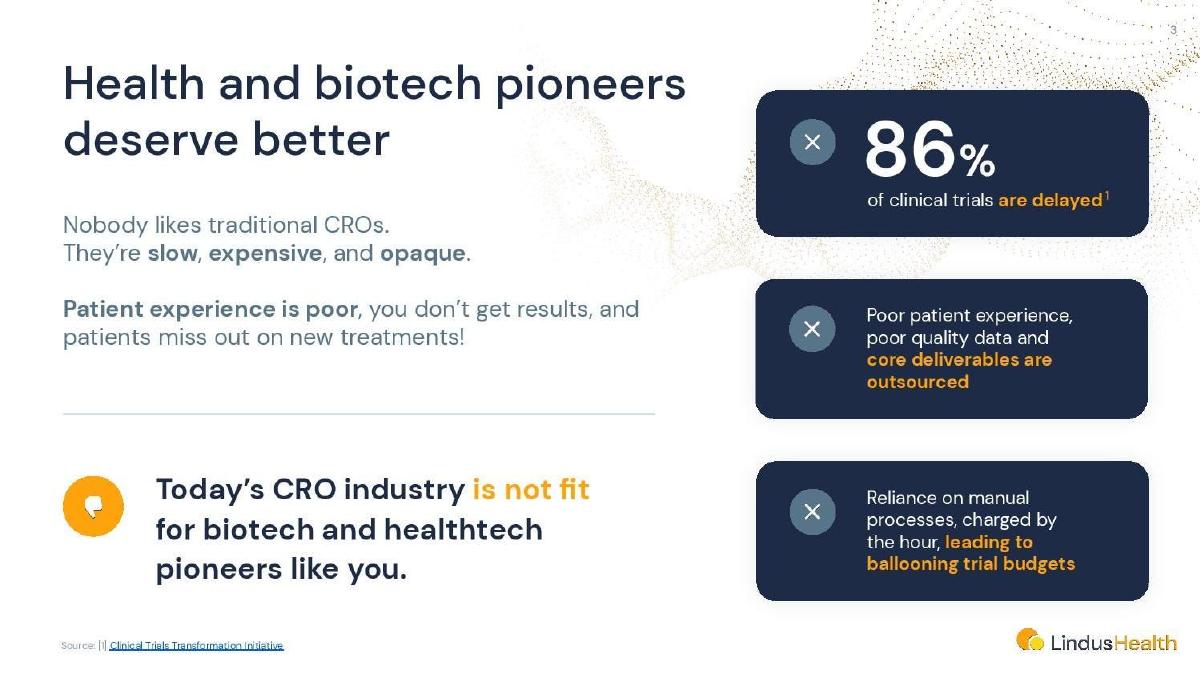
This is the most critical slide for establishing market urgency. Lindus Health makes a bold claim: "Health and biotech pioneers deserve better." They cite a statistic from the Clinical Trials Transformation Initiative stating that 86% of clinical trials are delayed . They categorize the failure of traditional CROs into three buckets: poor patient experience/data quality, reliance on manual processes that lead to "ballooning trial budgets," and a general lack of transparency. By framing the industry as "not fit for pioneers," they align themselves with the innovative startups they aim to serve.
Slides 4-5: The Solution and Product Suite
Slide 5 introduces the "Full range of options for end-to-end trial delivery." This is where Lindus Health differentiates itself by naming its technology. They present the Citrus suite: Citrus Recruit, Citrus Clinical, and Citrus Sentry. Underneath these product names, they list specific capabilities such as 21 CFR part 11 compliant eConsent, CDISC format databases, and 'Always on' monitoring. This slide effectively communicates that they are not just a service company, but a software-enabled platform.
Slide 7: Flexible Delivery Models
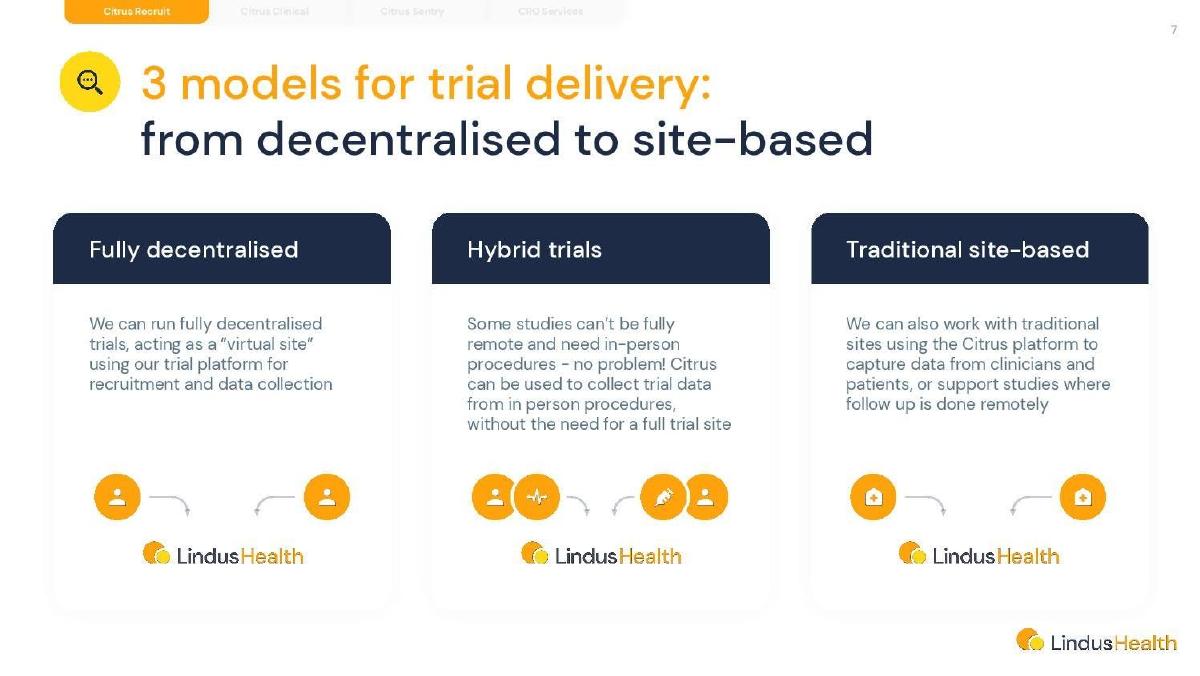
Recognizing that clinical trials are not one-size-fits-all, Slide 7 outlines three models: Fully decentralized (virtual sites), Hybrid trials (remote data collection with some in-person procedures), and Traditional site-based (using the Citrus platform to capture data at physical sites). This flexibility is a strong selling point for biotech companies that may have complex procedural requirements that cannot be fully digitized.
Slide 9: Citrus Recruit Deep Dive
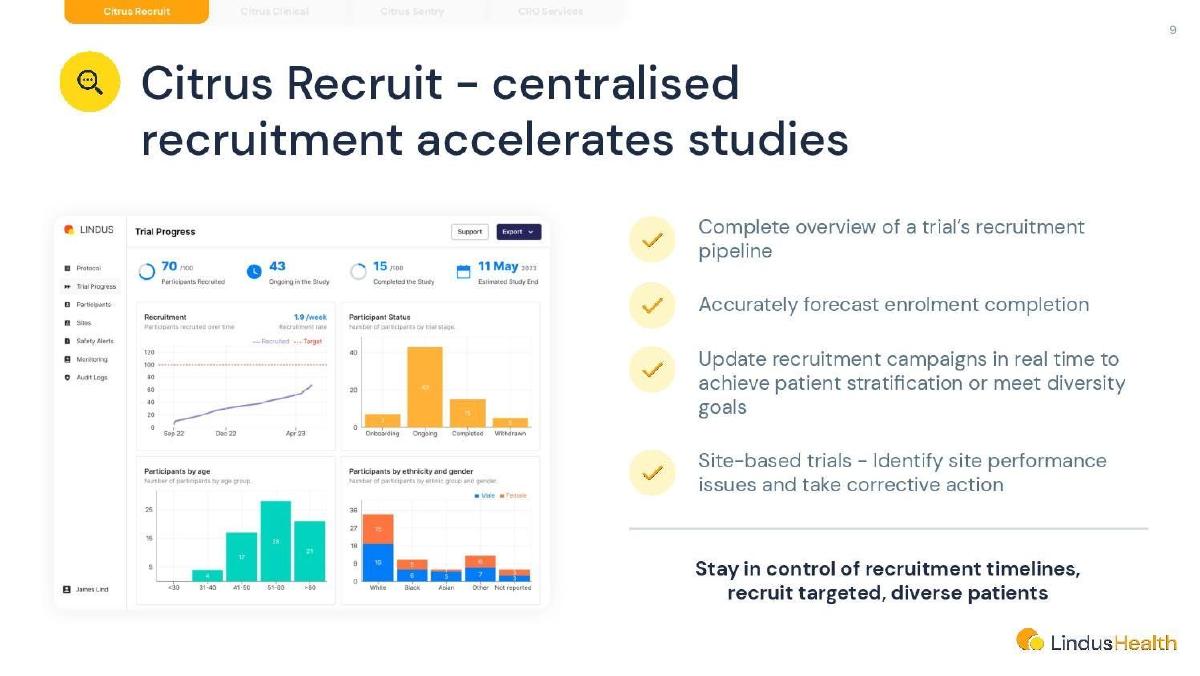
Slide 9 focuses on the recruitment bottleneck. It shows a dashboard screenshot featuring metrics like "Participants Recruited" (70/100) and "Estimated Study End." The slide lists key benefits: a complete overview of the recruitment pipeline, real-time updates to meet diversity goals, and the ability to identify site performance issues. This addresses the specific pain point of "opaque" processes mentioned on Slide 3.
Slide 11: Data and Compliance
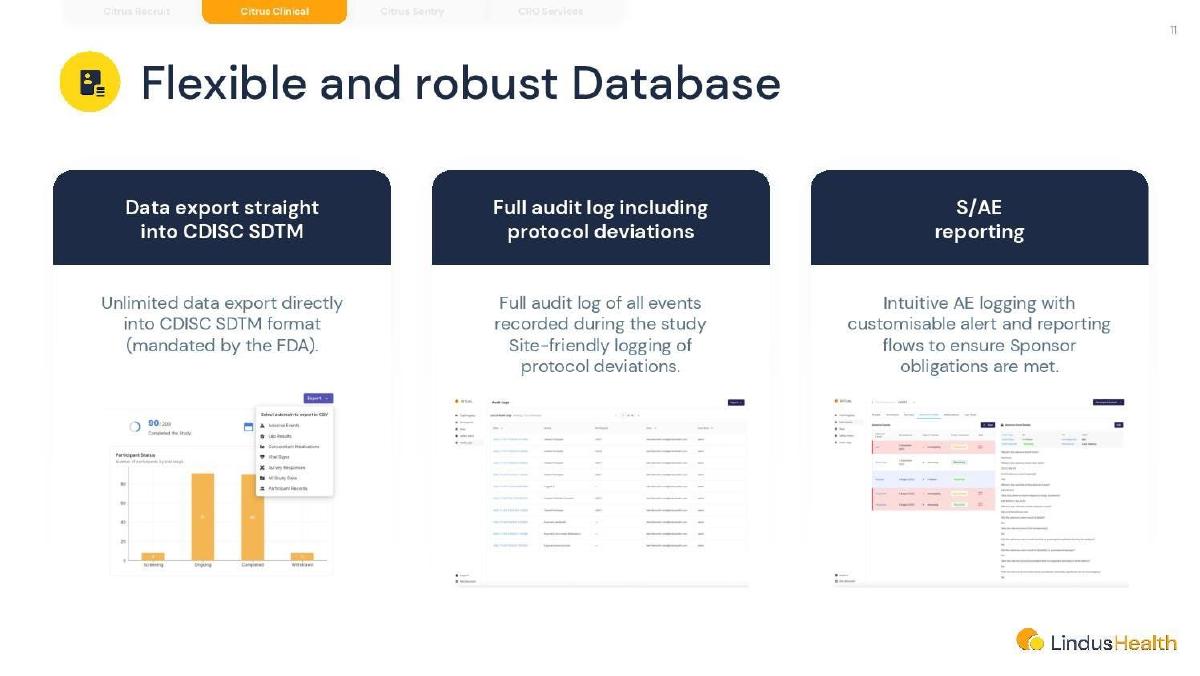
For healthcare investors, compliance is a binary check. Slide 11 addresses this head-on with the heading "Flexible and robust Database." It highlights three pillars: Data export straight into CDISC SDTM (mandated by the FDA), a full audit log including protocol deviations, and intuitive S/AE (Serious/Adverse Event) reporting. The inclusion of the FDA mandate shows the founders understand the regulatory hurdles their clients face.
Slide 13: Investigator Overhead
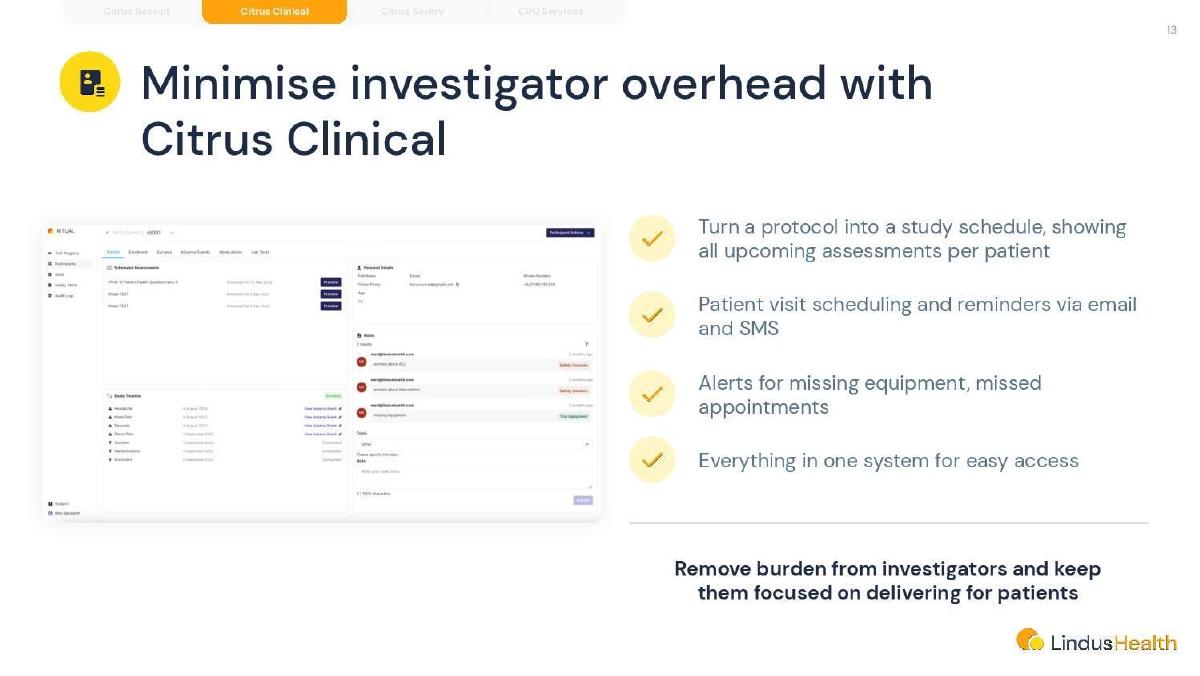
Slide 13 pivots to the "Investigator" persona. By promising to "Minimise investigator overhead," Lindus Health addresses the supply side of the clinical trial market. Features like automated study schedules, patient visit reminders via SMS/email, and alerts for missing equipment are presented as ways to "keep them focused on delivering for patients." This suggests the platform improves the experience for all stakeholders, not just the trial sponsor.
Slide 15: Additional CRO Services
To ensure they are viewed as a true end-to-end partner, Slide 15 lists the "human" services they provide alongside their tech. This includes protocol design, medical writing, feasibility studies, ethics/IRB approval, biostatistics, and medical monitoring. This slide prevents the common objection that "software can't do everything in a clinical trial." It positions the tech as the engine and the team as the expert operators.
Slide 17: The Leadership Team
The team slide is a significant strength of this deck. It features eight individuals with deep domain expertise. Notable highlights include:
Meri Beckwith (Co-Founder): Ex-VC focused on digital health. · Michael Young (Co-Founder): Former Special Adviser to the UK Prime Minister on Life Sciences. · Nik Haldimann (CTO): 15 years of experience, including Google and Benevolent AI. · Dr. Emma Ogburn (VP Clinical Ops): Formerly ran the Oxford Primary Care & Vaccine CTU. · Dr. Luke Twelves (Medical Director): Former CEO of Omnes Healthcare.
The mix of high-level government advisory, big tech engineering, and clinical leadership provides the credibility necessary to disrupt a highly regulated industry.
What Lindus Health Does Well
The deck is exceptionally strong at productizing services . By giving their software tools a name (Citrus) and showing actual dashboard screenshots, they move away from the "black box" reputation of traditional CROs. The visual design is consistent, professional, and uses a color palette that feels modern yet trustworthy. They also do a great job of citing external sources (Slide 3) to validate the problem, which grounds their pitch in market reality rather than just founder opinion.
What is Missing from the Deck
Despite the strong product and team presentation, there are several standard pitch deck elements missing from these 18 slides:
The Ask: There is no slide detailing how much capital is being raised or how it will be allocated (though publisher facts indicate a $1M seed round). · Traction and Case Studies: While they show the platform, they don't list specific trials they have completed or the names of biotech companies currently using the platform. · Market Size (TAM/SAM/SOM): There is no quantification of the total addressable market for CRO services. · Competition: The deck lacks a competitive landscape slide. While they attack "traditional CROs," they don't address other tech-enabled competitors like Science37 or Medable. · Unit Economics: There is no mention of how they charge (e.g., SaaS fees vs. project-based fees) or their margins.
Founder Takeaways
Founders in the "tech-enabled service" space should study how Lindus Health uses modular product descriptions . Instead of saying "we have a platform," they break it down into Recruit, Clinical, and Sentry. This makes the value proposition tangible. Additionally, the team slide is a model for how to highlight "pedigree"—specifically by calling out recognizable names like Google and the UK Prime Minister's office to build instant authority. Finally, the focus on regulatory compliance (Slide 11) is a must-copy for any founder in a space where the FDA or similar bodies act as gatekeepers; addressing these concerns early in the deck removes friction for specialized investors.
Frequently asked questions
- What is the primary problem Lindus Health is solving?
- Lindus Health targets the inefficiency of traditional Contract Research Organizations (CROs). According to Slide 3, 86% of clinical trials are delayed due to a reliance on manual processes, poor patient experiences, and opaque billing. They solve this by replacing manual workflows with their proprietary 'Citrus' technology platform to accelerate trial timelines.
- How does Lindus Health handle data and regulatory compliance?
- Compliance is a core focus of the deck. Slide 11 specifies that their database allows for unlimited data export directly into CDISC SDTM format, which is mandated by the FDA. They also highlight 21 CFR part 11 compliance for eConsent and maintain a full audit log of all events and protocol deviations to meet sponsor obligations.
- What are the different components of the Citrus platform?
- As shown on Slide 5, the platform consists of Citrus Recruit (feasibility and patient community), Citrus Clinical (EDC and database), and Citrus Sentry (CTMS and monitoring). These software tools are paired with traditional CRO services like protocol design, biostatistics, and medical writing to provide an end-to-end solution.
- Does the deck include financial projections or a valuation?
- No. The provided slides focus entirely on the problem, the product suite, the delivery models, and the team. There is no mention of current revenue, burn rate, projected growth, or the specific valuation sought during the seed round.
- Who are the key members of the leadership team?
- The team (Slide 17) includes Co-Founders Meri Beckwith (ex-VC) and Michael Young (former Special Adviser to the UK PM). Technical leadership is provided by CTO Nik Haldimann (ex-Google), supported by clinical experts like Dr. Emma Ogburn (Oxford Primary Care) and Dr. Luke Twelves (former CEO of Omnes Healthcare).