Linguatrip’s 2015 pitch deck is a lean, 10-slide presentation that focuses on the transition of the language travel industry from offline to online. The deck identifies a $24B annual market currently hampered by inefficient offline agents who burden customers with paperwork and extra fees. Linguatrip positions itself as the solution, offering a three-step digital booking process. The deck shines in its traction slide, reporting 50% month-over-month growth and a 4x revenue increase during their accelerator program. However, it lacks a specific financial 'ask,' a detailed competitive landscape,…
Key takeaways
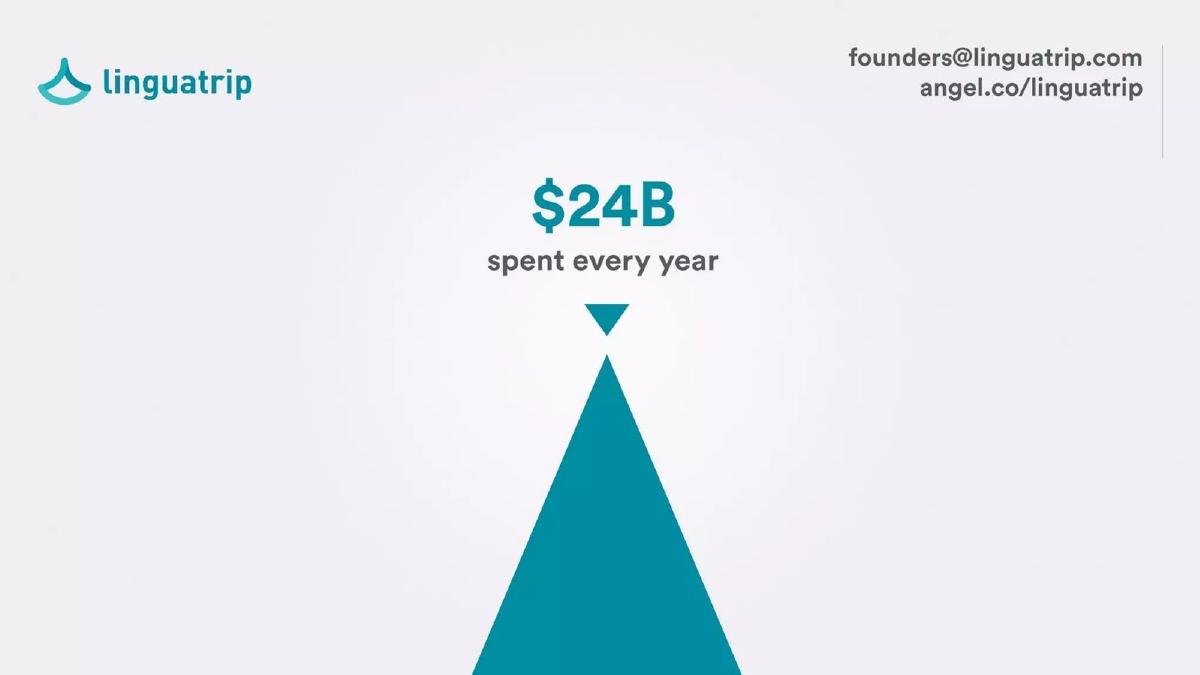
- The company identifies a $24B annual market for language travel on slide 4.
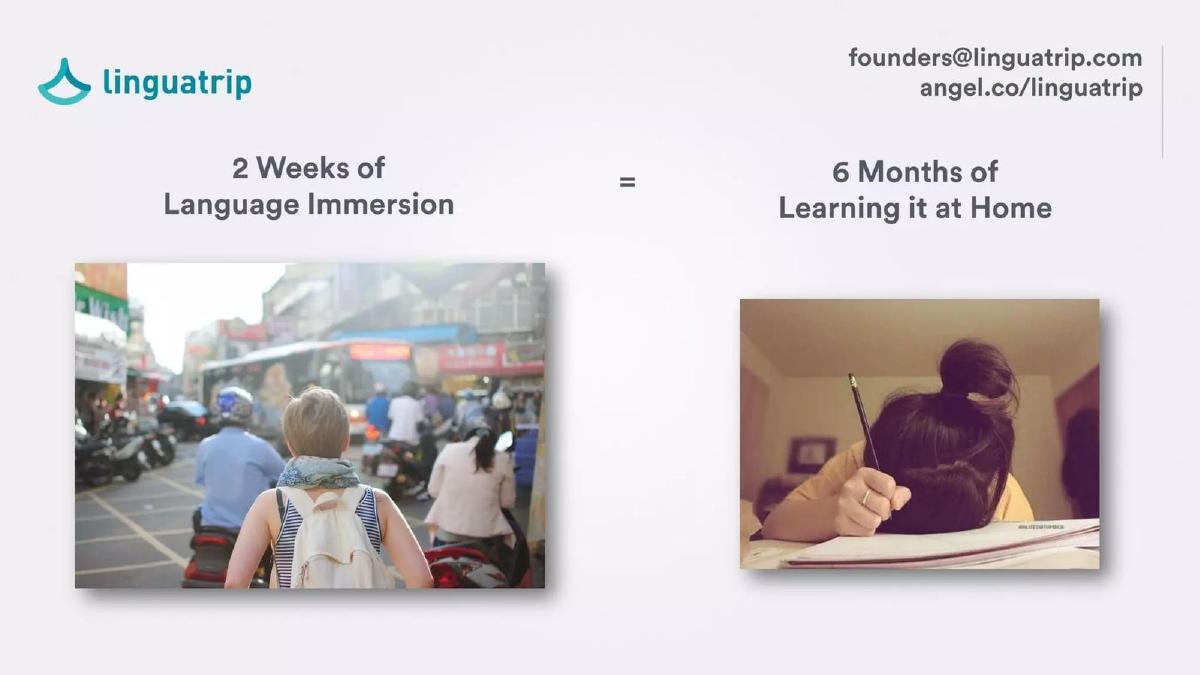
- Linguatrip claims that 2 weeks of immersion is equivalent to 6 months of learning at home on slide 3.
- The deck highlights that course providers suffer from 30% unsold inventory due to inefficient agent management on slide 6.
- The product simplifies a complex offline process into a 3-step online flow: Search, Review, and Book, as shown on slide 7.
- Traction is a core strength, with the company reporting 50% month-over-month growth on slide 8.
- The founders report they '4x-ed revenues' during their program, according to slide 8.
- The team possesses significant domain expertise, with two founders having 5 years of market experience each on slide 9.
- The deck provides an LTV figure of $400 on slide 8 but omits the corresponding Customer Acquisition Cost (CAC).
The Linguatrip Pitch Deck: A Minimalist Approach to Marketplace Disruption
Linguatrip’s 10-slide deck is a study in brevity. Produced in 2015, likely for a demo day or a seed-stage bridge, it avoids the dense text blocks common in corporate presentations. Instead, it relies on high-quality photography and bold, singular metrics to tell the story of a marketplace disrupting a legacy industry. The company positions itself as the digital bridge between language learners and immersion programs, aiming to replace the 'offline agent' model that has historically dominated the space.
The Hook: Value Proposition and Market Size
Slide 1: Title Slide The deck opens with a full-bleed lifestyle image of young travelers in an urban park setting. The branding is clean, featuring the Linguatrip logo and contact information. Notably, it includes an AngelList link, signaling the company's active fundraising status at the time.
Slide 2: The Mission Linguatrip defines itself immediately: 'Linguatrip is a marketplace where we connect language learners to language immersions abroad.' This slide uses a nighttime shot of London’s Big Ben, reinforcing the 'travel' aspect of the education product.
Slide 3: The Efficiency Argument This is the core 'Why' of the product. The slide presents a simple equation: '2 Weeks of Language Immersion = 6 Months of Learning it at Home.' By contrasting a vibrant street scene with a photo of a student slumped over a desk, Linguatrip makes an emotional and practical case for their service. It frames the product not just as a trip, but as a shortcut to fluency.
Slide 4: Market Size The deck moves to the 'How Big' question. A simple graphic shows a triangle pointing to the figure '$24B spent every year.' There is no complex breakdown of TAM, SAM, or SOM here; the goal is to establish that the industry is massive and currently underserved by modern technology.
The Problem: Friction in the Status Quo
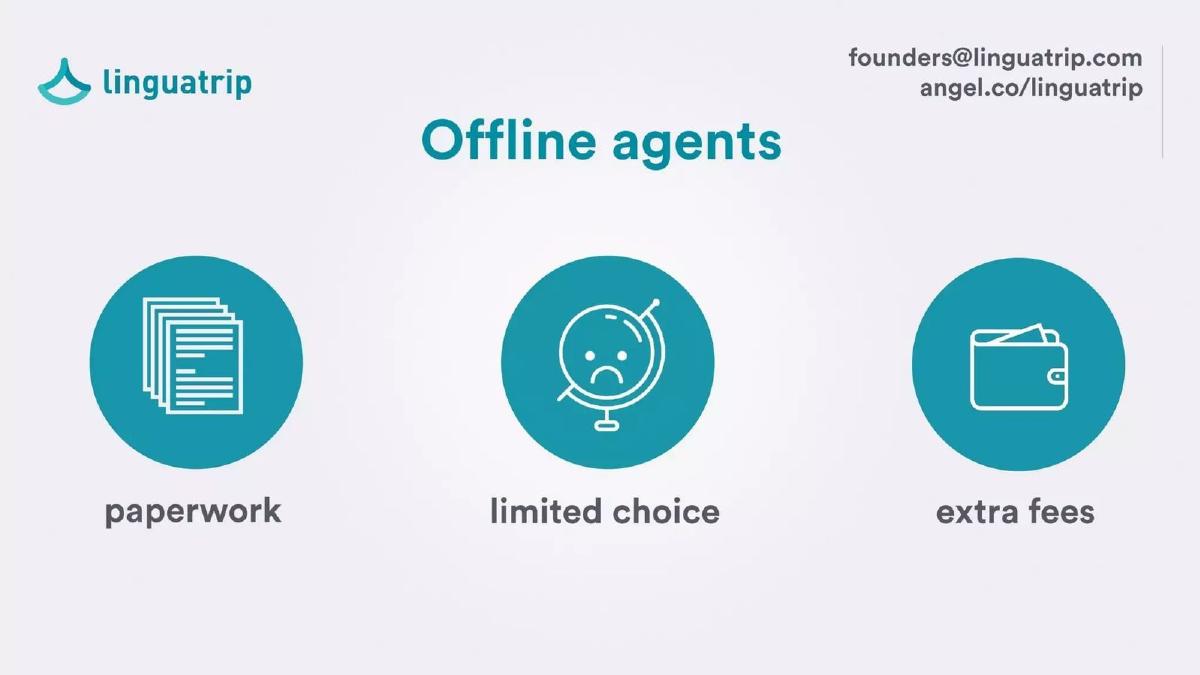
Slide 5: The Consumer Problem The deck identifies 'Offline agents' as the primary antagonist. It lists three pain points for the traveler: paperwork, limited choice, and extra fees. The use of simple icons makes the slide easy to digest in seconds, a hallmark of a deck designed for a live presentation.
Slide 6: The Provider Problem Marketplaces must solve problems for both sides. Slide 6 addresses the schools (Course Providers). It notes that these providers struggle with 'Managing Agents' and, more importantly, face '30% Unsold Inventory.' This 30% figure is a critical piece of the pitch, as it represents the immediate revenue opportunity Linguatrip can capture by providing a more efficient distribution channel.
The Solution and Traction
Slide 7: The Product Linguatrip shows a 3-step user flow: 1. Search by Country, 2. Review Immersions, 3. Book! A mockup of the website on an iMac shows a clean, Airbnb-style interface. This slide aims to prove that the complexity of the offline world has been successfully distilled into a familiar, easy-to-use digital experience.
Slide 8: Traction This is the most important slide in the deck. Against a backdrop of happy travelers, three bubbles highlight key growth metrics: '4x-ed revenues during program,' '50% MoM' (Month-over-Month growth), and '$400 LTV.' This slide provides the 'proof of work' that investors look for, showing that the model is not just theoretical but is actively scaling.
The Team and Conclusion
Slide 9: The Team The team slide features the three founders: Marina Mogilko, Dmitrii Pistoliako, and Dmitrii Kravchuk. The deck highlights their specific roles and experience. Mogilko and Pistoliako are noted for having '5 years in the market,' suggesting they didn't just stumble into this idea but have deep industry roots. Kravchuk is positioned as the technical foundation with '8 years of coding.'
Slide 10: Closing The deck ends with a minimalist closing slide featuring the logo and contact details. There is no specific call to action or 'Ask' amount on this slide, which is a missed opportunity to create urgency, though it maintains the clean aesthetic of the rest of the presentation.
What Works in the Linguatrip Deck
Clarity of Purpose: Within the first two slides, any investor knows exactly what Linguatrip does. They are a marketplace for language travel. There is no jargon or 'AI-powered' fluff.
Strong Visual Contrast: Slide 3 is particularly effective. By visually and textually comparing the 'pain' of home study with the 'gain' of immersion, they create a compelling reason for the product to exist. This is a classic marketing technique that works well in venture decks.
Focus on Supply-Side Pain: Many marketplace decks focus only on the consumer. By highlighting the 30% unsold inventory for course providers on slide 6, Linguatrip shows they understand the economics of their partners. This suggests a sustainable path to acquiring supply.
Momentum: The traction slide (Slide 8) uses '4x revenue' and '50% MoM' to create a sense of an accelerating 'rocket ship.' For a seed-stage company, these growth rates are often more important than the absolute dollar amounts.
What Is Missing from the Linguatrip Deck
The Ask: The most glaring omission is the lack of a fundraising ask. Investors need to know how much the company is raising, what the valuation expectations are (or if it's a convertible note/SAFE), and specifically how the new capital will be deployed to hit the next set of milestones.
Competitive Landscape: The deck mentions 'offline agents' as the competition, but it ignores other online players or indirect competitors like Duolingo or Rosetta Stone. A 'Competitor Matrix' would have helped define Linguatrip’s unique moat.
Unit Economics: While an LTV of $400 is provided on slide 8, it is meaningless without a CAC (Customer Acquisition Cost). If it costs $500 to acquire a customer with a $400 LTV, the business is not viable. Including a CAC or a contribution margin per booking would have added significant weight to the financial argument.
Geographic Focus: The deck mentions 'Search by Country' but doesn't specify which markets Linguatrip is currently active in or where they plan to expand. Given the logistical challenges of international travel, a roadmap of geographic expansion is a standard expectation.
What a Founder Should Copy
The 3-Step Solution: Slide 7 is a perfect example of how to present a product. Don't list fifty features; show the three steps it takes for a user to get value. This demonstrates product-led thinking.
Founder-Market Fit: The way the team slide (Slide 9) emphasizes 'years in the market' is excellent. If you have industry experience, don't just list your previous job titles—list the number of years you've spent obsessing over the specific problem you are now solving.
High-Quality Imagery: Linguatrip uses photography to sell a lifestyle. For any B2C or 'passion' marketplace (travel, hobbies, fitness), the deck should feel like the product. This deck feels like a travel experience, which helps the investor buy into the vision.
The 'Equation' Slide: Using a simple mathematical comparison (2 weeks = 6 months) to explain your value proposition is a powerful way to make a claim stick in an investor's mind. It’s a 'sticky' fact that is easy to repeat during partner meetings.
Frequently asked questions
- What is the primary problem Linguatrip is solving?
- Linguatrip targets the inefficiencies of the traditional language travel market. According to slides 5 and 6, the industry is dominated by offline agents who create excessive paperwork, offer limited choices, and charge extra fees. Furthermore, course providers struggle with a 30% unsold inventory rate because they rely on these manual, fragmented agent networks to fill their classrooms.
- How does Linguatrip quantify its market opportunity?
- The deck identifies the market size as $24B spent every year on slide 4. While it doesn't provide a bottom-up build of this number, the accompanying catalogue description notes that this includes both language courses abroad and student accommodation, suggesting a broad Total Addressable Market (TAM) within the travel and education sectors.
- What traction did Linguatrip have at the time of this deck?
- Linguatrip showed significant early momentum on slide 8. They reported 50% month-over-month (MoM) growth and stated they quadrupled their revenue during their accelerator program. They also listed a Lifetime Value (LTV) of $400, though the deck does not specify the timeframe or volume of users used to calculate this metric.
- Who are the founders and what is their background?
- The team consists of three founders shown on slide 9: Marina Mogilko (Operations/Marketing), Dmitrii Pistoliako (Strategy/Product), and Dmitrii Kravchuk (Tech). Mogilko and Pistoliako each bring 5 years of market-specific experience, while Kravchuk is credited with 8 years of coding experience. This suggests a high level of founder-market fit.
- What is missing from the Linguatrip pitch deck?
- The deck is missing several standard fundraising components. There is no 'Ask' slide (specifying dollar amount or terms), no detailed competitive analysis, and no financial projections. Additionally, while it mentions an LTV of $400, it lacks unit economics like CAC or payback period, which are critical for evaluating a marketplace business.