Lines, a Web3 messaging startup, secured $4 million in seed funding in 2024 with a minimalist 7-slide deck. Led by solo capitalist Elad Gil, the round supported a platform designed to bridge the gap between decentralized wallets and social communication. The deck identifies a specific market gap—82 million wallet users with no native way to communicate—and proposes a cross-chain solution that integrates with existing platforms like Discord and Telegram. By focusing on 'social graphs from on-chain transactions,' Lines positions itself as more than just a chat app, but as an identity layer for…
Key takeaways
- The deck identifies a total addressable market starting point of 82 million wallet users who currently lack native communication tools (Slide 2).
- Lines positions itself as a central hub connecting disparate ecosystems including MetaMask, Discord, Telegram, and Kraken (Slide 3).
- The product strategy involves uncovering social graphs specifically from on-chain transactions and digital ownership (Slide 3).
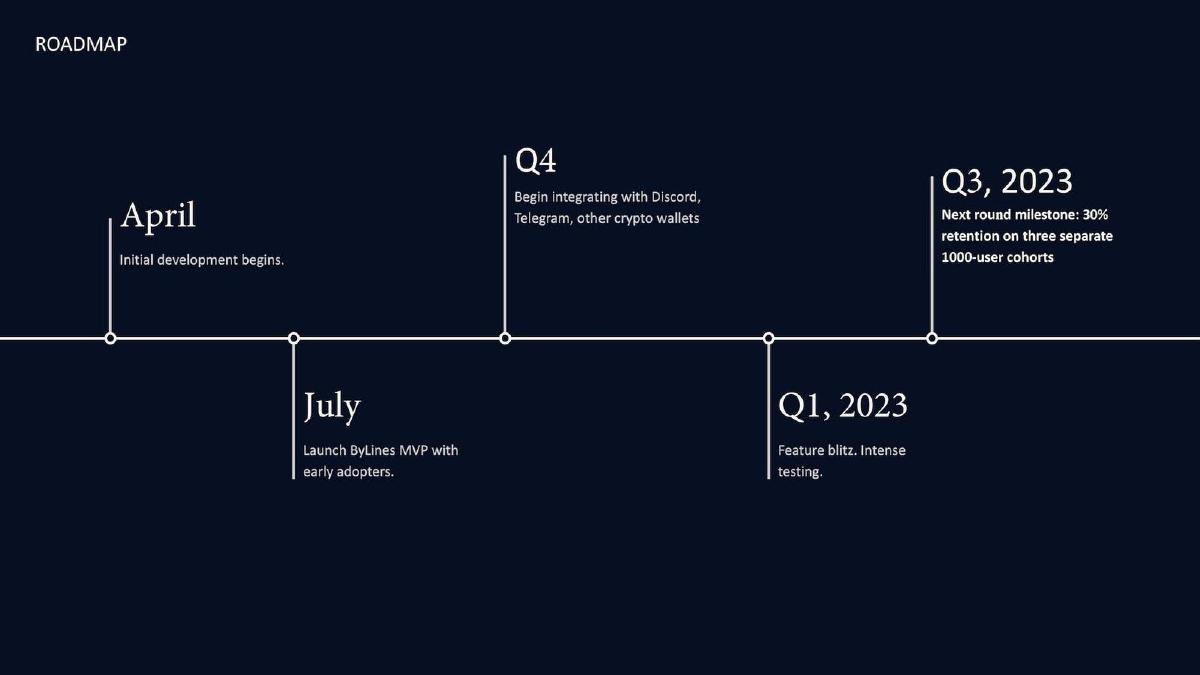
- The roadmap sets a specific performance target of 30% retention across three separate 1000-user cohorts for its next round milestone (Slide 5).
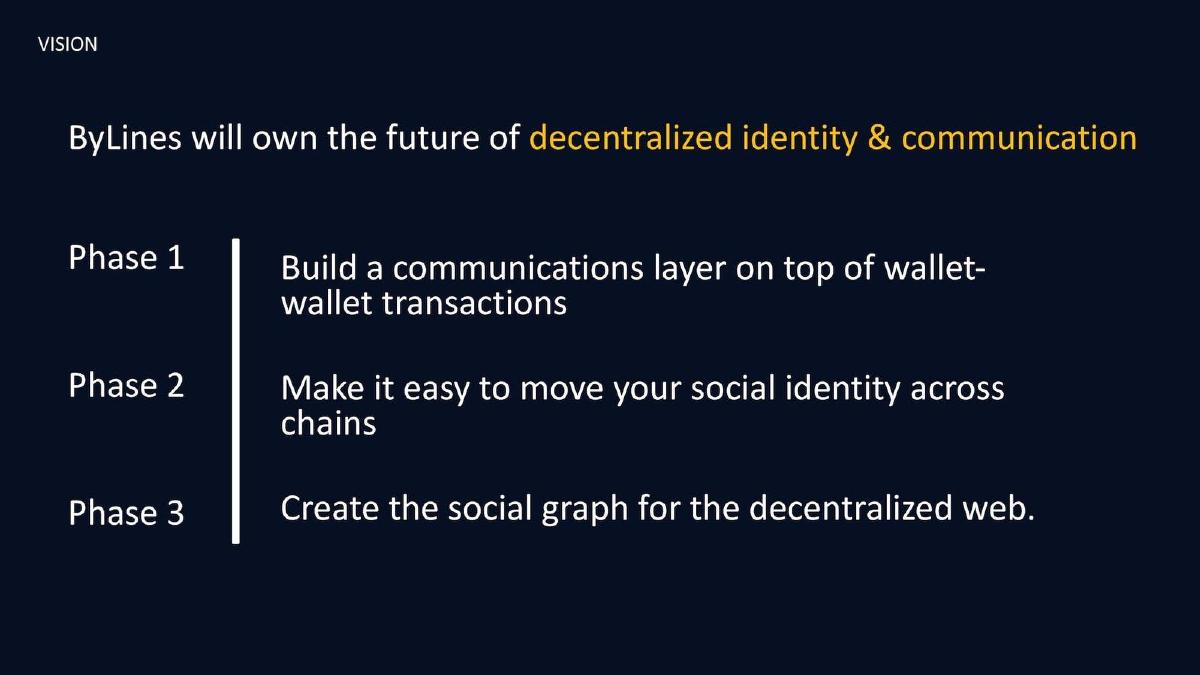
- The long-term vision is structured in three phases, moving from a communication layer to a cross-chain social identity and finally a full decentralized social graph (Slide 6).
- The founding team highlights significant academic and professional pedigree, including Harvard degrees and experience at the NSA and Cisco (Slide 7).
- CEO Sahil Handa cites prior success in consumer growth, specifically growing a newsletter to 50k readers in one week (Slide 7).
- The deck entirely omits a business model, revenue projections, or a specific funding 'ask' slide.
The Power of Brevity in Web3 Fundraising
The Lines pitch deck is a testament to the 'less is more' philosophy in early-stage fundraising. With only seven slides, the company managed to secure $4 million from one of the most prominent solo capitalists in the industry, Elad Gil. The deck does not get bogged down in the technical minutiae of blockchain protocols; instead, it focuses on a glaring utility gap in the market: the inability for 82 million wallet holders to talk to each other. By framing the solution as a 'cross-chain communications platform,' Lines positions itself as the connective tissue for the next generation of the internet.
Slide 1: Title and Tagline
The cover slide is minimalist, featuring the brand name 'BYLINES' (which appears to have been shortened to 'Lines' in subsequent reporting) and the clear value proposition: 'Web3.0 Messaging: Encrypted wallet-to-wallet chat.' The use of an arrow graphic suggests movement and progress. It establishes the sector (Web3) and the primary function (Messaging) immediately, ensuring the investor knows exactly what category this startup occupies before turning the page.
Slide 2: The Problem
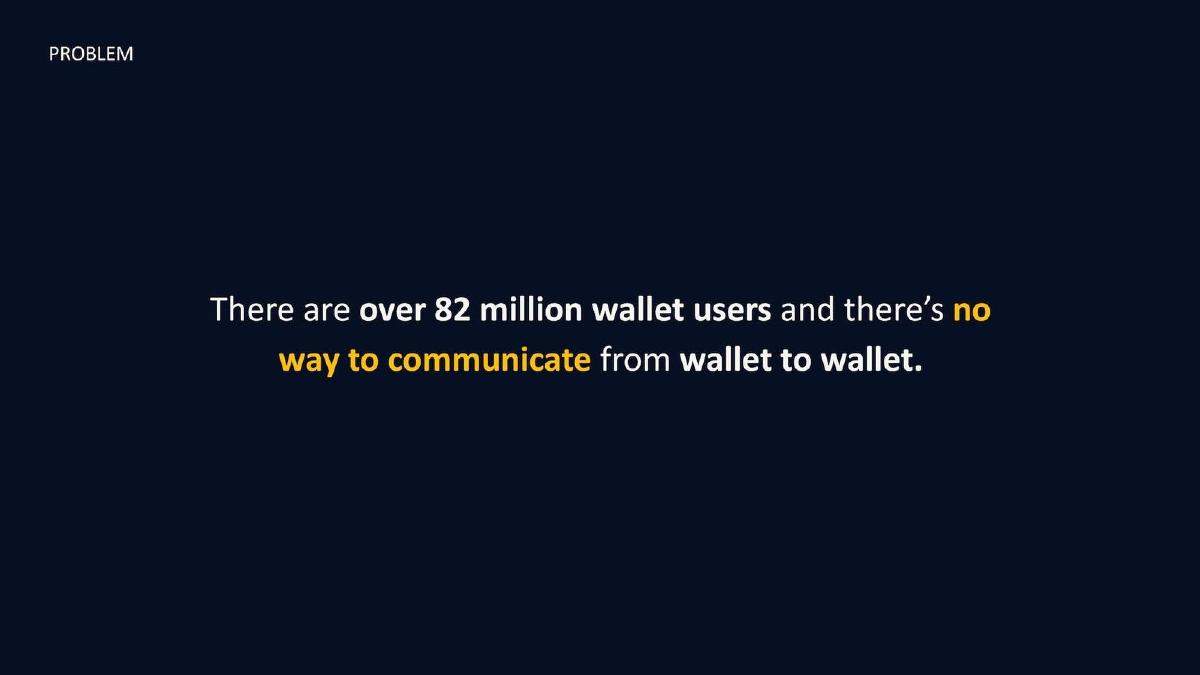
Slide 2 presents a single, punchy statistic: 'There are over 82 million wallet users and there’s no way to communicate from wallet to wallet.' This is a classic 'gap in the market' slide. It quantifies the potential user base and identifies a fundamental lack of functionality. By highlighting 'no way to communicate' in yellow, the founders emphasize the pain point they intend to solve. It is a broad but effective way to establish the Total Addressable Market (TAM) without using a traditional pyramid chart.
Slide 3: The Solution and Ecosystem
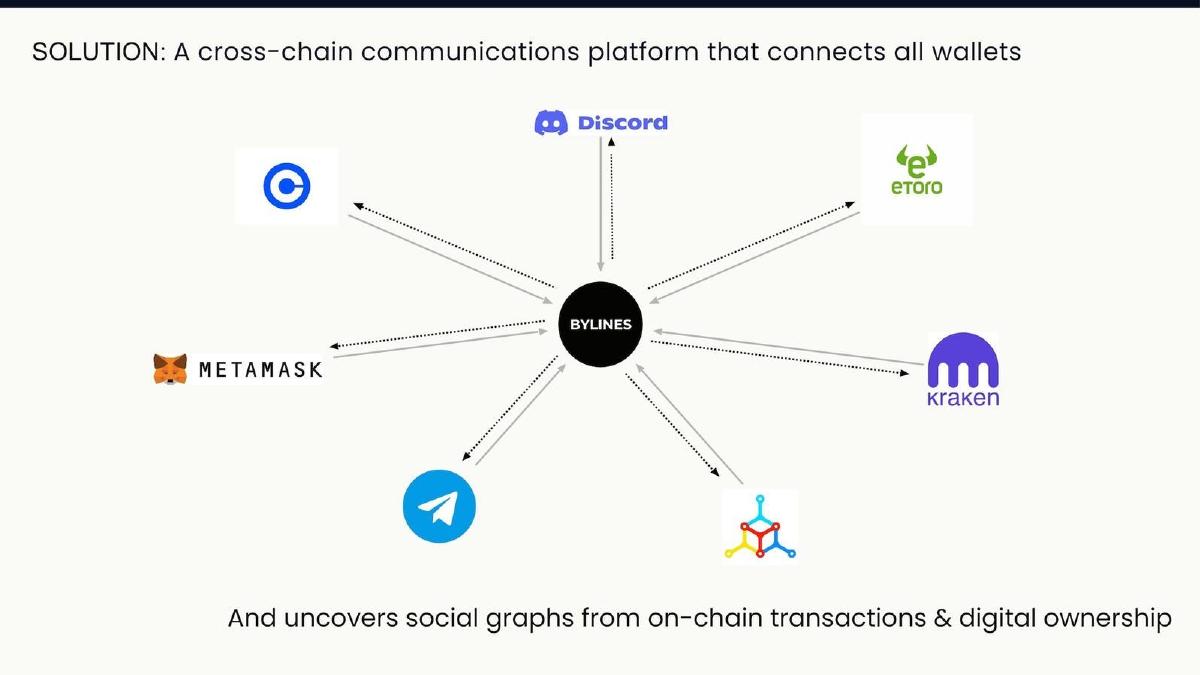
The solution slide uses a hub-and-spoke diagram to show how Lines (referred to here as BYLINES) sits at the center of the Web3 ecosystem. It shows bidirectional connections to MetaMask, Coinbase, Discord, eToro, Kraken, and Telegram. The text at the bottom, 'And uncovers social graphs from on-chain transactions & digital ownership,' is the most important part of this slide. It signals that Lines isn't just a UI for chat; it is a data play that leverages public ledger data to map relationships between users.
Slide 4: Product Mockups
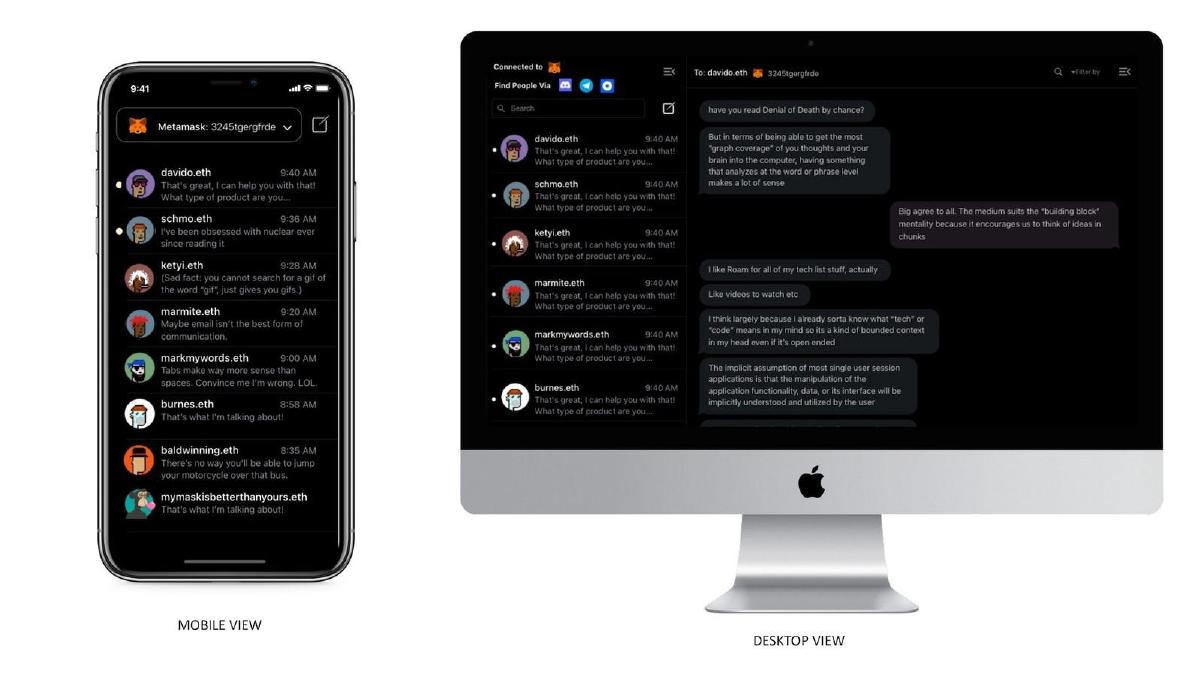
This slide provides visual proof of the concept. It features a 'Mobile View' and a 'Desktop View.' The UI is dark-themed and familiar, mimicking the layout of successful Web2 messaging apps. However, the user list is populated with ENS (Ethereum Name Service) handles like 'davido.eth' and 'burnes.eth.' This demonstrates that the product is designed specifically for the crypto-native user, integrating wallet identities directly into the chat interface. The presence of a desktop view suggests a robust, cross-platform approach rather than a simple mobile utility.
Slide 5: The Roadmap
The roadmap is unusually specific for a seed-stage deck. It tracks progress from 'Initial development' in April to a 'Next round milestone' in Q3 2023. The most impressive detail here is the commitment to a specific metric: '30% retention on three separate 1000-user cohorts.' This gives investors a concrete way to measure success and shows that the founders are thinking about growth and stickiness, not just user acquisition. The inclusion of a 'Feature blitz' and 'Intense testing' in Q1 2023 indicates a transition from MVP to a more polished product.
Slide 6: The Vision
Slide 6 expands the scope of the project. It moves from a simple chat app to a 'decentralized identity' play. The vision is broken into three phases: building the communication layer, enabling social identity across chains, and finally creating the 'social graph for the decentralized web.' This slide is designed to show 'venture scale.' It tells the investor that while they are starting with chat, the ultimate goal is to own the underlying infrastructure of how people interact in Web3.
Slide 7: The Team ('Why Us?')
The final slide focuses on the pedigree of the founders. Sahil Handa (CEO), David Grant (CTO), and Eli Burnes (VP of Eng) all share a common thread: Harvard. The slide highlights a mix of academic excellence (Philosophy, CS, Physics) and practical experience (NSA, Cisco, Rackspace). Sahil Handa’s mention of growing a newsletter to 50k readers in a week provides evidence of 'growth hacking' ability, while the technical backgrounds of Grant and Burnes suggest they can handle the 'very difficult data problems' mentioned in the footer. The claim of having spent 'three years building successful online communities & DAOs' adds industry-specific credibility.
What Works in the Lines Deck
The primary strength of this deck is its clarity of purpose . Within seven slides, the reader understands the problem, the solution, what the product looks like, how they will measure success, and who is building it. The roadmap specificity (Slide 5) is a standout feature; most seed decks use vague terms like 'Scale' or 'Growth,' but Lines commits to a retention percentage, which builds significant trust with data-driven investors.
Furthermore, the positioning as an identity layer (Slide 6) is a smart strategic move. In the crowded messaging space, 'just another chat app' is a hard sell. By framing the product as a way to 'own the future of decentralized identity,' the founders elevate the company from a utility to a platform. This is essential for justifying a $4 million seed round in a competitive market.
What is Missing from the Lines Deck
The most notable omission is a Business Model or Monetization slide . There is no mention of how Lines intends to generate revenue. While common in early-stage social media or infrastructure plays where user growth is prioritized over immediate cash flow, it remains a significant question for long-term sustainability.
There is also no Competitor Analysis . The Web3 messaging space is highly competitive, with projects like XMTP, Lens Protocol, and Farcaster all vying for similar territory. By omitting a slide on the competitive landscape, the founders avoid direct comparisons but leave the investor to do their own research on how Lines differentiates itself from existing protocols. Finally, there is no Ask Slide detailing how the $4 million will be spent, though this information is often handled in the verbal pitch or a separate deal sheet.
Founder's Playbook: What to Copy
Quantify the Gap: Use a single, large-scale statistic to define your problem (Slide 2). If you can show millions of users are missing a basic feature, the need for your product becomes self-evident. · Define Success Metrics Early: Don't just say you will 'grow.' Define what a successful cohort looks like (Slide 5). This shows you understand your unit economics and user behavior. · Phase Your Vision: Start with a narrow, solvable problem (Phase 1) and show how it leads to a massive, market-dominating position (Phase 3). This makes a big vision feel achievable (Slide 6). · Leverage Pedigree: If your team has elite academic or professional backgrounds, put them front and center. In early-stage investing, the 'who' is often more important than the 'what' (Slide 7). · Show, Don't Just Tell: Even if the product is in early stages, high-quality mockups (Slide 4) help investors visualize the user experience and the team's design sensibility.
Frequently asked questions
- How much did Lines raise with this deck?
- As reported by Business Insider, Lines raised $4 million in a seed round in 2024. The round was led by solo capitalist Elad Gil. The deck itself does not state the amount being raised or the valuation, which is common for decks shared after a round closes or for highly sought-after seed rounds.
- What is the core problem Lines is solving?
- According to Slide 2, the problem is the lack of communication infrastructure for the 82 million existing crypto wallet users. While these users hold assets and perform transactions, there is no native, encrypted way to message wallet-to-wallet without moving to centralized platforms like Twitter or Discord.
- Who are the founders of Lines?
- The team consists of Sahil Handa (CEO), David Grant (CTO), and Eli Burnes (VP of Eng). All three founders have backgrounds at Harvard. Their experience spans philosophy, computer science, and physics, with professional stints at the NSA, Cisco, and Rackspace, as detailed on Slide 7.
- Does the deck show a working product?
- Slide 4 displays high-fidelity mockups of both a 'Mobile View' and a 'Desktop View.' The interface resembles a modern chat application (like Slack or Telegram) but uses .eth handles (e.g., davido.eth, schmo.eth) as the primary user identifiers, demonstrating the wallet-native nature of the app.
- What are the key milestones in the Lines roadmap?
- The roadmap on Slide 5 outlines a progression from initial development in April to an MVP launch in July. It targets Q4 for integrations with Discord and Telegram, followed by a 'feature blitz' in Q1 2023. A critical milestone for the next round is achieving 30% retention in three 1000-user cohorts by Q3 2023.