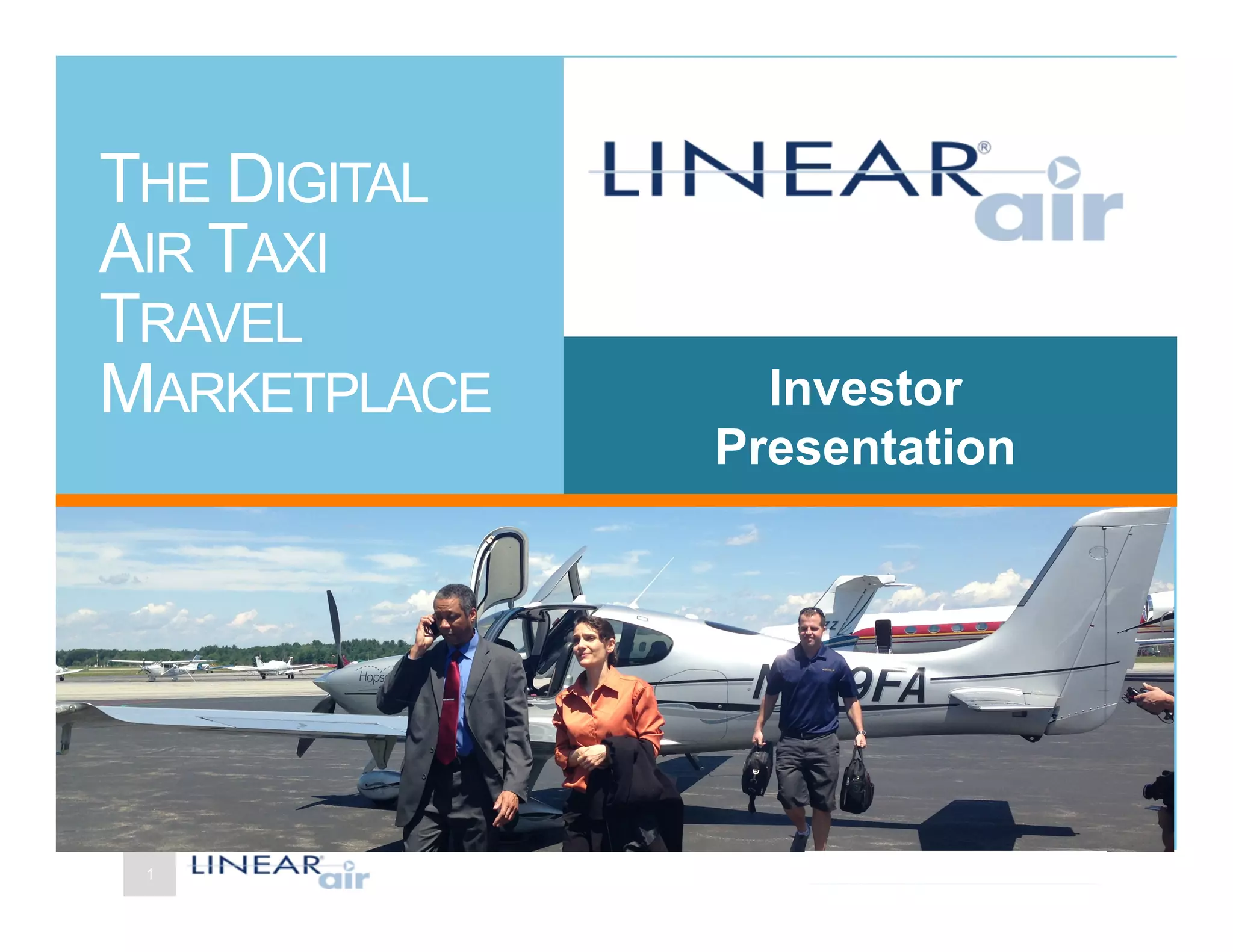
Linear Air positions itself as a digital marketplace for the air taxi industry, aiming to solve the inefficiencies of regional travel. By connecting passengers directly with operators of small aircraft like the Cirrus, they seek to offer a 'pleasant' alternative to 'painful' commercial airlines. The deck highlights a transition from manual booking to a mobile-first app ecosystem for both customers and operators. Notably, the presentation includes a highly specific Series B terms slide, citing a $4.66 million pre-money valuation and a maximum offering of $3.5 million. While the team boasts sig…
Key takeaways
- The company defines itself as 'The Digital Air Taxi Travel Marketplace' on slide 1, signaling a platform-based business model.
- Linear Air emphasizes a shift from email and web-based booking to a mobile app rollout for both customers and operators on slide 4.
- The management team includes founders of e-Dialog and Midnight Networks, with advisors like Clayton Christensen and Santo Politi of Spark Capital as shown on slide 7.
- Slide 10 contrasts traditional airlines as 'painful' and 'hub-to-hub' against air taxis which are 'pleasant' and 'point-to-point'.
- The marketplace offers 'Quickbooks integration' and 'cash management' as specific incentives for aircraft operators on slide 13.
- Linear Air claims a competitive advantage by having 'no upfront fees' and 'no aircraft ownership risk' compared to other providers on slide 16.
- The competitive landscape on slide 19 positions Linear Air at the top of the 'Digital Marketplace Platform' axis, above Blade and ImagineAir.
- Slide 25 provides exact Series B terms: a $4.66 million pre-money valuation and a $1.30 price per unit for preferred equity.
Executive Summary: The Uber of the Skies?
Linear Air presents itself as a digital solution to the perceived failures of regional commercial aviation. By leveraging a marketplace model, the company avoids the heavy capital expenditures associated with owning a fleet of aircraft, instead focusing on the software layer that connects travelers with existing small-plane operators. The deck is structured to move from the high-level vision of 'Air Taxi' travel to the specific technical and financial mechanics of their platform.
Slides 1-4: The Digital Transition
Slide 1 establishes the brand identity: 'The Digital Air Taxi Travel Marketplace.' The imagery of a Cirrus aircraft and business travelers sets a professional, high-end tone. Slide 4 is a critical product slide titled 'App Feature Rollout.' It shows two interfaces: a Customer App and an Operator App. The primary value proposition here is the transition from 'existing email/web-based' processes to a mobile-first experience. For customers, this means real-time booking and trip management. For operators, it involves a streamlined 'Trip Acceptance' process. The inclusion of a specific trip offer (#1371829) with a price of $4283.13 on the operator screen suggests the platform handles significant transaction volumes.
Slide 7: A Heavyweight Team and Advisory Board
The 'Team' slide is one of the strongest in the deck. CEO William Herp is credited with founding e-Dialog, which was sold to GSI. The management team is balanced with technology and marketplace expertise. However, the 'Advisors' section is particularly notable. It lists Clayton Christensen, the renowned Harvard Business School professor and author of 'The Innovator’s Dilemma,' and Santo Politi, a General Partner at Spark Capital. Having an investor from a top-tier firm like Spark Capital on the advisory board provides significant institutional credibility to a Series B pitch.
Slides 10-13: The Problem and the Marketplace Solution
Slide 10, 'Air Taxi: The Time is Now,' uses a classic 'Us vs. Them' table. It characterizes airlines as 'Painful,' 'Hub-to-Hub,' and 'Antiquated,' while positioning Air Taxi as 'Pleasant,' 'Point-to-Point,' and 'Cutting Edge.' While effective for storytelling, it lacks data on the actual time saved or the cost delta for the average traveler. Slide 13 dives into the 'Frictionless' nature of the marketplace. It lists specific features for operators that go beyond just booking, such as 'Cash management' and 'Quickbooks integration.' This suggests Linear Air is attempting to become the operating system for small aviation companies, not just a lead generation source.
Slides 16-19: Competitive Positioning
Slide 16, 'A Better Solution,' compares Linear Air to 'Others.' The key differentiators claimed are 'FAA approved,' 'No upfront fees,' and 'No aircraft ownership risk.' The mention of 'Attractive per seat pricing' is a hint at their revenue model, though the exact take rate is not disclosed on this slide. Slide 19 provides a competitive matrix. Linear Air places itself at the top right, claiming superior 'Digital Marketplace Platform' capabilities and 'Air Taxi Know How.' It identifies Blade, Airpooler, Flytenow, and ImagineAir as competitors. Interestingly, it positions Blade as having high marketplace platform capability but lower 'Air Taxi Know How' than Linear Air.
Slides 22-25: The Ask and Financial Terms
Slide 22 serves as a transition to the 'Financials and Fund Raising' section, though the specific 'Projections' and 'Use of Proceeds' slides are not included in this 10-slide sample. Slide 25 is the most data-dense slide, titled 'Series B Terms.' It explicitly states a $4.66 million pre-money valuation. The round seeks between $1.5 million and $3.5 million in Preferred Equity. A $25,000 minimum investment size suggests they may be open to smaller checks or individual angel participation alongside institutional leads.
Slide 28: Regional Focus and Go-to-Market
The final slide in the sample focuses on a specific use case: 'Hail an Air Taxi to Martha's Vineyard.' It highlights the Northeast regional market and emphasizes the 'no crowds, no security lines' aspect of the service. This slide acts as a landing page mock-up, reinforcing the 'easy, pleasant experience' narrative established earlier in the deck.
What Linear Air Does Well
The deck excels at defining a clear, two-sided marketplace. By showing the app interface for both the passenger and the operator, the founders demonstrate they understand the friction points on both sides of the transaction. The team slide is exceptionally strong, leveraging the reputations of well-known business theorists and venture capitalists to build trust. Furthermore, the inclusion of a specific terms slide (Slide 25) is a bold move that provides immediate clarity to potential investors regarding the valuation and structure of the deal.
What Is Missing from the Deck
While the vision and team are clear, this 10-slide selection omits several crucial metrics. There is no mention of Customer Acquisition Cost (CAC) or Lifetime Value (LTV), which are vital for a marketplace business. We see a 'Projections' header on slide 22, but the actual data is missing from the sample. Additionally, while the deck mentions 'Attractive per seat pricing,' it does not explain the unit economics—how much Linear Air keeps from each $4,000+ flight. There is also no mention of the regulatory hurdles or insurance requirements that often plague the air taxi industry, which would be a primary concern for a Series B investor.
Founder Takeaways: Copy These Moves
Specific Terms: If you have a lead investor or a set valuation, including a 'Terms' slide like Slide 25 can save time and filter for serious investors. · Dual-Sided Product Views: When building a marketplace, show the UI for both the buyer and the seller. It proves you are building a complete ecosystem, not just a storefront. · Value-Add for Suppliers: Linear Air doesn't just offer operators 'more flights'; they offer 'Quickbooks integration' and 'Cash management.' Solving administrative pain for your suppliers is a great way to ensure retention. · Visual Contrast: The use of side-by-side imagery (Slide 10) to contrast the 'pain' of the status quo with the 'pleasure' of your solution is a classic but effective persuasion tactic.
Frequently asked questions
- What is Linear Air's core business model?
- Linear Air operates as a digital marketplace connecting passengers with air taxi operators. According to slide 16, they avoid aircraft ownership risk, focusing instead on providing a platform for real-time booking, online quotes, and secure payments. They provide value to operators through business analytics and decreased hands-on administrative time, as detailed on slide 13.
- Who are the key people behind Linear Air?
- The team is led by CEO William Herp, who previously founded e-Dialog. The management includes Peter Schmidt (Senior Technology Advisor), Scott Healy (Senior Marketplace Advisor), and Melissa O'Shea (VP Sales & Ops). The advisory board features high-profile names such as Harvard Professor Clayton Christensen and Spark Capital General Partner Santo Politi, as listed on slide 7.
- How does Linear Air differentiate itself from commercial airlines?
- Linear Air uses slide 10 to frame commercial airlines as antiquated and time-consuming. They pitch the air taxi experience as a 'point-to-point' service that uses regional airports to optimize travel duration. The visual comparison shows a crowded airline cabin versus a private, two-passenger Cirrus aircraft cabin to emphasize comfort and exclusivity.
- What are the specific terms of the funding round mentioned?
- Slide 25 outlines a Series B round with a minimum offering of $1.5 million and a maximum of $3.5 million. The pre-money valuation is set at $4.66 million, with a price per unit of $1.30. The security type offered is Preferred Equity, and the minimum investment size is $25,000.
- What technology is Linear Air developing?
- The company is focused on a mobile feature rollout for both sides of its marketplace. Slide 4 illustrates a Customer App for booking and trip management, and an Operator App for trip acceptance and passenger check-in. The goal is to transition away from manual, email-based processes to a frictionless digital environment.