Should your ask slide give a minimum investment, and what else does an investor need beside it?
Minimum Investment on the Ask Slide: Say the Smallest Cheque, What It Buys and How Many Investors Fit
Some founders raising from angels, friends and family or the crowd put a minimum investment on the ask slide: '$2,500 minimum', 'Minimum Investment Size $25,000'. It is a practical line. It tells a reader whether they can take part at all, and it helps the founder avoid a cap table with dozens of tiny holdings. But on its own, a minimum answers only one question. An investor reading it also wants to know what that cheque buys, how many investors the round can hold, and whether the minimum differs by type of investor. This guide looks at four slides that state a minimum and shows which surrounding details make it useful.
TL;DR
If you set a minimum, state it next to the terms that let an investor work out what it buys: the round size, the instrument, and the price, valuation or cap. Linear Air does this most completely: 'Minimum Investment Size $25,000' sits in a table with 'Minimum Offering $1.5 million', 'Maximum Offering $3.5 million', 'Price per Unit $1.30' and 'Pre-Money Valuation $4.66 million', so a reader can calculate that $25,000 buys about 19,230 units, roughly 0.3% to 0.4% of the company depending on the final raise. Paper puts a '$2,500 minimum' among SAFE terms with a '$5 million cap'. IGT Financial Services sets different minimums for angels (INR 25 lakh, about USD 38,000) and institutions (INR 150 lakh, about USD 230,000). MySwimPro starts at '$500' and ties extra rights to larger cheques, including pro-rata rights at $25,000. Give the minimum with the terms beside it, and say why it is set where it is.
Four ask slides that state a minimum investment
Each slide is read at full size. Quotes are exact; calculated figures are our arithmetic from the slide.
Linear Air ask slide — slide 25
Regional air charter marketplace. Terms table for a preferred equity round.
Linear Air deck, slide 25. Exact stored slide matched to this analysis.
Our analysis: Every figure needed to value the minimum cheque is on one slide.
Evidence and limitation: About 19,230 units; roughly 0.31% to 0.41% of the company depending on the raise, by our arithmetic.
What a founder can adapt: Add the reason for the minimum and which terms may change.
Supporting analysis
What the deck claims: "Minimum Investment Size $25,000" with "Minimum Offering $1.5 million", "Maximum Offering $3.5 million", "Price per Unit $1.30", "Pre-Money Valuation $4.66 million".
Presentation choice: Shows the minimum in context with price, valuation and round range.
When it does not fit: 'Subject to change' with no indication of what.
What each slide lets an investor work out about the minimum
Whether the minimum comes with the figures needed to value it.
Example
Minimum
Round size
Price, valuation or cap
Instrument
By investor type
Extra rights
Linear Air
$25,000
$1.5–3.5 million
Yes (price and pre-money)
Preferred equity
No
No
Paper
$2,500
$100,000 CAD
Yes ($5 million cap)
SAFE
No
No
IGT Financial
INR 25 lakh / 150 lakh
INR 15 Cr
No
Equity
Yes
No
MySwimPro
$500
Not on slide
Not on slide
Not on slide
No
Pro-rata at $25,000
Key Takeaways
Put the minimum beside the round size, instrument and price, valuation or cap.
Check that an investor can calculate what the minimum cheque buys.
Know how many investors the round can hold at the minimum, and whether that suits you.
If minimums differ by investor type, say so and give both figures in one currency.
If larger cheques earn extra rights, list the rights and the thresholds.
Say whether terms are final or subject to change.
Set and state your minimum
Answer these before you add a minimum to the ask slide.
Count. Round size divided by your minimum: how many investors could that be, and can you manage them?
Audience. Who are you approaching, and what cheque sizes do they usually write?
Value. What does the minimum buy at your valuation or cap? Can a reader calculate it from the slide?
Exceptions. Will you accept less from strategic investors? Do larger cheques earn extra rights?
Copyable framework: "Raising $[round] on [instrument] at $[valuation / cap]. Minimum $[X] (about [P]% at the full raise); lower for strategic investors."
Illustrative example 1 — written by us
Before: "Our minimum investment level starts at $500 USD."
After: "Raising $[X] at a $[Y] valuation; $500 minimum buys about [Z] shares."
What improved: Our illustrative rewrite of MySwimPro's opening line. Bracketed details are not stated on the slide.
The question this guide answers
This guide answers one founder question: should my ask slide state a minimum investment, and if so, what needs to sit beside it so the number is useful to an investor?
Our deal terms guide covers instruments, caps and discounts, our crowdfunding round draft covers raising on a platform, and our cap table guide covers ownership. None of them makes the minimum cheque its subject. The advice here is specific: how a minimum relates to the round size and price, how it shapes the number of investors, and when to set different minimums for different investors.
The question matters most for rounds raised from many smaller investors: angels, friends and family, syndicates and crowdfunding. Institutional rounds led by one fund rarely state a minimum, because the lead negotiates its own allocation.
How we chose and read the examples
We searched extracted slide text for 'minimum investment', 'minimum ticket', 'minimum check' and similar phrases. Most matches came from investment funds, real estate offerings and funds raising for property loans; we excluded those because they are not startups raising for an operating company, and we excluded listed companies. We kept four startup slides that each handle the minimum differently: a full terms table, a minimum among SAFE terms, minimums by investor type, and a tiered list with rewards and rights.
Each slide was rendered from the source deck and read at full size. Where we give calculated figures, such as units bought or ownership share, we did the arithmetic from the numbers printed on the slide and say so. We did not check any figure against company filings or outside sources, and we don't know whether these rounds closed on these terms.
What a minimum tells an investor, and what it doesn't
It tells them whether they can take part. A reader with $10,000 to invest knows at once whether a $25,000 minimum rules them out.
It doesn't tell them what they get. A $25,000 cheque could buy 0.1% or 5% of a company, depending on the price. Without the price, valuation or cap on the same slide, the minimum is a number with nothing to compare it to.
It shapes the cap table. Dividing the round size by the minimum gives the largest number of investors the round could hold. A $100,000 round with a $2,500 minimum could, in principle, have 40 investors; a later lead investor may ask how those holdings are managed. Founders should do this arithmetic before choosing a minimum, and be ready to explain how small investors will be grouped or administered if there are many.
It signals who the round is for. A $500 minimum points to customers and the crowd; $25,000 points to angels; $230,000 points to institutions. The figure should match the investors you are actually approaching.
A minimum in a full terms table: Linear Air
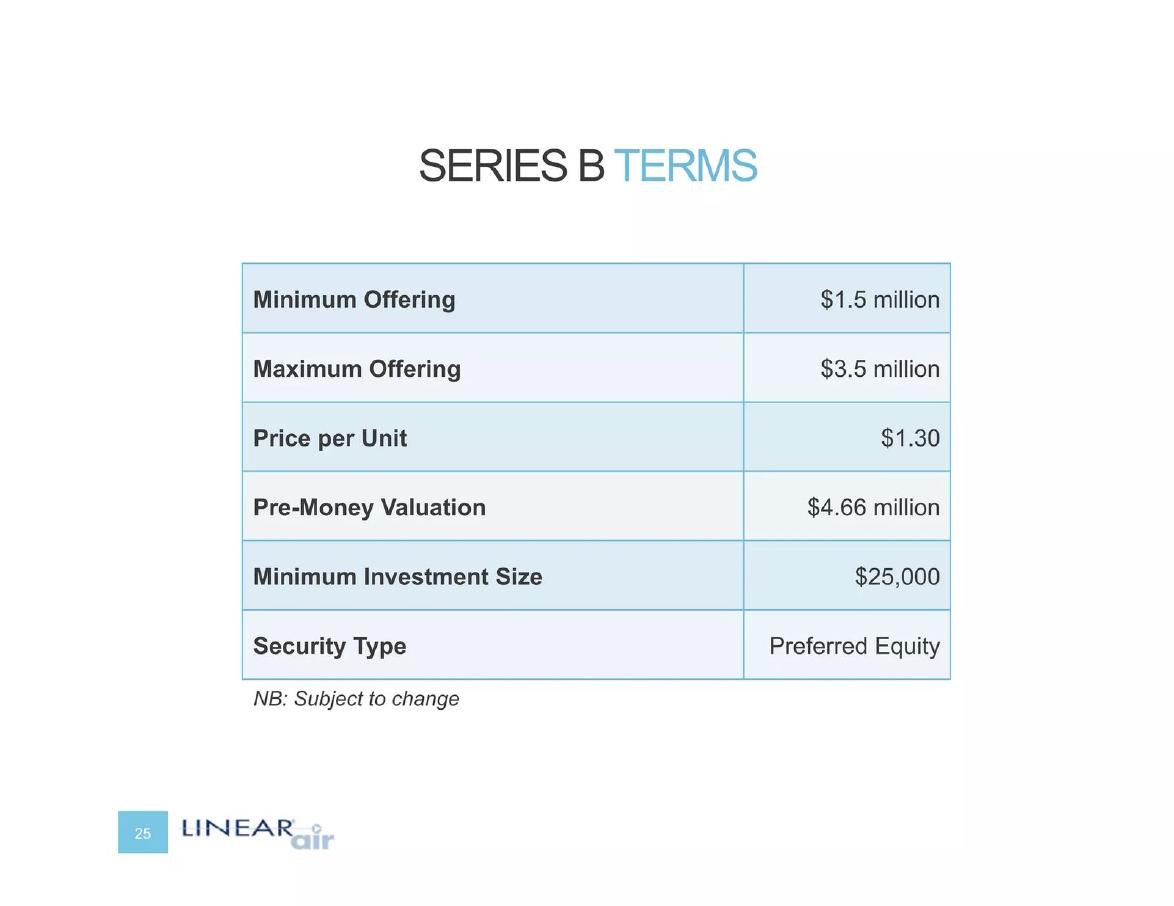
Linear Air, which was building an online booking marketplace for regional air charters, has a slide headed 'Series B Terms'. A table lists 'Minimum Offering $1.5 million', 'Maximum Offering $3.5 million', 'Price per Unit $1.30', 'Pre-Money Valuation $4.66 million', 'Minimum Investment Size $25,000' and 'Security Type Preferred Equity'. Below the table: 'NB: Subject to change'.
This is the most complete example. Every figure an investor needs to value the minimum cheque is on one slide. By our arithmetic, $25,000 at $1.30 buys about 19,230 units. If the company raises the minimum offering, post-money valuation is $6.16 million and $25,000 is about 0.41% of the company; at the maximum offering it is $8.16 million and about 0.31%. The minimum and maximum offering also tell an investor the round can close at $1.5 million, so their money is not waiting on the full $3.5 million.
Two points would strengthen it. The slide doesn't say why the minimum is $25,000; a short reason, such as keeping the number of investors manageable, would help. 'Subject to change' is honest, but it leaves open which terms might move; 'valuation fixed, minimum negotiable for strategic investors' would be clearer. The label 'Series B' at a pre-money valuation under $5 million is unusual, and some readers will want to know what earlier rounds were; that belongs on a funding-history slide.
A minimum among SAFE terms: Paper
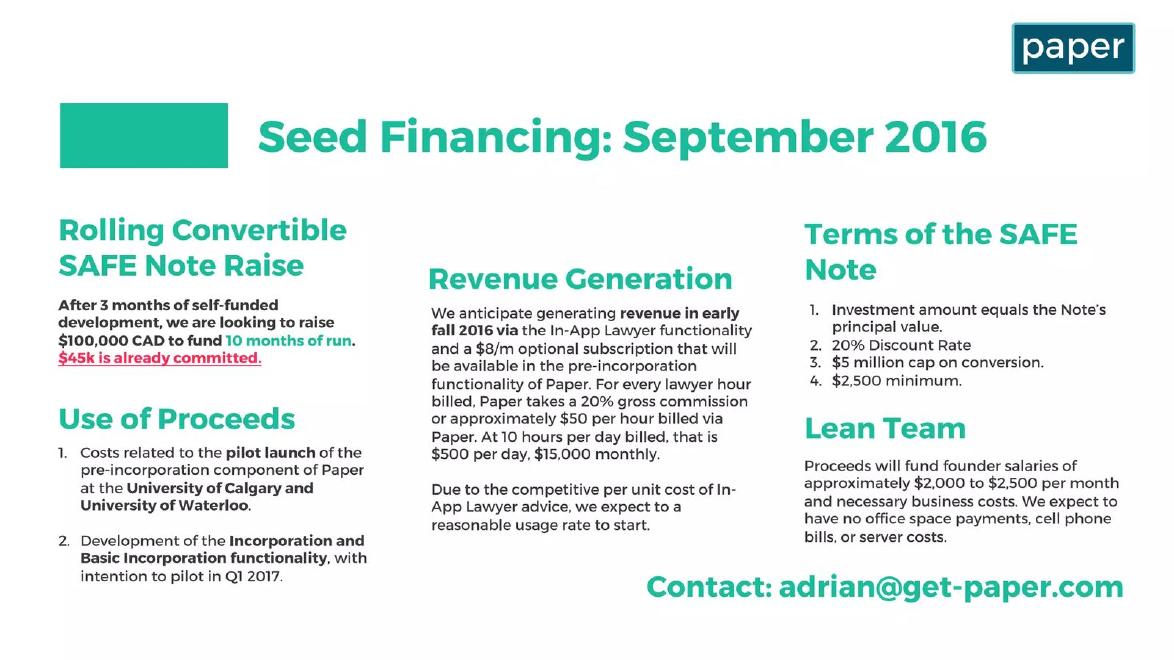
Paper, which was building software to automate legal paperwork for new companies, has a slide headed 'Seed Financing: September 2016'. Under 'Terms of the SAFE Note': '1. Investment amount equals the Note's principal value. 2. 20% Discount Rate 3. $5 million cap on conversion. 4. $2,500 minimum.' On the left: 'we are looking to raise $100,000 CAD to fund 10 months of run. $45k is already committed.'
The minimum sits with the instrument, the cap and the discount, so a reader can see roughly what $2,500 buys: at a $5 million cap, about 0.05% of the company on conversion, by our arithmetic, or more if the discount gives a lower price. The committed $45k also helps; it tells a small investor the round already has support.
The arithmetic a founder should do is the number of investors. A $100,000 round with a $2,500 minimum could, in principle, have up to 40 investors, and the $55,000 not yet committed could come from up to 22. That may be exactly what the founders want for a friends-and-family round, but a later investor may ask about it. The slide also gives the raise in Canadian dollars and the cap and minimum without a currency label; saying 'CAD' on each figure would remove the doubt. Whether the cap is measured before or after the money is not stated, which changes the ownership calculation; our deal terms guide covers that point.
Different minimums for different investors: IGT Financial Services
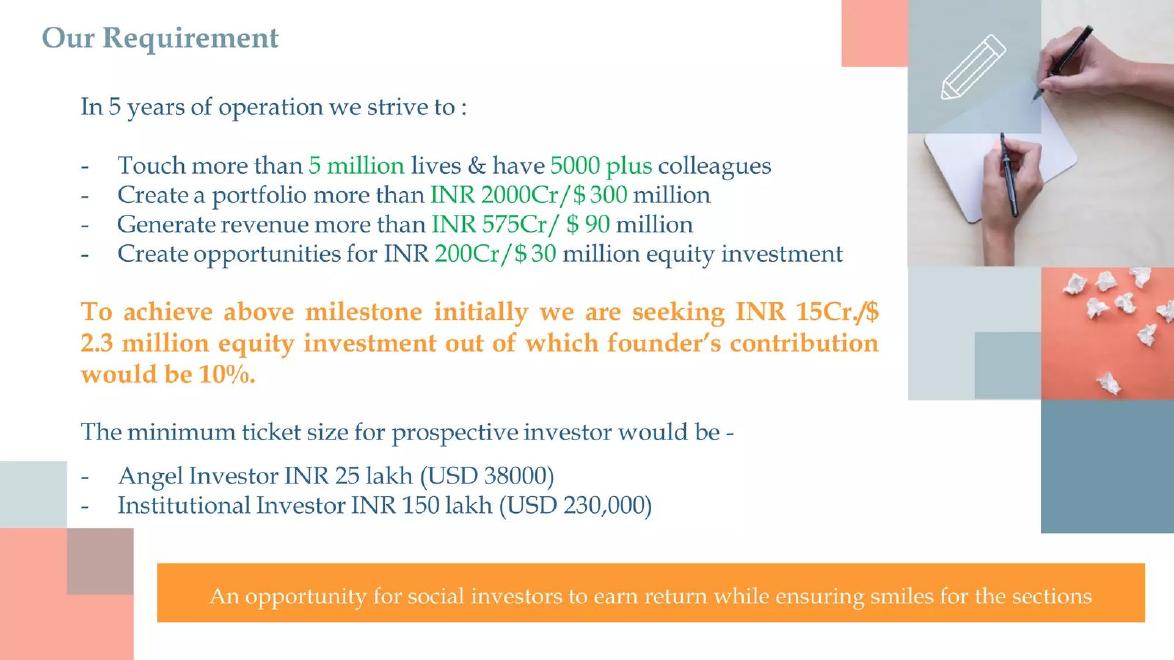
IGT Financial Services, which was planning a microfinance business in rural India, has a slide headed 'Our Requirement'. It lists five-year goals, then: 'To achieve above milestone initially we are seeking INR 15Cr./$ 2.3 million equity investment out of which founder's contribution would be 10%.' Then: 'The minimum ticket size for prospective investor would be - Angel Investor INR 25 lakh (USD 38000) - Institutional Investor INR 150 lakh (USD 230,000)'.
This is the only example with separate minimums by investor type, and it gives each in both rupees and dollars, which helps foreign readers. By our arithmetic the conversions are consistent with each other (about 65 rupees to the dollar throughout). The angel minimum is about 1.7% of the round and the institutional minimum about 10%, so the slide also implies the round is meant for a modest number of investors.
What's missing is what either cheque buys. The slide gives no valuation, price or instrument beyond 'equity investment', so an investor can't calculate a share. The phrase 'founder's contribution would be 10%' is also unclear: it could mean founders put in 10% of the money or keep a 10% stake. Adding a pre-money valuation and one plain sentence on the founders' contribution would make the minimums meaningful.
Tiers with rewards and rights: MySwimPro
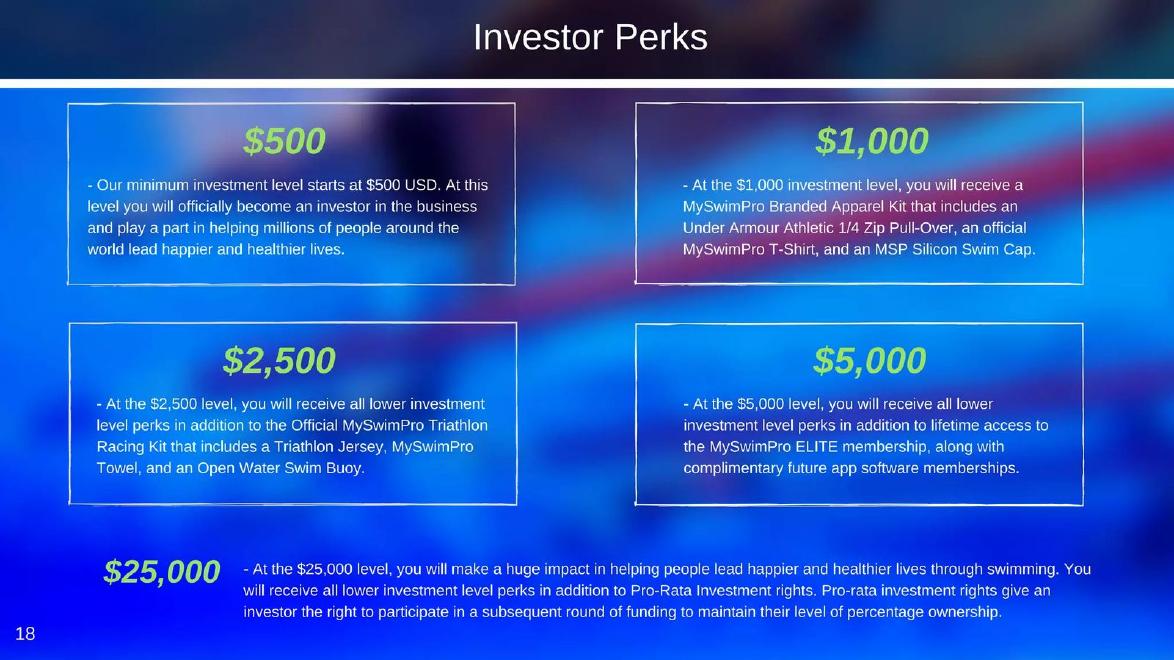
MySwimPro, which offers a swimming training app, has a slide headed 'Investor Perks' with five tiers. '$500 - Our minimum investment level starts at $500 USD. At this level you will officially become an investor in the business'. At $1,000, a branded apparel kit; at $2,500, a triathlon racing kit; at $5,000, lifetime access to its premium membership. At $25,000: 'You will receive all lower investment level perks in addition to Pro-Rata Investment rights. Pro-rata investment rights give an investor the right to participate in a subsequent round of funding to maintain their level of percentage ownership.'
The slide is aimed at customers investing small amounts, and it handles that audience well: a low minimum, rewards tied to the product, and a plain-language explanation of pro-rata rights. It is the only example that tells investors what larger cheques earn beyond more shares.
But the slide gives none of the terms that say what $500 buys: no round size, instrument, price or valuation. On this page, at least, the perks are clearer than the investment. For a customer audience, a line such as 'Raising $[X] at a $[Y] valuation; $500 buys about [Z] shares' at the top would keep the perks from being the main thing a reader remembers. Founders offering rights only above a threshold, as here with pro-rata at $25,000, should also check that this matches the terms in the investment documents.
How to choose a minimum
Start from the round size and the number of investors you can manage. Round size divided by the minimum gives the most investors you could end up with. If that number is uncomfortable, raise the minimum or plan how small investors will be grouped.
Match it to who you are approaching. Customers and the crowd invest hundreds; individual angels often thousands to tens of thousands; institutions much more. A minimum far above your audience's usual cheque will exclude them; one far below may bring more administration than money.
Keep it flexible where it helps. Many founders accept a smaller cheque from a strategic investor or an experienced adviser. If so, say 'minimum $[X], lower for strategic investors' rather than leaving readers to guess.
What to write
Terms line: 'Raising $[round] on a [instrument] at $[valuation or cap]; minimum $[X].'
What it buys: '$[X] buys about [N] shares / [P]% at the [minimum / maximum] raise.' Linear Air's table lets a reader work this out; stating it saves them the step.
Investor types: if minimums differ, give each in one currency, as IGT does with rupees and dollars side by side.
Extra rights: list rights that depend on cheque size, such as pro-rata or information rights, with the threshold.
Status: say whether terms are final or which ones may move.
What these examples can and cannot show
These four slides show how founders have presented a minimum investment. They can't show whether the minimums were well chosen, how many investors took part, or whether the rounds closed on these terms. Calculated figures in this guide come from numbers printed on the slides; we have not checked any against filings or outside sources.
Treat them as patterns of presentation. Linear Air's table is the model for completeness. Paper shows a minimum in SAFE terms and the arithmetic of investor numbers. IGT shows separate minimums by investor type. MySwimPro shows tiered rights, and what is lost when the terms themselves are missing.
Common mistakes
Minimum without a price. No valuation, cap or price beside the minimum.
No investor count. A minimum chosen without counting how many investors it allows.
Mixed currencies. Some figures labelled, others not.
Ambiguous contributions. Phrases that could mean money or ownership.
Perks over terms. Rewards stated more clearly than what the investment buys.
Diagnostic checklist
Minimum stated with currency.
Round size, instrument and valuation or cap on the same slide.
What the minimum buys can be calculated.
Possible number of investors checked.
Different minimums by investor type stated if they apply.
Rights tied to cheque size listed with thresholds.
Frequently asked questions
Do I have to state a minimum investment?
No. Rounds led by one institutional investor rarely do. It is most useful when raising from many angels, friends and family or the crowd.
What minimum should I set?
Start from round size and how many investors you can manage, then check it matches the cheques your audience usually writes. Allow exceptions for strategic investors if you want them.
How we chose these examples
Corpus: published pitch deck teardowns on StartupFundraising.com. Founder-uploaded private decks are excluded.
Selection (2026-10-01): we searched extracted slide text for minimum-investment phrases, excluded investment funds, real estate and lending offerings, and listed companies, and kept four startup slides each presenting the minimum differently.
Review: the four slides were rendered from the source decks on 2026-10-01 and read in full at full size against company, deck and page number (editorial model review, with AI assistance in drafting; not human-reviewed). Calculated figures are arithmetic from the printed numbers. No figure was checked against filings or outside sources.