Investment Terms on the Ask Slide: 7 Real Examples
How startups state SAFE, convertible note and priced-round terms on the ask slide: instrument, amount, valuation or cap, discount and what's already committed.
Investment Terms on the Ask Slide: Instrument, Valuation and What's Committed
Some ask slides go beyond the amount and use of funds and state the deal itself: a SAFE with a valuation cap, a convertible note with interest and a discount, or a priced round at a pre-money valuation. When they do, an investor can work out what they'd own. This guide compares seven real slides that state terms, checks the ownership arithmetic, and notes which terms are missing or blanked out.
TL;DR
If you put terms on the slide, name the instrument, the amount, the valuation or cap and whether it's pre- or post-money, any discount or interest, and how much is already committed. KEA does this for a SAFE: $300,000 at a $2 million post-money cap, no discount, which implies at least 15% ownership for those investors. Properati and Yboo state priced rounds with pre-money valuations and current ownership or commitments; both imply the stated stake. Synthium names a note's interest and discount but no cap, and calls it Series A. K&R Bash names only the instrument and amount. Astek and a Series A example leave the valuation as blanks.
Ask slides with investment terms from real pitch decks
Each example shows the slide above its analysis and links to the full teardown. Slides where an investor can work out their stake come first. Claims are as shown on the slides; calculations and comments are ours.
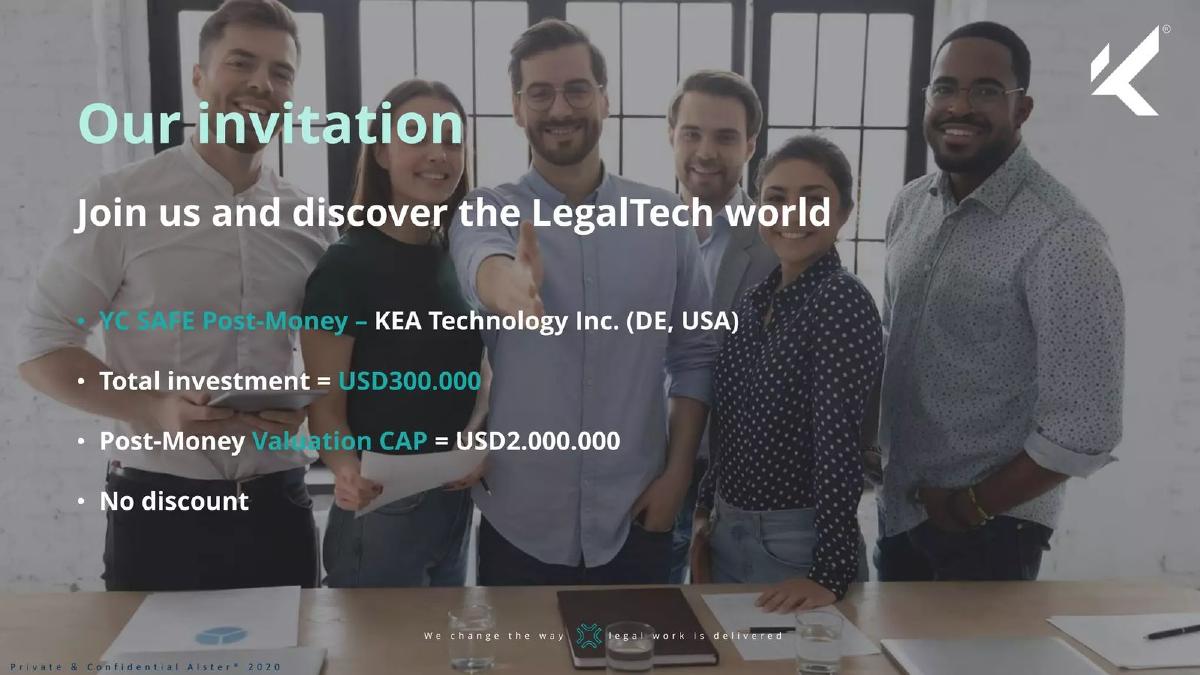
KEA ask slide — slide 19
Legal technology company. Other pages of this deck appear in the legaltech problem and solution guides.
KEA deck, slide 19. Exact stored slide matched to this analysis.
Our analysis: Complete terms for a SAFE on one slide.
Evidence and limitation: Instrument, issuing entity, amount, cap, cap type and discount are all stated. With a post-money cap, $300,000 ÷ $2,000,000 = 15% minimum ownership for the SAFE holders at conversion. No commitments to date, use of funds or milestones on this page.
What a founder can adapt: Add "$[X] committed from [investor type]" and a close date.
Supporting analysis
What the deck claims: "Our invitation. Join us and discover the LegalTech world." "YC SAFE Post-Money – KEA Technology Inc. (DE, USA)"; "Total investment = USD300.000"; "Post-Money Valuation CAP = USD2.000.000"; "No discount".
Presentation choice: An investor can compute their minimum stake without asking a question.
When it does not fit: Writing a cap without saying pre- or post-money.
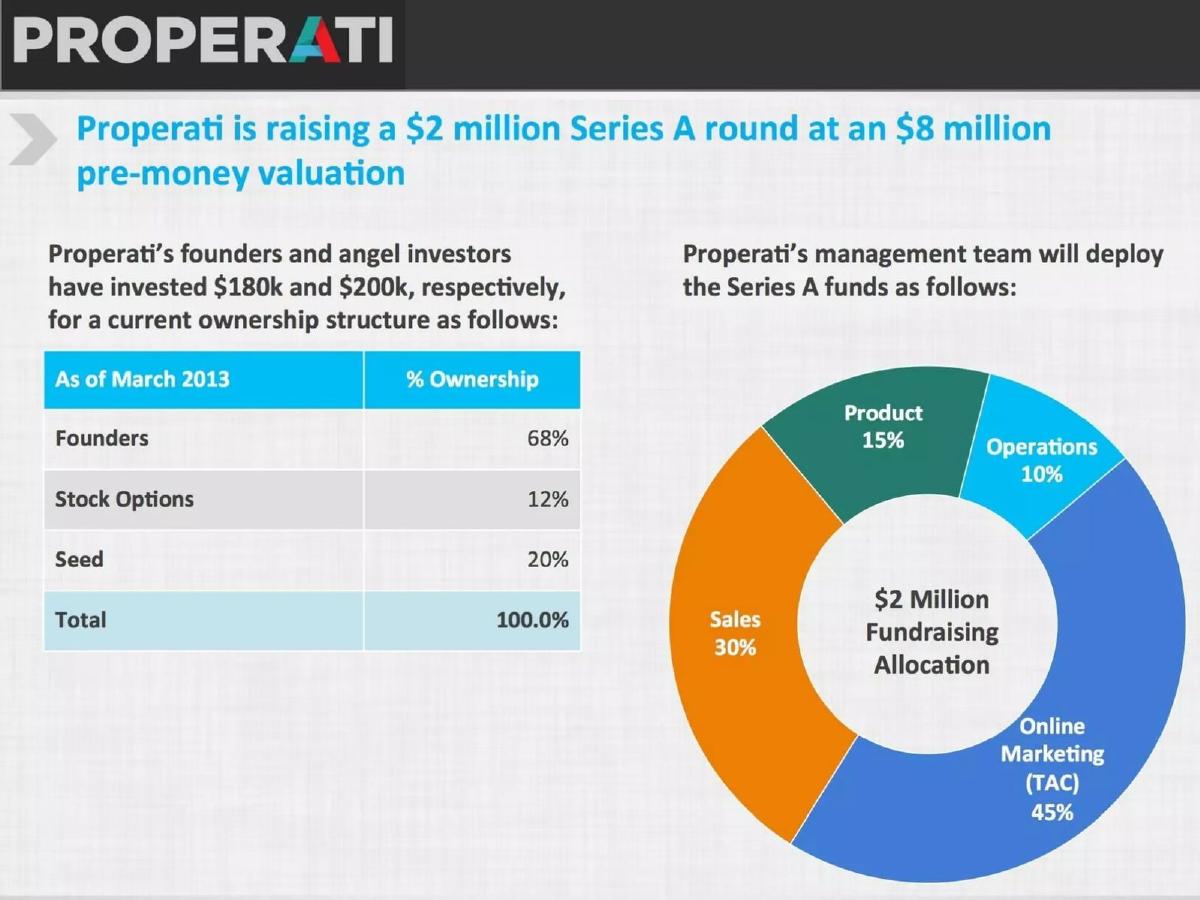
Properati deck, slide 11. Exact stored slide matched to this analysis.
Our analysis: Priced round, current ownership and allocation together.
Evidence and limitation: $2 million ÷ ($8 million + $2 million) = 20% to new investors. The current table sums to 100% and is dated. The slide doesn't say whether the 12% option pool is issued or reserved, or whether it will be enlarged before the round, which would change the effective pre-money.
What a founder can adapt: Add the post-round table: "Founders [X]%, options [Y]%, seed [Z]%, Series A 20%".
Supporting analysis
What the deck claims: "Properati is raising a $2 million Series A round at an $8 million pre-money valuation." "Properati's founders and angel investors have invested $180k and $200k, respectively, for a current ownership structure as follows: As of March 2013 — Founders 68%; Stock Options 12%; Seed 20%; Total 100.0%." "$2 Million Fundraising Allocation": Online Marketing (TAC) 45%, Sales 30%, Product 15%, Operations 10%.
Presentation choice: It gives investors the terms, today's cap table and where the money goes on one page.
When it does not fit: Leaving the option pool treatment unstated.
UK mobile deal-switching app. The teardown refers to this as slide 12; it is page 23 of the deck file.
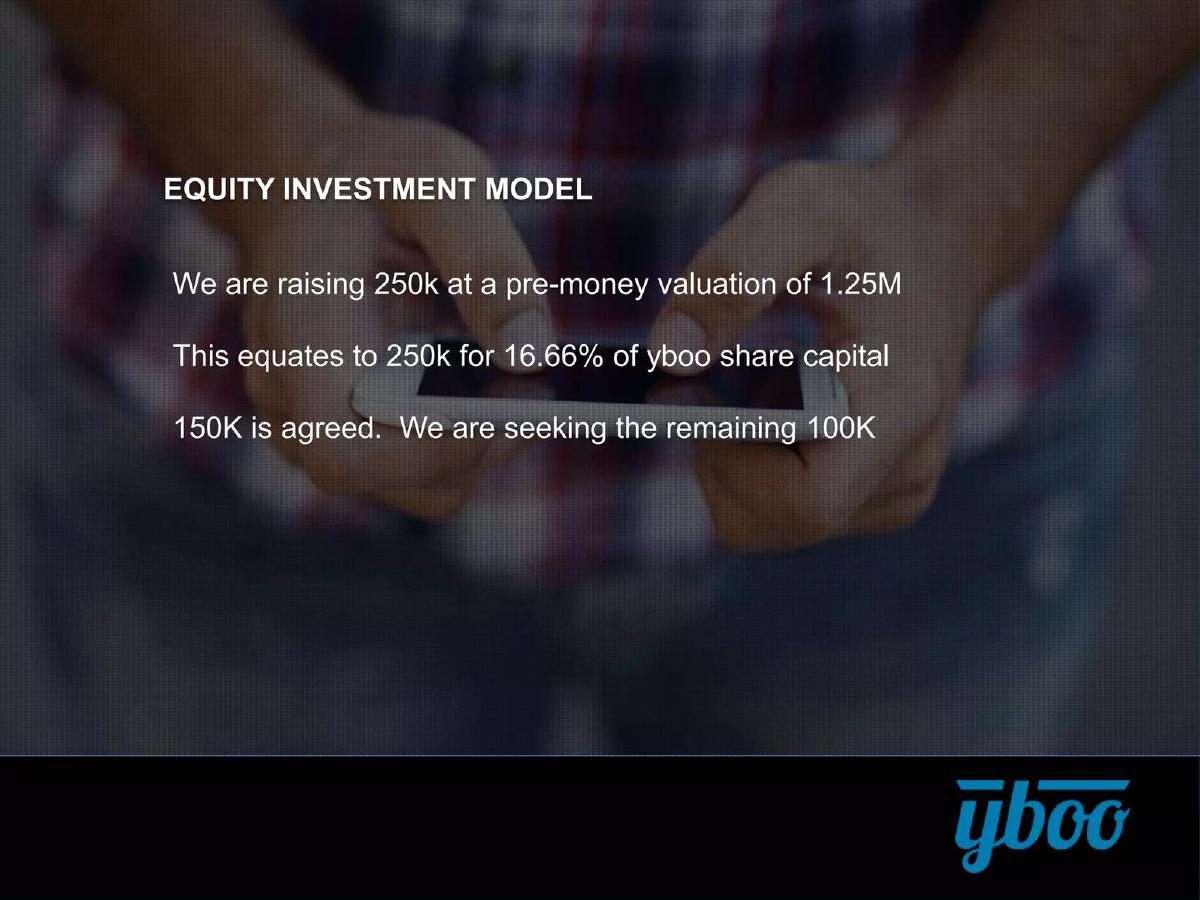
Yboo deck, slide 23. Exact stored slide matched to this analysis.
Our analysis: Priced terms with commitments to date.
Evidence and limitation: £250,000 ÷ (£1.25 million + £250,000) = 16.67%, so the stake matches (the slide truncates to 16.66%). It says how much is committed, which the other slides don't. No currency symbol on the figures; the company is UK-based.
What a founder can adapt: "£250k at £1.25M pre-money (16.7% post); £150k committed from [who]; closing [date]".
Supporting analysis
What the deck claims: "Equity Investment Model." "We are raising 250k at a pre-money valuation of 1.25M." "This equates to 250k for 16.66% of yboo share capital." "150K is agreed. We are seeking the remaining 100K."
Presentation choice: Committed money tells an investor the round is moving.
Healthcare supply marketplace. The teardown refers to this as slide 7; it is page 13 of the deck file.
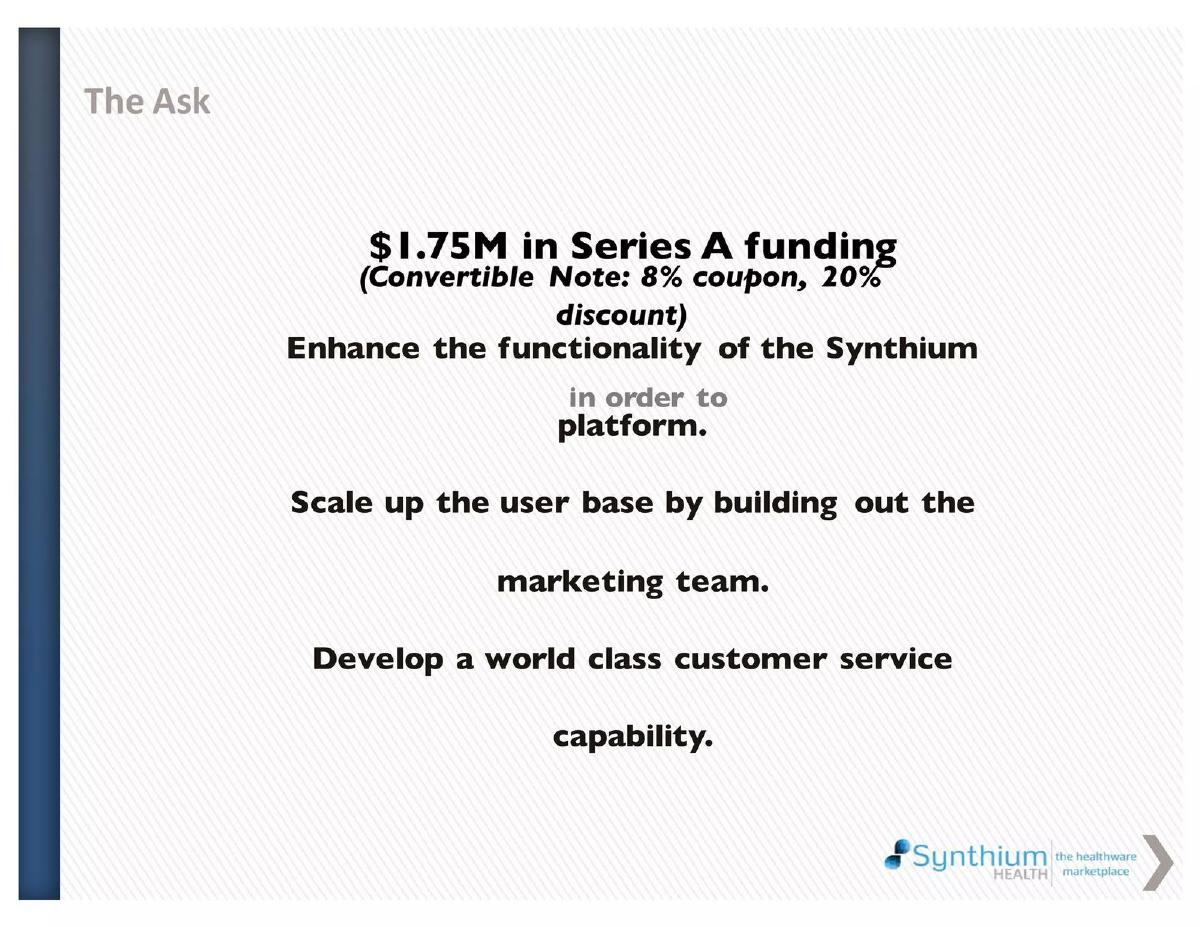
Synthium Health deck, slide 13. Exact stored slide matched to this analysis.
Our analysis: Partial note terms under a priced-round label.
Evidence and limitation: Interest and discount are stated, but there's no valuation cap or maturity date. Without a cap, the investor's price depends entirely on the next round. It also calls a convertible note "Series A", a term usually used for a priced round, which may confuse investors.
What a founder can adapt: "$1.75M convertible note: 8% interest, 20% discount, $[X]M [pre/post]-money cap, [N]-month maturity".
Supporting analysis
What the deck claims: "The Ask." "$1.75M in Series A funding (Convertible Note: 8% coupon, 20% discount)." "Enhance the functionality of the Synthium platform. Scale up the user base by building out the marketing team. Develop a world class customer service capability."
Presentation choice: It shows the gap a missing cap leaves.
Digital greeting card and gift card app. The teardown refers to this as slide 8; it is page 15 of the deck file.
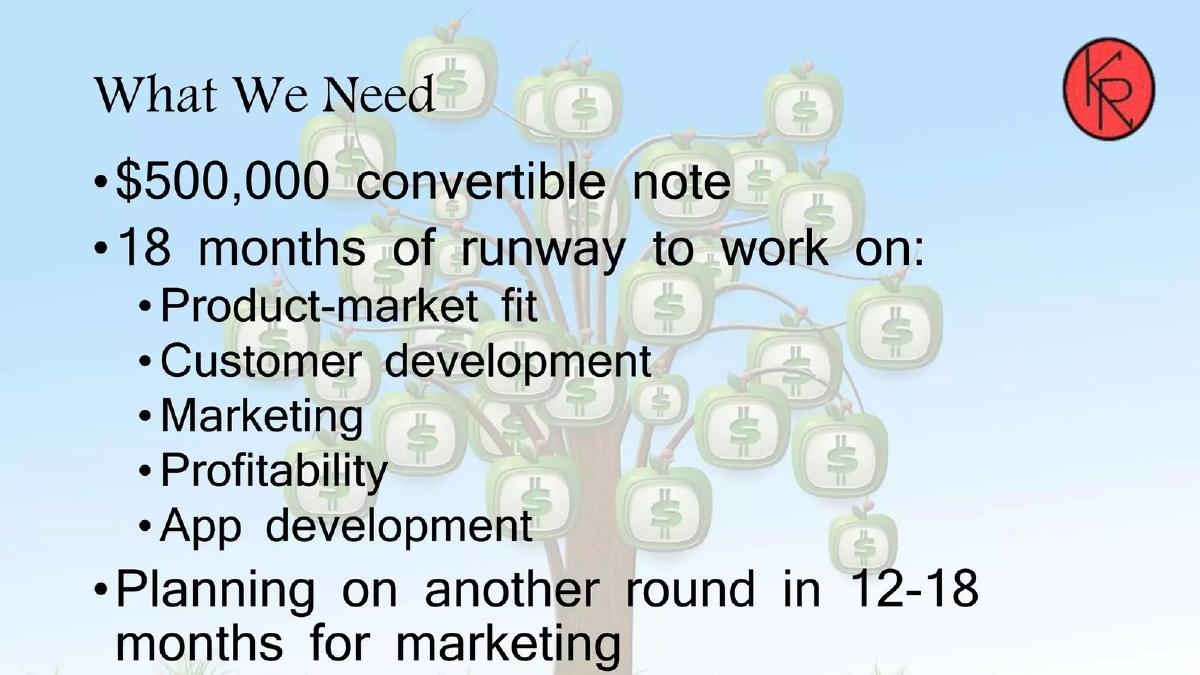
K&R Bash deck, slide 15. Exact stored slide matched to this analysis.
Our analysis: Instrument named, terms missing.
Evidence and limitation: Instrument, amount and runway are stated, and it's honest that another round follows. No cap, discount, interest or maturity, so the note's terms are unknown.
What a founder can adapt: Add the cap and discount, or "Terms: [cap], [discount]; available on request".
Supporting analysis
What the deck claims: "What We Need." "$500,000 convertible note." "18 months of runway to work on: Product-market fit; Customer development; Marketing; Profitability; App development." "Planning on another round in 12–18 months for marketing."
Presentation choice: It shows the minimum: an instrument and runway, with terms still to discuss.
When it does not fit: Naming a note with none of its terms.
Diagnostic testing company. A different page of this deck appears in the hardware business model guide. Included as a weaker example because the key figures are blanked.
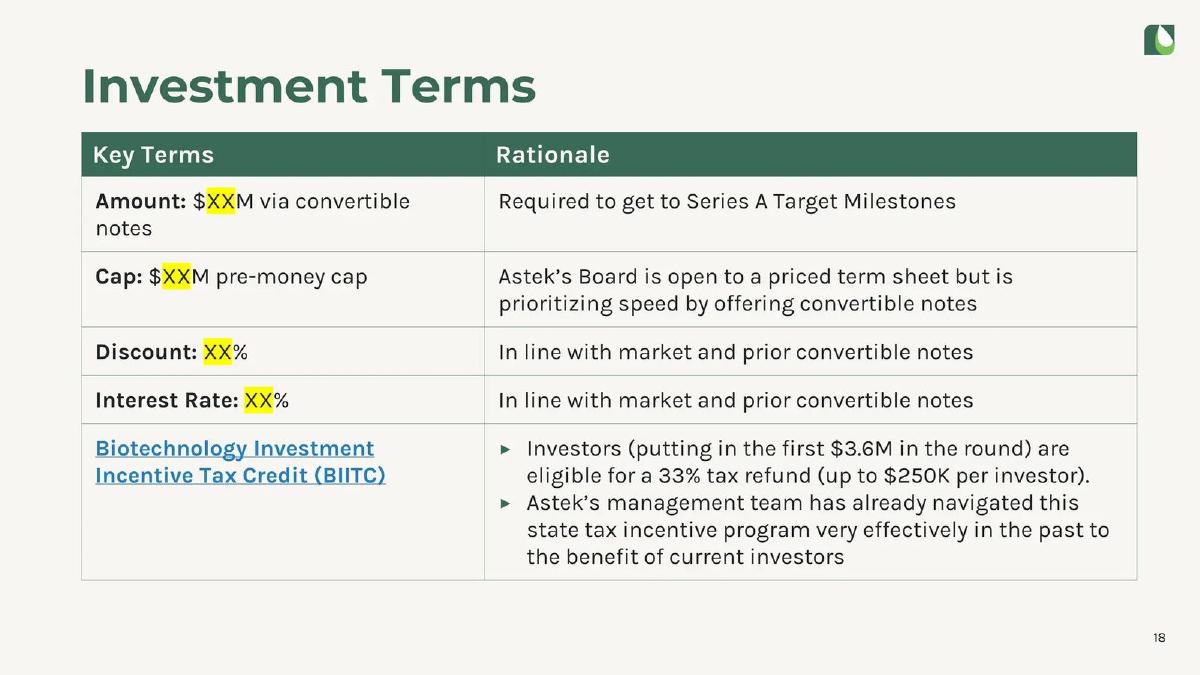
Astek Diagnostics deck, slide 18. Exact stored slide matched to this analysis.
Our analysis: A strong template sent without its numbers.
Evidence and limitation: The best structure here: each term has a reason next to it, and it flags a state tax credit that changes the investor's net cost. But every figure is "XX", highlighted in yellow. We haven't checked the tax credit's terms or eligibility.
What a founder can adapt: Fill every term, or remove the table from the sent version.
Supporting analysis
What the deck claims: "Investment Terms." A table of Key Terms and Rationale: "Amount: $XXM via convertible notes — Required to get to Series A Target Milestones"; "Cap: $XXM pre-money cap — Astek's Board is open to a priced term sheet but is prioritizing speed by offering convertible notes"; "Discount: XX% — In line with market and prior convertible notes"; "Interest Rate: XX% — In line with market and prior convertible notes"; "Biotechnology Investment Incentive Tax Credit (BIITC): Investors (putting in the first $3.6M in the round) are eligible for a 33% tax refund (up to $250K per investor)."
Presentation choice: Included for its term-plus-rationale layout, and as a warning about unfilled placeholders.
When it does not fit: Highlighted "XX" placeholders in an investor deck.
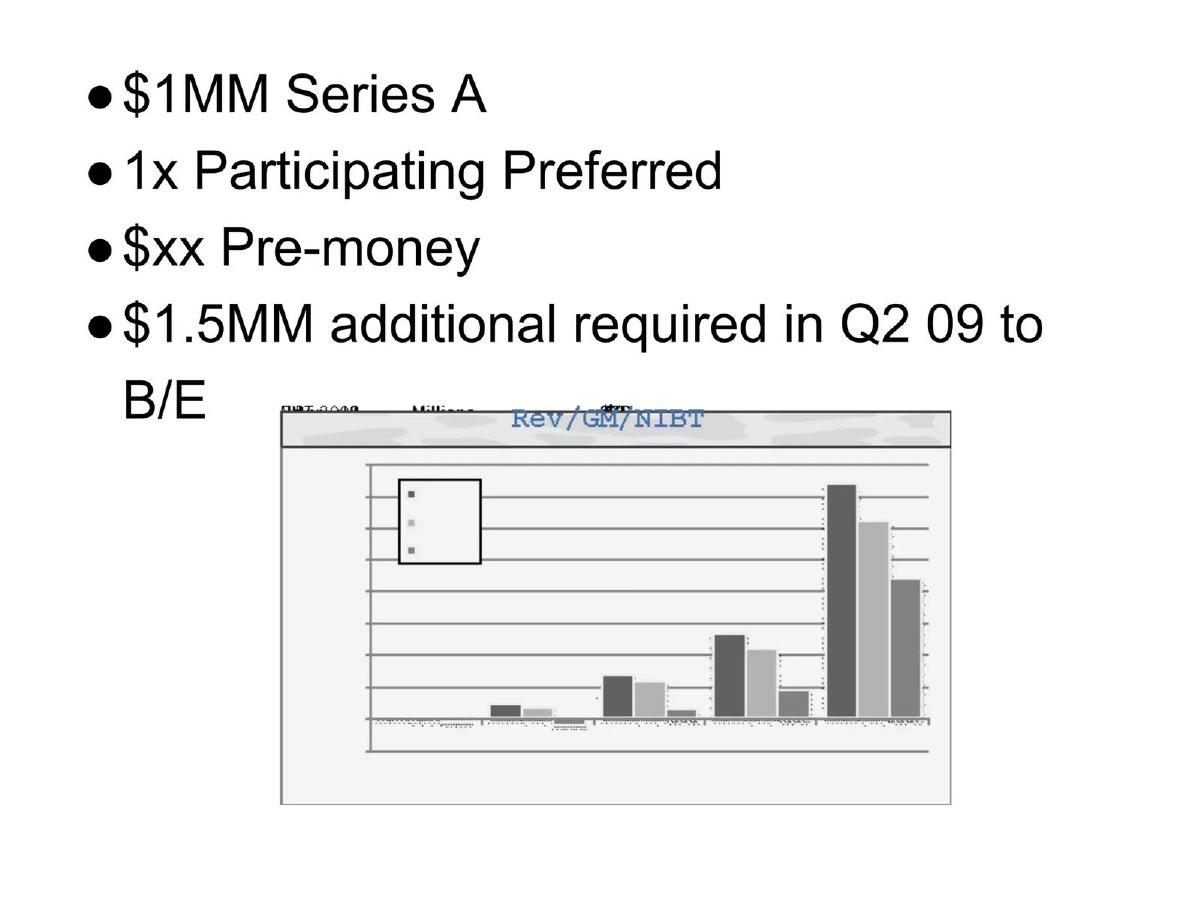
Evidence and limitation: It names a liquidation term (1x participating preferred), which most decks leave to the term sheet, and says more money will be needed to break even. The valuation is blank and the chart has no readable axes or legend.
What a founder can adapt: "$1M Series A at $[X]M pre-money ([Y]% post), 1x participating preferred; a further $1.5M needed by Q2 2009 to break even".
Supporting analysis
What the deck claims: "$1MM Series A"; "1x Participating Preferred"; "$xx Pre-money"; "$1.5MM additional required in Q2 09 to B/E". An unlabelled chart titled "Rev/GM/NIBT".
Presentation choice: Included because it states a preference term but leaves out the valuation that matters most.
When it does not fit: An unreadable chart on the terms slide.
What improved: Our illustrative rewrite of the K&R Bash slide; bracketed figures are placeholders, not company terms.
What this guide adds
The main ask slide guide covers the amount, the milestones it buys, runway and allocation, and notes that instrument and valuation are usually discussed after the slide. This guide covers the decks that put the terms on the slide, and what investors check when they do.
The ownership arithmetic
Priced round: new investors own the amount divided by the post-money valuation, where post-money is pre-money plus the amount raised. $2 million at an $8 million pre-money is $2 million of $10 million, or 20%.
Post-money SAFE: the SAFE's cap is a post-money figure, so SAFE holders own at least the amount divided by the cap when it converts (more if a later round prices lower). $300,000 on a $2 million post-money cap is 15%.
Pre-money caps and convertible notes: ownership depends on how much else converts and on the next round, so there is no single figure from the slide alone. Stating pre- or post-money matters.
How we read each slide
We quote the text on the slide images and redid each ownership calculation. We have not checked whether any round closed on these terms. Several page numbers differ from the teardown's numbering; the pages shown are the ones quoted. None of these pages was in our stored image set, so we rendered each from the original deck file in our library.
Common mistakes
Cap without pre- or post-money. The two give different ownership.
Note called Series A. Use the instrument's name.
Placeholders in the sent deck. Fill them or remove the terms.
No currency. State it on every figure.
Nothing about commitments. Say how much is agreed.
Option pool left vague. Say whether it is enlarged before the round.
Diagnostic checklist
Instrument named correctly.
Valuation or cap, with pre- or post-money stated.
Discount, interest and maturity for notes.
Implied stake checks out.
Commitments to date stated.
Frequently asked questions
Should I put investment terms on my ask slide?
It's optional; many decks leave terms to the conversation. If you include them, state them fully: instrument, amount, valuation or cap (pre- or post-money), any discount or interest, and commitments. KEA lists a $300,000 post-money SAFE at a $2 million cap with no discount.
How do I work out what an investor would own?
For a priced round, divide the amount by the post-money valuation (pre-money plus the amount). Properati's $2 million at $8 million pre-money is 20%. For a post-money SAFE, divide the amount by the cap: $300,000 on $2 million is at least 15%.
How we chose these examples
Corpus: published pitch deck teardowns on StartupFundraising.com. Founder-uploaded private decks are excluded.
Selection (2026-09-26): we searched teardowns for valuation cap, pre- and post-money, SAFE, convertible note and discount. We rendered 10 candidate pages from 10 decks (one deck file was missing), then the closing pages of four decks whose teardown numbering didn't match the file.
Kept seven. Excluded: FaZe Clan p7 (a public SPAC merger, not a startup round; another page of that deck is in the advertising guide), Fundanna (the terms page could not be located in the file), Beatstoc (deck file not in the library).
None of the chosen pages was in our stored image set; we rendered them from the original deck PDFs in our library and stored them with the existing slide-image workflow. All seven decks were confirmed as published teardowns on 2026-09-26.
This page explains common arithmetic, not legal or investment advice. Instrument terms vary; read the actual documents.
Review: slide images were checked on 2026-09-26 and matched to company, deck and page (editorial model review). No person has yet completed an editorial review of this page. We make no claim that any slide caused a fundraising outcome.