Astek Diagnostics presents a compelling case for a decentralized, rapid diagnostic platform addressing the critical issue of antibiotic misuse. Their Jiddu system aims to reduce the time for antibiotic sensitivity testing from days to one hour, initially focusing on Urinary Tract Infections (UTIs). The deck effectively leverages pilot data from prestigious institutions like the University of Maryland and MedStar Health, showing accuracy levels reaching 96.97%. With $1.4M in scientific grants and $2.6M from investors like Y Combinator and Harvard, the company demonstrates strong early-stage va…
Key takeaways
- The Jiddu system aims to provide UTI confirmation and antibiotic sensitivity results in 1 hour, compared to the current 24-72 hour standard (Slide 6, 8).
- Pilot data shows accuracy improving over time, reaching 96.97% in the MedStar Health pilot (Slide 14).
- The business model utilizes a 'razor and blade' approach with a $10K one-time device purchase and $50 recurring test cartridges (Slide 8).
- Astek has secured $1.4M in scientific grants from bodies including the NSF, FDA, and NIH (Slide 16).
- The company has a clear IP strategy with one issued patent for its test algorithm and three pending disclosures (Slide 15).
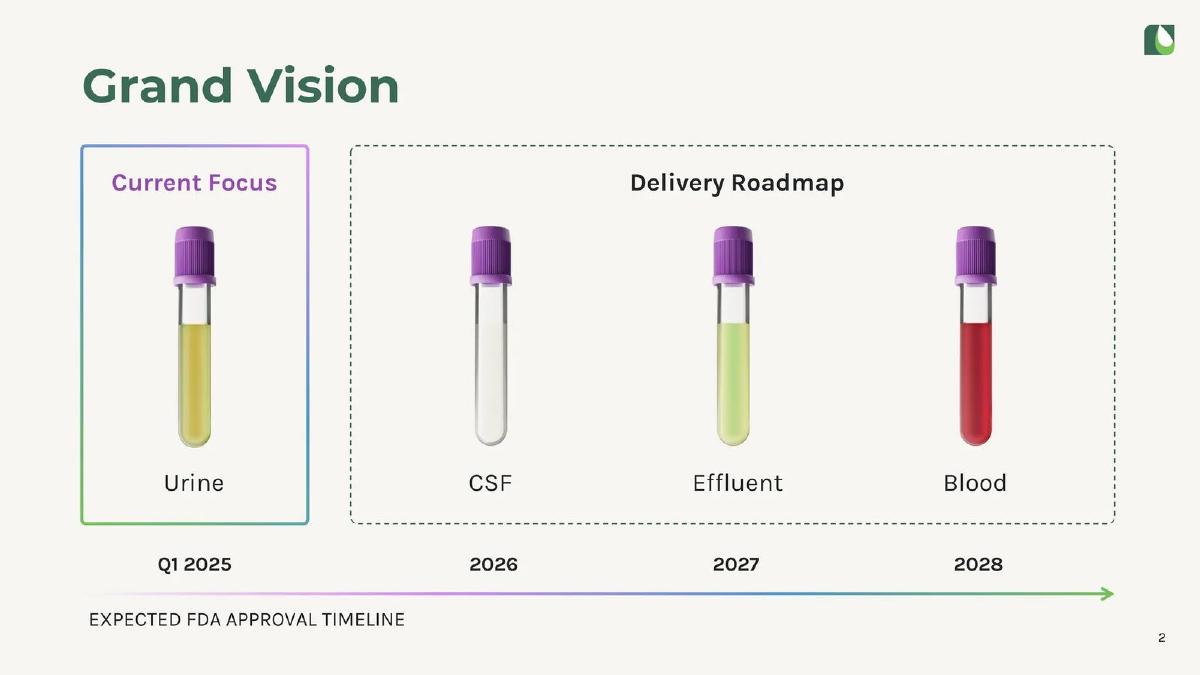
- A multi-sample roadmap is planned, expanding from urine to CSF, effluent, and blood by 2028 (Slide 2).
- The deck identifies specific potential acquirers, including BioMerieux, BD, and Qiagen, supported by a table of comparable transaction multiples (Slide 19, 20).
- FDA clearance is targeted for April 2025, which the company believes will trigger prime acquisition interest (Slide 19).
Executive Summary and Vision
Slides 1-3: The Grand Vision and Universal Platform
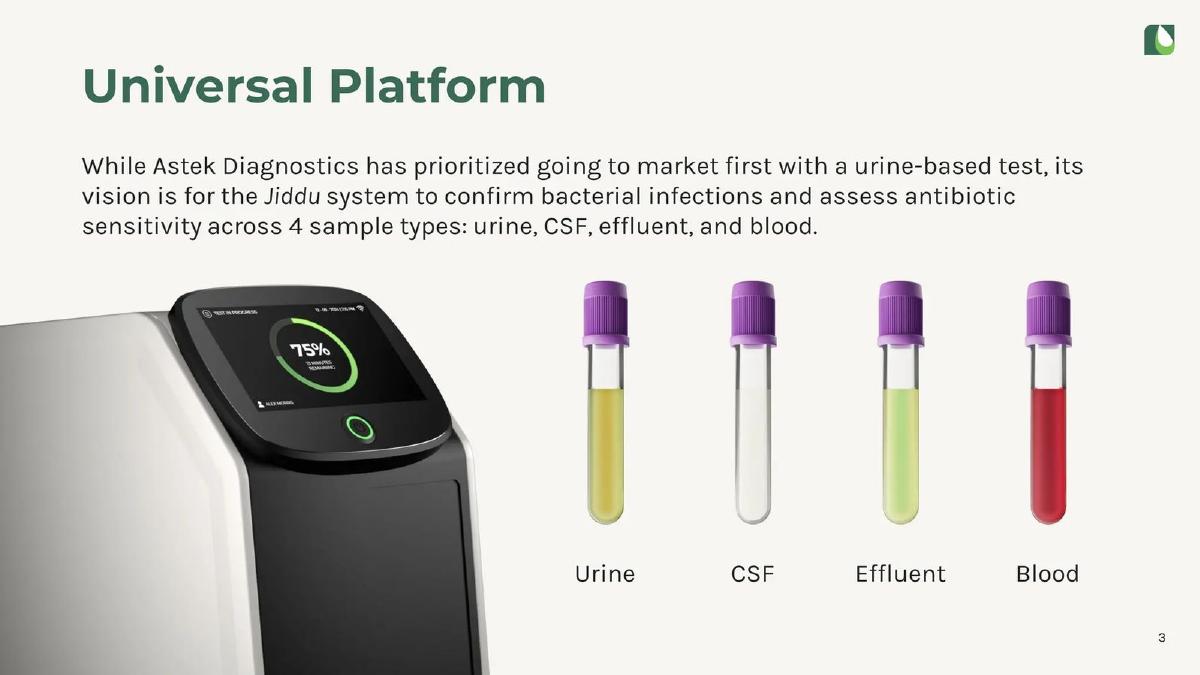
Astek Diagnostics opens with a clear mission statement: "Saving Lives Through Antibiotic Sensitivity Precision Diagnostics." The cover slide features a relatable human element, which is often effective in MedTech to ground the technology in patient outcomes. Slide 2 introduces the "Grand Vision," which is a phased delivery roadmap. While the current focus is on urine-based testing (targeted for Q1 2025), the company plans to expand to Cerebrospinal Fluid (CSF) in 2026, Effluent in 2027, and Blood in 2028. This establishes that Astek is not just a single-product company but a platform capable of addressing multiple high-stakes diagnostic needs. Slide 3 reinforces this by showcasing the "Jiddu" system as a universal platform where the hardware remains the same, but the cartridges change based on the sample type.
The Problem and Market Opportunity
Slides 4-7: Defining the Diagnostic Gap
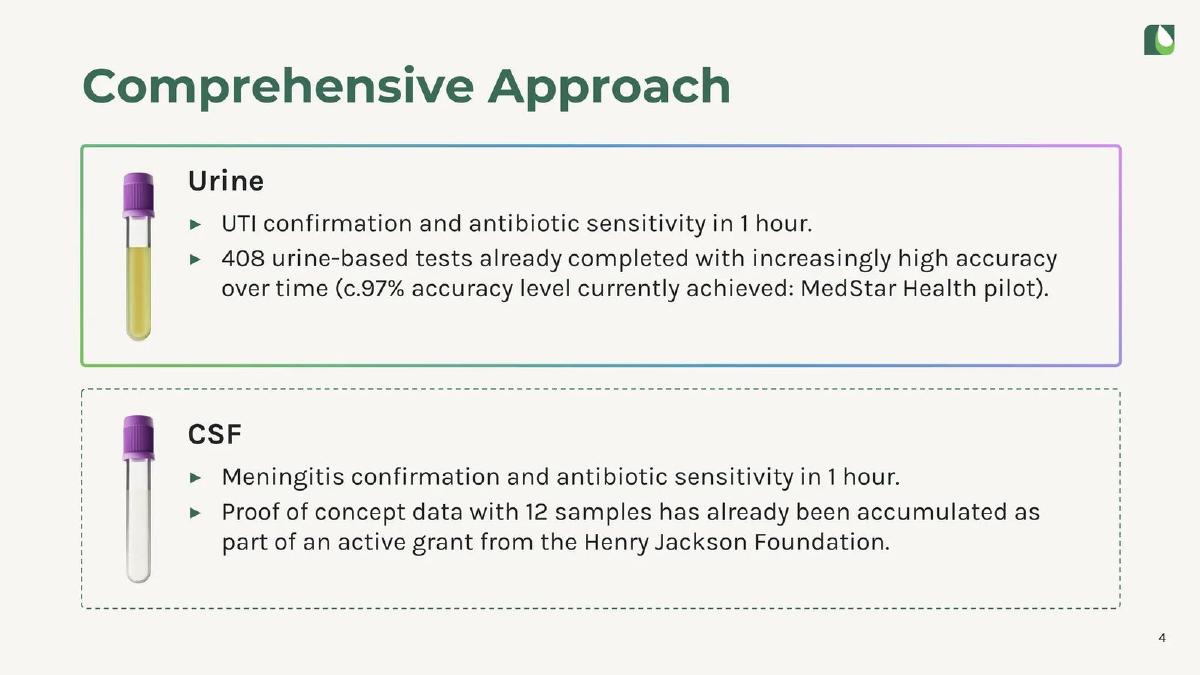
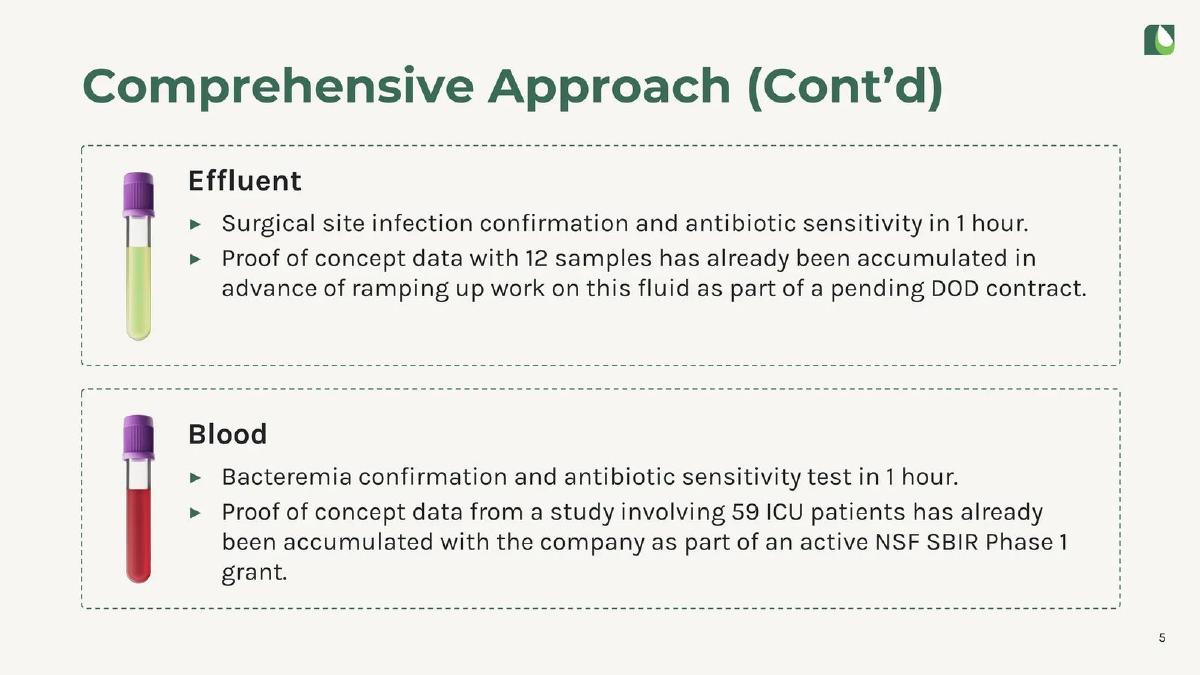
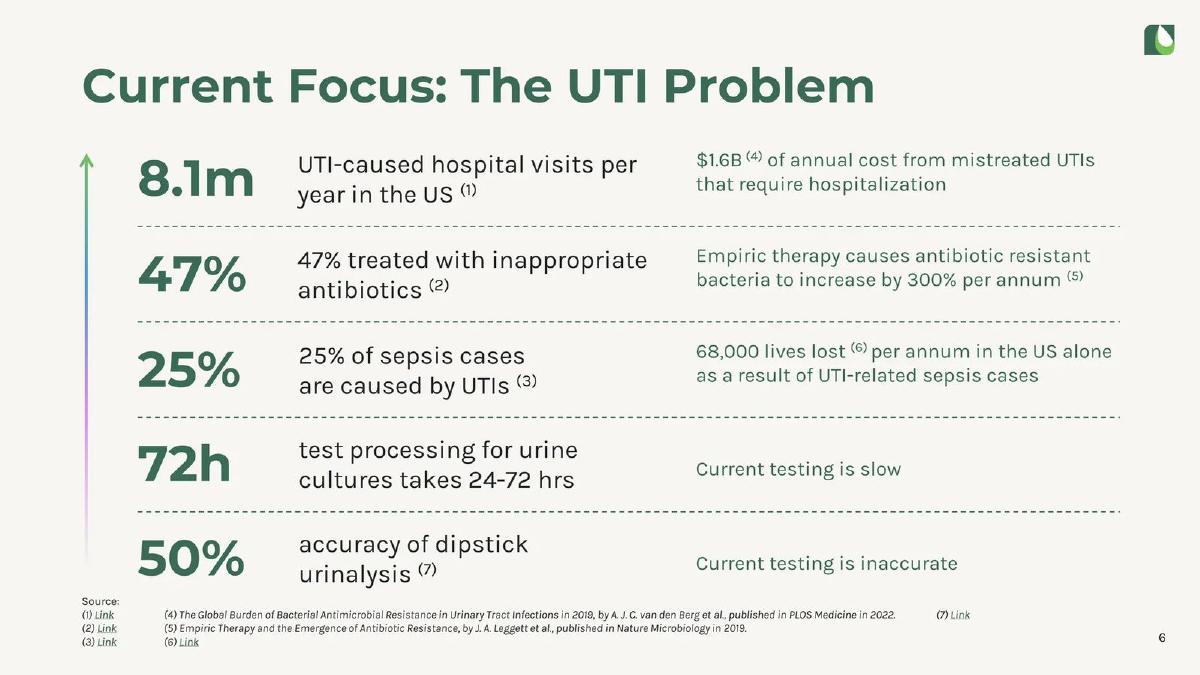
Slides 4 and 5 provide a "Comprehensive Approach" breakdown, detailing the specific clinical needs for each sample type. For urine, the focus is UTI confirmation; for CSF, it is meningitis; for effluent, surgical site infections; and for blood, bacteremia. Each section cites early proof-of-concept data or active grants, such as the NSF SBIR Phase 1 grant for blood testing. Slides 6 and 7 dive deep into the "UTI Problem." The metrics are stark: 8.1 million hospital visits per year, 47% treated with inappropriate antibiotics, and 25% of sepsis cases originating from UTIs. By highlighting that current cultures take up to 72 hours, Astek positions its 1-hour solution as a necessity rather than a luxury. The mention of a $55 billion annual economic cost for Antimicrobial Resistance (AMR) in the US provides a macro-economic justification for the investment.
The Solution and Technology
Slides 8-11: The Jiddu System Mechanics
Slide 8 introduces the hardware. The key selling points are speed (1-hour results), point-of-care utility, ease of use (disposable cartridges), and a clear cost structure ($10K device, $50 cartridge). Slides 9 and 10 explain the underlying microfluidic process. This is a critical section for technical due diligence, as it explains the automated filtering, cultivation, and analysis steps. Slide 11 provides the scientific 'aha' moment: Metabolic Activity Detection. The bar chart shows how metabolic activity drops significantly when an effective antibiotic (like Cephalexin) is introduced to the sample, compared to the high activity in the untreated sample. This visual proof of the technology's mechanism of action is vital for building investor confidence in the science.
Team and Validation
Slides 12-14: Human Capital and Pilot Results
The team slide (12) shows a balanced mix of executive leadership (CEO Mustafa Al-Adhami), technical expertise (CTO Kevin Tran), and specialized engineering/microbiology staff. Slide 13 is particularly impressive for a seed-stage company, listing a 10-person advisory board with representatives from Loyola, Johns Hopkins, and the University of Maryland. This level of external validation suggests the company is well-integrated into the medical research community. Slide 14, "Technology Validation," is the most important slide for traction. It shows a clear progression of accuracy: from 82% in early 2022 to 96.97% in late 2023. Showing this upward trend in performance is far more persuasive than simply stating a single high number, as it demonstrates the team's ability to iterate and improve the product.
IP and Corporate Standing
Slides 15-16: Protecting the Moat
Slide 15 lists the company's intellectual property. Having an issued patent for the "Test Algorithm" provides a foundational moat, while the pending disclosures for the fluidic cartridge and reagent mix show ongoing R&D protection. Slide 16, "Company Validation," is a 'logo slide' that packs a punch. It separates pilot partners, industry recognition (Y Combinator, J&J JLABS), scientific grants ($1.4M), and investors ($2.6M). The diversity of funding—combining prestigious accelerators, university funds, and federal grants—indicates that Astek has passed multiple rigorous screening processes.
Roadmap and Investment Terms
Slides 17-18: The Path to Series A
Slide 17 provides a timeline from 2022 through 2025. It marks key milestones like the Alpha prototype (April 2024), Beta prototype (Nov 2024), and the start of clinical trials (Jan 2025). The goal is clear: 10 pilots and FDA clearance by April 2025. Slide 18, "Investment Terms," is notably redacted with "$XXM" placeholders. However, it reveals the structure of the round: convertible notes with a pre-money cap. A unique highlight here is the Biotechnology Investment Incentive Tax Credit (BIITC), which offers investors a 33% tax refund. This is a sophisticated inclusion that appeals directly to the investor's bottom line.
Exit Strategy and Summary
Slides 19-21: The End Game
Slide 19 explicitly names potential acquirers like BioMerieux and Bio-Rad, stating the company has already been approached by strategic investors. This is a bold claim that needs to be backed up in private discussions, but it sets a clear exit expectation. Slide 20 supports this with "Comparable Transactions," showing revenue multiples ranging from 3.8x to 59.5x. This helps investors calculate a potential Return on Investment (ROI) based on market precedents. Finally, Slide 21 provides an executive summary that reiterates the $XXM raise and the 95%+ accuracy achieved to date.
What Astek Diagnostics Does Well
Data-Driven Traction: The progression of accuracy percentages across different pilots (Slide 14) is a masterclass in showing technical growth. · Platform Breadth: By showing the roadmap for CSF and blood (Slide 2), they transform a UTI diagnostic tool into a multi-billion dollar platform play. · Regulatory Awareness: The timeline specifically accounts for FDA clearance and clinical trials, showing the founders understand the MedTech path to market (Slide 17). · Investor Incentives: Including the BIITC tax credit (Slide 18) shows a founder who is thinking about the investor's risk-adjusted return.
What is Missing from the Deck
Specific Financial Ask: The use of "$XXM" placeholders throughout the deck (Slides 17, 18, 21) makes it impossible to evaluate the valuation or the specific runway this $2M (per the source listing) provides. · Unit Economics Detail: While they provide the price of the device and cartridge, they do not disclose the COGS (Cost of Goods Sold) or the expected margins, which are critical for assessing the long-term viability of the business model. · Competitive Landscape: The deck mentions comparable transactions for exits but does not include a traditional competitor matrix. Investors will want to know how Jiddu stacks up against other rapid diagnostic startups or established lab equipment. · Use of Funds: There is no breakdown of how the requested capital will be allocated (e.g., % to R&D, % to clinical trials, % to payroll).
Founder Takeaways
Show the 'Why Now': Astek does an excellent job of linking their solution to the global crisis of antibiotic resistance. Founders should always connect their product to a massive, urgent macro-trend. Leverage Non-Dilutive Funding: Highlighting $1.4M in grants alongside VC investment proves that experts in the field (like the NIH and NSF) have vetted the science. This is a huge de-risking signal for investors. Plan the Exit Early: Including a slide on comparable transactions and naming potential acquirers shows that the founders are focused on a liquidity event, which is exactly what VCs want to see. Visualizing the Process: The step-by-step microfluidic explanation (Slides 9-10) makes complex science accessible to generalist investors without dumbing it down too much.
Frequently asked questions
- What is the primary problem Astek Diagnostics is solving?
- Astek addresses the slow and inaccurate nature of current UTI testing. Slide 6 notes that current cultures take 24-72 hours and dipstick urinalysis is only 50% accurate. This delay leads to 47% of patients being treated with inappropriate antibiotics, contributing to the rise of antibiotic-resistant 'super bugs' and costing the US economy approximately $55 billion per year.
- How does the Jiddu system technology actually work?
- The system uses metabolic activity detection. As shown on Slides 9 and 10, a sample is placed in a microfluidic cartridge, bacteria are captured via automated filtering, and then subdivided into channels mixed with specific antibiotics. After 35 minutes of cultivation, the device measures metabolic activity; a decline in activity indicates the antibiotic is effectively killing the bacteria.
- What is the current stage of product development and validation?
- Astek is in the pilot and prototype stage. Slide 14 details completed pilots at the University of Maryland (95.60% accuracy) and ongoing work at MedStar Health (96.97% accuracy). Slide 17 outlines a timeline where a Beta prototype is expected in November 2024, followed by clinical trials in January 2025 and targeted FDA clearance in April 2025.
- What is the revenue model for the company?
- The company employs a dual revenue stream model. According to Slide 8, they charge a $10,000 one-time fee for the Jiddu device purchase. This is supplemented by a recurring revenue stream from disposable test cartridges, priced at $50 per test. This model is designed to be cost-effective for point-of-care testing environments.
- Who are the key investors and partners involved with Astek?
- Astek has a high-pedigree investor base including Y Combinator, Harvard, and the Maryland Momentum Fund. They have also received significant non-dilutive funding ($1.4M) from the NSF, NIH, and BARDA. Their pilot partners include top-tier medical institutions like Johns Hopkins Medicine and the University of Maryland Medical Center (Slide 16).