Asseta AI’s 11-slide deck is a masterclass in niche positioning. By identifying a specific 'gap' in the market—where family offices are too complex for QuickBooks but find SAP or Oracle too cumbersome—Asseta AI frames itself as the essential middle ground. The deck leans heavily on impressive early traction, citing $10B+ in Assets On Platform (AOP) and a $5M+ sales pipeline. While the deck is light on technical architecture and competitive granularities, it excels at communicating a clear value proposition: a unified 'Operating System' for billionaire families. The successful $4.2M Seed round…
Key takeaways
- Asseta AI identifies a specific market gap between 'Lightweight' small business tools and 'Resource Intensive' ERPs (Slide 5).
- The company reports significant early-stage traction with 6 billionaire families and $10B+ Assets On Platform (Slide 2).
- The sales pipeline is valued at $5,000,000+ in ARR over the last 180 days (Slide 2).
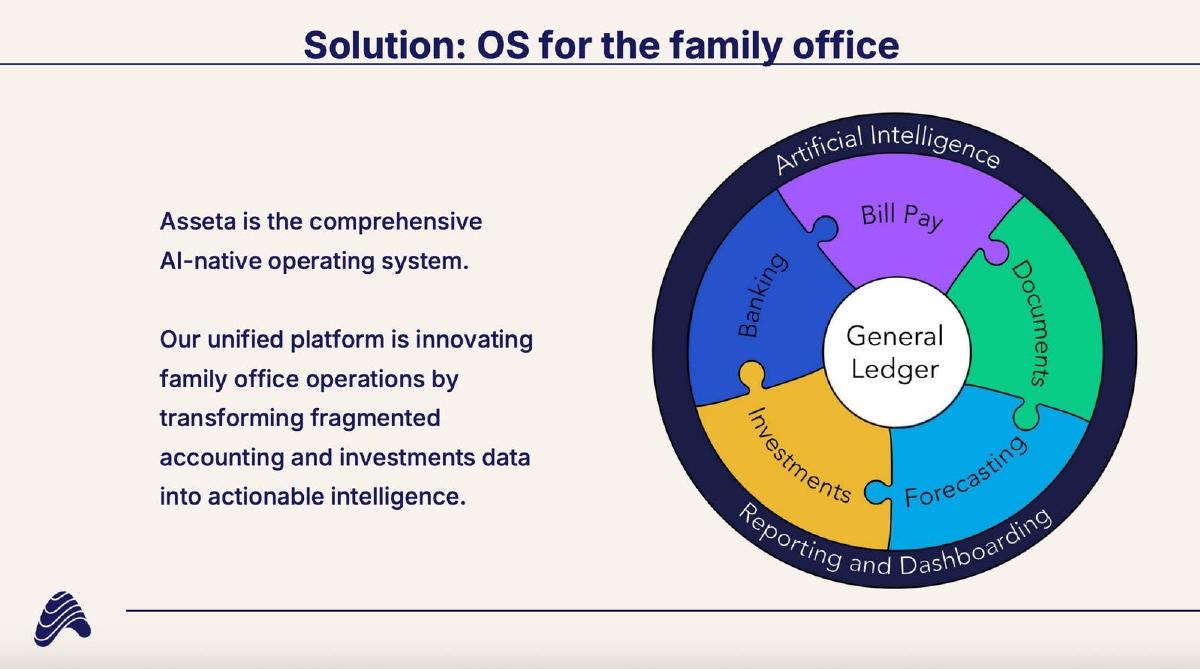
- The platform is positioned as a comprehensive 'OS for the family office,' integrating banking, bill pay, and general ledger (Slide 3).
- Market opportunity is defined as a $2.5B tech spend in North America, projected to reach $4B by 2030 (Slide 4).
- The deck claims a 31.24% compounded monthly growth rate over the trailing six months (Slide 2).
- Asseta AI aims to build an ecosystem of AI-powered apps on top of 'clean accounting and investments data' (Slide 6).
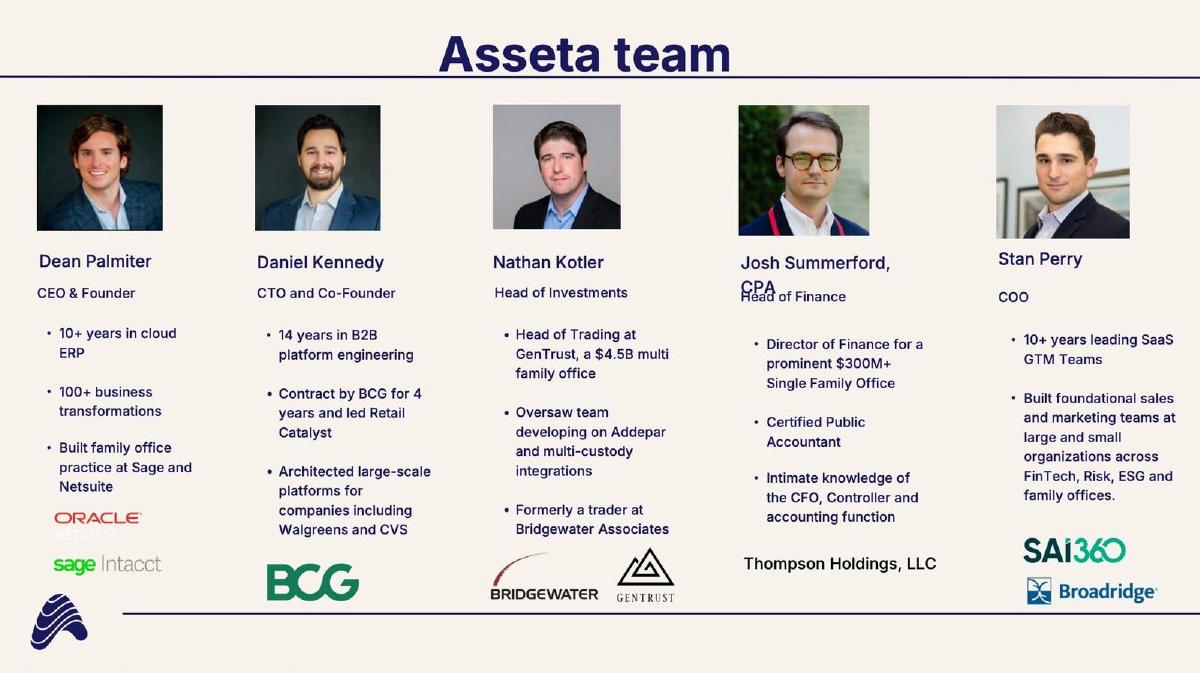
- The deck omits a traditional team slide, unit economics, and a specific use-of-funds breakdown in the provided materials.
The Niche Power of Family Office Tech
Asseta AI’s pitch deck is a focused narrative on a very specific, high-value problem: the technological neglect of the family office. While enterprise accounting and small business bookkeeping are crowded markets, the 'middle'—where billionaire families manage complex, multi-entity portfolios—has historically been forced into ill-fitting software. Asseta AI raised $4.2M in 2023 by promising to be the 'Intelligent Family Office Suite' that bridges this gap.
Slide 1: Title and Positioning
The deck opens with a clean, minimalist title slide. The logo is a stylized, gradient 'A' that feels modern and 'tech-forward.' The tagline, "The Intelligent Family Office Suite™," immediately identifies the target customer and the core value proposition. By using the word 'Suite,' they signal that this is not a point solution but a comprehensive platform. The use of 'Intelligent' hints at the AI-native nature of the product without needing to explain the tech stack on page one.
Slide 2: The Traction Powerhouse
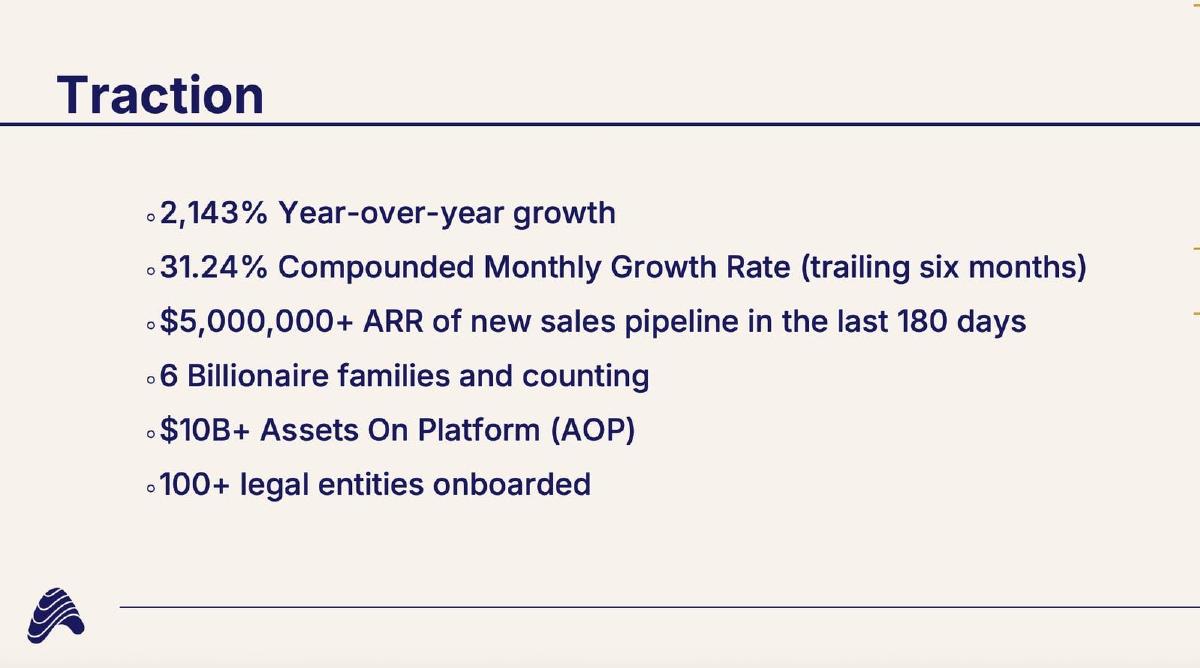
Asseta AI moves its traction slide to the very front of the deck, a common tactic when the numbers are undeniably strong. They report "2,143% Year-over-year growth" and a "31.24% Compounded Monthly Growth Rate" over the last six months. The most compelling figure for a Seed-stage investor, however, is likely the "6 Billionaire families and counting" and "$10B+ Assets On Platform (AOP)." In the world of family offices, access is the hardest hurdle; proving they have already onboarded six ultra-high-net-worth families validates the product-market fit more than any theoretical chart could.
Slide 3: The Operating System Vision
Slide 3 defines the solution as an "OS for the family office." The visual is a circular puzzle diagram where the "General Ledger" sits at the center. This is a crucial architectural choice—accounting is the 'source of truth' for wealth management. The surrounding pieces include Banking, Bill Pay, Documents, Forecasting, Investments, and Reporting. By wrapping the entire circle in an "Artificial Intelligence" border, Asseta AI positions AI as the connective tissue that automates the flow of data between these fragmented silos.
Slide 4: Market Opportunity
The market sizing slide is surprisingly conservative but realistic. It states that "Family Office tech spend is $2.5B in North America," growing to "$4B by 2030." While many startups try to claim a $100B TAM (Total Addressable Market), Asseta AI focuses on the specific budget currently allocated to technology within their niche. This suggests a 'land and expand' strategy where they first capture existing tech spend before potentially moving into the broader wealth management or private equity markets.
Slide 5: The Competitive Gap
Slide 5 is perhaps the most important strategic slide in the deck. It uses a two-axis chart (Resource Intensive vs. Lightweight and Small Business Functionality vs. Enterprise Grade Features) to show a 'dead zone' in the market. On the left are QuickBooks and Xero , which are 'Functional & Easy to Use' but have 'Limitations.' On the far right are SAP, Oracle, and Workday , which cost "$1 Million+" and are 'bloated' and 'non-innovating.' Asseta AI positions itself in the upper-right quadrant—providing enterprise-grade features without the million-dollar price tag or the resource-heavy implementation of legacy ERPs.
Slide 6: Vision for the Future
The final slide in the provided sequence outlines the long-term goal: becoming the "only modern all-in-one family operating system of the last decade." The strategy involves building an ecosystem of AI-powered apps on top of "clean accounting and investments data." This is a classic platform play: first, solve the data problem (clean accounting), then become the 'source of truth' that powers every other financial decision the family makes. It moves the company from a 'tool' to an 'infrastructure' play.
What Asseta AI Does Well
The deck excels at niche identification . By explicitly naming billionaire families and the failure of QuickBooks/NetSuite to serve them, they create a 'category of one.' The traction slide is also exceptionally well-constructed; it doesn't just show growth percentages, it shows quality of revenue and scale of assets . For a Seed round, having $10B+ AOP is a massive de-risking signal for investors. The visual language is consistent, professional, and avoids the 'clutter' often found in early-stage fintech decks.
What is Missing from the Deck
The most glaring omission in the provided slides is the Team Slide . In a $4.2M Seed round, the founders' backgrounds in finance, AI, or accounting are usually the primary reason for the investment. Without seeing who is building this, it is hard to judge the 'founder-market fit.' Additionally, there is no Unit Economics slide. While they mention a $5M pipeline, they don't disclose their pricing model (AUM-based vs. SaaS subscription) or their Customer Acquisition Cost (CAC). Finally, the Ask is missing—we know from publisher reports they raised $4.2M, but the deck should ideally state what they are looking for and how they will spend it (e.g., hiring engineers, expanding sales to the EU, etc.).
Founder Takeaways
Front-load your 'Wow' metrics: If you have billionaire clients or billions in assets under management, don't hide that on slide 10. Asseta AI put it on slide 2 to set the tone for the entire pitch. · Define the 'No-Man's Land': If you are building for the mid-market, use a chart like Slide 5 to show why small business tools are too weak and enterprise tools are too heavy. Investors love 'gap' stories. · The 'OS' Narrative: Positioning a product as an 'Operating System' rather than a 'Tool' increases your perceived valuation. It implies high switching costs and a central role in the customer's workflow. · Keep AI as a Layer, Not a Feature: Asseta AI doesn't pitch 'an AI tool'; they pitch a Family Office Suite that is 'AI-native.' This makes the AI feel like a fundamental improvement to the architecture rather than a bolted-on buzzword.
Frequently asked questions
- What is the primary problem Asseta AI is solving?
- According to Slide 5, family offices are currently forced to choose between 'Lightweight' tools like QuickBooks, which have functional limitations, and 'Resource Intensive' ERPs like SAP or Oracle, which cost $1M+ and are described as 'bloated' and 'cumbersome.' Asseta AI aims to provide a professionalized, AI-native alternative that fits between these two extremes.
- How does Asseta AI define its traction?
- Traction is defined on Slide 2 through several high-impact metrics: 2,143% year-over-year growth, 6 billionaire families as clients, over 100 legal entities onboarded, and more than $10B in Assets On Platform (AOP). They also highlight a $5M+ ARR sales pipeline generated in the last 180 days.
- What are the core components of the Asseta AI platform?
- Slide 3 illustrates the 'OS for the family office' as a unified platform. The core is the 'General Ledger,' surrounded by integrated modules for Banking, Bill Pay, Documents, Forecasting, Investments, and Reporting and Dashboarding. The entire suite is wrapped in an 'Artificial Intelligence' layer.
- What is the projected market growth for this sector?
- Slide 4 states that the current Family Office tech spend in North America is $2.5B. The company projects this market will grow to $4B by the year 2030, representing a steady expansion of the addressable market for specialized accounting and management tools.
- What is missing from the Asseta AI pitch deck?
- The provided 11-slide sequence lacks a dedicated Team slide, which is unusual for a Seed round where founder pedigree is critical. It also omits a detailed 'Ask' slide, unit economics (LTV/CAC), and a specific roadmap of how the $4.2M will be deployed to reach the next milestone.