AssetsHub is a cloud-based CMMS platform targeting the Middle East, specifically Saudi Arabia, by addressing the inefficiencies of manual paperwork in maintenance. The deck highlights a significant pricing advantage, offering a 'Basic' plan at $19 per user/month compared to competitors like Maximo at $250. Its primary value proposition lies in 'Native Arabic Support' and a marketplace for custom extensions, aiming to serve industries ranging from hospitals to HVAC repair. While the deck provides a clear product overview and market sizing ($34.86 Billion in Saudi Arabia by 2028), it suffers fr…
Key takeaways
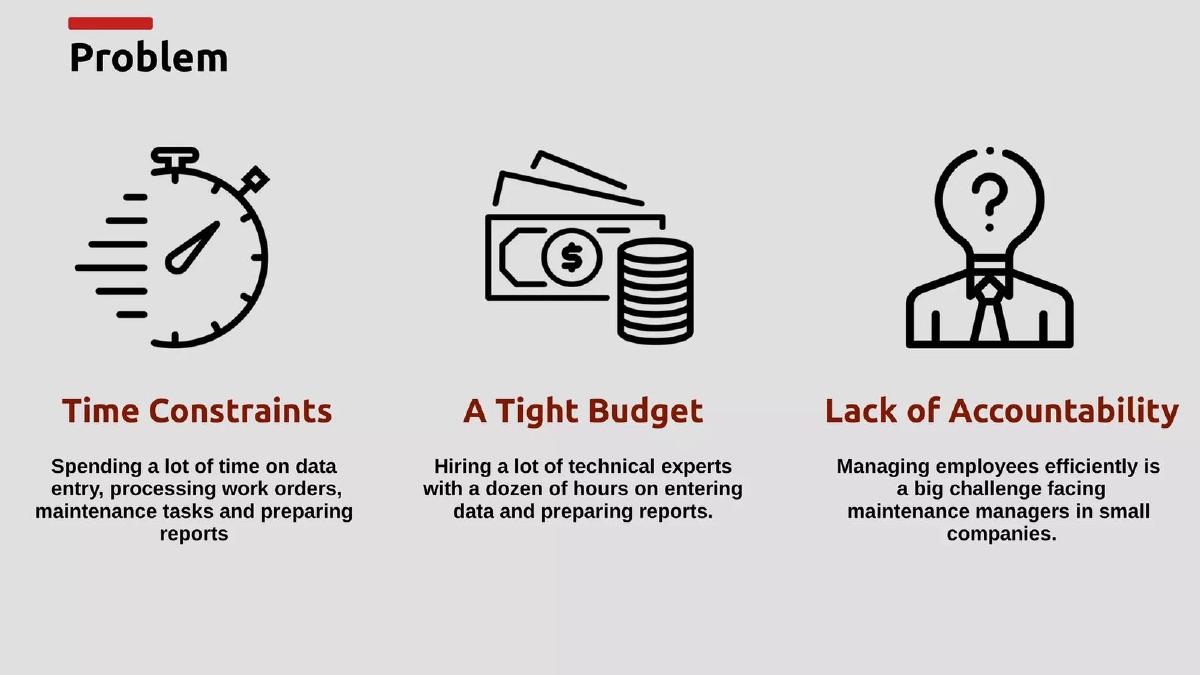
- The startup identifies three core pain points: time constraints, tight budgets, and a lack of employee accountability (Slide 3).
- AssetsHub positions itself as a low-cost alternative, with its $19/month entry price being roughly 13x cheaper than IBM Maximo (Slide 11, 14).
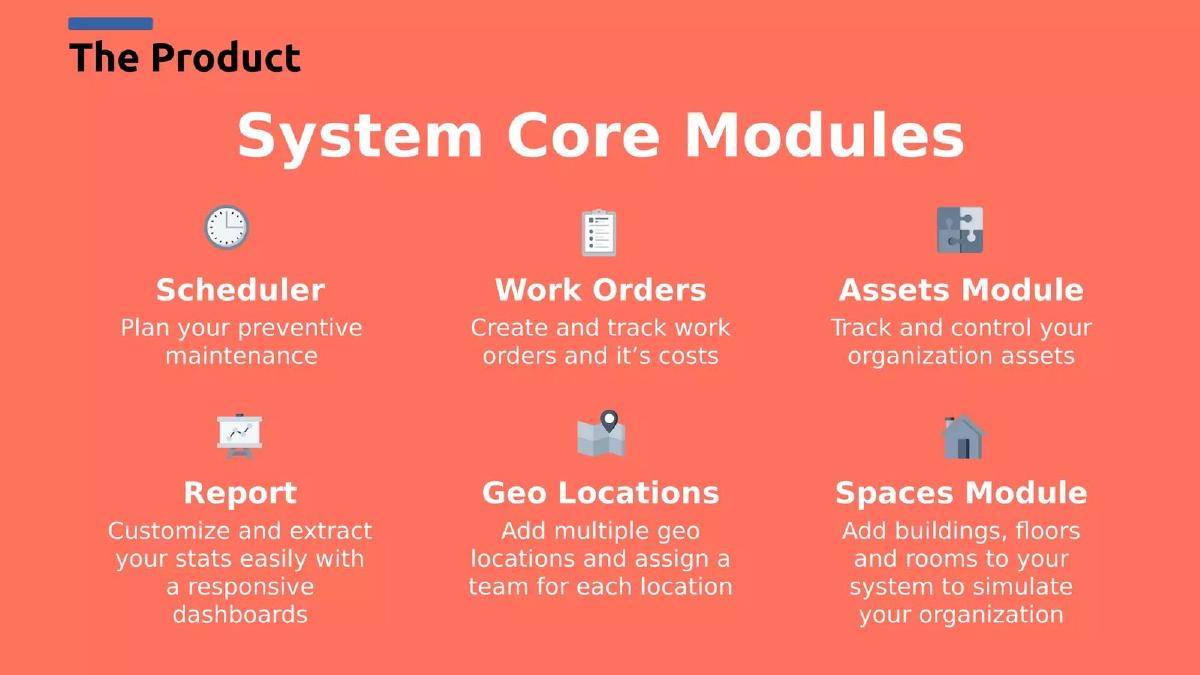
- The platform includes six core modules: Scheduler, Work Orders, Assets, Reports, Geo Locations, and Spaces (Slide 6).
- Market sizing is split between a global $1.8 trillion opportunity and a localized $34.86 billion Saudi Arabian market by 2028 (Slide 12, 13).
- A key competitive differentiator is the inclusion of 'Native Arabic Support,' which is absent in the listed competitors UpKeep and eMaint (Slide 14).
- The business model relies on per-user subscription tiers ($19, $29, $49) plus a marketplace for paid extensions (Slide 11).
- The deck lacks a team slide, failing to establish the technical or industry credibility of the founders.
- There is no financial 'ask' or use-of-funds slide, leaving investors without a clear understanding of the capital requirements.
Slide-by-Slide Analysis
Slide 1: Title Slide
The title slide introduces 'Assets Hub' with a subtitle in Arabic. The visual features two technicians working on gears, immediately signaling the industrial and maintenance focus of the software. The Arabic text translates to 'The first cloud-based maintenance management and asset tracking program in the Arab region,' establishing a clear geographic niche.
Slide 2: The Hook
This slide uses a relatable illustration of an overwhelmed office worker buried in paperwork. The text 'Tired of paper work? Automate your work flow right now!' is a classic 'pain point' opener. It targets the transition from manual, analog processes to digital automation.
Slide 3: Problem Statement
AssetsHub categorizes the problem into three pillars: Time Constraints (manual data entry), A Tight Budget (cost of technical experts), and Lack of Accountability (difficulty in managing employees). This slide is effective because it identifies that the problem isn't just 'maintenance'—it's the administrative and financial overhead associated with it.
Slide 4: Solution Overview
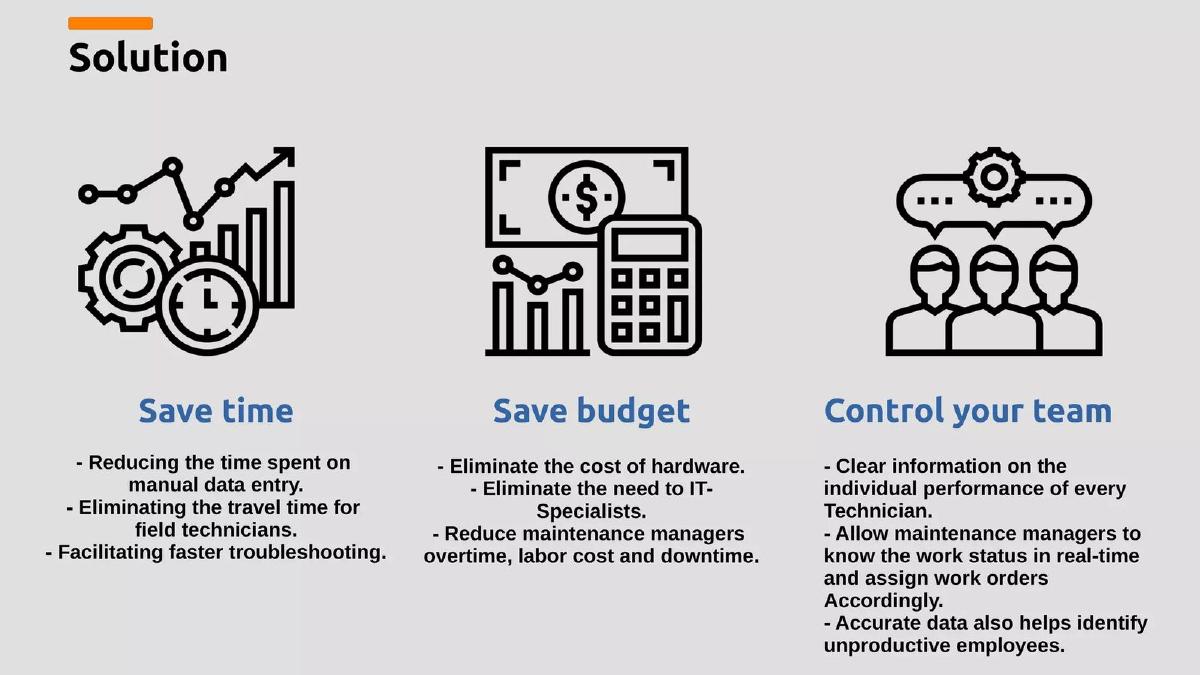
The solution mirrors the problem slide, promising to Save time (faster troubleshooting), Save budget (eliminating hardware and IT specialists), and Control your team (real-time work status). It explicitly mentions that accurate data helps identify 'unproductive employees,' reinforcing the accountability angle.
Slide 5: The Product - Onboarding
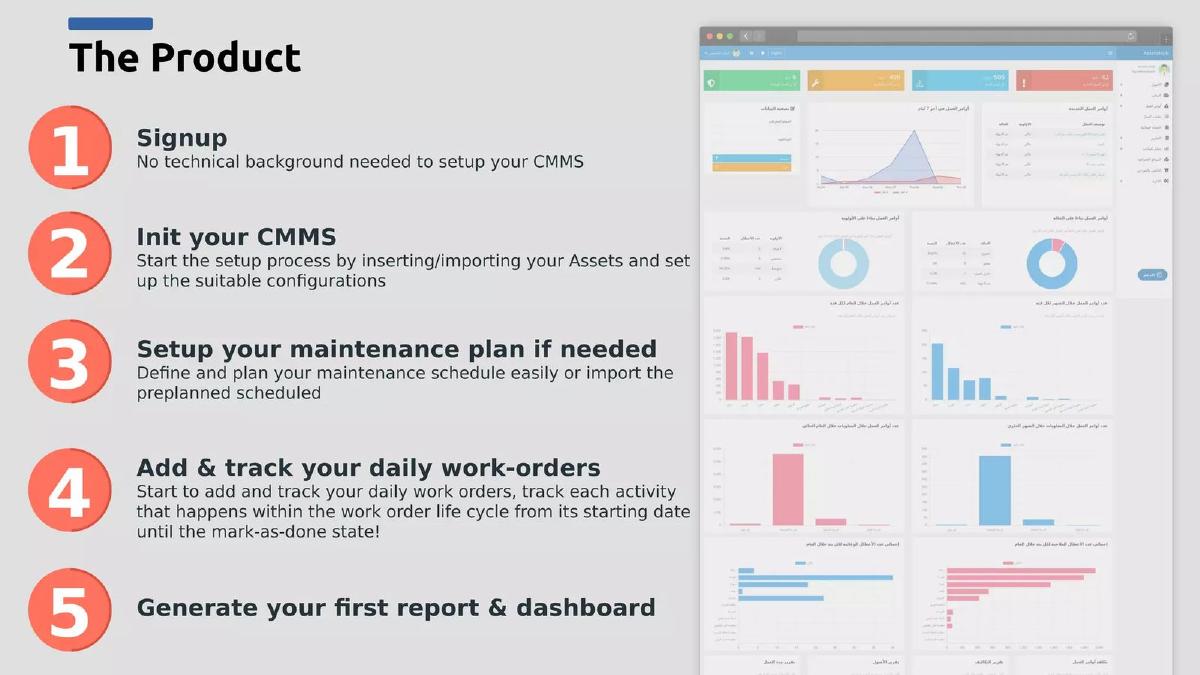
This slide outlines a five-step onboarding process: Signup, Init your CMMS (importing assets), Setup maintenance plan, Add & track work-orders, and Generate reports. A screenshot of the dashboard is provided, though the text on the dashboard is in Arabic, confirming the localized nature of the product.
Slide 6: System Core Modules
AssetsHub breaks down its functionality into six modules: Scheduler (preventive maintenance), Work Orders (cost tracking), Assets Module (control), Report (responsive dashboards), Geo Locations (team assignment), and Spaces Module (simulating buildings/floors). This demonstrates a comprehensive feature set comparable to enterprise CMMS tools.
Slide 7-10: Product Deep Dives
These slides provide large-scale screenshots of the interface. Slide 7 focuses on asset tracking, Slide 8 on the work order dashboard, and Slide 10 on 'Variant dashboards' for decision-making. The UI appears clean and modern, utilizing standard web-based SaaS design patterns. All screenshots prominently feature Arabic text, emphasizing the product's primary market.
Slide 11: Business Model
The pricing strategy is transparent: Basic ($19) , Business ($29) , and Professional ($49) per user/month. The slide also mentions a marketplace for extensions and custom integration fees. This is a standard SaaS land-and-expand model, though the entry price is notably low for the B2B industrial space.
Slide 12: The Global Market
Citing Fortune Business Insights, the deck claims a global market of $1,260 Billion in 2022 , growing to $1,856 Billion by 2028 with a CAGR of 5.7%. These are massive, top-down numbers that likely encompass the entire asset management industry, not just CMMS software.
Slide 13: The Local Market and Segments
This is a more focused market slide. It identifies a $34.86 Billion market in Saudi Arabia by 2028 . It also lists target users: Owners, Maintenance Managers, Engineers, and Technicians across hospitals, hotels, and factories. This slide helps investors understand the specific 'where' and 'who' of the business.
Slide 14: The Competitors
The competitive matrix compares AssetsHub to Maximo, UpKeep, and eMaint. AssetsHub wins on price ($19 vs Maximo's $250) and 'Native Arabic Support.' It also claims to be 'Extendable' via a marketplace, a feature it shares only with Maximo in this comparison. This slide effectively positions AssetsHub as the localized, affordable alternative to Western enterprise giants.
Slide 15: Closing Slide
A standard 'Thanks' slide with a 'Questions?' prompt. It includes credits for the template used (Slidesgo), which is a minor detail that slightly detracts from the 'bespoke' feel of a professional investment deck.
What Works Well
Clear Value Proposition: The deck does an excellent job of explaining exactly what the software does and why it is better than paper-based systems. · Pricing Transparency: Including specific dollar amounts for tiers and competitors makes the 'low-cost leader' strategy very clear. · Localization Focus: By highlighting Arabic support and Saudi Arabian market data, the company carves out a defensible niche against larger, non-localized competitors. · Visual Consistency: The use of consistent iconography and a clean color palette makes the deck easy to read.
What Is Missing
The Team: This is the most glaring omission. Investors back people, especially at the early stage. There is no information on who built this or why they are qualified to disrupt the maintenance industry. · Traction: There are no metrics regarding current users, revenue, or pilot programs. Without this, the deck is purely theoretical. · The Ask: The deck does not state how much money the company is looking to raise or what they plan to do with the capital. · Roadmap: There is no timeline for future feature development or market expansion beyond the current product state. · Unit Economics: While pricing is shown, there is no mention of Customer Acquisition Cost (CAC) or Lifetime Value (LTV), which are critical for evaluating a SaaS business.
Founder Recommendations
Add a Team Slide: Introduce the founders and key engineers. Highlight any previous experience in facility management or SaaS development. · Show, Don't Just Tell, Traction: Even if the company is pre-revenue, show the number of beta signups or letters of intent (LOIs) from Saudi Arabian hospitals or factories. · Define the Investment Ask: If this is for fundraising, include a slide that says 'We are seeking $X for 18 months of runway to achieve Y.' · Refine Market Data: A $1.8 trillion global market is too broad. Founders should calculate the SAM (Serviceable Addressable Market) specifically for CMMS software in the MENA region to appear more realistic. · Include a Case Study: A single slide showing how one 'Hotel' or 'Hospital' saved X hours or Y dollars using AssetsHub would provide much-needed social proof.
Frequently asked questions
- What is the primary problem AssetsHub is solving?
- According to Slide 3, the company is tackling the 'paper work' burden in maintenance management. Specifically, it addresses the high time cost of manual data entry, the expense of hiring technical experts for reporting, and the difficulty maintenance managers face in tracking employee performance and accountability in small companies.
- How does AssetsHub differentiate itself from global competitors?
- The differentiation is twofold: price and localization. Slide 14 shows AssetsHub at $19/month versus Maximo at $250/month. Furthermore, AssetsHub offers 'Native Arabic Support,' a feature not listed for competitors like UpKeep or eMaint, making it more accessible to the specific Saudi Arabian and Middle Eastern markets it targets.
- What industries is the software designed for?
- Slide 13 lists several target segments: Facility Management, Hospitals, Universities, Hotels, Industrial facilities and factories, and HVAC Repair. The 'Spaces Module' on Slide 6 further suggests it is built to simulate complex organizations with multiple buildings, floors, and rooms.
- What is the revenue model for the company?
- The company uses a SaaS subscription model based on the number of actual users. Slide 11 outlines three tiers: Basic ($19/user/month), Business ($29/user/month), and Professional ($49/user/month). Additionally, they generate revenue through custom integrations and a marketplace featuring both free and paid software extensions.
- Is this a seed-stage investment deck?
- While it contains market data and a business model, it lacks the essential components of a venture pitch. There is no team slide, no traction data, and no funding request. It appears to be a product overview or a sales deck repurposed for a general audience rather than a specific investment round.