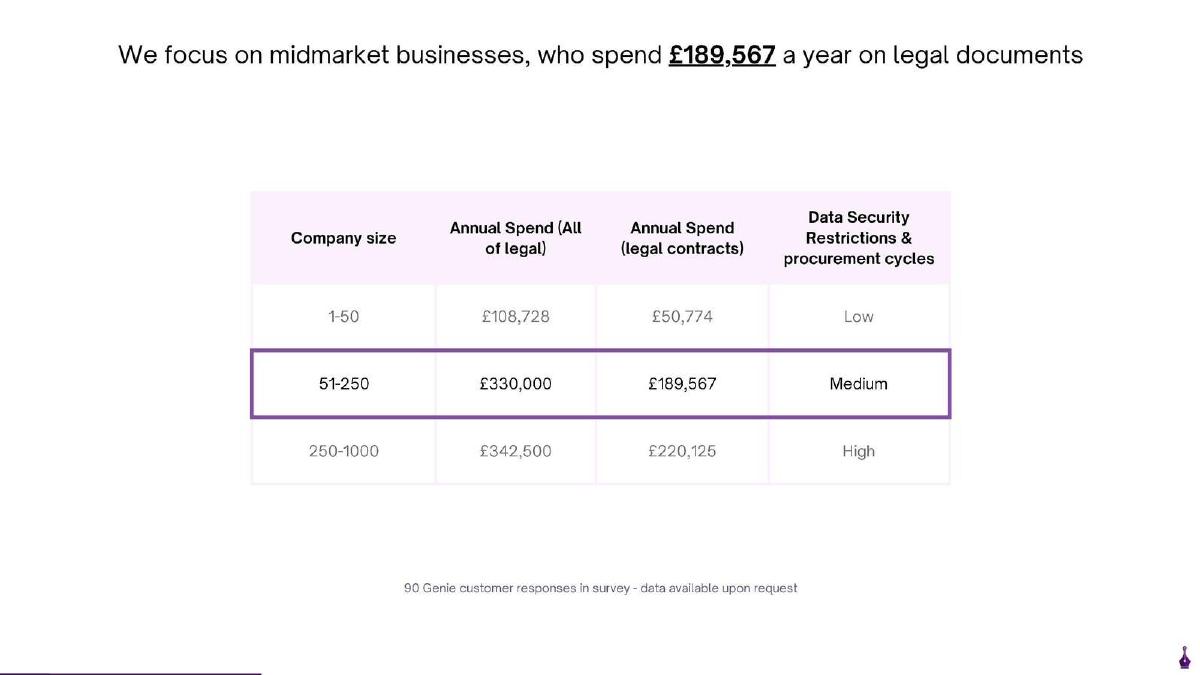
Genie AI’s Series A deck is a high-signal presentation that prioritizes two things: technical authority and growth momentum. By showcasing a team of 16 'generative AI and legal veterans,' including a former President of the UK Supreme Court, the company overcomes the 'hallucination' stigma often associated with LLMs in law. The deck highlights a massive surge from 2,154 to 26,637 companies in just ten months, providing the 'why now' through undeniable market adoption. While the deck is light on financial unit economics and competitive landscape, it succeeds by positioning the product as a 'co…
Key takeaways
- The deck leads with a bold mission to enable 'everyone to be a lawyer' while augmenting existing professionals (Slide 2).
- Product validation is quantified through a survey of 174 lawyers who rated the AI's accuracy between 92% and 94% (Slide 5).
- Growth is presented as an exponential curve, moving from 2,154 companies in January to 26,637 by October (Slide 6).
- The team slide emphasizes deep academic and professional roots, citing 15+ years of experience for almost every key lead (Slide 7).
- Genie AI utilizes a 'collective intelligence' model, leveraging a library of 1,000s of templates to ground its AI (Slide 4).
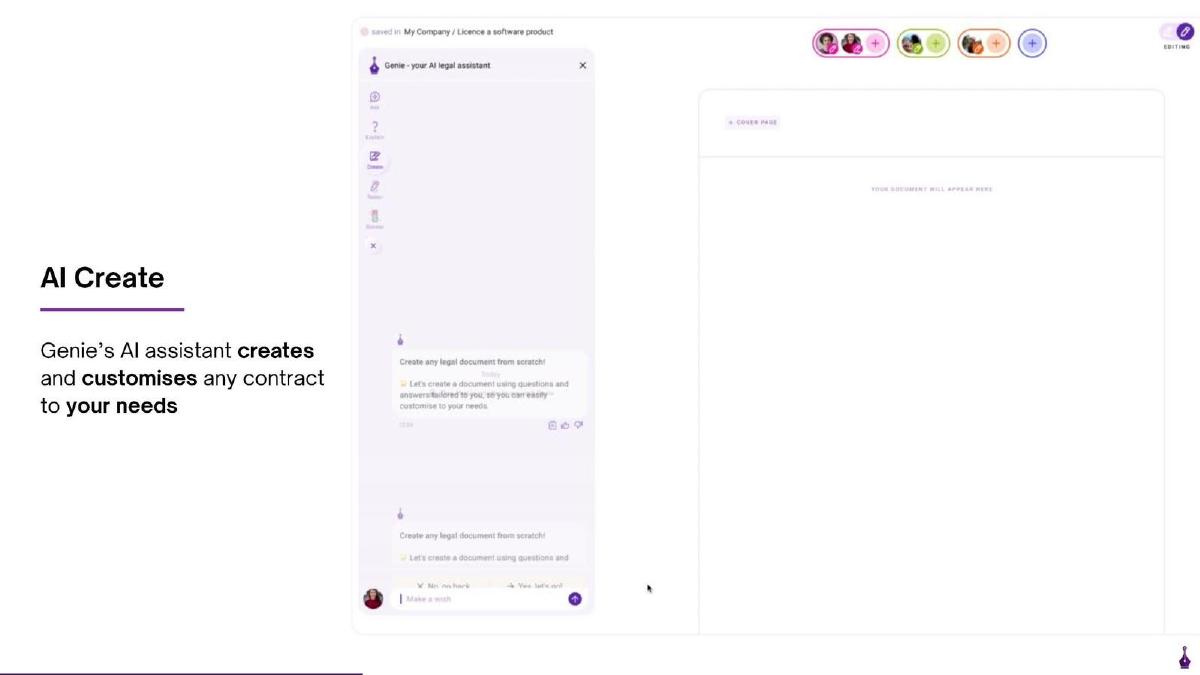
- The platform features a proprietary 'AI Create' assistant that customizes contracts in a native editor environment (Slide 3).
- Advisory roles are used strategically to build trust, featuring high-profile legal figures like Lord Neuberger (Slide 7).
- The deck focuses on user growth and product accuracy rather than traditional revenue metrics or a specific funding ask (Slides 5-6).
Genie AI: The Series A Momentum Play
Genie AI’s Series A deck, which helped secure $17.8M in 2024, is a focused exercise in establishing trust in a high-stakes industry. Legal tech is notoriously difficult for AI startups because the cost of error is absolute. Genie AI addresses this by moving away from the 'black box' AI narrative and toward a 'collective intelligence' framework. The deck is visually clean, data-heavy, and relies on the pedigree of its team to bridge the gap between Silicon Valley innovation and London’s legal establishment.
Slides 1-2: The Vision and Mission
The deck opens with a minimalist title slide (Slide 1) branding Genie AI as 'The Legal Editor.' The subtitle, 'Powered by collective intelligence,' is a strategic choice. It suggests that the AI isn't just guessing; it is learning from a curated body of legal knowledge. This is a crucial distinction for investors who fear the liability of hallucinating LLMs.
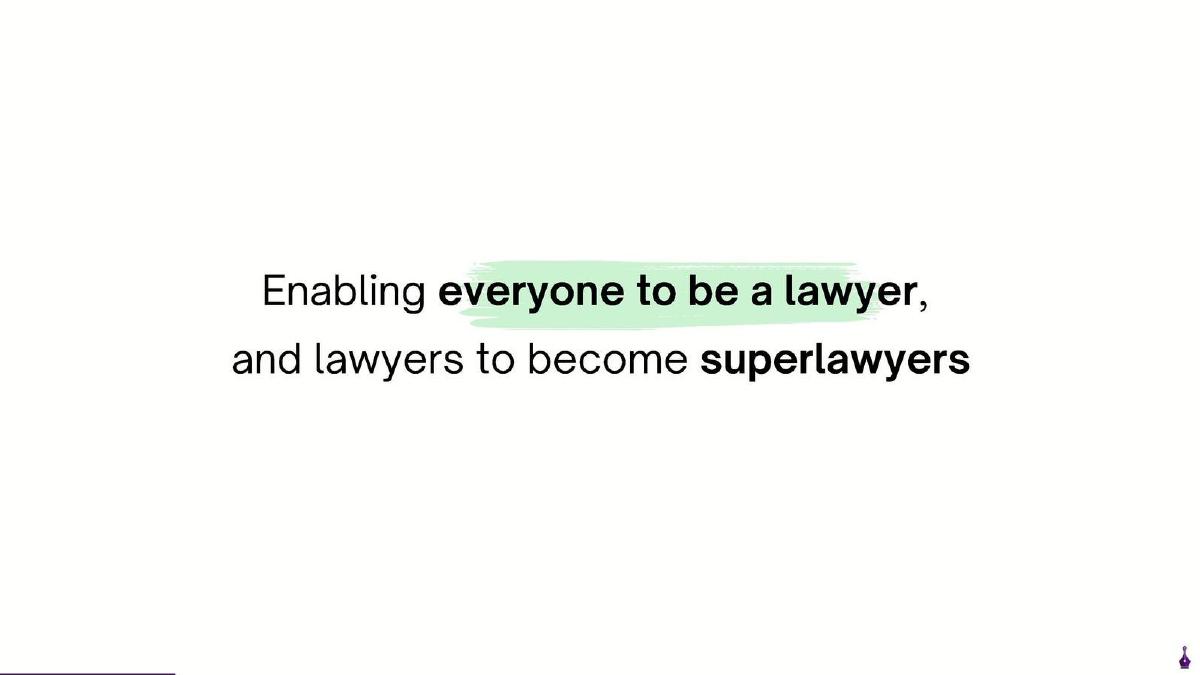
Slide 2 delivers the mission statement: 'Enabling everyone to be a lawyer, and lawyers to become superlawyers.' This 'bionic' approach is a classic SaaS trope, but it works well here because it addresses two distinct markets: the underserved SME market that cannot afford legal fees, and the enterprise law firms looking for efficiency gains. By positioning the tool as an enabler for both, they signal a massive Total Addressable Market (TAM).
Slides 3-4: Product and Content Strategy
Slide 3 introduces 'AI Create.' The screenshot shows a clean, modern interface where an AI assistant customizes contracts. The emphasis here is on the 'native' experience—it is an editor, not just a plugin. This suggests higher user retention because the work happens inside the Genie ecosystem.
Slide 4 highlights the 'AI contract & clause library.' This is the 'moat' slide. By offering '1000s of tried and tested templates,' Genie AI provides the grounding data necessary for accurate legal work. For an investor, this slide represents the company’s proprietary data advantage. It’s not just an interface for OpenAI; it’s a structured library that guides the AI’s output.
Slide 5: The Accuracy Validation
This is arguably the most important slide in the deck. In legal tech, accuracy is the only metric that matters. Slide 5 states that '174 lawyers using Genie have rated our AI algorithms as 92% and 94% accurate.' The accompanying graph shows a 'thumbs up' percentage that stabilizes as the number of interactions increases. By quantifying the satisfaction of actual legal professionals, Genie AI moves the conversation from 'Is AI safe for law?' to 'Our AI is already being validated by experts.'
Slide 6: The Growth Curve
If Slide 5 provides the 'trust,' Slide 6 provides the 'greed.' The chart shows a classic hockey-stick growth curve. The data is granular, listing monthly company counts and growth percentages. Starting at 2,154 companies in January and ending at 26,637 in October, the 12-month exponential growth is the primary driver for a Series A valuation. The table on the right shows consistent double-digit growth, including a massive 49.6% spike in May. This level of adoption suggests a strong product-market fit and a viral or highly effective acquisition loop.
Slide 7: The Pedigree Slide
The team slide is a powerhouse of 'appeal to authority.' It lists 16 veterans, but focuses on 10 key individuals. The inclusion of Lord Neuberger (Former President of the Supreme Court UK) as Lead Legal Advisor is a massive credibility signal that few startups can match. The technical side is equally represented, with the CEO and CTO both holding MScs in Machine Learning and 15 years of experience. The slide uses logos from UCL, LSE, Nomura, and Adobe to anchor the team’s history in elite institutions. This slide tells investors that the founders aren't just 'AI tourists'; they are deep-domain experts who understand both the code and the courtroom.
What Makes This Deck Effective?
The effectiveness of the Genie AI deck lies in its narrow focus. It does not try to explain the entire history of law or the technical architecture of transformers. Instead, it focuses on two pillars: Validation and Velocity .
Validation: By using professional lawyers as their primary benchmark for accuracy (Slide 5) and recruiting the highest levels of the UK judiciary as advisors (Slide 7), they neutralize the primary objection to legal AI (unreliability). They aren't asking investors to trust the AI; they are asking them to trust the lawyers who trust the AI.
Velocity: The growth data on Slide 6 is presented without fluff. It shows a company that has figured out how to scale its user base rapidly. For a Series A, showing that you can grow from 2k to 26k users in under a year is the most compelling argument for an infusion of $17.8M.
What Is Missing?
While the deck is strong on credibility, it omits several standard components that investors usually look for in a Series A:
Unit Economics: There is no mention of Customer Acquisition Cost (CAC), Lifetime Value (LTV), or even the basic pricing model. While the user growth is impressive, it is unclear how many of those 26,000 companies are paying customers versus free users of the template library. · Competitive Landscape: The deck does not mention competitors like Harvey, Spellbook, or Ironclad. In a crowded legal tech market, explaining why Genie’s 'Legal Editor' approach is superior to 'AI-in-Word' plugins is a missed opportunity. · The Ask: The provided slides do not include a breakdown of how the $17.8M will be allocated. Usually, a Series A deck concludes with a roadmap for hiring, geographic expansion, or R&D. · Financial Projections: There are no forward-looking revenue targets. The deck relies entirely on past user growth to imply future financial success.
Lessons for Founders
Founders in highly regulated or 'expert' industries (Law, Medicine, Engineering) should take notes on Genie AI’s approach to the team and validation slides.
Quantify Subjective Quality: If your product’s value is 'quality,' find a way to turn it into a number. Genie AI didn't just say their AI is good; they said 174 lawyers gave it a 94% thumbs-up rating. · Anchor with Authority: If you are a young founder, your advisory board is your shield. Bringing on a 'Lead Legal Advisor' with the stature of a Supreme Court President makes the company look like a permanent fixture rather than a risky experiment. · Show, Don't Tell Growth: Use a table alongside your graph. Slide 6 is effective because it provides the raw numbers (26,637) and the growth rates (22.35%) simultaneously. This prevents investors from squinting at a line chart to guess the actual scale. · Focus on the 'Workplace': By calling themselves 'The Legal Editor,' Genie AI stakes a claim on the user's desktop. Founders should aim to define their product by where the work happens, not just what the technology does.
Frequently asked questions
- How does Genie AI prove its product actually works for lawyers?
- Genie AI uses a specific validation slide (Slide 5) showing that 174 lawyers rated their AI algorithms as 92% and 94% accurate. By using a 'thumbs up/down' metric over 150 interactions, they provide a data-driven rebuttal to the common concern that AI produces unreliable legal work.
- What is the core value proposition of the Genie AI platform?
- The platform is described as 'The Legal Editor' (Slide 1). Unlike generic AI tools, it combines a proprietary editor with an 'AI Create' assistant (Slide 3) and a library of thousands of 'tried and tested' templates (Slide 4), aiming to democratize legal drafting for non-lawyers while speeding up work for professionals.
- How fast is Genie AI growing according to the deck?
- The growth is significant. Slide 6 shows the company grew from 2,154 companies in January to 26,637 companies by October of the same year. Monthly growth rates peaked at 49.6% in May and remained above 20% for the final four months shown in the data set.
- Who is behind the company?
- The team (Slide 7) consists of 16 veterans. Notable members include CEO Rafie Faruq and CTO Nitish Mutha, both with MScs in Machine Learning and 15 years of experience. The advisory board is particularly strong, featuring Lord Neuberger, the former President of the UK Supreme Court.
- What information is missing from this pitch deck?
- The provided slides lack a traditional 'Competitor' matrix, a detailed 'Business Model' or 'Pricing' slide, and a specific 'The Ask' slide detailing how the $17.8M will be spent. It functions more as a momentum and credibility deck than a full financial operational plan.