Sora’s 2020 seed deck is a masterclass in timing. By leaning heavily into the 'COVID effect' on homeschooling, the founders presented a compelling case for a new educational paradigm. The deck identifies a massive middle-market gap between $50/month 'umbrella schools' and $2,690/month elite online programs, positioning Sora as a scalable, project-based alternative. While the deck lacks traditional SaaS metrics like CAC or LTV, it compensates with strong social proof from advisors at Lambda School and Outschool, and a very specific hiring plan for its $2.5M target. The narrative focuses on stu…
Key takeaways
- The deck identifies a significant pricing gap in the market between $380/mo mid-tier options and $2,690/mo elite programs on slide 2.
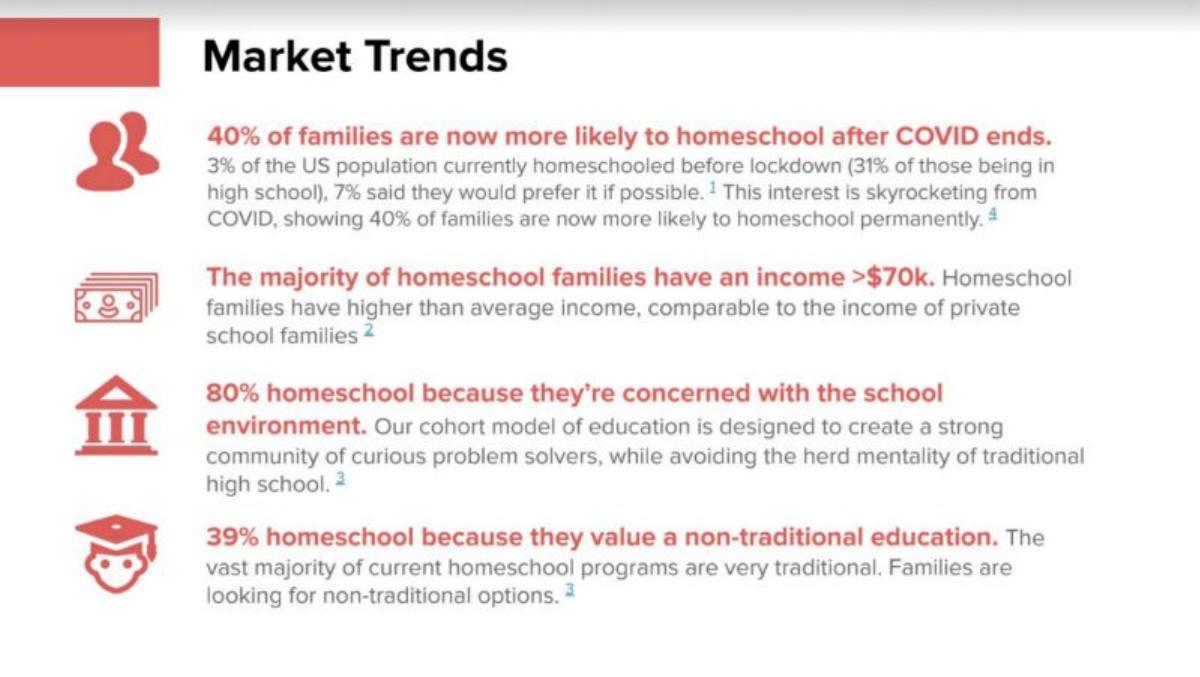
- Sora leverages a 40% increase in families likely to homeschool post-COVID to justify market expansion on slide 4.
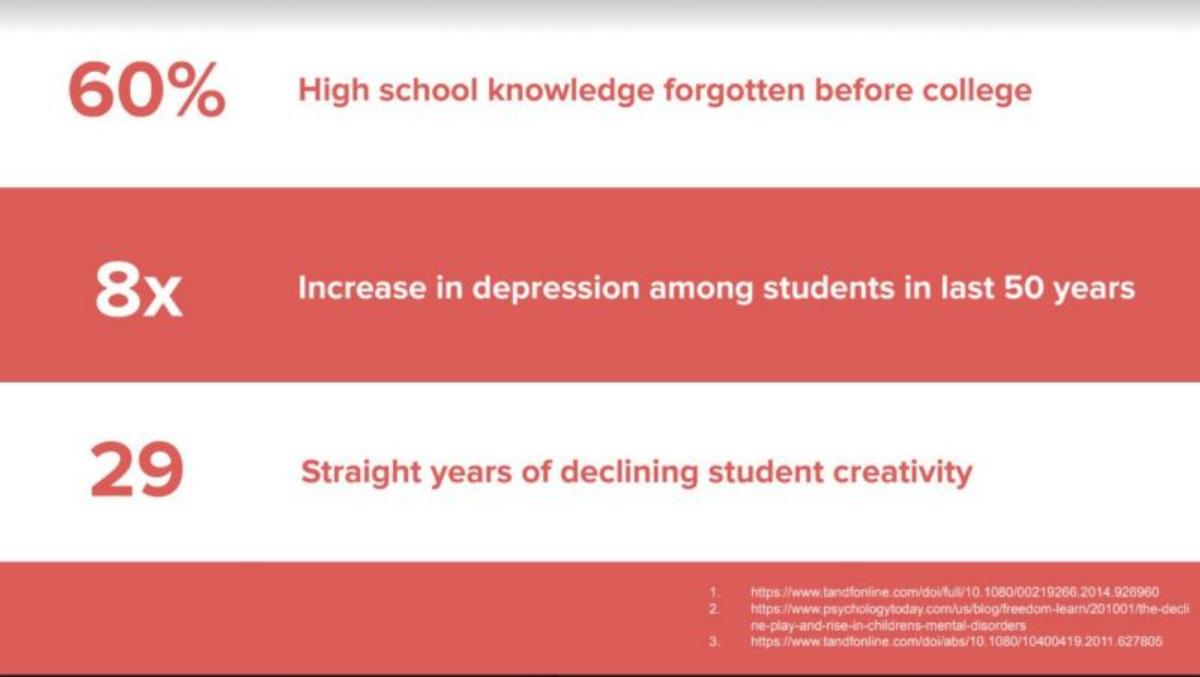
- The 'Problem' slides (5 and 8) highlight emotional and academic pain points, citing an 8x increase in student depression and 60% knowledge loss before college.
- The solution is defined as a 'live, virtual, project-based high school' on slide 3, emphasizing community over isolation.
- Sora explicitly states they are 'software enabled' but not 'software driven' on slide 9, prioritizing the human process of education.
- The deck includes a specific $2.5M ask with a detailed four-point hiring plan on slide 12.
- Advisor pedigree is a core strength, featuring founders and early employees from Lambda School, Outschool, and Connections Academy on slide 14.
- The deck omits current revenue, student enrollment numbers, and specific unit economics, relying instead on qualitative testimonials on slide 16.
The Sora Pitch Deck: A COVID-Era Education Play
Sora’s 17-slide deck, used to raise a $2.1M Seed round in 2020, is a product of its time. It captures a moment when the traditional education system was under extreme stress and homeschooling was transitioning from a niche choice to a mainstream necessity. The deck focuses less on the 'how' of the technology and more on the 'why' of the pedagogy and the 'who' of the team.
Slide 1: Title and Vision
The deck opens with a clean logo and the tagline: "High School Built For You." It establishes the brand identity immediately—bright, approachable, and student-centric. There are no complex mission statements here, just a clear indication of the target demographic: high schoolers.
Slide 2: The Competitive Landscape
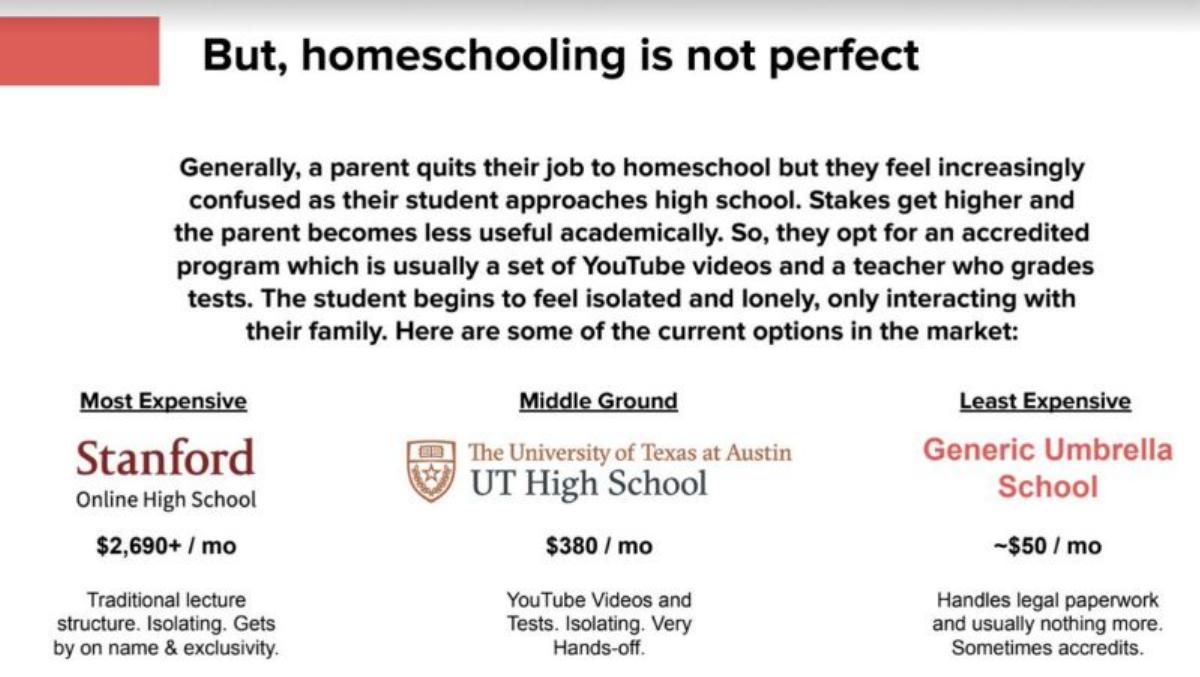
This is one of the most effective slides in the deck. It breaks the market into three price points: Stanford Online High School ($2,690+ / mo) , UT High School ($380 / mo) , and Generic Umbrella Schools (~$50 / mo) . By labeling the expensive option as "Isolating" and the cheap option as "legal paperwork and usually nothing more," Sora carves out a space for a premium, community-driven experience that doesn't cost $30k a year. It identifies a 'missing middle' in the online education market.
Slide 3: The Solution Statement
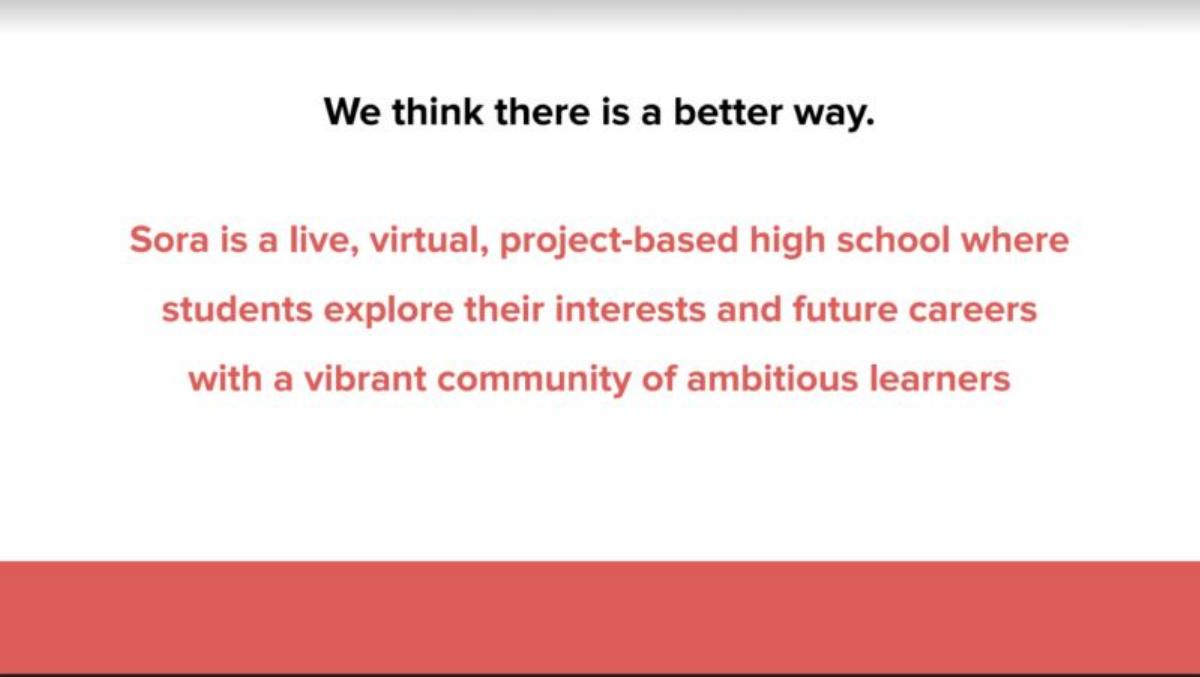
Sora defines itself as a "live, virtual, project-based high school." The inclusion of "live" and "vibrant community" is a direct rebuttal to the isolation mentioned in the previous slide. It promises a shift from passive consumption (YouTube videos) to active exploration.
Slide 4: Market Trends and the COVID Tailwinds
Fundraising in 2020 required addressing the pandemic. Sora cites that "40% of families are now more likely to homeschool after COVID ends." They also note that the majority of homeschool families have an income >$70k , suggesting a high willingness to pay for a service that replaces the parent as the primary educator. This slide transforms a temporary crisis into a permanent market expansion.
Slide 5: The Efficacy Gap
This slide uses three startling statistics to build urgency: 60% of high school knowledge is forgotten before college , there has been an 8x increase in depression among students in the last 50 years, and 29 straight years of declining student creativity . These figures frame the current system as not just inefficient, but actively harmful, setting the stage for a "New Educational Paradigm."
Slide 6: A New Educational Paradigm
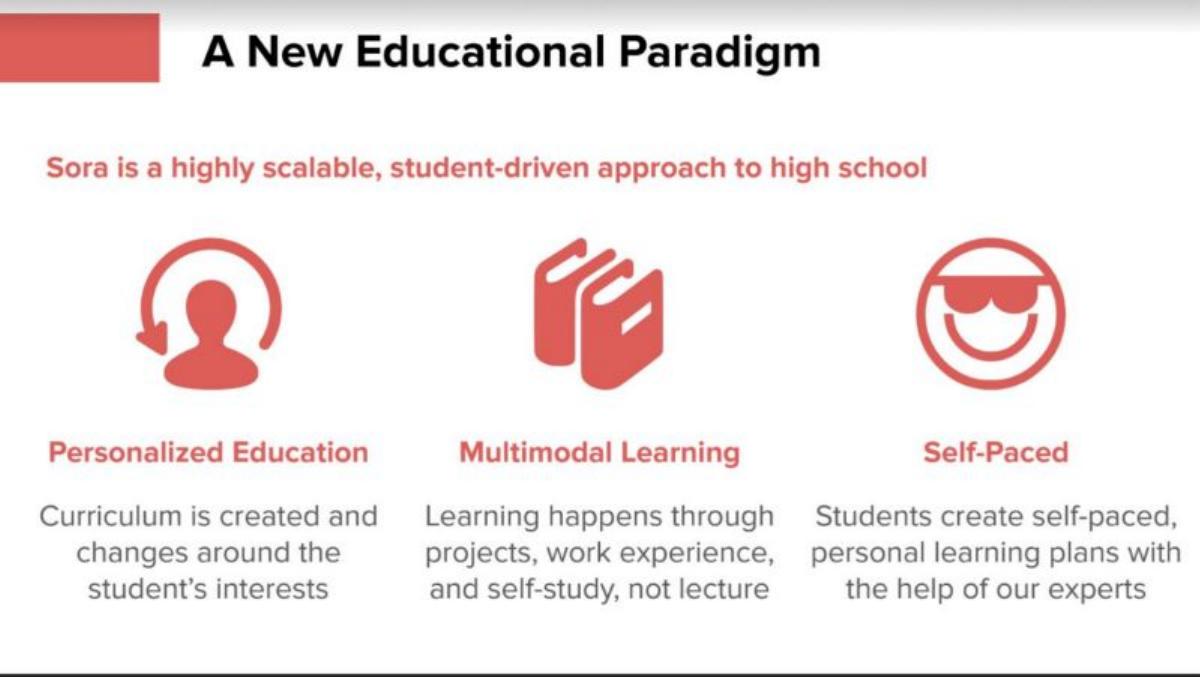
Sora outlines its three pillars: Personalized Education (curriculum follows interest), Multimodal Learning (projects and work experience over lectures), and Self-Paced (personal learning plans). This slide is light on detail but heavy on philosophy, appealing to investors who believe the industrial school model is broken.
Slide 7: Growth of Homeschooling
A bar chart shows the growth of homeschooling in the US, peaking at 2.3 Million in 2016. The chart visually reinforces the 'Market Trends' slide, showing a steady upward trajectory even before the pandemic-induced spike.
Slide 8: The Problems with High School
Sora reiterates the pain points: content geared toward tests, lack of student agency, and parents who "can no longer answer questions" as the material gets harder. This third point is a subtle but powerful sales hook—Sora isn't just for the student; it's a relief for the parent.
Slide 9: Our Focuses
This slide clarifies the operational model. It mentions a "cohort model of education with student houses" and emphasizes that they are "Software Enabled" but not "software driven." This is a crucial distinction for EdTech; it signals that they aren't trying to replace teachers with AI, but rather using software to handle the "headache of organization, facilitation, and tracking."
Slide 10: Future Opportunities
Sora looks beyond the core high school model to Learning Pods and White-Labeling for Colleges . They mention that colleges like MIT are taking freshman years online but "don't know how to do that." This suggests a B2B pivot or expansion path, increasing the potential TAM (Total Addressable Market).
Slide 11: The 'Free' Model
A bold claim is made here: "Completely comping tuition through real-world work from our Work+Study Program." This is presented as a way to scale access, though the mechanics of how student work generates enough value to cover tuition are not explained on the slide.
Slide 12: The Ask
The deck specifies a Target Capital of $2.5M . The spend is allocated to four specific hires: two software engineers, a Head of Work+Study, a Head of Growth, and a Curriculum Developer. This is a standard, logical use of seed funds—building the product, the content, and the distribution engine simultaneously.
Slide 13: Contact Information
A simple closing slide with the logo and contact details for Garrett Smiley.
Slide 14: Our Advisors
For a seed-stage company with young founders, this slide is the 'Trust' anchor. It features John Danner (Rocketship Education, Lambda School, Outschool), Chris Mahoney (Spark Academy), and Linda Leftrict (Connections Academy). These are heavy hitters in the alternative education space, providing the necessary industry credibility.
Slide 15: Faculty
Sora introduces three key faculty members with impressive credentials: a STEM Learning Expert with a Masters in Math, a Counselor from Emory/CDC, and a Humanities Learning Expert who is a Ph.D. candidate. This reinforces the "human process" mentioned earlier.
Slide 16: Founding Team
The three founders— Wesley Samples, Garrett Smiley, and Indra Sofian —all share a common background at Georgia Tech and experience at Contrary Capital . Their history of working together at Elevate Media and their involvement in startup incubators suggests a team that is 'venture-ready' despite being early in their careers.
Slide 17: Social Proof
The deck ends with two long quotes—one from a student and one from a parent. The student mentions that "group project meetings are highlights of the week," while the parent notes their son is "over the moon" to be amongst his own. This provides qualitative evidence that the 'community' aspect of Sora is working.
What Works in the Sora Deck
The Pricing Gap: Slide 2 is the strongest slide. It identifies a clear market opportunity based on price and quality that is easy for any investor to understand. · Pedigree by Association: The advisor slide (14) is exceptional. By listing Lambda School and Outschool—two darlings of the EdTech world—Sora positions itself as the next logical step in that lineage. · Specific Use of Funds: Many seed decks are vague about hiring. Sora lists the exact roles they need, which shows they have thought through the operational bottlenecks of their model.
What is Missing from the Sora Deck
Traction Data: There are no numbers on how many students are currently enrolled, what the retention rate is, or what the current revenue looks like. The testimonials on slide 17 prove the product exists, but not that it is a business yet. · Unit Economics: While they show competitor pricing, they don't show their own. Investors want to know the LTV (Lifetime Value) of a student vs. the CAC (Customer Acquisition Cost), especially in a crowded EdTech market. · Accreditation Strategy: High school is a high-stakes environment because of college admissions. The deck mentions "Generic Umbrella Schools" handle legal paperwork, but it doesn't explicitly state Sora's own accreditation status or how they ensure their diplomas are recognized by universities.
Founder Takeaway: Copy the Narrative, Fix the Data
Founders should emulate Sora’s ability to contextualize their startup within a macro trend . They didn't just say "we are an online school"; they said "the world has changed because of COVID, and the current options are either too expensive or too lonely." This creates a 'Why Now' that is hard to ignore.
However, modern seed rounds often require more than just a 'Why Now.' If you are pitching today, you need to supplement this narrative with hard evidence of product-market fit . A slide showing month-over-month enrollment growth or a waitlist size would have made this an even stronger pitch. Sora relied heavily on the 'All Turtles' studio pedigree and their advisor network to bridge the gap where data was missing—a luxury not every founder has.
Frequently asked questions
- How much did Sora raise with this deck?
- According to the catalogue facts, Sora raised $2.1M in a Seed round in 2020. Interestingly, slide 12 of the deck lists a 'Target Capital' of $2.5M, suggesting they closed slightly under their initial target or adjusted the round size during negotiations.
- What is Sora's business model?
- The deck does not explicitly state the tuition price for Sora, but slide 2 positions them against competitors ranging from $50 to $2,690 per month. The model is a 'live, virtual, project-based high school' that uses a cohort model with 'student houses' to drive engagement and retention.
- Who are the key competitors mentioned?
- Slide 2 identifies three tiers of competition: Stanford Online High School (Most Expensive at $2,690+/mo), UT High School (Middle Ground at $380/mo), and Generic Umbrella Schools (Least Expensive at ~$50/mo).
- What is the 'Work+Study' program mentioned in the deck?
- Slide 11 introduces a 'Work+Study' program as a future opportunity to offer free tuition. The slide suggests that students could 'comp' their tuition through real-world work, with a first version slated to start in September 2020.
- Does the deck show any traction metrics?
- No. The deck is notably devoid of hard traction data such as current student count, MRR, or growth rates. It relies on market trends (Slide 4), problem validation (Slide 5), and qualitative testimonials from an 'Enrolled Student' and 'Enrolled Parent' (Slide 16).